Introduction: Bridging the RWA Liquidity Gap
Real-world assets (RWAs) are becoming a key narrative driving Web3's mainstream adoption. However, bringing trillions of dollars of real-world assets onto blockchains requires more than just tokenization; building efficient and robust secondary market liquidity for them is the true challenge that will determine success or failure. Automated market makers (AMMs), as a cornerstone of DeFi, are naturally highly anticipated, but can they be directly replicated in the world of RWAs?
Summary (three-sentence summary)
Conclusion: Current mainstream AMMs (centralized liquidity, stablecoin curves, etc.) are unsuitable to serve as the "main market" for RWAs. The biggest obstacle is not the curve model, but the unsustainable economic model of LPs (liquidity providers) in the low-turnover, strict compliance, and slow-pricing RWA environment.
Positioning: Issuance/redemption, KYC order books/RFQs, and periodic auctions should be the “main arteries” of RWA liquidity; AMMs should be relegated to the “convenience layer,” only handling small, daily, and convenient secondary turnover needs.
Methodology: Through a combination of narrowband market making, Oracle slippery belts/hooks, and revenue bridging, we effectively transfer RWA’s native revenue (such as coupons and rent) to LPs, supplemented by comprehensive risk control and information disclosure.
1. AMM should not be the “main market” for RWA
RWAs pursue a predictable, measurable, and settleable financial framework. While innovative, the continuous quote AMM mechanism presents three inherent challenges in most RWA scenarios: weak organic trading volume, slow information flow, and a lengthy compliance process . This makes returns for LPs based solely on transaction fees extremely meager, while also exposing them to the risk of Impermanent Loss.
Therefore, our core argument is that AMMs should not serve as the "main market" for RWAs, but rather as the "last mile" of liquidity . Their role is to allow users to conveniently exchange small amounts of assets anytime, anywhere, improving the user experience. However, the core functions of large-scale transactions and price discovery must be delegated to more suitable mechanisms.
2. Why can AMM thrive in the crypto-native world?
To understand the limitations of AMM in the RWA scenario, we must first understand the cornerstone of its success in the crypto-native world:
● Trading never stops: A 24/7 global market, coupled with unlicensed cross-market arbitrageurs, ensures that any price differences are instantly eliminated, creating continuous trading activity.
● Highly composable: Almost anyone and any protocol can become an LP or participate in arbitrage without any threshold, forming a strong network effect and self-enhancement of traffic.
● Volatility is business: High volatility brings a large amount of trading demand and arbitrage opportunities, and the transaction fees generated give LPs the opportunity to "outperform"Impermanent Loss.
When we try to replicate these three points in the RWA field, we find that the entire foundation has changed: transaction frequency has dropped significantly, pricing heartbeat is extremely slow, and compliance thresholds have been greatly increased .
【On-site explanation|Pricing heartbeat】
“Pricing heartbeat” refers to the “frequency of credible price updates” and is the key to understanding the difference between RWA and crypto-native assets.
Crypto-native assets: Heartbeats are typically in the order of seconds (exchange quotes, oracle price feeds).
Most RWAs: Their heartbeat is often daily or even weekly (fund net asset value updates, property valuations, auction prices).
The slower the heartbeat of an asset, the less suitable it is for long-term exposure to a deep continuous quotation pool.
3. In the RWA scenario, LPs face an unbalanced economic situation
The annualized return on LP investment depends primarily on three factors: transaction fees, the turnover rate of funds within the effective price range, and the number of times the transaction rhythm is repeated annually.
For RWA, this bill is difficult to settle because:
● Turnover rates are generally low: “Funds deposited in the pool” are rarely “activated” by high-frequency trading, resulting in scarce commission income.
● Excessive opportunity cost: When there are substantial coupons or risk-free rates in the external market, it is often more cost-effective for LPs to directly hold the RWA assets themselves (if possible) rather than providing liquidity with the same principal.
● Risk-return imbalance: In the context of low fee income, LPs also have to bear the risk of Impermanent Loss(relative to the loss of unilaterally held assets) and being "preyed upon" by arbitrageurs due to lagging price feeding.
Overall, LP's economic model is naturally at a disadvantage in RWA AMM.
IV. Two major structural frictions: pricing and compliance
In addition to the economic model, there are two structural problems that hinder the application of AMM.
Misaligned pricing rhythms: RWAs’ net asset value, valuation, and auctions are slow-paced, while AMMs provide instant, tradable quotes. This time difference creates a massive arbitrage window for those with the latest information, allowing them to easily exploit the price difference of uninformed LPs on AMMs.
Compliance disrupts composability: Compliance requirements such as KYC, whitelisting, and transfer restrictions lengthen the inflow and outflow of funds, disrupting DeFi’s Lego-like model of “everyone can participate.” This directly leads to fragmented liquidity and insufficient depth.
Cash flow plumbing: RWA cash flows, such as coupons or rent, must be reflected either through net asset value appreciation or distributed directly. If the AMM/LP mechanism doesn't properly design a path for capturing and distributing returns, LPs may not receive their fair share of these cash flows or face dilution during the arbitrage process.
V. Applicable Boundaries and Practical Cases
Not all RWAs are incompatible with AMMs, and we need to discuss them in categories.
More user-friendly: Assets with short duration, daily updated net asset values, and high price transparency (such as money market fund shares, short-term government bond tokens, and interest-bearing certificates). These assets have a clear central price and are suitable for narrowband AMMs to provide convenient exchange services.
Less user-friendly: Assets that rely on offline valuations or infrequent auctions (e.g., commercial real estate, private equity). These assets have slow trading activity and significant information asymmetry, making them better suited to order books/RFQs and periodic auctions.
Case: Arbitrage Window on Plume and Nest
Background: Nest's nALPHA and nBASIS tokens have AMM pools on Curve and the native Rooster DEX. While redemptions were initially fast (approximately 10 minutes), token prices were updated approximately once a day, sometimes even slower.
Phenomenon: Since the net value is updated daily and the AMM is reported instantly, the AMM price fails to keep up with the new net value, resulting in an arbitrage window of "buy at a low price on DEX → immediately apply for redemption from the project party → settle at the updated higher net value".
Impact: Arbitrageurs profit, while AMM LPs bear the full Impermanent Loss, especially those LPs who provide liquidity in more deviated price ranges, who suffer more severe losses.
Review and repair suggestions:
● Review: The root cause of the problem lies in the mismatch of pricing heartbeats, and the agreement lacks the necessary risk control guardrails and order diversion mechanisms.
● Repair suggestions:
-Order diversion: AMM only conducts small transactions (see explanation below), and large orders are forcibly directed to RFQ or issuance and redemption channels.
- Active price tracking: Adopting the "Oracle Sliding Band + Hook" mechanism, it only provides liquidity within a narrow range of ± the latest net value. When the net value is updated, the price band will be automatically migrated or the fee rate will be temporarily increased.
-Risk control guardrails: Set oracle freshness thresholds, price discount and premium circuit breakers, and switch to auction or redemption-only mode on days with major valuation adjustments.
-Information Disclosure: Establish a public dashboard to display information such as premium and discount distribution, oracle status, redemption queue, etc., allowing LPs to make independent decisions.
6. Four-way parallel "liquidity framework"
In a mature RWA market, the liquidity structure should be multi-layered.
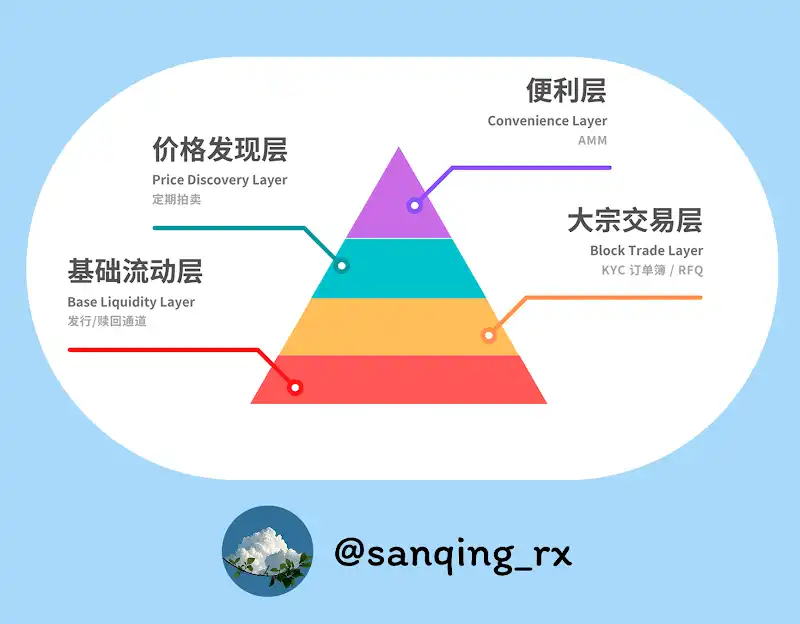
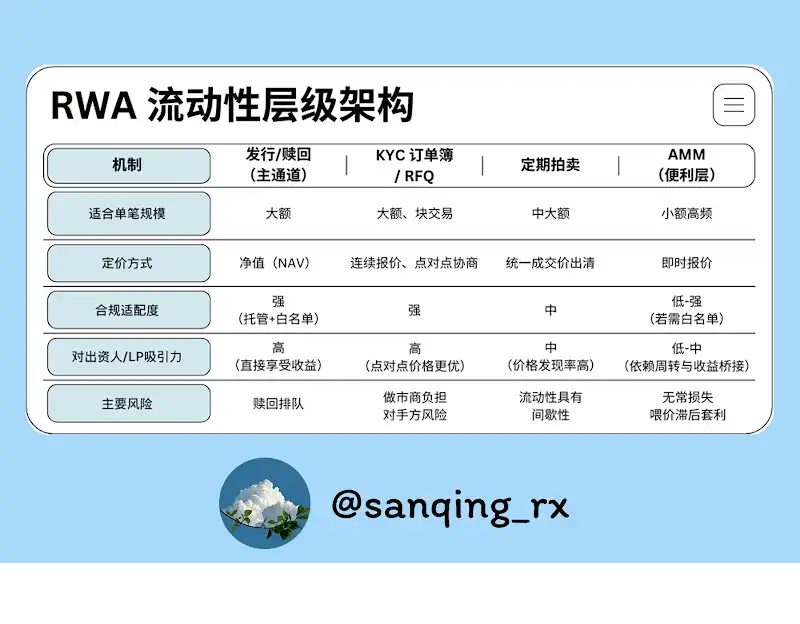
[On-the-spot explanation | "AMM only handles small amounts"]
Positioning: AMM is considered as a convenient turnover layer of the “last mile”, handling daily small orders and asset fine-tuning.
Practice: At the front-end routing level, orders exceeding a certain threshold (e.g., a single transaction > 0.5%–1% of the pool's TVL) are forcibly directed to the RFQ, order book, or issuance/redemption channel. The core responsibility of an AMM is to make the "casual exchange" experience smooth for users, rather than to handle the impact of large transactions.
7. Refined Operations: Three Key Axes for Making Good Use of RWA AMM
For AMM to play its role as a convenience layer, three things need to happen:
1. Concentrated Liquidity
Liquidity is only provided within a very narrow range above and below the net asset value. This can greatly improve capital efficiency and reduce the time window when liquidity is "hung at the old price" and arbitrage opportunities arise.
2. Oracle Slip-Band/Hooks
This is a dynamic upgrade of narrowband market making. Through the orchestration of oracles and smart contracts, it enables automatic price tracking and activates protection mechanisms when the market fluctuates.
[On-site explanation | Oracle Slide and Hook]
Slip-Band: A small “price corridor” that closely follows the oracle price feed (e.g., net asset value). Liquidity is concentrated here.
Hooks: These are programmable actions embedded in the AMM contract. When the oracle price updates, the hook is automatically triggered, shifting the slippery band to the new price, or even temporarily increasing the fee rate to hedge risk.
Core goal: Avoid being stuck at the old price for a long time at the mercy of others, while retaining the convenience of small transactions.
3. Yield Bridging
A clear mechanism must be established to accurately distribute cash flows, such as coupons and rent, generated by RWA assets to the limited partners (LPs) in the AMM pool. The key is to clearly define the complete path from "revenue entering the pool → how to determine ownership based on shares → when to claim" at the code level, expanding LPs' revenue streams from a single transaction fee to a combination of "transaction fees + native asset revenue."
8. Conclusion: From “Continuous Quotes” to “Predictable Flow”
RWA may not need the blockchain's 24/7 price noise, what it really needs is a predictable, measurable, and settleable liquidity backbone.
Let us leave professional matters to professional mechanisms:
Issuance/Redemption, KYC Order Book/RFQ, Periodic Auctions — Build these main pathways so that anchor price discovery and large trade execution can occur.
AMM — Place it at the “last mile” and focus on providing a small, smooth, and transparent exchange experience.
When capital efficiency is aligned with compliance reality, and when we cannot and no longer force AMM to carry the illusion of the "main market", RWA's on-chain secondary liquidity ecosystem will become healthier and more sustainable.
Click here to learn about BlockBeats' BlockBeats job openings
Welcome to join the BlockBeats official community:
Telegram group: https://t.me/theblockbeats
Telegram group: https://t.me/BlockBeats_App
Official Twitter account: https://twitter.com/BlockBeatsAsia