The following content is published by JuCoin Labs Research Institute:
The JuChain ecosystem is experiencing rapid growth. Over the past week, the platform added over 51,000 new users, deployed over 760 on-chain contracts, and surpassed 3.26 million transactions, demonstrating comprehensive growth in its user base, development activity, and real-world interactions. Furthermore, the native token $JU has surpassed $21, significantly strengthening market confidence in its ecosystem's value. User expansion, developer influx, and booming trading together form the triple driving force of the ecosystem, attracting more developers, institutions, and capital to JuChain. Following JuChain's development not only offers an opportunity to share in the dividends of on-chain innovation but also offers the potential to grow alongside the public chain during this explosive ecosystem development. In this issue, we will focus on CookPump, Kongfu Panda, and Koala, providing investors with forward-looking insights.
1. CookPump
1.1 Project Overview
CookPump is a decentralized launchpad for the issuance and trading of Juchain's native Meme tokens. Unlike traditional Meme projects, which often experience unchecked growth and high risk, CookPump prioritizes fair issuance, fair trading, and user protection. Its design not only prioritizes the narrative power of Memes but also incorporates risk control and protection tools to mitigate user losses from price fluctuations, project failures, or liquidity depletion.
CookPump's core positioning is a lossless meme launch platform, aiming to provide developers, traders, and communities with a worry-free environment for meme creation and participation. While preserving the high-risk, high-reward nature of the meme market, CookPump provides user risk mitigation through underlying mechanisms. As meme narratives continue to flourish within the Web3 ecosystem, CookPump aims to serve as a market stabilizer, building an infrastructure capable of supporting community consensus and narrative experimentation.

1.2 Main Highlights
Community Voting Selection Mechanism: CookPump introduces a voting-based selection process, allowing community members to play a key role in platform governance. Users can vote on upcoming meme projects on the platform. The projects with the highest number of votes will enter the fair launch phase, thereby receiving more attention and resource support.
Fair Launch Model: The platform utilizes a fair launch mechanism to ensure that all participants have equal opportunities in the token issuance process. Unlike traditional meme projects, where venture capital or insiders take advantage first, CookPump eliminates the drawbacks of unfair first-mover benefits at the institutional level, ensuring that community users truly have the same starting line as institutions.
Permissionless token creation: Any user can freely create their own tokens on CookPump without the need for additional permissions or complex audits.
No-loss protection mechanism: The most differentiated highlight of CookPump is its no-loss protection mechanism. Unlike other Meme platforms, CookPump provides users with financial protection through a unique underlying design, reducing losses caused by market fluctuations, liquidity risks or project failures.
1.3 Usage Steps
To participate in CookPump, users first need to prepare $JU. There are two ways to do this: one is to purchase it through the JuCoin exchange and withdraw it to the JuChain wallet; the other is to use the JuChain Bridge to cross-chain ETH, USDT (Ethereum) or BNB, USDT (BNB Chain) to JuChain, and then redeem JU on Jamm. Once completed, configure your wallet to the JuChain mainnet and follow the steps below:
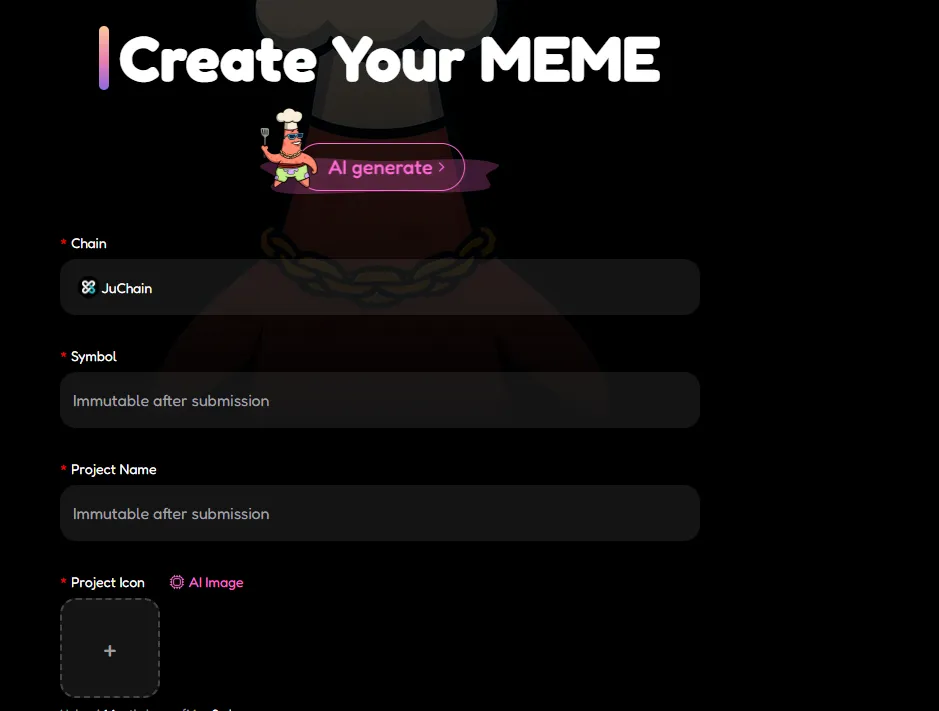
Step 1: Create a Meme Token. Users can create a Meme Token on the CookPump platform with zero gas fees. Simply fill in basic information and choose whether to enable Memetrust insurance. The platform also offers AI-powered image generation to create unique visuals for your token project. Currently, only the JuChain network is supported. Once created, you can enter the community display phase.
Step 2: Participate in the Community Vote. Meme tokens enter the voting phase, where the community decides whether to advance. If a token ranks in the top three in the voting within a designated time period, or accumulates 300 votes, it will enter the Fair Launch phase. Both the project owner and voters will receive rewards (0.1% of tokens for the creator and 0.5% for the voter equally), creating a strong incentive for participation.
Step 3: After the Fair Launch vote is passed, the token will enter the Fair Launch phase, where backers can use $JU to participate in the token subscription. If the raised funds reach 1,060 $JU, the system will automatically add liquidity to the token and open it for trading.
Step 4: Online Trading: Once the fair launch is successful, the token will automatically be listed on JuChain DEX (Jamm), enabling free trading. Prices are determined by market behavior, and users can participate in real-time transactions, driving the narrative and value of the meme. This marks the complete lifecycle of a meme project, from creation, community recognition, to market trading, and is now closed.
1.4 Lossless Participation Mechanism
CookPump has partnered with MemeTrust, a decentralized insurance protocol, to introduce a unique no-loss participation mechanism, providing risk protection for users when trading Meme tokens. The core of this mechanism is that token creators can choose whether to enable insurance for their projects. Once enabled, all purchases made on the CookPump internal market are automatically and mandatoryly covered by insurance, ensuring that every user's transaction is protected. After funds are deposited, the system will use 70% of the funds to actually purchase Meme tokens, 30% will be added to the insurance pool as premium, and a standard 1% transaction fee will be charged.

CookPump uses US dollar denominated tokens as a unified standard for compensation. When a user sells tokens and the total value falls below the average purchase price, the system compensates based on the proportion of the loss. If the loss is within 70%, the platform will issue JU computing power equivalent to the loss. If the loss exceeds 70%, the excess will be refunded as $JU as premium (covering up to 30% of the loss), with the remainder still compensated in computing power. Compensation must be manually triggered by the user in their transaction history. Once the claim is confirmed, tokens are automatically distributed daily, starting the next day. By combining continuous computing power production with premium refunds, CookPump effectively prevents users from losing their entire investment due to the failure of a meme project or a sharp price drop, thus enabling true loss-free participation in the meme market.
1.5 Investment Logic
CookPump's investment logic is primarily reflected in its reshaping of the meme market structure! Through a model of community voting and fair launch, project screening and token distribution no longer rely on venture capital or insiders, but are instead driven entirely by community consensus. This mechanism provides users with a fairer starting point for participation while ensuring that the popularity and attention of meme projects are aligned with real market demand, thereby increasing project survival and subsequent liquidity.
Furthermore, the zero-loss participation mechanism directly addresses the meme market's greatest pain points: high volatility and a high dropout rate. Upon entry, funds are automatically split into token purchases and insurance premiums, ensuring that users can still receive a return of JU computing power or a portion of their $JU even if a project fails or prices plummet. This structure reduces the risk exposure of users' single investments and improves the platform's overall capital utilization efficiency. The value of CookPump lies not in the success of individual meme projects, but in the high-frequency trial-and-error, low-risk participation model fostered by the platform, which provides a more sustainable growth path for the meme economy.
2. KongfuPanda
2.1 Project Overview
Kongfu Panda is a GameFi and Meme-inspired project incubated by JuCoin and incorporated into the JuChain Traffic Ark initiative. It aims to become a core traffic gateway for Web3. Using the lightweight GameFi application as a vehicle, the project combines entertainment and profitability, lowering the barrier to entry for new users in Web3 and expanding the reach of meme culture. On an ecosystem level, Kongfu Panda received a strategic investment of 100,000 $JU from the JuChain-Meme Foundation and is leveraging JuCoin's platform traffic and resources for key support. Its goal is to build a meme community of over 200,000 members, break down information silos through cross-platform compatibility, and connect with major platforms like Binance to create a sustainable GameFi-Meme ecosystem.

2.2 Main Highlights
Powerful IP empowerment: Kongfu Panda leverages the cultural influence of the "Kung Fu Panda" film series, using the image of the martial arts panda as the core of its brand, reducing education costs and quickly building user awareness.
Web3 traffic entrance: The project uses the lightweight PC game "Airplane Bombing Bunker" to carry user traffic, allowing novices to naturally interact with tokens in an entertainment scenario.
Meme culture empowerment: Kongfu Panda uses meme as a community driver and combines it with gamification interaction to create stronger entertainment and dissemination power.
2.3 Token Economy
Kongfu Panda issued its native token, $PO (CA: 0x866915645760adcec6DcC5C955FD38DD22949999), based on JuChain. The total supply is 1 billion. 80% (800 million) of this token will be publicly distributed to the community through a fair launch to ensure broad user participation in the initial phase. Another 20% (200 million) will be used to establish a liquidity pool to enhance trading depth and market stability. $PO will be issued through a fair launch on the Juicy.meme platform, raising 2,050 $JU. 50 $JU will be used as a platform fee, and the remaining 2,000 will be injected into the liquidity pool proportionally with the 200 million tokens. Spot trading will then begin. In terms of market capitalization management, Kongfu Panda is jointly maintained by the DAO community. Members participate in governance and share in the ecosystem's dividends, strengthening the consensus-based nature of meme culture. Furthermore, the project team will repurchase tokens from the secondary market through a regular repurchase and incentive mechanism to reward GameFi ecosystem players, thereby increasing user stickiness and building long-term value support for the token.
2.4 Roadmap
Kongfu Panda's development path consists of three phases: infrastructure development, user expansion, and ecosystem development. In the early phase (May-July 2025), the project secured strategic investment from JuCoin and completed content development, including a business plan, promotional materials, and marketing resources, laying the foundation for subsequent promotion. In the mid-term (August-September 2025), core work focused on the GameFi application and token issuance. This included PC game beta testing, a fair launch of $PO on the Juicy.meme platform, multi-platform beta testing, and mobile DApp development, thereby rapidly expanding user reach.
In the mid-to-late stage (after October 2025), the project will shift its focus to ecosystem integration and market empowerment. During this phase, the project will deepen its collaboration with social media platforms like Telegram and YouTube to increase community size and user engagement. Furthermore, the project will apply for listing on first-tier exchanges like Binance and enter the secondary market.
2.5 Investment Logic
The investment rationale behind Kongfu Panda lies primarily in its traffic entry value and differentiated IP endorsement. Leveraging the international cultural symbol of "Kung Fu Panda," Kongfu Panda was able to quickly gain market recognition and community resonance. Combined with the lightweight GameFi app "Airplane Bombing Bunkers," Kongfu Panda combines entertainment with token interaction, becoming a key entry point for lowering the barrier to entry for Web3 within the JuChain ecosystem. This combination of strong IP and application scenarios sets it apart from meme projects that rely solely on sentiment, and it possesses greater potential for user retention and external growth.
On the other hand, $PO's token mechanism and ecosystem development path provide medium- to long-term value support. Through a fair launch and community-first distribution, the project mitigates the risk of capital monopoly, while DAO governance and regular buybacks strengthen the token's value capture. Combined with the resource support of JuCoin and JuChain, and its gradual expansion into DApps, social media, and exchanges, Kongfu Panda is expected to achieve a positive cycle of user growth, community consensus, and secondary market liquidity, thereby establishing long-term competitiveness in the Meme-GameFi arena.
3. Koala
3.1 Project Overview
Koala is a distributed computing power finance platform, jointly launched by Koala Protocol Crypto Lab and JuCoin Exchange, and built on the JuChain public blockchain. The project leverages the proprietary Gruber-Morgan algorithm and co-evolution mechanism to achieve the ownership, financialization, and autonomous governance of computing power. It also introduces RWA physical resources to promote the deep integration of the real economy and Web3. Koala is committed to creating a new value system where computing power is an asset and contribution is an incentive. Through a decentralized node network, NFT-based ownership confirmation mechanism, and DAO governance structure, Koala achieves the free circulation of computing power assets and a closed value loop.
3.2 Main Highlights
Koala's innovation lies in the financialization of computing power. Traditionally, computing power has been concentrated in PoW or AI training scenarios. Koala, on the other hand, introduces computing power as a native asset into blockchain finance. Through node operation and algorithm allocation mechanisms, it transforms computing resources into governance rights and economic incentives. Furthermore, Koala utilizes node autonomy and a global DAO community governance model. Unlike traditional centralized computing networks, each node in Koala possesses sovereignty, meaning that participants, while providing computing power, can also directly participate in ecosystem governance decisions. This governance structure ties computing power distribution to community consensus, ensuring the decentralized resilience of the system while enhancing the ecosystem's sustainability and resilience.
3.3 Token Economy
Koala's native token, KL, is set at a total supply of 130 million, 100% of which will be directly injected into the Swap liquidity pool, ensuring fairness and transparency in the initial phase. This eliminates any team reservations or early capital advantages. Token production is entirely dependent on the hashrate allocated by the ecosystem's mining pools. Users can obtain hashrate and KL allocations by providing funds and participating in node construction.
The specific mining threshold is 100U/JU = 300U of kinetic fuel. Individual hashing power is calculated progressively based on "deposit × 1 × 1.015ⁿ" (n is the number of days of participation). Later users receive a higher hashing power weight, incentivizing long-term participation and new users. KL utilizes a three-tiered mechanism for output distribution: static rewards, dynamic rewards, and competition incentives. Of the daily KL release, 60% is allocated to individual hashing power output to reward individual contributions; 33% is allocated to community hashing power output to promote teamwork and community building; and the remaining 7% is injected into the competition pool to reward communities with outstanding new hashing power. The competition pool conducts weekly rankings and distributions, with the top 349 community members receiving rewards. Rewards are released on a rolling basis to maintain consistent incentives.
Koala's withdrawal fee design combines both incentive distribution and deflationary logic. The overall fee distribution is: 5% goes to node communities for weighted incentives, 5% is injected into the DAO (requires 10,000 $JU staked on-chain), 10% is used as a newcomer bonus, 45% is returned to the accumulator to enhance liquidity, and 55% is burned directly. The combination of the accumulator and the accumulator creates a strong deflationary effect, driving up the price of Koala tokens.
At the same time, a portion of the transaction fees goes to the DAO and community blocks to ensure long-term governance and node development. As the price of $JU rises, the value of KL will further increase. Combined with the insurance pool's support mechanism, this creates a cycle of price increases, incremental growth, and deflation. Koala has officially launched node sales and recruitment, allowing early users to participate in network construction. The purchase price per node is 109 $JU. The native token, KL, has been launched, and users can earn corresponding token rewards by mining nodes.
3.4 Investment Logic
Traditional computing power resources are often limited to vertical applications like PoW mining or AI training. Koala, however, leverages the Gruber-Morgan algorithm and co-evolution mechanism to authenticate computing power and transform it into a tradable on-chain asset. Combined with real-world Reliable Work Area (RWA) resources, this approach broadens its application scenarios. Furthermore, Koala's token mechanism and deflationary logic provide solid value support. KL has a total supply of 130 million tokens, 100% of which is invested in the Swap liquidity pool, ensuring fairness and transparency in its early stages. Its production system creates a strong deflationary effect, which, combined with the value linkage between JU and the insurance pool, is expected to drive long-term KL price growth. With the launch of node sales and the gradual expansion of the ecosystem, Koala's value proposition has evolved beyond token speculation. Through a closed-loop system where computing power is an asset and contribution is an incentive, Koala is poised for sustainable growth.
Summarize
As the JuChain ecosystem continues to expand, the application matrix built around the public chain is rapidly taking shape, gradually covering multiple levels of the ecosystem, from narrative to infrastructure. Furthermore, JuChain's increased support in funding, resources, and traffic further strengthens the project's growth certainty, making JuChain not just a technological extension of a single public chain, but a value capture platform with a complete closed-loop industry. For early investors, participating in these projects means not only obtaining a single point of return on investment, but also a deep connection to the overall growth of the public chain. As the ecosystem matures, narrative, liquidity, and user dividends will form a compounding effect, driving exponential growth in asset value!