Source: PolkaWorld
Original link: https://mp.weixin.qq.com/s/23hgx9ucfsBCjbOMbQVITA
Today I’d like to share with you the last part of Gavin Wood’s speech at the Web3 Summit!
Gavin Wood has proposed several directions for exploration that could reshape the future of Web3. This isn't just an extension of technical details; it's more like an outline for blockchain research over the next decade.
He bluntly stated that today's Web3 still lacks key foundational capabilities, and if these issues are not addressed, we will not be able to truly enter the era of large-scale applications. To this end, he proposed several strategic breakthroughs:
Rebuilding Financial Privacy: Building legal and secure privacy protection tools within the FATF compliance framework.
Proof of Person (PoP): An uncompromising Sybil resistance mechanism, which he calls the “silver bullet of Web3.”
Web3 Oracle: Replacing centralized services operated by foundations and individuals with decentralized oracles.
Web3 Outpost: Bringing on-chain rules into the real world to build autonomous communities and economies.
Polkadot native stablecoin: Not only should there be a protocol-level stablecoin with over-collateralized DOT, but also a new type of "stable-ish" system should be explored.
These directions point not to single innovations, but rather to an upgrade of Web3's underlying narrative: from simple on-chain experiments to real-world institutions and economies. As Gavin said, if these puzzle pieces can be completed, they will be key turning points in Web3's development.
Rebuilding Financial Privacy in Web3
In the second half of my talk, I want to focus on some of the new directions we are exploring in the Parity and Web3 worlds, one of the most important of which is privacy protection.
The right to privacy is a right that most people should enjoy, and it is even explicitly written into the constitutions of many countries. However, in reality, these rights are often ignored, especially in traditional institutions such as banks.
The role of technologists is not to force choices on people, but to provide them with the tools to exercise their privacy rights freely and securely.
However, there is currently a lack of effective technical means in this regard, which is an area that urgently needs improvement.
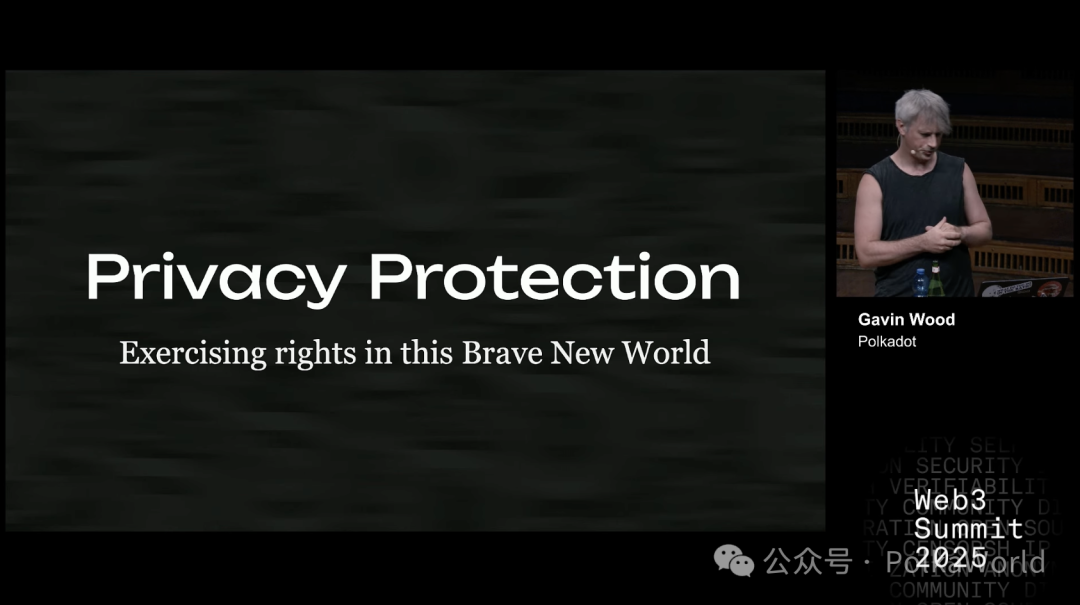
Therefore, we are working to develop specialized tools to help people protect their privacy while ensuring that these tools are legal and secure for both providers and users. In fact, this type of technology is already partially used in our "Proof of Personhood" system to hide the identity of users when distributing rewards.
Internationally, the Financial Action Task Force (FATF) has issued relatively clear guidance. Although it is not a government agency, it is often seen as more influential than most governments. Many countries follow its standards. According to FATF's recommendations:
• Transactions under $1,000 should be private, while transactions above that should require KYC.
• Individuals should also enjoy privacy when trading under $10,000 per day, but KYC is also required for transactions exceeding that amount.
These standards are actually very consistent with the daily banking experience: you can usually withdraw about US$1,000 from an ATM, and if you want more, you need to go to the teller; if it exceeds US$10,000, you must fill out the relevant form.
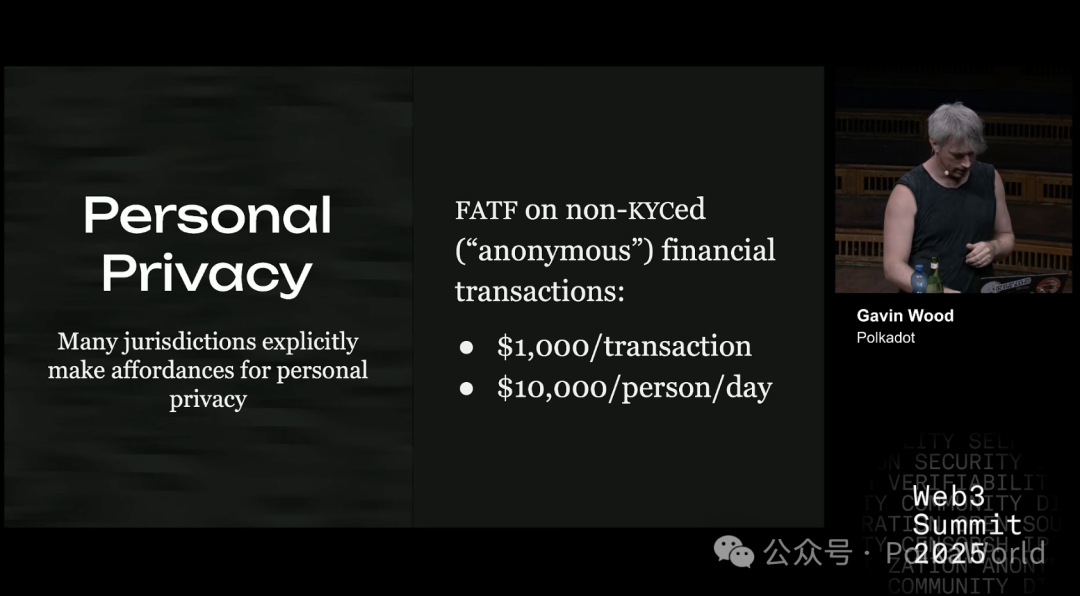
Therefore, we hope to establish the underlying primitives of financial privacy, allowing users to conveniently and securely enjoy privacy protection within these widely recognized limits. Exceeding these limits may require further caution.
PoP: A New Weapon Against Witches
Next, we'll discuss individuality and Sybil resistance, one of the most thorny issues in the Web3 world.
I've been working on this for a long time. Simply put, I believe that if Proof of Personhood (PoP) can be successful and widespread, it could be a silver bullet—a solution to a problem that has eluded us for over a decade.
However, it must conform to the concept of Web3, otherwise it will regress to the old path of Web2, which is unacceptable.
No reliance on “confessionals”: Users should not be forced to surrender their privacy or identity to an institution, organization, or individual for verification.
There can be no “key holders”: that is, no institution or authority should decide who counts as an individual and who does not.
Any solution that relies on government identification, GitHub commit records, etc. essentially falls into these two traps - either it requires a "key holder" or a "confessional."
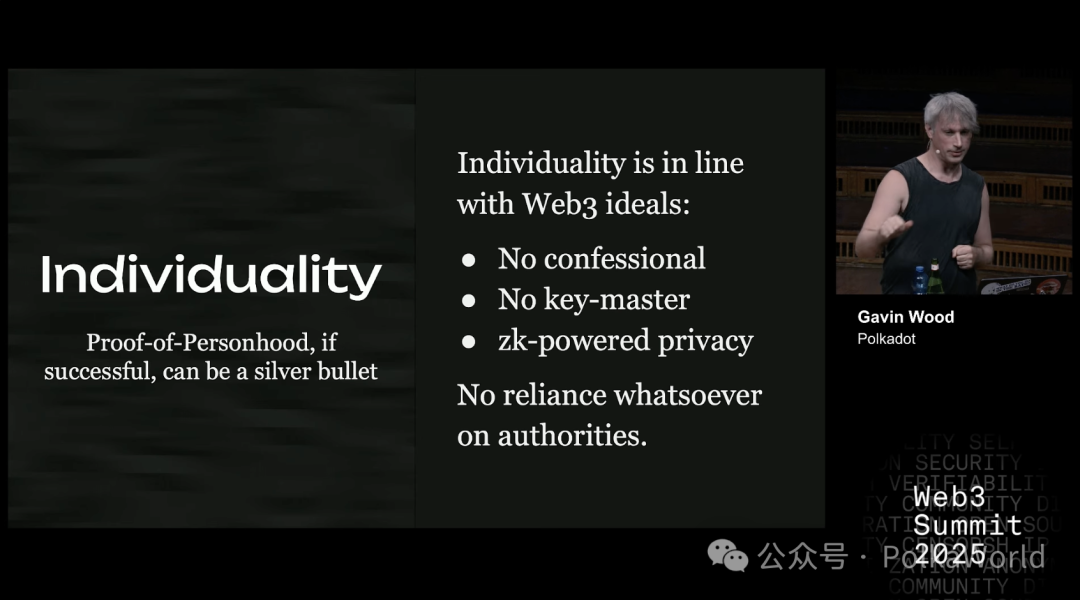
Furthermore, the system must have strong privacy protections. Once individuality is involved, if privacy cannot be rigorously guaranteed mathematically, the potential for abuse becomes significant. For me to trust and use it, it must thoroughly ensure privacy by design.
If such a system could be built and widely used—of course, promotion and popularization are another hurdle in themselves—it would bring enormous value:
Significantly increase user engagement in Web3;
Significantly reduce funding requirements and capital costs.
In fact, the industry has already seen many attempts: Worldcoin, some solutions within the Ethereum ecosystem, and the Estonian digital identity system. However, each has its own trade-offs and compromises. My vision is that if we can one day achieve a truly "compromise-free" PoP system and establish it all at once, it will be a major turning point in the development of blockchain.
The application scenarios are very broad: whether it is staking, stablecoins, markets, oracles or governance, it may bring higher efficiency and lower costs.
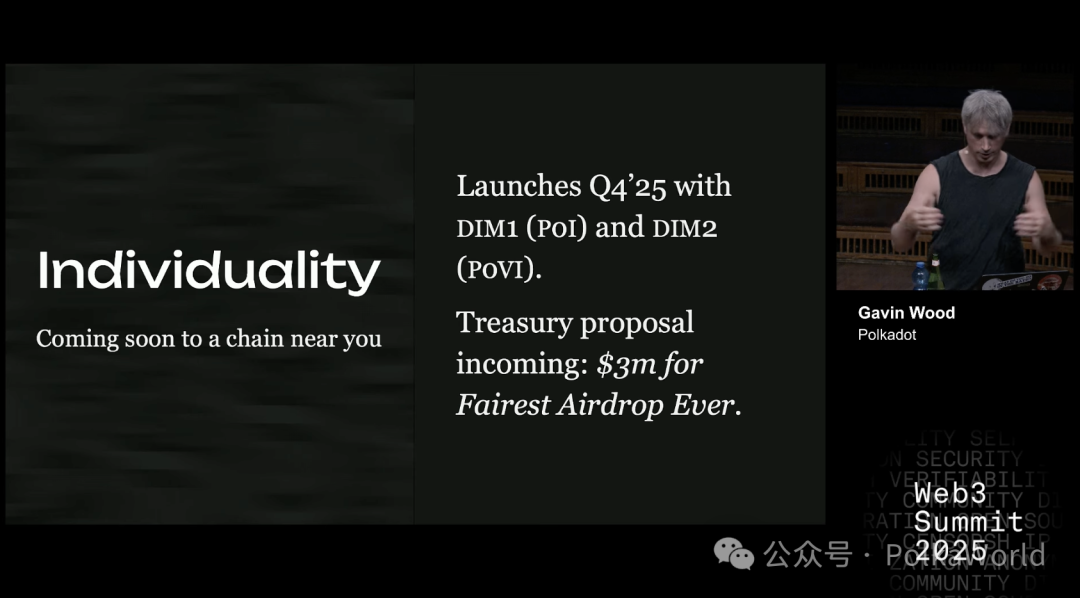
We have been conducting research and development in this area for the past three years and have achieved some results. We expect to officially launch two digital individualization mechanisms by the end of this year.
One such mechanism is Proof of Ink, which I discussed a year ago at the Polkadot Decoded presentation. The basic idea is that you receive a unique tattoo at a specific location. Because it's unique, the chain tells you (or lets you choose) what you receive. You can then use this to assert your individuality. Since the tattoo's location is unique, you can't have more than one.
Another mechanism, DIM2, has a lower barrier to entry and is called Proof of Video Interaction. More details will be announced in the near future.
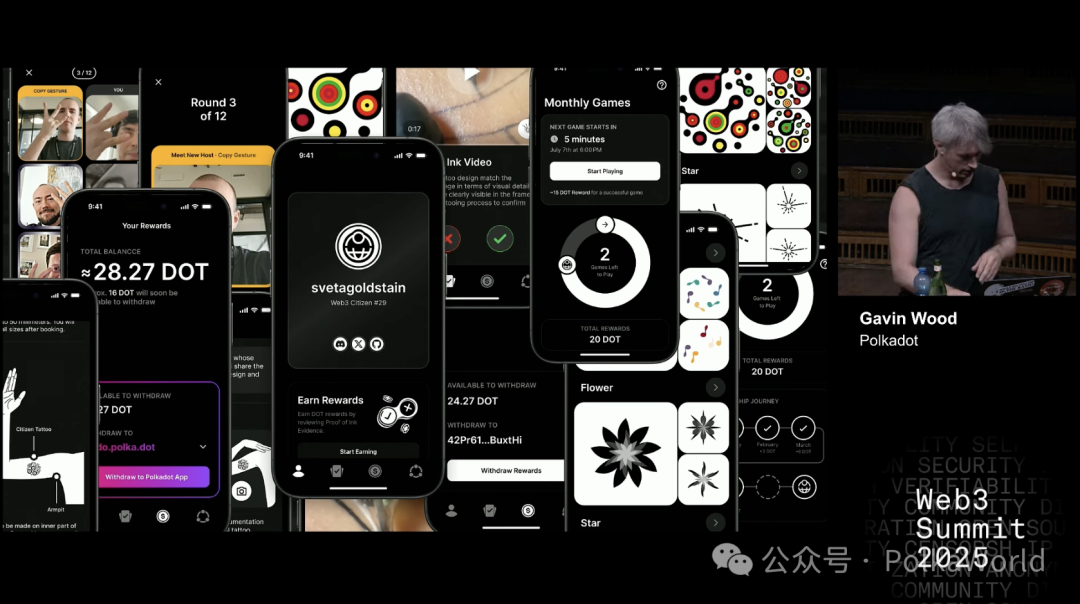
Additionally, there's a $3 million proposal for a fair airdrop! The value of all this work depends on how many people we can get to participate. I think it's like a snowball effect—if enough people participate, it will only get bigger. But the key is getting the first group of people on board.
We're doing everything we can to make the whole process fun, exciting, and engaging, so that people will be willing to participate, even without the need for proof of individuality and these additional benefits. But making it truly fun takes time and a lot of iteration. That's why progress has been slower than I initially anticipated. But once it's fully launched, I believe it will be incredibly cool and worth everyone's anticipation.
Rebuilding Oracle
Next up is Web3 Oracle (decentralized oracle). This is another area where some have tried before, but I've never felt they struck a good balance between cost, generalizability, and correctness. It turns out we need an oracle to support the first Digital Individuality Mechanism (DIM1, decentralized individuality mechanism).
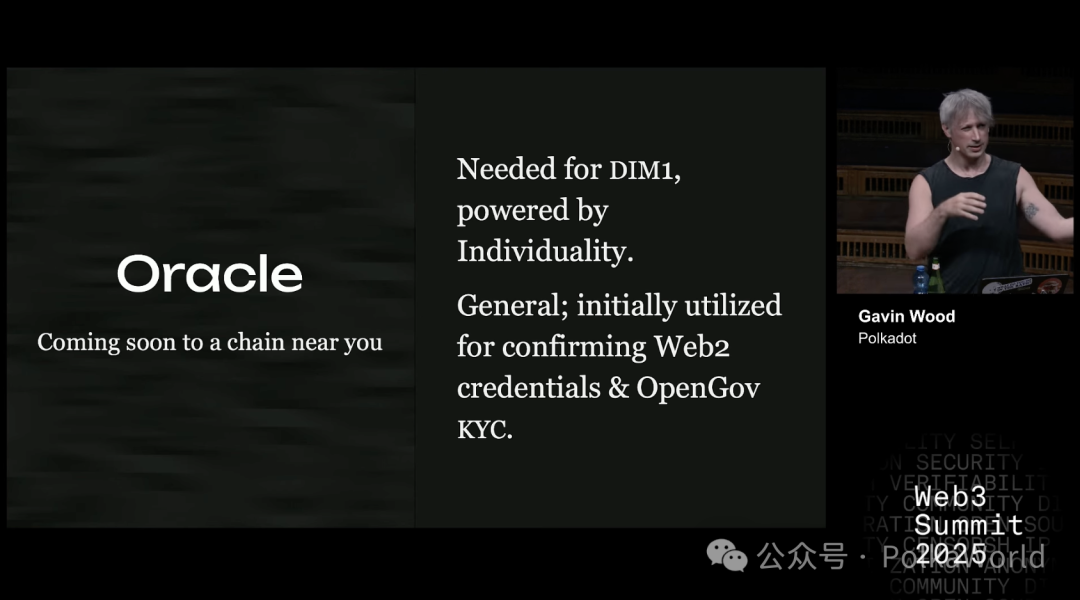
More importantly, this oracle mechanism is highly versatile. We can use it to replace the current Polkadot registrar service. This service is essentially operated solely by the Web3 Foundation, or initially maintained by community member Shevdor. This is clearly not in line with the spirit of Web3. Therefore, we should migrate it to a true Web3 mechanism. This is also necessary for DIM1, and the reasons will become clear as you use the application in practice.
Web3 Outpost: A community space that brings Web3 to the real world
Finally, there are Web3 Outposts. These are a series of projects I've been putting on the "side burner" list, but they're now starting to get off the ground. Consequently, my focus is gradually shifting to them. Their goal is to bring Web3 into real-world community spaces. In other words, to create rules-based, collaborative, high-tech "work-live" spaces. These are community spaces, but they're community spaces with clear rules.
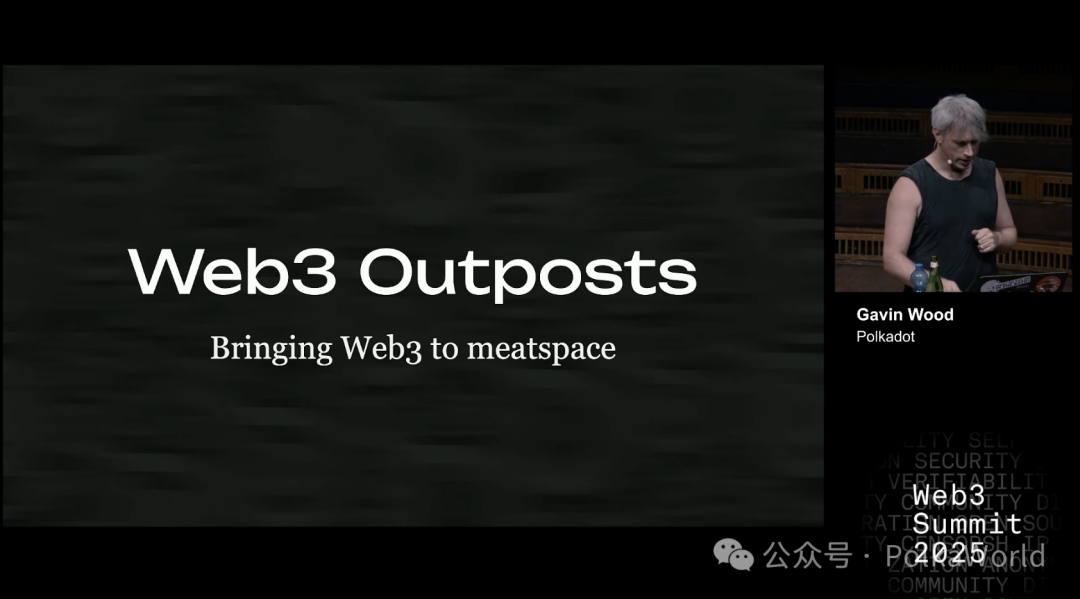
Web3 is a rules-based concept. At its core, rules are the core, and their goal is to meet user expectations. To achieve these expectations within a space, clear rules are essential: interaction rules, etiquette, language standards, and so on. Different spaces naturally have different rules. Furthermore, appropriate security mechanisms are needed to enforce these rules.
What are the purposes of these spaces? Many things: community outreach, experimentation, and integration with various aspects of life (at least the parts I find interesting). Examples include integrating Web3 blockchains with real-world businesses, selling goods, providing services, food, art, culture, and technologies that are close to Web3 but not actually Web3. Some outposts will focus more on certain areas, but that's the general scope.
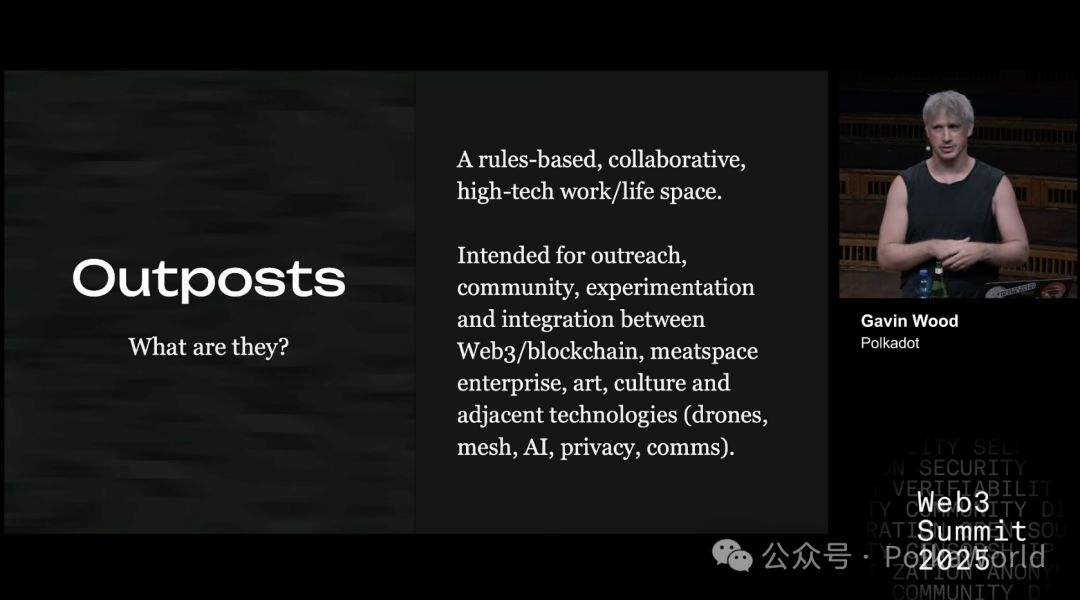
Why are these different from regular community spaces? Because they're blockchain-based. We want to build a rules-based space driven by the underlying technology, not just a community for people interested in blockchain. Some communities today might use one-time wallets or token spending, but we want to go further.
For example, we want a room and booking system that's directly tied to an on-chain community or collective. This way, without revealing their identity, a person could join an on-chain collective, book a room at a Web3 Outpost, and then, using their phone or a QR code (similar to a Polkadot Vault experience), navigate through security gates and into their room. All of this should be autonomous, without the need for human administrators. This is exactly the kind of system and physical space I'm interested in building.
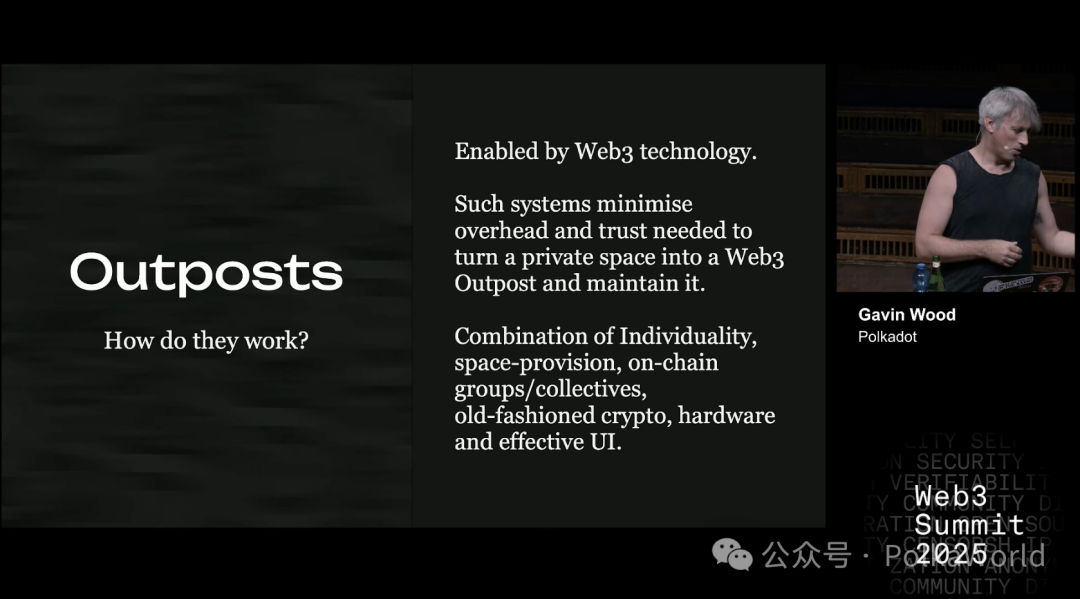
Once these systems are established and operational, we can minimize costs, reduce management overhead, and reduce reliance on human interaction. For example, imagine a bar where you don't need to trust the bartender with tedious tasks like inventory management and security. They simply mix and serve drinks. The system takes care of everything else. This is the area I hope to focus on in the near future.
As for management methods, individuality is crucial. We must be able to promptly ban anyone who violates the rules. Providing spaces can rely on on-chain group organizations. We already have some examples, such as the Fellowship and Kusama Society. Beyond that, traditional encryption technologies will be involved: hardware door locks, WhatsApp bot integration, and, most importantly, an efficient user interface. User experience is crucial, extremely important.
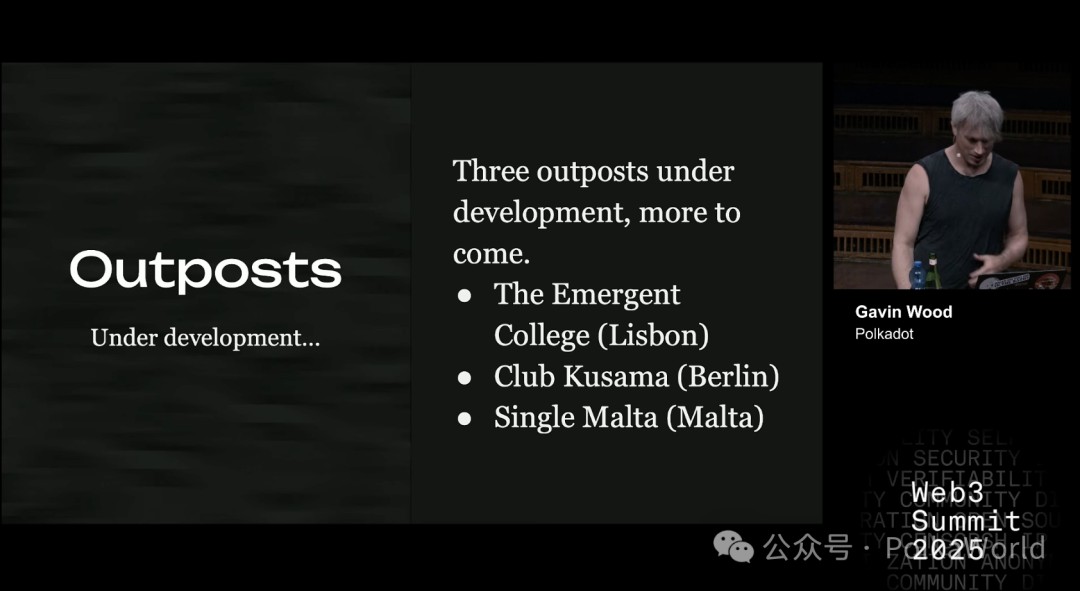
Some of the things we are currently working on include Emergent College, Kusama Bar, which has been in the works for many years and will hopefully open soon, and another bar in Malta.
Polkadot native stablecoin
The last topic I want to briefly mention is: stablecoins.
I mentioned this before, and I'll elaborate on it now: What are we trying to achieve? It's simple: create a truly Web3 stablecoin.
There are already some so-called stablecoins on the market, some of which claim to be Web3, but those that are truly used on a large scale are not actually Web3. They are just Web2 with a Web3 shell, and are essentially "fake Web3."
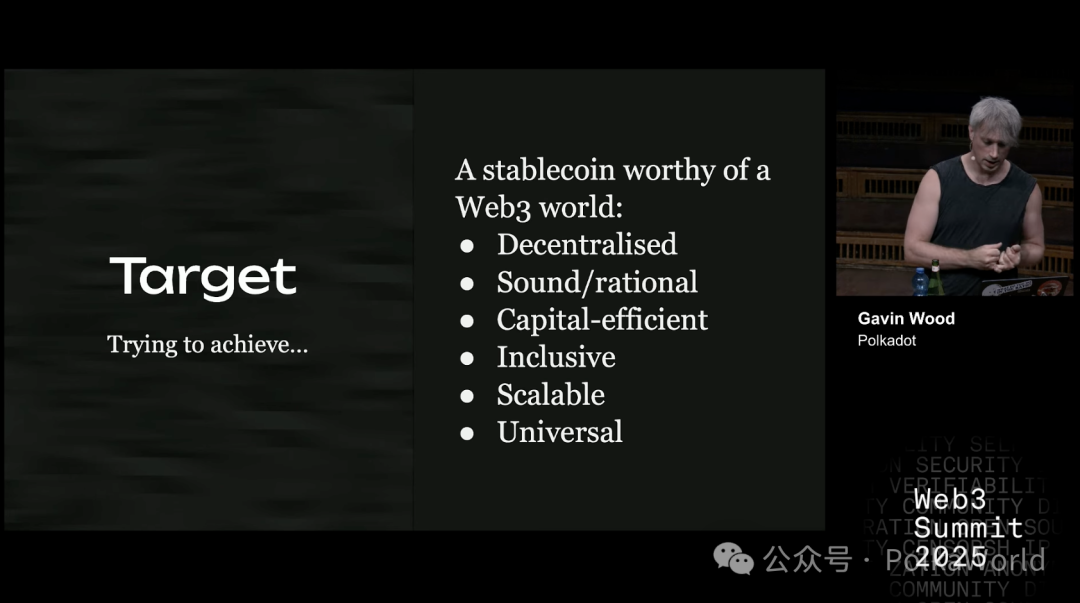
The stablecoin we need must meet the following conditions:
Decentralization: There cannot be a centralized issuer;
Economically sound: There is sound economic logic to prove that its value can remain stable over the long term;
Capital efficiency: Many decentralized stablecoins have unacceptably poor capital efficiency;
Inclusive: anyone can use it, not just a certain group of people;
Scalability: able to support large-scale use;
Universality: It can be used in any scenario and location.
A more interesting case recently is Circles. Its concept is cool, but unfortunately it is not universal. It relies on the location relationship of the social graph, which is different from what I want to achieve.
I won't go into the technical details here; that will be saved for another presentation later this year. However, I can reveal that DOT will be used in part as collateral to support this stablecoin project. We will also be submitting a treasury proposal to help launch the project.
PolkaWorld added: Gavin also shared more about stablecoins in a recent live broadcast:
1️⃣ Gavin is looking forward to the release of Hydration’s HOLLAR — it is decentralized and uses DOT as collateral, which is very important.
2️⃣ But Polkadot cannot rely solely on ecological projects, it must have a native stablecoin:
Directly controlled by Polkadot governance
Overcollateralized DOT
Similar to DAI, it becomes a core component of the protocol level
3️⃣ Before the release of native stablecoins, Gavin prefers using HOLLAR over USDC/USDT. However, in actual applications (such as validator rewards and integration), compatibility with USDC/USDT may still be required to meet user needs.
4️⃣ In addition to “fully collateralized” stablecoins, Gavin is also thinking about a stable-ish stablecoin:
No need to be fully overcollateralized at all times
Accept certain fluctuations
Allow DOT to have an intermediate state between high volatility and full anchoring
The goal is to “reduce volatility” and reduce costs while maintaining practicality
5️⃣ Polkadot can have a multi-layered stablecoin system:
Native stablecoin (secure anchor)
Stablecoin-like (reducing costs and increasing flexibility)
Ecological stablecoin (expanding liquidity and scenarios)
Overall, Gavin’s core point is: “Polkadot needs to treat stablecoins as a protocol-level strategic resource. It should not only have native stablecoins, but also explore innovative stable-ish models to ensure the long-term sustainability of DOT and the ecosystem.”