1. DAT Market Overview
In recent years, Digital Asset Treasury (DAT) has emerged as a new phenomenon at the intersection of capital markets and crypto markets. Its core principle is to raise funds through public equity financing instruments—including listed company stocks, convertible bonds, ATM follow-on offerings, and private placements of private equity funds (PIPEs). DATs allocate mainstream crypto assets such as Bitcoin and Ethereum to their balance sheets, and then generate returns for shareholders through operations and revenue management. Essentially, it "uses equity financing to purchase on-chain assets," allowing investors in traditional secondary markets to gain leveraged, structured, and tradable exposure to crypto assets in the form of stocks. This mechanism not only bridges the gap between on-chain and traditional finance but also creates new trading logic and investment narratives in the market.
Compared to ETFs, DATs exhibit significant differences in several dimensions. First, there are differences in liquidity paths. ETFs rely on a cumbersome subscription and redemption mechanism, requiring the involvement of authorized participants and market makers, and fund settlement often takes one to two days. DAT stocks, on the other hand, can be traded instantly in the secondary market, offering efficiency that better aligns with the liquidity characteristics of on-chain assets. Second, there is pricing. ETFs are typically anchored by net asset value (NAV), resulting in relatively limited volatility and better suited for long-term investment. DAT stocks, on the other hand, are anchored by market capitalization (MV), offering greater price elasticity and higher volatility. Hedge funds and arbitrageurs can exploit these premiums and discounts for structured trading. A third difference lies in leverage structure. ETFs typically lack leverage at the fund level, while DAT companies can leverage through convertible bonds, ATM follow-on offerings, PIPE financing, and other methods to expand their balance sheet and maximize excess returns during bullish cycles. Finally, there is discount protection. ETF premiums and discounts are quickly corrected by arbitrage mechanisms. Once DAT shares fall below their net treasury value, investors are effectively buying the underlying crypto assets at a discount, theoretically providing downside protection. However, this protection is not absolute. If the discount stems from passive deleveraging, companies selling underlying assets to repurchase shares may trigger even more severe downward pressure.
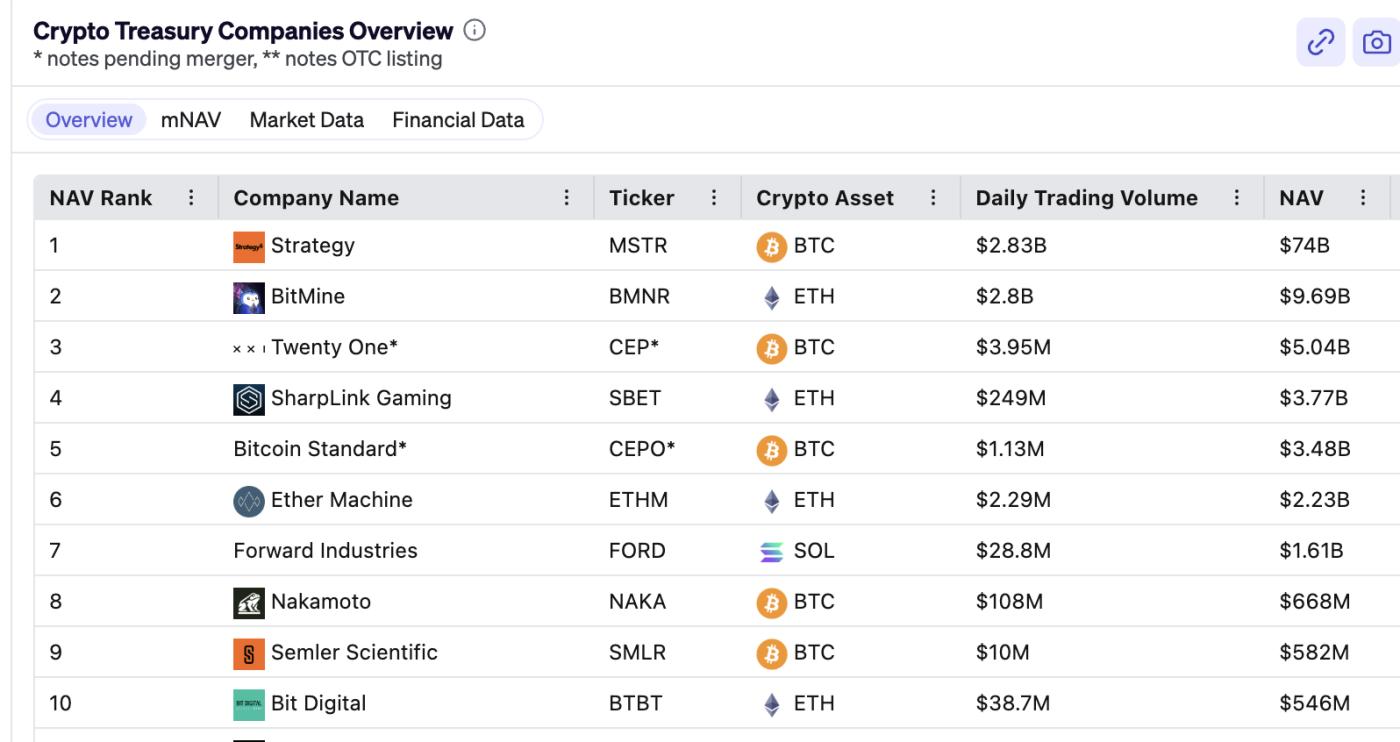
Since 2025, DATs have been rapidly developing in the Ethereum space, becoming a focal point of market attention. BioNexus was the first to announce its Ethereum treasury strategy, marking the first year of corporate ETH holdings. BitMine (BMNR) disclosed in August that it held 1,523,373 ETH, becoming the world's largest Ethereum treasury, with a market capitalization reaching billions of dollars. SharpLink (SBET) has continuously increased its ETH holdings through high-frequency ATM financing, reaching over 800,000 tokens and staking nearly all of its assets, thereby directly converting Ethereum's productive asset properties into cash flow. These companies, through equity market financing activities, have channeled traditional investor funds into crypto assets, driving the institutionalization and financialization of Ethereum prices. Meanwhile, the activity of decentralized exchanges (DEXs) also reflects the liquidity characteristics of this new mechanism. In August 2025, the DEX platform Hyperliquid's spot trading volume briefly surpassed Coinbase's in a single day, demonstrating the rapid migration of capital flows between on-chain trading, equity markets, and derivatives markets. DATs have become a key node in this cross-market capital flow. Some companies have even introduced innovative shareholder incentives. For example, BTCS announced that it would use ETH dividends and loyalty rewards to attract long-term investors, which not only strengthened market stickiness but also combated stock lending and short selling.
However, DATs also present significant risks. Their model relies on a premium flywheel during bull markets: rising stock prices drive additional financing, which is then used to purchase more crypto assets. The rising asset value further increases mNAV, fueling further stock price increases. This cycle can generate significant returns during bull markets, but can also amplify risk in bear markets. When mNAV shifts from a premium to a discount, investors lose confidence in management. To stabilize valuations, companies often sell underlying assets to buy back shares, creating a negative feedback loop. If multiple DATs simultaneously enter a discounting phase and adopt similar measures, the market could face systemic risks. Leverage is another key concern. DATs widely use convertible bonds, short-term financing, and additional equity issuances to leverage their assets. This can amplify returns during uptrends, but can trigger margin calls or even forced liquidations during downturns. If on-chain asset prices plummet, concentrated selling can have a market impact, especially in highly concentrated assets like Ethereum, where the risks are particularly pronounced.
Market research has simulated possible scenarios. In the baseline scenario, companies gradually adjust their positions through over-the-counter transactions, with limited downward pressure on ETH prices. In the severe scenario, if 20%–30% of ETH treasury holdings are sold off in a concentrated manner over a period of several weeks, the price could fall to $2,500–3,000. In the extreme scenario, if tightening regulations or a breakdown in funding chains force the liquidation of over 50% of holdings, the price could fall to $1,800–2,200. While the probability of these extreme scenarios is low, their potential impact should not be underestimated. Notably, DAT executive compensation is often highly correlated with stock price, leading them to take short-term measures when faced with a stock price discount, such as selling tokens to buy back shares to boost market capitalization, rather than maintaining a long-term strategic holding strategy. This misalignment in governance and incentives makes DATs more susceptible to the risk of procyclical amplification under stressful circumstances.
Despite this, the prospects for DATs remain promising. Over the next three to five years, DATs are likely to develop in parallel with ETFs, forming a complementary landscape. ETFs offer stable beta exposure, suitable for passive investors; DATs, on the other hand, offer highly flexible and financially engineered income opportunities, making them more suitable for hedge funds, family offices, and institutional investors seeking outsized returns. More importantly, the DAT model is expanding beyond Bitcoin and Ethereum to include high-quality Altcoin, providing some projects with access to the capital markets similar to an "IPO moment," further institutionalizing the crypto industry. The gradual clarification of the regulatory framework, the improvement of information disclosure mechanisms, and the diversification of shareholder incentive tools will jointly determine the long-term sustainability of DATs. Overall, DATs represent a significant experiment in the integration of capital markets and crypto markets. They could become a milestone in the development of a new generation of institutional financial instruments, but they could also, due to their pro-cyclical nature, become an amplifier of market volatility. For investors, leveraging the complementary nature of ETFs and DATs and flexibly adjusting strategies between mNAV premiums and discounts may become a core issue in the future era of crypto finance.
2. Industry Development and Key Events
The most striking phenomenon in the evolution of the digital asset treasury (DAT) market in 2025 was the surge in Ethereum. Unlike the previous Bitcoin-centric reserve model, Ethereum is gradually becoming the dominant force in corporate treasuries. BioNexus was the first to announce its Ethereum treasury strategy in March, officially adding ETH to its balance sheet and increasing its holdings through equity financing. This move was seen as a landmark event, symbolizing the entry of Ethereum into corporate ownership. Unlike exchanges like Coinbase, which previously held ETH for operational purposes, BioNexus's approach was to hold ETH directly as a strategic reserve asset, sending a signal of institutional ownership. This not only increased the company's own attention in the capital market but also led investors to recognize Ethereum's equal reserve status with Bitcoin. Subsequently, BitMine (BMNR)'s actions culminated in this trend. In August, the company disclosed that its ETH holdings had reached 1.52 million, representing a market capitalization exceeding $6 billion and approximately 1.3% of the circulating supply of ETH. This scale quickly established BitMine as the "Ethereum version of MicroStrategy," garnering significant recognition in both the capital markets and on-chain markets. BMNR's model is similar to that of MicroStrategy: continuously expanding its balance sheet through convertible bonds and equity financing, creating a flywheel of "financing - coin purchases - valuation increases - refinancing," driving a mutually reinforcing cycle between stock price and on-chain assets. Market sentiment is polarized: some see BMNR as a milestone in shaping Ethereum's institutionalization; others worry that excessive leverage and concentrated holdings could amplify systemic risks in the event of a market reversal. Regardless, BMNR has become one of the most anticipated DATs of 2025 and has directly altered the funding landscape of ETH.
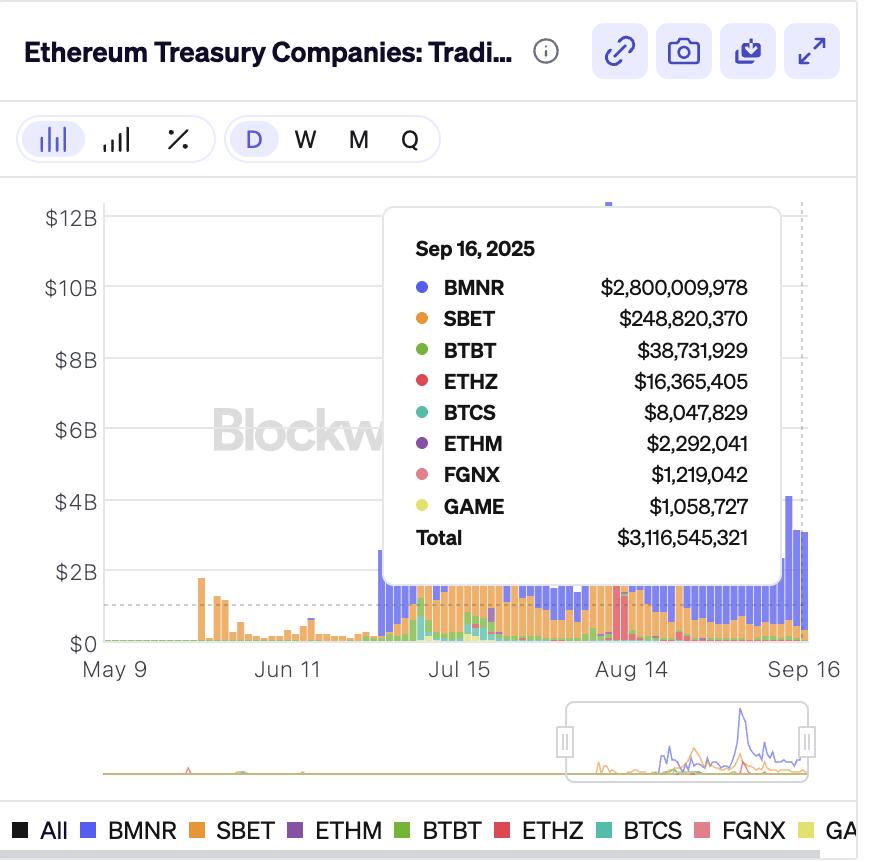
In parallel, SharpLink (SBET) has adopted a more frequent and aggressive approach to balance sheet expansion. SBET continues to issue additional ETH in the secondary market through its ATM financing mechanism, disclosing new financing and purchases almost weekly. By the end of August, the company had accumulated over 800,000 ETH, almost all of which was used for on-chain staking. This strategy directly converts Ethereum's productive asset properties into cash flow, allowing the company to generate both paper profits and tangible returns on its balance sheet. SBET's model has attracted significant attention. Its weekly disclosures and high transparency not only provide investor confidence but also make its strategy easier to quantitatively track and game in the market. Critics argue that this "full-collateralization" strategy increases exposure to on-chain protocol security and liquidity risks, but supporters emphasize that this approach to transforming ETH into a productive asset could become a best practice for DATs.
Notably, BTCS demonstrated another innovative approach in this round of competition. The company launched a combined "ETH Dividends + Loyalty Rewards" program, distributing dividends using ETH holdings while also incorporating a loyalty reward clause to encourage shareholders to transfer their shares to a designated transfer agent and hold them until early 2026. This approach not only allows investors to receive cash and ETH dividends, but also offers additional incentives for long-term holding. This approach not only increases shareholder loyalty but also, to a certain extent, curbs stock lending and short, thereby stabilizing market sentiment. While there are doubts about the sustainability of "paying dividends in ETH," this undoubtedly demonstrates the flexibility and creativity of DATs in financial engineering and highlights the differentiated strategies companies employ to address the risk of stock price discounts.
At the same time, changes at the trading level are also noteworthy. In August 2025, the decentralized exchange Hyperliquid's spot trading volume briefly surpassed Coinbase's in a single day, a highly symbolic development. CEXs have long been considered the core of cryptoasset liquidity, but with the continued emergence of DAT equity financing and the deepening interaction between on-chain funds and equity markets through DEXs, the liquidity landscape is undergoing a restructuring. Hyperliquid's trading volume surpassing Coinbase is not a single, isolated event, but rather a signal of the gradual integration of capital markets and on-chain trading. Funds are forming a new cycle through "DAT equity financing - companies purchase on-chain assets - staking/re-staking to generate returns - and investor arbitrage and trading." This cycle both accelerates the integration of on-chain and traditional markets and can also amplify liquidity shocks during times of market stress.
Overall, the evolution of the DAT market in 2025 demonstrates the embryonic form of a brand-new ecosystem. BioNexus opened the door to the ETH treasury strategy, BitMine established its industry leadership through large-scale holdings, SharpLink explored alternative paths using high-frequency financing and full collateralization strategies, and BTCS created a unique shareholder incentive tool through financial engineering. Meanwhile, Hyperliquid's trading volume fluctuations reflect the liquidity restructuring of capital markets and on-chain markets. These examples collectively demonstrate that DATs are more than just a simple "corporate token purchase" model; they have evolved into a comprehensive financial innovation encompassing multiple dimensions, including financing methods, asset allocation, income management, and shareholder governance. This ecosystem will continue to expand and evolve, potentially accelerating the institutionalization of crypto assets or amplifying market volatility due to leverage and liquidity mismatches. Regardless of the outcome, DATs have already profoundly changed the crypto asset capital market narrative in 2025, making them a key area that global financial observers must closely monitor.
3. Risks and Potential of DAT
As the DAT model rapidly develops, the hidden risks and systemic concerns behind it are becoming increasingly prominent. On the surface, digital asset vaults provide the market with new sources of funding and liquidity support. However, a closer look reveals that their operating mechanisms inherently have strong pro-cyclical properties, amplifying gains in bull markets while also exacerbating declines in bear markets. This double-edged sword effect makes the role of DATs in the capital and crypto markets particularly sensitive and complex. First and foremost is leverage risk. DATs often rely on equity issuance and convertible bond financing to expand their balance sheets. During bull markets, as stock prices and market capitalizations rise, companies can raise large amounts of capital at a low cost, further increasing their holdings in Bitcoin or Ethereum, creating a flywheel effect of valuation and position building. However, this leverage model can quickly backfire in market turns. If the underlying asset price experiences a sharp correction, debt repayment and margin requirements may be triggered, forcing companies to passively sell their holdings to address funding shortfalls. Leverage amplifies both returns and risks, which is particularly dangerous given the high volatility of crypto assets.
Secondly, there's the discount crisis. DAT valuations are anchored to the so-called mNAV (mNAV), the ratio of a company's market capitalization to the fair value of the crypto assets held in its treasury. During a bull market, mNAV is typically significantly above 1, and investors are willing to pay a premium for future expansion and earnings. However, once market sentiment reverses and the stock price falls below net asset value, the mNAV shifts from a premium to a discount, and investor trust in management rapidly erodes. In these situations, companies often attempt to repair valuations and appease the market by selling the underlying ETH or BTC to repurchase shares, attempting to bring the stock price back close to net asset value. However, this approach essentially sacrifices a long-term holding strategy for a short-term stock price correction. The result may be a temporary narrowing of the discount, but the market is then subjected to additional selling pressure, creating a vicious cycle.
Liquidity shocks are another concern. DATs hold increasingly large amounts of crypto assets, and a concentrated release of these holdings could have an unexpectedly large impact on the market. Especially given insufficient liquidity on decentralized exchanges, a coordinated sell-off by multiple DATs could easily trigger a cascading market decline. Past experience shows that when highly concentrated assets undergo passive deleveraging, price declines often exhibit nonlinear characteristics. In other words, even if the overall sell-off represents only a small fraction of the circulating market capitalization, insufficient liquidity can lead to significant volatility. This risk is particularly pronounced in tokens with highly concentrated holdings, such as Ethereum. Regulatory uncertainty is another significant obstacle hanging over the DAT model. Currently, there are no unified standards for treasury companies' accounting treatment, information disclosure, leverage ratio limits, and retail investor protection. Diverging approaches across jurisdictions could alter the DAT landscape at any moment. For example, regulators could require companies to disclose on-chain addresses and staking risks, restrict leverage ratios, or prohibit token dividends. These measures could significantly impact DATs' fundraising capabilities and market narrative. For DATs that rely heavily on capital market financing and investor confidence, such regulatory changes not only mean increased costs, but may also directly undermine the sustainability of their models.
Furthermore, a misalignment between governance structure and incentives is a potential problem with the DAT model. Most DAT executive compensation is directly linked to stock price, which can stimulate balance sheet expansion in bull markets but can lead to short-term management in bear markets. When stock prices are discounted and investor confidence declines, executives may prioritize selling underlying assets to repurchase shares, boost market capitalization, and protect their own compensation, rather than adhering to a long-term holding strategy. This incentive mismatch not only weakens the DAT's strategic stability but also increases the likelihood of pro-cyclical sell-offs, exacerbating market fragility. Beyond risk analysis, scenario simulations provide a more intuitive understanding. In the baseline scenario, assuming a mild ETH price correction, DAT companies may gradually sell their ETH through over-the-counter transactions to smooth the market impact, limiting the price impact. However, in a severe scenario, if 20%–30% of the ETH vault holdings were sold in a short period of time, the market might not be able to fully absorb the losses, potentially sending the ETH price plummeting to $2,500–3,000. This level represents a 30% drop from the current price, sufficient to reshape market sentiment. In an extreme scenario, if more than 50% of holdings are forced to liquidate due to a broken funding chain, tightened regulations, or a systemic crisis, the price of ETH could plummet to $1,800–2,200. Such a decline would completely wipe out the gains since the DAT boom began, returning the market to its early 2025 level. While the probability of this extreme scenario is low, given DATs' heavy reliance on financing and leverage, the market impact, if triggered, would be profound. Overall, the rise of DATs has undoubtedly injected new narratives and liquidity into the crypto market, but it is not a stable "new normal." Their procyclical nature makes them both an amplifier of bull markets and a source of risk in bear markets. For investors, understanding the DAT model's leverage structure, the dynamics of the mNAV premium/discount, and management incentive structure is key to assessing its sustainability. In the absence of comprehensive regulation and risk isolation, DATs resemble a highly leveraged financial experiment that could either promote the institutionalization of crypto assets or become a trigger for market volatility. In the next few years, the maturity of DAT’s risk management capabilities and regulatory framework will determine whether this model can truly move from a speculative narrative to a robust financial instrument.
Looking ahead to the next three to five years, digital asset treasuries (DATs) are likely to develop in parallel with ETFs, jointly building an institutionalized investment landscape for the crypto market. ETFs have proven their advantages in compliance, stability, and low costs, providing robust beta exposure for passive investors, pension funds, sovereign funds, and others. In contrast, DATs, with their greater flexibility, more complex capital engineering, and direct holdings of on-chain assets, are naturally more suitable for hedge funds, family offices, and active institutions seeking alpha. This division of labor in the market structure suggests that ETFs and DATs are not in a zero-sum competition, but rather complement each other, jointly promoting the deep integration of traditional capital and the crypto market. From the perspective of asset expansion, DATs' investment scope is likely to extend beyond BTC and ETH. As the industry ecosystem matures, high-quality altcoin projects may achieve an "IPO moment" similar to that of an IPO through DATs, leveraging equity financing from listed company treasuries to establish early, large-scale on-chain positions. This will not only provide institutional endorsement for the relevant tokens but also create a new narrative in the capital markets. For example, Layer 2, decentralized data networks, or core protocols related to stablecoins may all become targets for future DAT allocations. If this trend materializes, DATs will not only be leverage tools for BTC/ETH, but also a "booster" for the next generation of public chains and protocols in the capital market, with a profound impact on the crypto ecosystem.
In terms of operational models, DATs' revenue engineering will be the next key focus. Currently, some companies have begun exploring staking their token holdings to generate on-chain interest income, which they then convert into cash flow to return to shareholders. In the future, this model is expected to expand to diversified approaches such as option hedging, basis arbitrage, re-staking, and governance participation. Unlike traditional ETFs that simply track prices, DATs can actively operate to form a "dynamic treasury," generating both on-chain returns and enhancing their influence on the underlying ecosystem. This means that DATs are not just asset holders; they can also become important governance participants in on-chain protocols, even evolving into "institutional players" in the crypto economy. The gradual clarification of regulatory frameworks will be a key factor in the sustainable development of DATs. Currently, different jurisdictions have not yet reached a consensus on DATs, leaving unresolved issues such as information disclosure, accounting standards, leverage ratios, and retail protections. However, as the market scale and investor base expand, regulatory pressure will inevitably increase. In the future, DATs may be required to disclose their on-chain addresses, clarify their holdings and staking ratios, and even standardize dividend distribution methods to ensure transparency and investor protection. In a sense, this will enhance DATs' compliance and credibility, making them more attractive to institutional investors. However, it may also reduce their flexibility in capital engineering. Tighter regulation is both a challenge and a necessary step for DATs to move from "financial experiments" to "institutionalized tools."
In the long term, DATs have the potential to evolve into quasi-financial intermediaries in the crypto market. Their unique ability to connect both the equity capital market and the on-chain asset market, forming a bridge for cross-market capital allocation. When investors purchase DAT shares, they effectively participate indirectly in the holding and operation of on-chain assets, while DAT companies, through equity financing, bring traditional capital into the crypto space. This two-way interaction will enable DATs to play an increasingly important role in global capital flows and asset allocation. Especially given the difficulty of direct cross-border capital investment in crypto assets, DATs may become a compliant channel, providing "indirect exposure" and thus expanding the investor base for crypto assets. However, this bright prospect also carries significant systemic risks. The pro-cyclical nature of DATs means that they can accelerate price increases in bull markets, but can amplify market declines in bear markets. Unlike passive ETF holdings, DATs rely heavily on equity market financing and the premium on mNAV. If the market environment reverses, DATs' financing chain could quickly break down, leading to large-scale passive deleveraging. In other words, although DAT has a bright future, whether it can truly grow into a robust institutional sector depends on its performance in risk management and regulatory adaptation.
In general, over the next three to five years, DATs will develop along two parallel paths. On the one hand, they will continuously innovate, gradually building unique competitive advantages by expanding their asset base, embedding yield engineering, and increasing on-chain participation, becoming a highly resilient complement to ETFs. On the other hand, they will gradually explore more robust and sustainable models amidst the realities of regulatory constraints, leverage control, and market volatility. DATs are both a symbol of the convergence of capital markets and crypto markets, and a microcosm of procyclical risks. Only by striking a balance between institutionalization and innovation can they truly become a new type of intermediary in the global financial system, propelling crypto assets from the margins to the mainstream.
IV. Conclusion
The rise of digital asset treasuries (DATs) is undoubtedly one of the most iconic events in the capital markets and crypto industry in 2025. It's not just a new asset allocation tool, but also an institutionalized experiment in combining equity financing with on-chain assets, representing the deep coupling of the two major financial systems. Essentially, DATs directly tie the financing capabilities of listed companies to the high volatility of blockchain assets, creating an unprecedented investment logic and market narrative. For investors, they offer both a new channel for amplifying returns and a new hidden danger of amplifying risks. DATs operate particularly smoothly during bull markets. Stock price premiums boost mNAV, making it easier for companies to raise capital through convertible bonds, PIPEs, or ATM offerings. The funds raised are then converted into purchases of crypto assets like ETH and BTC. Balance sheet expansion, in turn, drives up market capitalization, creating a "premium-financing-increase" flywheel. This mechanism makes DATs a crucial driver of market growth, with market capitalization resilience far exceeding that of traditional ETFs, making them a sought-after target for hedge funds and high-net-worth investors. Under this narrative, DAT is not only a product of financial innovation, but also a core participant in bull market capital flow and valuation expansion.
However, DATs in a bear market can present a completely different picture. When prices fall, mNAV shifts from a premium to a discount, shaking market confidence in management. To repair stock prices, companies may sell underlying assets and repurchase shares to temporarily narrow the discount. However, this behavior often leads to increased selling pressure, accelerating price declines and simultaneously causing more DATs to deleverage. Under this procyclical mechanism, DATs cease to be market stabilizers and may become amplifiers of systemic risk. In other words, the risk of DATs is not simply the individual risk of a single company, but the potential impact on the overall cryptoasset market when multiple treasury companies sell off their assets in a coordinated manner. At the investment level, the functional division between DATs and ETFs is becoming increasingly clear. ETFs are more suitable as a cornerstone tool for long-term allocations, providing transparent, low-cost, and predictable beta exposure. DATs, with their high leverage, high resilience, and active return management, are an option for incremental allocations, particularly suitable for institutions and individuals seeking excess returns and willing to take on risk. For family offices or actively managed funds, DATs offer capital engineering advantages that traditional ETFs cannot replicate, but they also come with potential liquidity risks and governance uncertainties. Finding the right combination of ETFs and DATs will become a core issue in asset allocation strategies.
Over the next three to five years, DATs have the potential to grow into an institutional sector on par with ETFs. Their development path will depend primarily on three factors. First, regulatory clarity. Only when unified standards are established for accounting, information disclosure, leverage ratios, and shareholder protection can DATs attract a wider range of institutional capital. Second, information transparency. Public disclosure of on-chain addresses, holdings, and collateralization ratios will become a crucial basis for investors to assess risk and valuation, and a prerequisite for building long-term trust in DATs. Third, market resilience. Whether the crypto market can remain resilient in the face of potential procyclical shocks will directly determine whether DATs will be a positive force driving institutionalization or a source of risk exacerbating volatility.
If these conditions are met, DATs could become another milestone in financial history, much like ETFs were to index funds. From initial market trials to widespread adoption, DATs have the potential to redefine the boundaries between capital markets and crypto markets, allowing crypto assets to truly become part of larger investment portfolios. However, if these conditions are not met, DATs could be a fleeting fad, ultimately proving to be a "big gamble on financial innovation and risk management." The history of capital markets demonstrates that the emergence of every new tool brings both efficiency gains and opportunities, but also untold risks. The emergence of DATs is an inevitable product of our times, combining traditional financing methods with decentralized assets to create a novel approach to value capture. However, their long-term success depends not only on market enthusiasm but also on rational regulation, robust governance, and mature risk prevention and control mechanisms. Investors, businesses, and regulators must recognize that DATs are not risk-free arbitrage tools, but rather pose new challenges to the entire market structure. Ultimately, the future of DATs depends on the combined efforts of markets and institutions. If regulation and market mechanisms can foster a healthy interaction, DATs have the potential to become a crucial bridge for the institutionalization of crypto assets. Conversely, their procyclical nature and leveraged nature could exacerbate market volatility, becoming a case study in the failure of "financial alchemy." Just as ETFs, once skeptical twenty years ago, have become a cornerstone of global markets, the next decade may also reveal the fate of DATs. Regardless, their emergence has already left a mark on the long history of the capital market.