


By DappRadar
Compiled by Felix, PANews
Despite Bitcoin reaching new highs in the first week of October, the third quarter of 2025 sets the perfect foundation for growth by the end of the year. Dapps have been impacted by the crypto market downturn, but innovation never ceases. The past three months have witnessed the continued rise of Dapps, with tokenization becoming a key pillar of the industry, NFTs gaining momentum, and DeFi TVL reaching a new all-time high.
Key points:
- The average number of daily active wallets for Dapps was 18.7 million, down 22.4% from the previous quarter.
- Gaming consolidated its market dominance, increasing from 20.1% in Q2 to 25% in Q3, followed by NFTs (18.5%) and DeFi (17.9%).
- DeFi’s TVL hit a new all-time high, with the TVL across all blockchains and protocols reaching $237 billion.
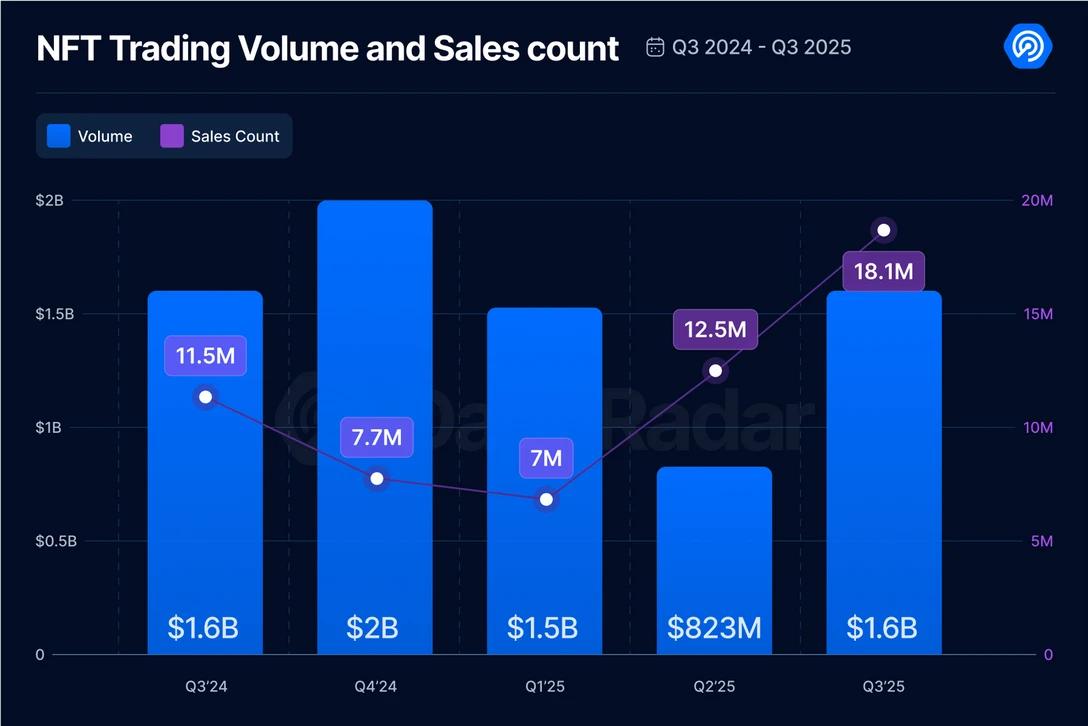
- NFT transaction volume nearly doubled to $1.58 billion during the quarter, while NFT sales hit a new quarterly high of 18.1 million.
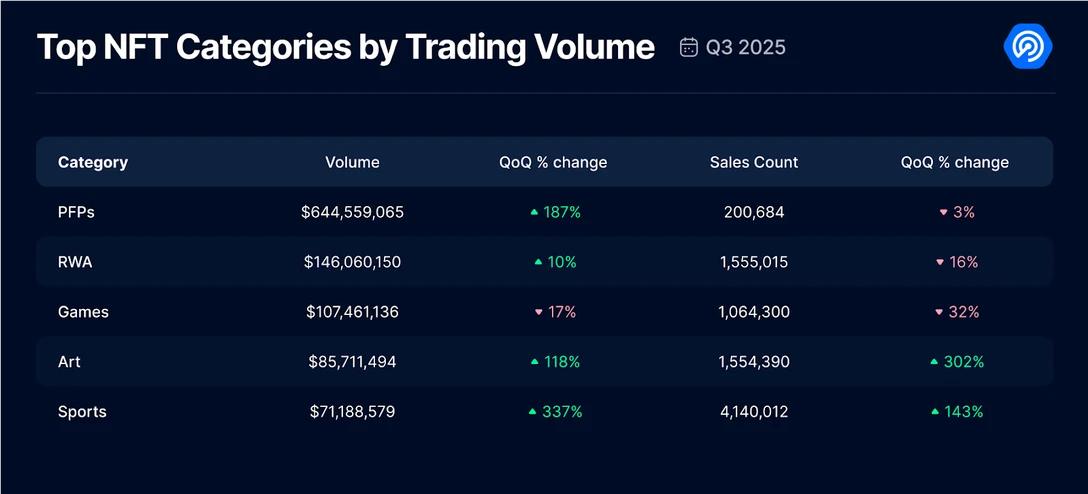
- Sports emerged as a major growth market for NFTs, with transaction volume in the category increasing 337% to $71.1 million.
- Losses from hacker attacks fell to their lowest point this year at $434 million, but threats are becoming more sophisticated.
1. Dapp usage declines as SocialFi and AI momentum fades
The average number of daily active unique wallets for Dapps decreased by 22.4%. In Q3, Dapps attracted an average of 18.7 million wallets per day. Throughout the quarter, the number of active wallets in every category declined, with the most significant declines in the Social and AI categories.
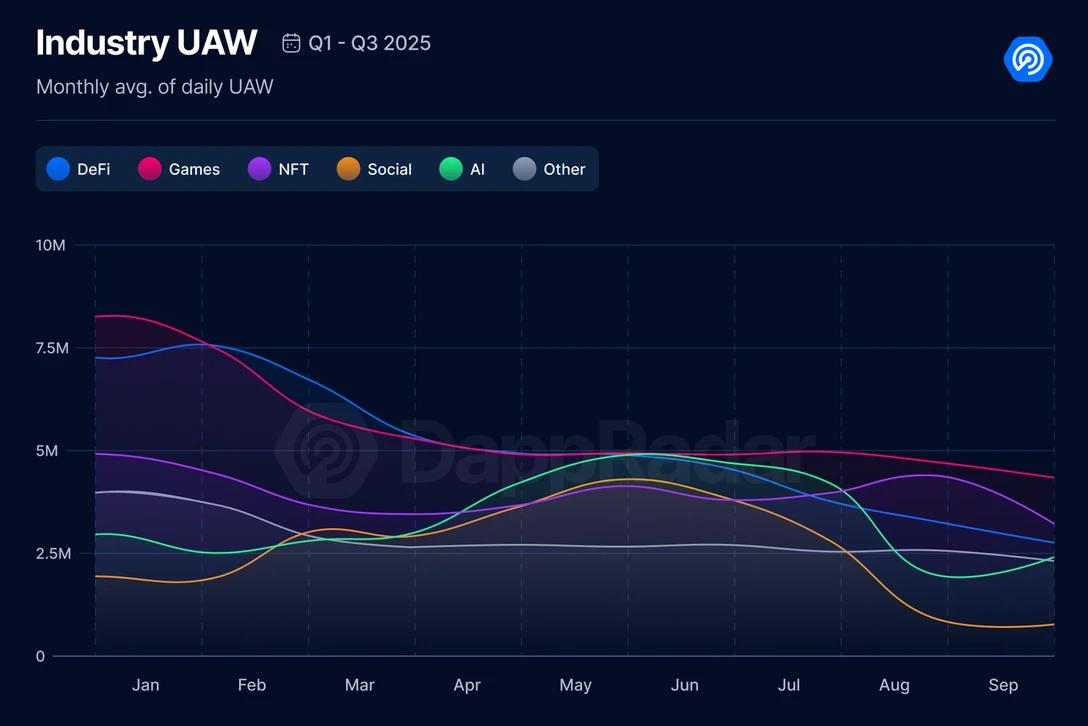
The AI category saw a decline in traction throughout the quarter, with the average number of active wallets falling from 4.8 million in Q2 to 3.1 million in Q3. This downward trend is evident in the success of Virtuals Protocol, an AI agent startup. In Q2, Virtuals Protocol attracted 10,000 daily active wallets, as millions of users flocked to the platform. It now attracts 1,000 to 1,500 daily active wallets, averaging approximately $100,000 in daily transaction volume.
In addition to AI, social dapps have also been impacted. In the second quarter of this year, the number of daily active wallets for social dapps reached 3.8 million. However, in Q3, this number plummeted by more than half, to 1.57 million active wallets. Social dapps such as The Arena, Layer3, and OnchainGM reached peak activity in Q2, but activity has declined significantly over the past three months.
When broken down by market sector, both the Social and AI categories lost market share over the past quarter. In Q2, AI was the third most active sector, accounting for 18.6%, but by Q3, this share had dropped to 16.8%. The Social sector was hit even harder, declining from 15.9% to 8.4%. In terms of market dominance, NFTs saw an increase in market share, currently occupying second place with 18.5%. Meanwhile, the Games category maintained its dominance within the Dapp industry, holding a 25% market share.
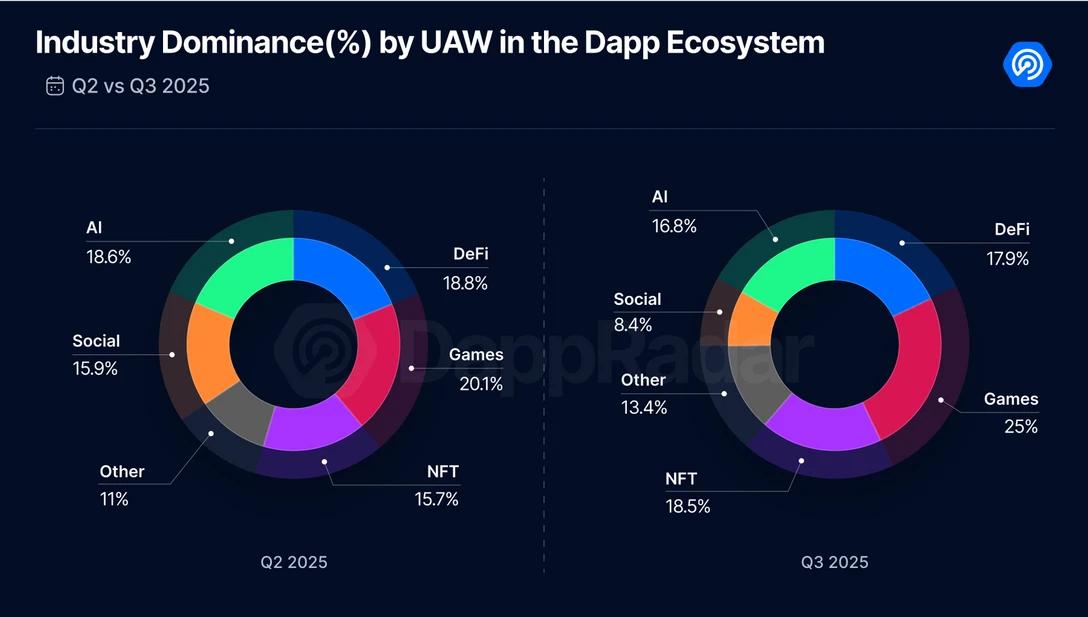
Earlier this year, Games, DeFi, and AI dominated, followed closely by Social and NFTs. This reversed the trend in Q3. Games still dominate, but NFTs have risen in the rankings and are now in second place. DeFi and AI are close behind, while Social is now the weakest sector in the market, surpassed by the diverse range of DApps in the "Other" category.
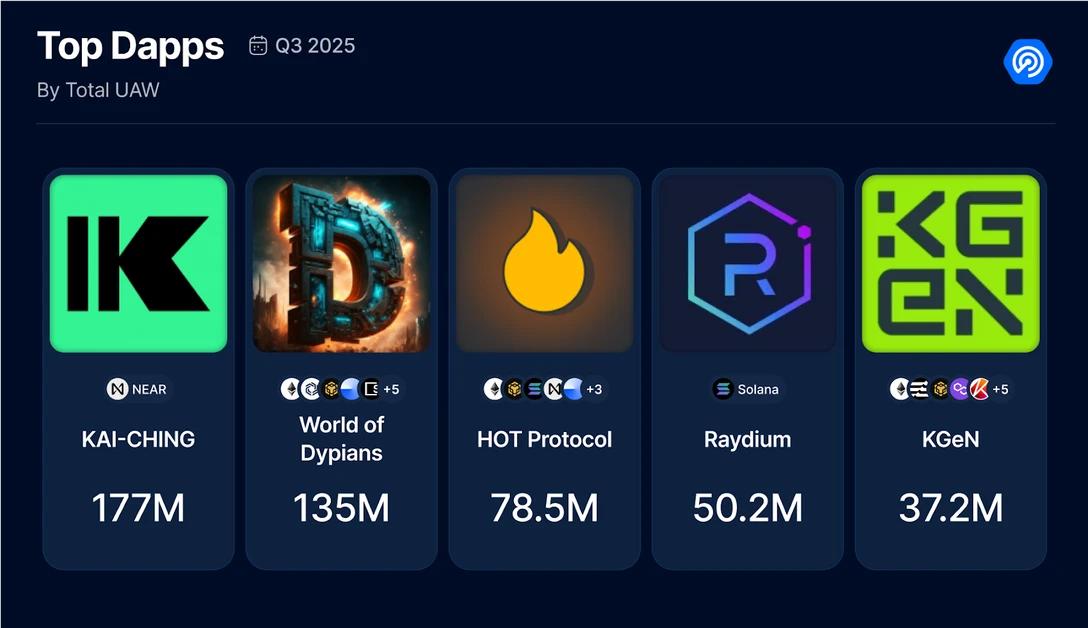
Looking at individual Dapps individually, gaming Dapps still dominate. While the shopping app KAI-CHING attracts the most active wallets, gaming accounts for a significant portion of the top five Dapps. World of Dypians is a social gaming metaverse, with HOT Protocol providing gamification services and KGeN serving as a gaming interaction platform.
2. DeFi TVL hits a record high of $ 237 billion
As cryptocurrency prices surge, innovation is driving the DeFi market to new all-time highs. Lending protocols are booming, cross-chain liquidity has become a hot topic in the industry, and the rise of memecoins and AI tokens has brought significant liquidity to certain ecosystems. Furthermore, the rise of stablecoins is propelling DeFi into the spotlight of traditional finance.
In Q3, the United States passed three pieces of cryptocurrency legislation, with the GENIU Act standing out. This bill provides the first legal framework for stablecoins, requiring issuers to hold cash reserves or short-term U.S. Treasury bonds. Meanwhile, corporations and investment funds poured billions of dollars into Bitcoin through Bitcoin ETFs. The launch of the Plasma stablecoin chain, along with announcements from Circle, PayPal, and other companies, has highlighted the growing demand among traditional financial institutions for crypto-based versions of the dollar, euro, Korean won, or yen.
It is against this backdrop that the DeFi sector has set a new record for TVL. At the end of Q3, $237 billion was locked in DeFi smart contracts. This is an all-time high, and with the growing tokenization of real-world assets and continued progress in the stablecoin sector, this could be the beginning of a significant influx of liquidity.
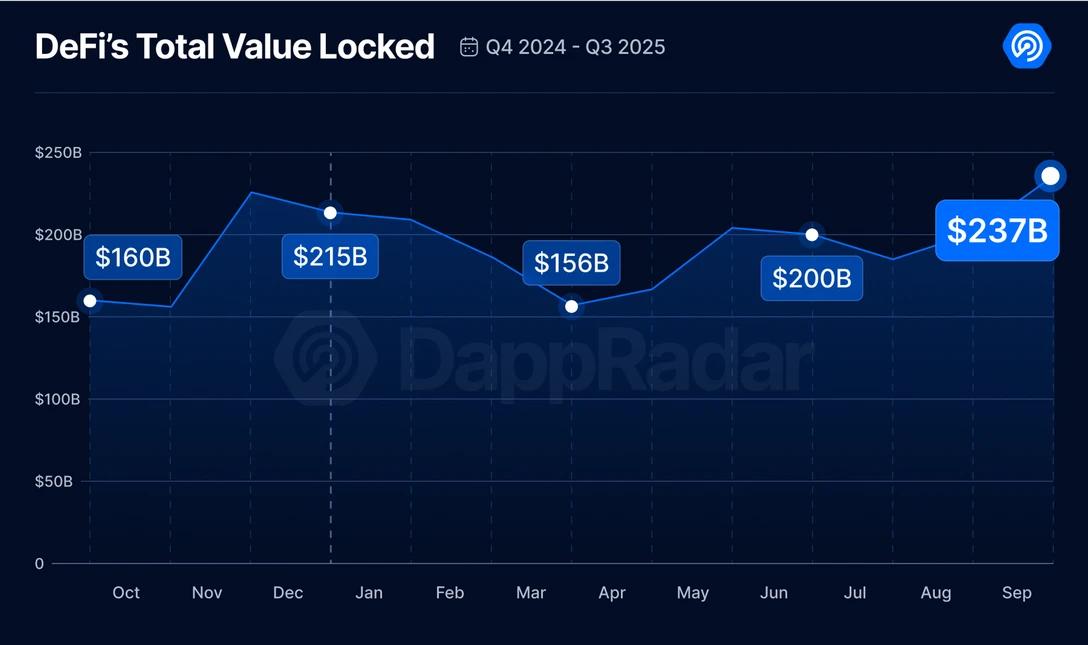
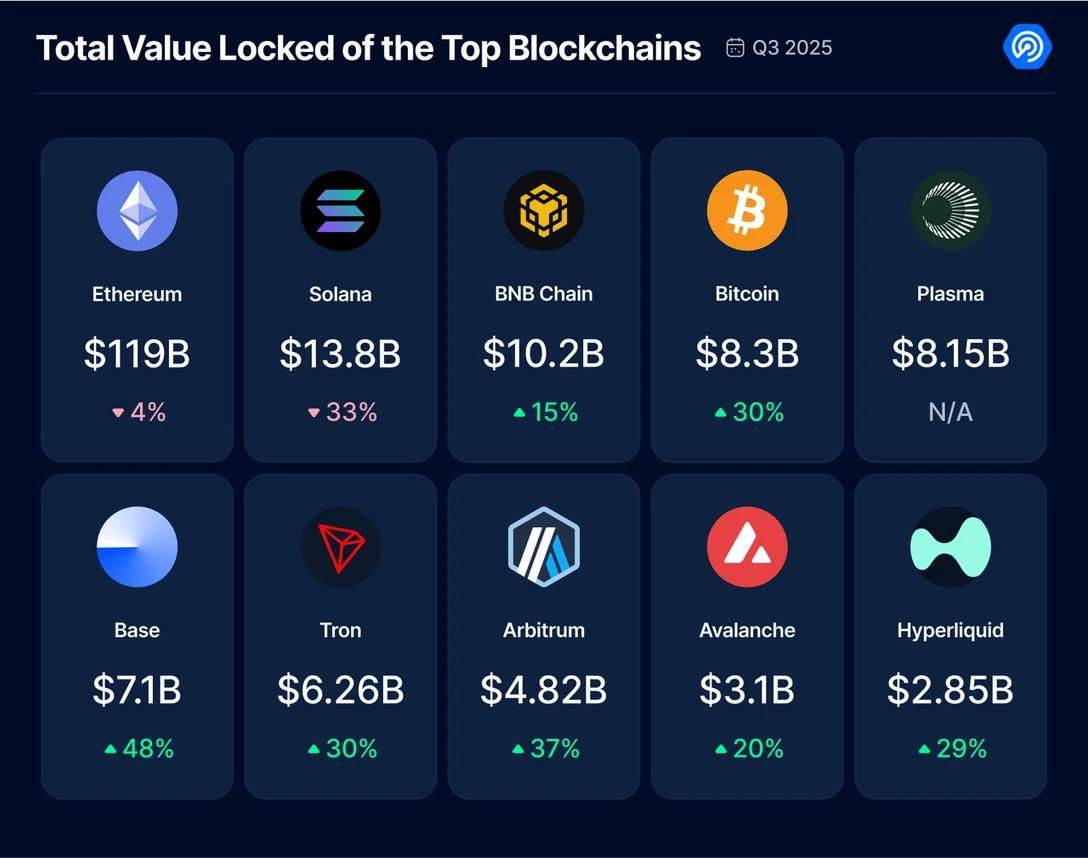
However, despite being a leader in the DeFi space, Ethereum failed to steal the spotlight in Q3. While Ethereum still maintained its lead with a TVL of $119 billion, its TVL still declined by 4%.
Solana managed to hold onto its second position but suffered the largest drop among the top 10 blockchains. Solana’s TVL fell 33% to $13.8 billion, primarily due to waning momentum around Pump.fun and Memecoin.
The situation for the other eight blockchains on the list is much more optimistic. BNB Chain's launch of Aster, a perpetual DEX, has caused a stir. Hyperliquid, designed for on-chain perpetual trading, has also been a hot topic over the past year, with its TVL increasing by 29% to $2.85 billion. This is a trend that has been evident this quarter: DEXs are gradually becoming as feature-rich as CEXs.
3. NFT sales hit a new high since 2022
Due to the low prices of many NFTs today, transaction volume decreased slightly. However, the number of transactions increased in 2025. Seven million NFTs were sold in the first quarter, reaching 12.5 million in the second quarter. This upward trend continues. In the third quarter, the market recorded sales of over 18.1 million NFTs, generating $1.6 billion in transaction volume.
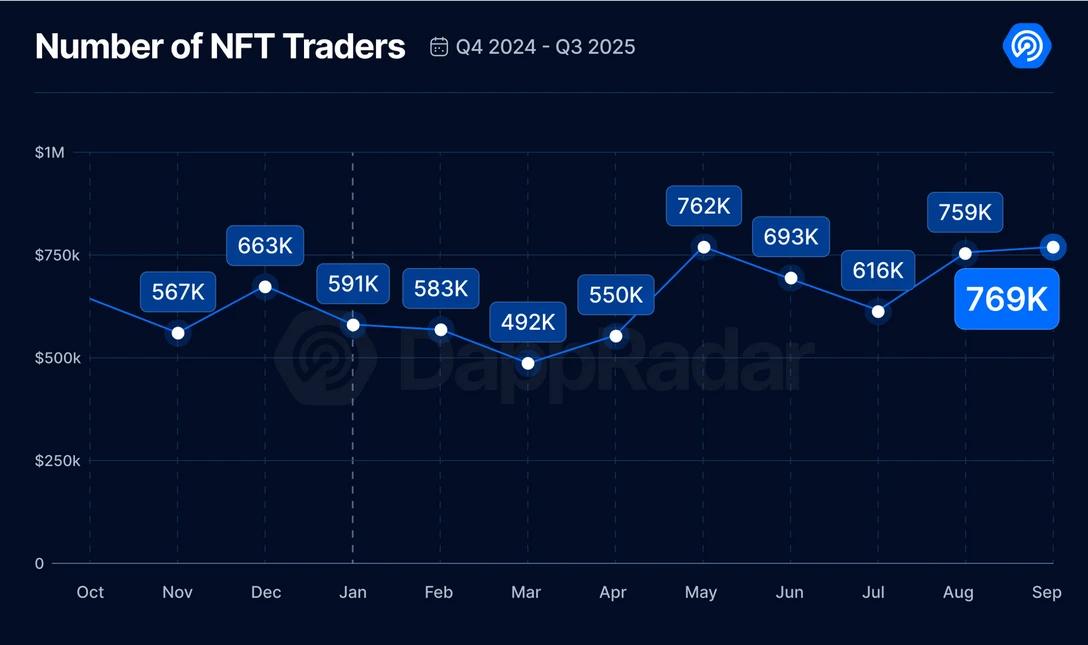
The increase in sales has not been reflected in actual usage. Although the number of NFT traders reached its highest monthly number in 12 months, the increase was minimal compared to the number of sales.
In the first quarter of 2025, 1.66 million wallets traded NFTs. During the same period, 7 million NFTs were recorded as sold, meaning an average of 4.2 NFTs were traded per wallet. In the third quarter, 2.14 million wallets traded 18.1 million NFT assets, meaning an average of 8.4 NFTs were traded per wallet.
Between the two quarters, sales increased by 158%. However, the number of wallets only grew by 28.6%. This indicates strong support from existing players rather than a massive influx of new users.
The only NFT category to experience a decline was gaming. Over the past quarter, gaming NFT transaction volume decreased by 17%, while the number of units sold decreased by 32%. In contrast, sports NFT transaction volume increased by 337% to $71 million, while the number of units sold increased by 143% to 4.1 million.
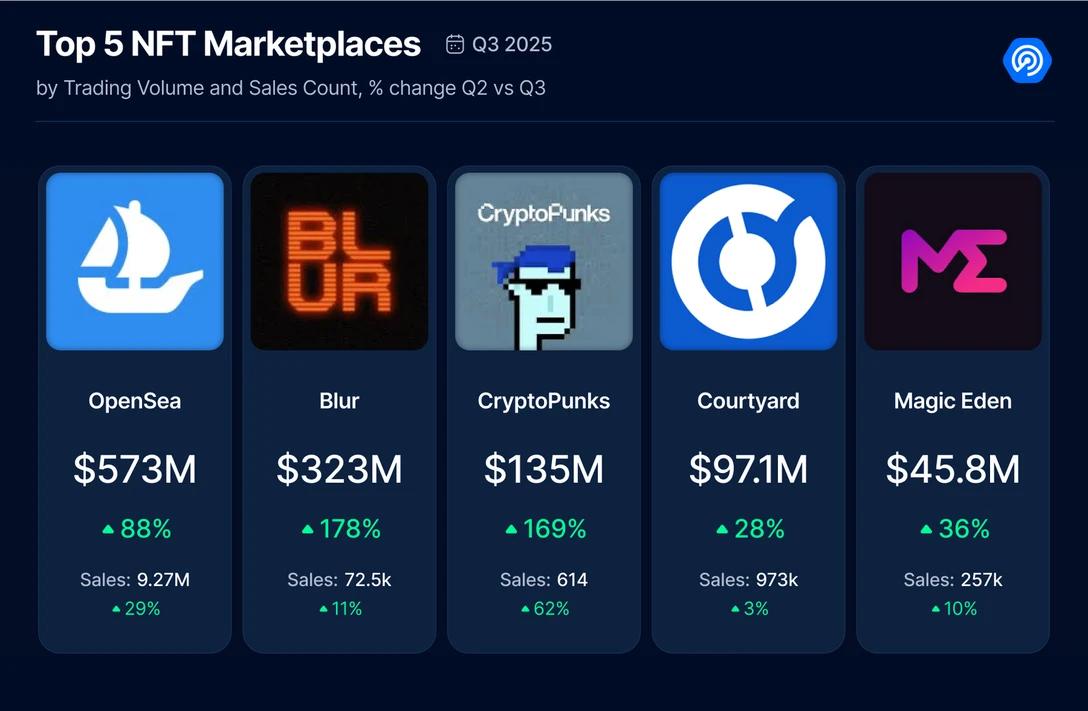
The surge in trading volume was also driven by several developments. For example, OpenSea launched a campaign for its upcoming token, rewarding the most active traders on its platform. This led users to begin trading low-value NFTs to meet daily standards. OpenSea managed to increase its sales by 29% to 9.27 million assets.
Meanwhile, PFPs (personal NFTs), led by CryptoPunks, Moonbirds, BAYC, and Pudgy Penguins, have garnered attention. PFP transaction volume increased 187% quarter-over-quarter to $544 million. While CryptoPunks remains the holy grail for NFT collectors, Pudgy Penguins is evolving into a Web3-integrated entertainment brand encompassing gaming and other forms of entertainment.
Yuga Labs, the company behind Bored Ape Yacht Club, sold some of its assets to focus on BAYC, MAYC, and Otherside. This brought some new life to the Bored Ape community. However, they also sold Moonbirds.
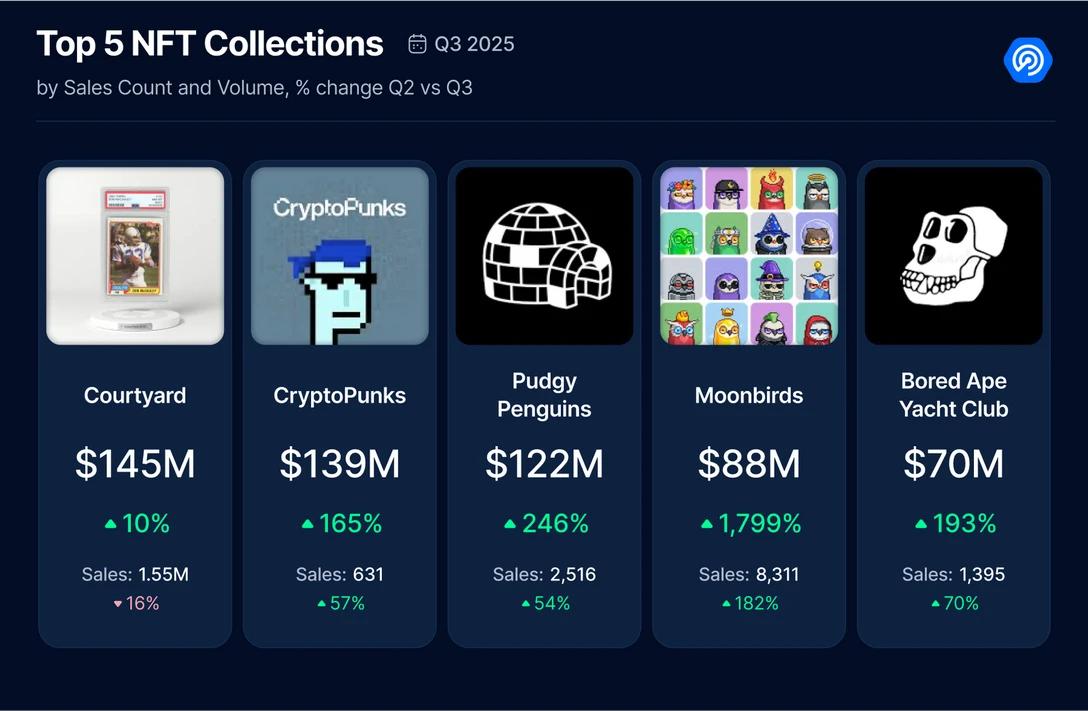
Moonbirds was a standout project this quarter, with 8,311 NFTs sold and $88 million in trade volume. The Moonbirds IP is now owned by Orange Cap Games, which announced plans to bring the BIRB token to Solana in the first week of October.
Putting aside the data, the real change is happening quietly. NFT is far more than a JPEG picture of a monkey. It is integrating with the emerging RWA trend and DeFi.
A leading NFT platform is Courtyard, which tokenizes physical collectible cards and sells them as NFTs on the blockchain. Each NFT on Courtyard is a tokenized physical trading card, such as a Pokémon or baseball card. Users can trade digital versions of their collectibles or redeem them for physical cards. In Q3 alone, Courtyard sold 1.55 million items, generating over $145 million in transaction volume.
September saw the emergence of a new trend: NFT microstrategies. Token Works launched PunkStrategy, an automated protocol concept for buying and selling CryptoPunks. Users acquire PNKSTR tokens, and 10% of transaction fees goes into a funding pool. Once the protocol raises enough funds, it purchases the cheapest CryptoPunks and lists them for sale at a 20% premium over the purchase price.
When a CryptoPunk is sold on the open market, the protocol uses the ETH obtained to purchase PNKSTR from the market. These tokens are then destroyed and removed from circulation. Therefore, PNKSTR becomes a way to get exposure to CryptoPunk without purchasing expensive NFTs.
NFTs are no longer just about collectibles. These digital assets can represent ownership of physical assets and can also become part of automated DeFi protocols.
4. Hacker threats continue, with $ 434 million stolen
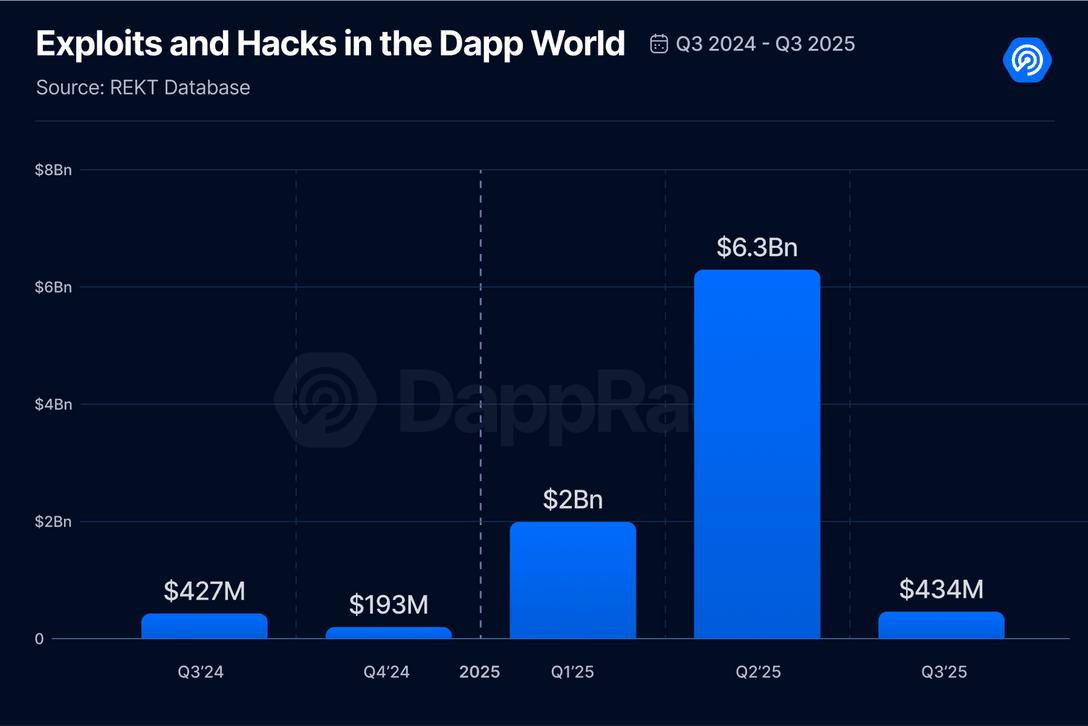
In Q3, hackers stole over $434 million worth of cryptocurrency. The largest attacks involved social engineering and vulnerability exploits. In July, a hacker exploited a malicious contract in GMX V1 to manipulate internal accounting safeguards, withdrawing more funds than they were entitled to, resulting in a $42 million loss. A few days later, CoinDCX lost $44 million due to a server compromise.
Most recently, in September, the social project UXLINK suffered a multisig vulnerability attack, resulting in the theft of $21.7 million worth of assets. Furthermore, the hacker obtained unauthorized minting rights and issued 1 billion UXLINK tokens. A subsequent sell-off caused the token's value to plummet 70%. Ironically, the hacker later lost $48 million worth of tokens in a phishing attack.
The second-largest event of Q3 was the hack of the Turkish exchange BTCTurk. However, the largest incident was a single victim who lost 783 Bitcoin (approximately $91 million) through a social engineering scam. The attacker deceived the victim by impersonating exchange and wallet customer service representatives. Details are unknown, but with the rise of AI tools, such attacks appear more likely.
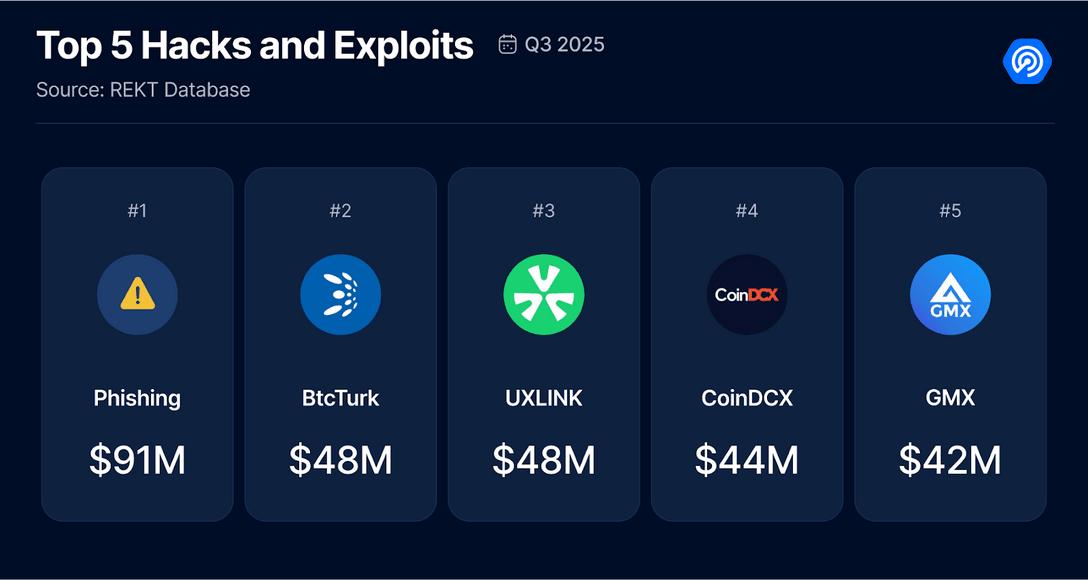
These five incidents accounted for the majority of stolen funds in Q3. With $434 million stolen, the intensity of attacks appears to have decreased this quarter. However, with the tokenization of real-world assets, the rise of more advanced DeFi functionality, and institutional adoption of stablecoins, it's certain that crypto wallets will remain a target for scammers and hackers. Recent reports of zero-click vulnerabilities in iOS and WhatsApp highlight the need for crypto users to remain vigilant.
Conclusion
Q3 demonstrated the resilience and adaptability of DApps in the ever-changing crypto market. Despite a decline in daily active wallets and challenges in the SocialFi and AI sectors, DApps continued to make steady progress and achieved significant milestones. DeFi's TVL hit a record $237 billion, demonstrating strong growth and growing interest from institutional investors, particularly in stablecoins and tokenized assets.
The NFT market saw sales surge to 18.1 million, highlighting its evolving role beyond collectibles to merge with DeFi and real-world assets. Gaming still dominates.
Dapps are gradually touching the lives of everyday users seeking financial services, fun games, or rare Pokémon cards. Currently, the number of active wallets is in the millions, but will soon reach billions.
Related Reading:August Dapp Report: On-chain activity cools down, while NFT continues to recover






