Author: Lucas Tcheyan, Source: Galaxy Digital , Translated by: Jinse Finance
Introduction
Solana entered 2025 with steady confidence. Having shaken off the shadow of the FTX crash, it made a remarkable comeback during the 2024 Memecoin craze, solidifying its cultural standing and re-establishing itself as a leading high-performance general-purpose blockchain.
Today, the network faces a different challenge: how to translate this dominance into lasting market influence. The initial speculative frenzy has evolved into a phase of sustained technological and economic integration. Solana's core developers have leveraged this momentum to strengthen the network infrastructure, while the ecosystem team is working to translate active market activity into lasting economic depth.
Solana's recent trajectory is less a rebound and more a transformation, characterized by a mature technological architecture and the ability to translate speed into sustained economic impact. Today, the network is evolving toward a broader vision of an "Internet Capital Market," building a system capable of supporting a full range of digital financial activities, from retail speculation and consumer applications to enterprise-grade infrastructure and the tokenization of Real-World Assets (RWAs).
This evolutionary process is supported by three mutually reinforcing dynamic factors:
Technical resilience : A maturing core architecture characterized by stability and continuous performance improvements to help the network outperform Web2 and traditional financial benchmarks.
Economic drivers : The accelerated growth of on-chain activity is reflected in record-breaking decentralized exchange (DEX) trading volumes, network and application fee revenues, and stablecoin circulation velocity, all of which will translate into real network value.
System Integration : Integrate Solana's technical architecture, market microstructure, and developer ecosystem into a unified framework to support internet-scale financial activities.
The following report explores how this integration is reshaping Solana's role in the broader blockchain economy. It traces the evolution of the Solana network at both the validation and consensus layers, including the redesign of its execution and fee structures, as well as changes in on-chain activity dynamics, covering everything from DEX and perpetual futures trading volumes to stablecoin liquidity, staking, and institutional participation. In summary, these developments highlight how Solana's technological ambitions and economic momentum mutually reinforce each other, positioning it as a leading force driving the development of emerging internet capital market architectures.
Key Takeaways
Solana is moving toward its Internet Capital Markets (ICM) vision, with upcoming upgrades such as Agave 3.0, Firedancer, and Alpenglow expected to significantly improve bandwidth, reduce latency, and optimize validator performance.
Iterative improvements to the validator architecture, including scheduler optimization, higher computational unit (CU) limits, and runtime efficiency enhancements, have improved network stability and large-scale throughput.
Solana's ongoing development in networking (DoubleZero), execution (ACE and APE), and consensus (Alpenglow) enables it to support low-latency, high-frequency market infrastructure suitable for both consumer and institutional use cases.
Solana maintains one of the highest staking ratios in the cryptocurrency space (approximately 75% of circulating SOL), but the adoption of its Liquidity Staking Token (LST) remains limited, accounting for only about 6% of staked SOL, highlighting untapped potential in terms of capital efficiency.
Solana leads all blockchains in economic activity, ranking first in DEX trading volume, network fees, and application-generated fees, but it still lags behind in total value locked (TVL) and stablecoin supply, reflecting its fast money turnover but low long-term money retention.
The perpetual contract market on Solana has seen growth, but it still lags behind off-chain trading platforms and Hyperliquid, the leading trading chain in the space. Jupiter and Drift remain the leading perpetual contract platforms on Solana, while new entrants are focused on gaining market share through innovative, high-performance designs that integrate validators.
The Meme coin cycle spawned token issuance platforms such as Pump.Fun, which standardized on-chain issuance and retail participation. Second-generation platforms such as MetaDAO, Metaplex, and Believe expanded token issuance from speculation to the realm of creator and corporate financing.
Institutional adoption is accelerating: Since June, over $90 million worth of stock has been tokenized on Solana, with transfers exceeding $1 billion, highlighting the network's growing role as a venue for tokenized RWAs.
The continued growth momentum of developers remains a key moat, with Solana being named the preferred ecosystem for new developers in 2024, and the number of active contributors increasing by 83% year-on-year.
Digital asset treasury companies (DATs) have emerged as a new source of institutional demand for SOL. Currently, there are 18 active Solana DATs, holding approximately 18 million SOL (about 3.1% of the total supply), integrating functions such as treasury reserve management, staking, and validator participation.
Solana exchange-traded funds (ETFs) are expected to launch soon (translator's note: they are already launched) and may offer staking functionality from the outset. These products will significantly expand participation channels for institutional investors and solidify Solana's position as a core digital asset.
I. Technology Roadmap
Solana's developer community is working to upgrade its technical architecture to continuously improve network performance across all aspects of the blockchain. This upgrade primarily addresses two needs. First, "Increased Bandwidth and Reduced Latency (IBRL)" aims to differentiate Solana from other blockchains, meeting or even surpassing Web2 and traditional financial standards. Second, it improves Solana's market microstructure, enabling any application to build itself on Solana without worrying about its users competing with users of other applications for block inclusion rights or priority.
The continuous iteration and improvement of Solana's underlying technical protocol is not a flaw, but a characteristic. This demonstrates that Solana understands its long-term success is far from guaranteed and that the chain operates in an increasingly competitive environment where other chains are vying to surpass it. As Anza Labs, which maintains Solana's main validator client, stated in its 2025 roadmap release: "Complex systems are not optimized by a single magic fix, but by the accumulation of thousands of tiny improvements."
1. Agave client update
Agave is the primary validator client for Solana, managed by the Anza team and forked from the initial validator client at Solana Labs. Anza was formed by members of the Solana Labs team with the aim of building an improved Solana validator client, released in early 2024. Agave 2.0, released in November 2024, was a fundamental update to the previous Solana Labs validator client code, significantly optimizing the codebase. By 2025, Anza had released three updated versions of the Agave client: 2.1, 2.2, and 2.3. As stated in Anza's 2025 roadmap, these updates focused on "increasing bandwidth and reducing latency… to maintain Solana's competitiveness." The improvements primarily focused on several key elements of the Solana technical architecture, including transaction scheduling, block propagation, data storage, and hash performance.
One of the most critical components in the optimization efforts is the Transaction Processing Unit (TPU) scheduler, which manages how validators order and process transactions. Previously, this had been a bottleneck for improving network throughput. Over the past year, Agave developers introduced a smarter scheduling algorithm called the "greedy scheduler," prioritizing high-value transactions. Simultaneously, Solana's block propagation protocol, Turbine, has been improved, increasing network propagation efficiency. This is crucial because as block sizes increase with CU limits (see below), efficient propagation ensures validators remain synchronized, guaranteeing a smooth user experience.
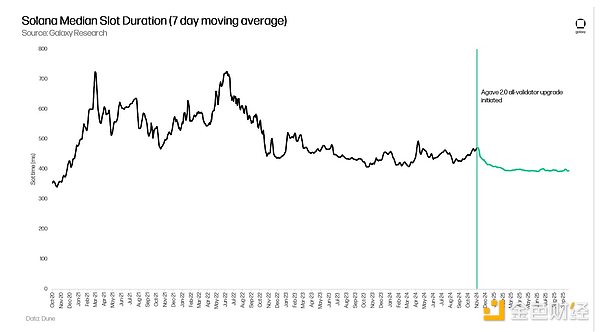
Since the release of Agave 2.0, Solana's slot times have stabilized significantly, with the median slot duration consistently reaching the network target of 400 milliseconds, marking an improvement for Solana. Currently, Solana is working to improve execution overhead, such as leveraging state caching to speed up transaction lookups; optimizing the block storage insertion mechanism to handle higher data throughput more efficiently; and deploying faster hash algorithms (such as ahash) to replace the slower default algorithm. These updates collectively enhance Solana's ability to handle continuously increasing throughput while maintaining low latency and high reliability.
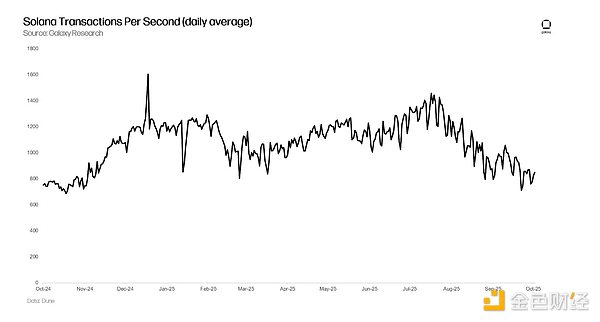
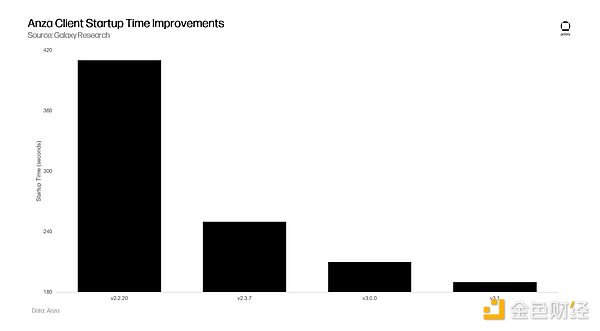
Agave client 3.0 was launched on the testnet in August and is expected to launch on the mainnet in the fourth quarter. Agave 3.0 includes preparations for Alpenglow, an update to the Solana consensus protocol (see below), which reduces transaction final confirmation time from approximately 12.8 seconds to approximately 150 milliseconds. This update also introduces comprehensive improvements to the caching mechanism, increasing transaction processing speed by 30-40%, and expands computation and cross-programming invocation (CPI) limits while relaxing entry restrictions, thereby increasing activity and laying the foundation for asynchronous execution. Furthermore, validator restart time has been reduced to approximately 3.5 minutes through snapshot and recovery optimizations. All these improvements collectively enhance Solana's parallelism, performance, and operational resilience.
2. AlpenGlow
Alpenglow is a major update to the Solana consensus protocol, which Anza calls "the biggest change to the Solana core protocol ever." It was developed by researchers at ETH Zurich (a Swiss university) who pointed out potential vulnerabilities in the Solana consensus design in 2024. Following their research, the Anza team invited them to develop an improved consensus mechanism to address the issues they discovered. The validators approved the Alpenglow update on September 2nd, and the developers aim to deploy it to the Solana mainnet in early 2026, potentially as early as the community's annual Breakpoint conference in December.
Solana's consensus mechanism combines two key mechanisms: Proof-of-History (PoH) and TowerBFT. PoH acts as a decentralized clock, generating a verifiable sequence of hashes that timestamp transactions and determine their order. TowerBFT, based on this timeline, allows validators to vote on whether to include a block, progressively locking their choices and ensuring security and finality once enough votes are accumulated. PoH provides a clock for Solana's global validator set, while TowerBFT enforces consensus and prevents forks. Alpenglow introduced two major upgrades: Rotor and Votor. Rotor revolutionized block propagation by upgrading Solana's multi-hop Turbine design to a streamlined single-hop model. Staking relay nodes directly distribute blocks to all validators, reducing latency, simplifying data propagation, and laying the foundation for future bandwidth incentive mechanisms.
Votor replaces TowerBFT and PoH in finality verification with an off-chain voting system. By eliminating the need for on-chain voting, Votor improves Solana's architecture. More importantly, it reduces the cost of running validators on Solana. Under Solana's current architecture, validators are required to submit a voting transaction for each block, resulting in a daily cost of approximately 1 SOL, severely impacting validator profitability. Under Alpenglow's latest design (which may change before release), validators now only need to submit a "Validator Admission Ticket (VAT)" once per epoch (approximately 2 days on Solana), costing 1.6 SOL. This equates to a reduction of approximately 20% in the operating costs incurred by validators due to voting transactions. These fees will be fully burned, whereas currently only 50% of voting fees are burned, helping to offset SOL inflation. While this is currently only a small reduction, Anza team members have stated that they plan to explore further methods to reduce VAT costs after Alpenglow's implementation.
Furthermore, Alpenglow addresses a long-standing issue of validator misconduct. Some Solana validators intentionally wait slightly longer than the target duration of 400 milliseconds. They do this to increase the number of transactions available for selection, thereby earning more rewards per block. While the Solana protocol doesn't explicitly prohibit this practice, it does slow down the network. By introducing a "skip vote" feature, Alpenglow will allow validators to vote to skip blocks that take too long to propagate, thus proactively suppressing this "time game." Continuous updates to the computation unit limit (see below) also help improve validator profitability, reducing their incentive to intentionally delay.
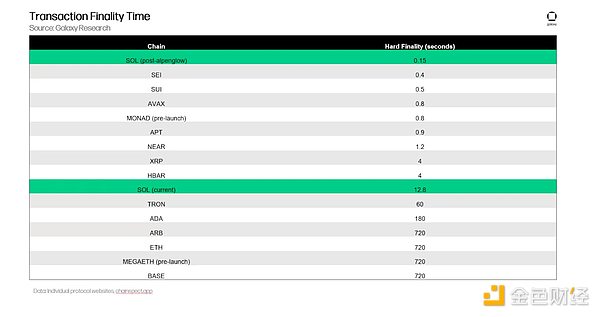
Votor offers two parallel voting mechanisms: fast final confirmation and slow final confirmation. Fast final confirmation requires 80% or more stake in the first round of voting to approve a block, while slow final confirmation only requires 60% or more. Validators will be incentivized to use fast final confirmation certificates, potentially introducing another source of rewards, but the specific economic/reward mechanism is yet to be determined. The elimination of on-chain voting computation overhead, coupled with improvements in block propagation, significantly improves Solana's block final confirmation speed from 12.8 seconds to 100-150 milliseconds (depending on whether fast or slow final confirmation is used). This will make Solana one of the fastest final confirmation blockchains, further advancing its ability to achieve application user experiences comparable to Web2 and traditional finance.
Alpenglow also improved Solana's security model, abandoning the common fault-tolerance mechanism that targets the 33% stake held by malicious validators. Instead, Alpenglow adopted a "20+20" approach, ensuring the network can withstand disruptions even if 20% of the stake is controlled by malicious actors and another 20% cannot participate in consensus for non-malicious reasons.
Alpenglow presents both an advantage and a challenge for Solana. This upgrade enhances network fault tolerance, improves final confirmation speed from seconds to sub-seconds, and lowers the barrier to entry for validators to participate and profit. These improvements collectively solidify Solana's position as an institutional-grade blockchain, making it more suitable for financial and consumer applications, enterprise use cases, and developers building time-sensitive transaction infrastructure. Faster final confirmation reduces settlement risk and gives market participants greater confidence that transactions are virtually instantaneous and irreversible.
However, upgrading consensus mechanisms is inherently delicate. Changing the core of the network's technical architecture poses a significant risk to network stability. Given Solana's previous outages, the Anza team is well aware of this risk and has built a strong reputation over the past year through a series of successful Agave releases, each significantly improving performance without compromising stability. These successes are reassuring, but they do not eliminate the complexity of future challenges.
If successfully implemented, Alpenglow's actual importance is comparable to Ethereum's merge upgrade in 2022. It will solidify Solana's ability to continuously innovate and maintain stability at the consensus layer, and could play a decisive role in its status as a high-performance blockchain, enabling its adoption by large-scale institutions.
3. Firedancer
As mentioned in our previous Solana update, Firedater is the second Solana validator client that Jump Crypto is developing. The team is building a completely new Solana validator client from scratch, written in C++ instead of Rust. From a performance perspective, Firedater focuses on improving Solana's throughput and efficiency, aiming to enable the network to process over 1 million transactions per second (TPS), far exceeding the current peak average of approximately 2000-4000 TPS. It achieves this goal by optimizing the code to better utilize hardware resources, reduce latency, and accelerate block finalization.
The addition of Firedancer is a key step in improving the stability of the Solana network, reducing its reliance on a single client. Currently, the vast majority of Solana's validator nodes run the Agave client, meaning that a single vulnerability or flaw could trigger widespread outages. By adding Firedancer, a separately built client, the network can reduce the risk of cascading failures, similar to how Ethereum benefits from multiple production-grade clients.
Frankendancer, a streamlined version of the Firedancer client, launched mainnet in September 2024 during the Solana community's Breakpoint conference. Because Firedancer employs incremental development, some components of the protocol have not yet been fully rebuilt. To bridge this gap, Frankendancer runs Firedancer's key systems, including high-performance networking, block distribution, signature verification, and block packaging, while relying on Agave to provide the runtime environment and other unfinished features. Although still in an iterative phase, the client has already demonstrated impressive performance. In August of this year, a Solana validator node using the Frankendancer client generated a series of blocks with a TPS exceeding 100,000.
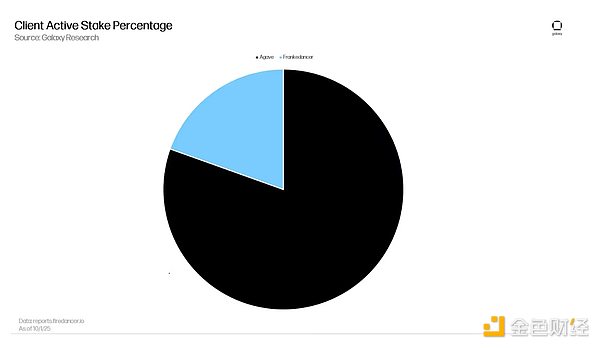
Frankendancer's initial adoption was slow, partly due to its lack of integration with the Jito blockchain engine, which allows validators to earn MEV rewards. In April 2025, Jito was integrated with the client, and the Firedancer team launched a staking delegation program, leading to increased adoption. Currently, over 20% of active staking transactions run on Frankendancer. The Firedancer team states that 20% is the current upper limit for adoption, and they will continue to review and test the client to ensure it doesn't introduce any issues.
The development of Firedancer was not conducted in isolation, which presented the team with numerous challenges. First, Firedancer had to be compatible with existing Anza clients to ensure they could work together. As mentioned above, the Anza team continuously and rapidly updates its validator client. Therefore, the Firedancer team's goals were constantly evolving. Consequently, the development work on Firedancer over the past few years has primarily focused on compatibility with Anza clients. For example, Firedancer significantly optimized Solana's PoH and Tower BFT mechanisms. With the launch of Alpenglow, these mechanisms may no longer be applicable when Firedancer goes live on the mainnet. Furthermore, if validators running Anza clients cannot keep up, even if Firedancer's performance improvements surpass those of Anza clients, it will be meaningless and may even put pressure on other participants in the block building process, such as Remote Procedure Call (RPC) providers. The Firedancer team must keep these constraints in mind while striving to improve network performance.
One often overlooked aspect of this rollout is the interaction between Firecanver and Anza. While each team focused on driving adoption of their respective clients, they also ensured interoperability, creating a healthy competition. This competition spurred teams to iterate faster, as evidenced by Anza's rapid release pace in recent months, while also allowing both sides to benefit from each other's innovations. In fact, this dual-client environment enhanced Solana in two ways: it improved technical robustness while fostering a culture of accelerated innovation.
The full release and adoption of Firedancer will be a significant milestone in Solana's development, making it one of the few Layer-1 blockchains, besides Ethereum, that supports multiple independently developed validator clients. This redundancy mechanism not only enhances network resilience by reducing single-client risk but also significantly improves the performance of the entire validator architecture.
4. SOL staking and issuance
Pledge
Solana has consistently had a very high staking rate, with 68% of its total supply (75% of the circulating supply) currently staked. This is thanks to its lack of minimum staking requirements, a fast unstaking period of about 2 days, attractive staking yields of 5%-10%, and a user-friendly wallet infrastructure that is easy to use even for the least tech-savvy participants.
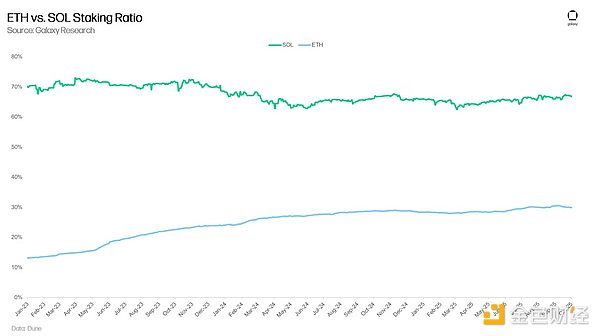
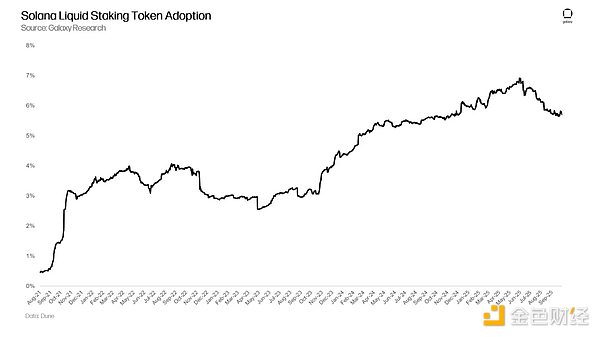
However, the high staking rate has not yet translated into a corresponding LST adoption rate, which limits Solana's on-chain productivity. Only about 6% of staked Solana is deployed in LST. This pales in comparison to chains like Ethereum, where 35% of staked ETH is deployed in LST (although only 30% of ETH is actually staked). It is precisely the benefits of Solana's high staking rate that are hindering the rapid adoption of LST.
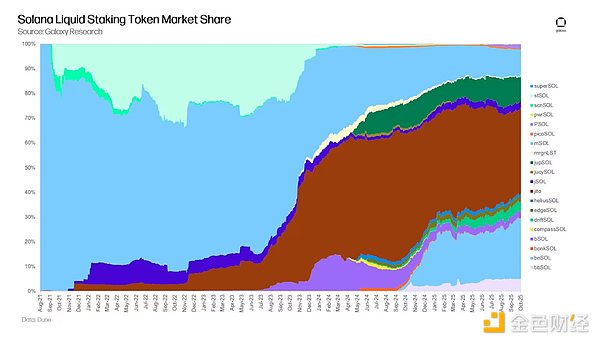
JitoSOL remains the dominant LST in the Solana ecosystem, accounting for more than one-third of the total LST supply. Jito provides Solana with the most widely used MEV block-building infrastructure; over 90% of SOL is staked to validator clients using the Jito block builder. Binance's SOL staking token, bnSOL, has seen a surge in users over the past year, with its market share growing from 2% to 24%. However, this has not had a significant impact on SOL deployment within the ecosystem, as most bnSOL is utilized by Binance CEX users who do not deploy LST on-chain. This is particularly evident on Kamino, Solana's largest lending market, where bnSOL trading volume is only $12,000, while JitoSOL's total trading volume is close to $500 million.
Driving the adoption of LSTs remains a key focus for core developers and application teams, aiming to increase the total amount of SOL available for effective use across the ecosystem. Digital asset treasury companies focused on Solana and the Solana ETF (see below) are recent positive factors driving staking and LST adoption. Currently, several Solana digital asset treasury companies have partnered with LST providers or launched their own SOL LSTs to attract users to stake on their validator nodes and increase the yield on their SOL holdings through DeFi deployments.
SOL Inflation Rate and Staking Rewards
Solana's base inflation rate (the annual supply increased through staking rewards) is approximately 4.2%. This inflation rate is scheduled to decrease by 15% every 180 cycles (each cycle is approximately two days, so roughly one year) until it eventually reaches a minimum inflation rate of 1.5%. In addition to newly minted SOL, validators also receive rewards from base/voting fees, priority fees, and MEV. Therefore, the actual annualized staking yield (APY) is typically higher than the inflation rate, averaging approximately 6.5% over the past 90 days and nearly 8% year-to-date.
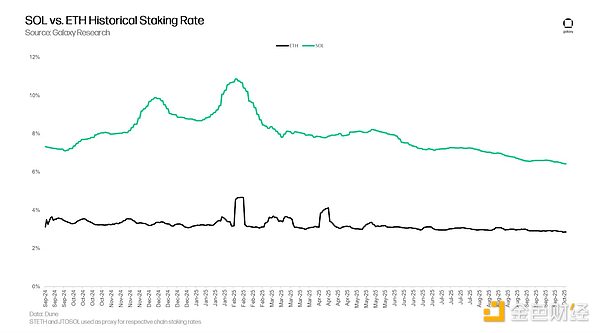
Over the past year, the annualized yield (APY) of SOL staking has remained stable between 6% and 8%, peaking during periods of high market activity. Inflation, coupled with rewards for on-chain activity, has kept Solana's staking rate higher than Ethereum's. However, this high staking rate driven by inflationary rewards has sparked intense debate within the community. In March of this year, Solana validators rejected the SIMD-0228 proposal, which aimed to make SOL's issuance rate dynamic. Solana's improvement document proposed adjusting SOL's inflation rate based on the proportion of SOL staked on the network. Lower staking ratios would increase the issuance of SOL, while higher staking ratios would decrease it. At the current staking level of approximately 67%, this model would reduce Solana's inflation rate by more than half.
Inflation rewards are the initial launch mechanism for Proof-of-Stake (PoS) ecosystems, designed to attract validators to join and maintain network security. A stable and predictable inflation rate is crucial to ensuring validators can make long-term operational plans. However, as these networks mature, inflation should not be the primary incentive mechanism. It can be replaced by rewards based on real economic activity, such as base fees and priority fees, as well as non-malicious forms of MEV. High staking ratios artificially raise the barrier to entry, thus dampening enthusiasm for DeFi activity. This is particularly important for Solana, which, despite its active on-chain activity, has made slow progress in DeFi applications.
Although the SIMD-228 proposal ultimately failed to pass, its near-passing underscores the possibility that SOL inflation scenarios are not static. (The proposal garnered strong support early in the voting, but a late surge prevented it from securing the required absolute majority.) For example, in April, Galaxy Research submitted a proposal suggesting maintaining SOL's final inflation rate of 1.5%, but allowing validators to vote on the future deflation rate (i.e., the rate at which inflation slows, currently at 15%). More proposals are expected in the coming year, particularly given the continued strong activity at the Solana application level, which will reduce the need to provide economic incentives through inflation.
5. Limitations and efficiency of block computing units
Calculation unit limits
Solana implemented two new Solana Improvement Documents (SIMDs) this year aimed at increasing the limits on the Block Computation Unit (CU). The block CU limit represents the maximum amount of computation that a single block can complete, similar to Ethereum's gas limit. It also serves as an objective measure of time, with the optimal CU limit equal to the time required for validators to receive, place orders, and execute a block (approximately 400 milliseconds in the current time slot).
Increasing the block CU (Computation Unit) cap is one way to increase transaction throughput by increasing the total computation that validators can include in a block. This allows the network to process more transactions or handle more complex operations in each block, thus helping to reduce congestion during peak periods and lower average transaction fees. Currently, other block size variables, including the maximum writable account unit, maximum voting unit, and maximum block account data size increment, will remain unchanged.
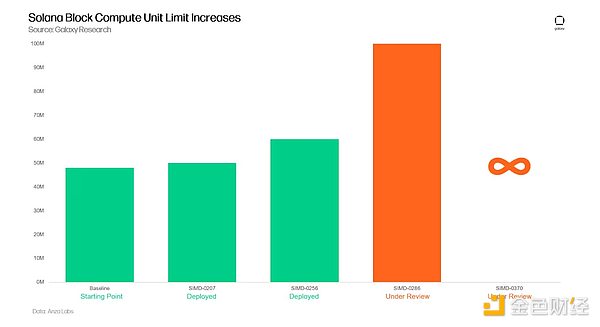
Solana launched in 2020 with a block size cap of 48 million compute units (CUs). In April of this year, Solana implemented the SIMD-0207 proposal, increasing the block size cap by 4% to 50 million CUs. Then, in July, Solana implemented the SIMD-0256 proposal, as part of Agave v2.2, further increasing the block size cap by 20% to 60 million CUs. Currently, another proposal, SIMD-0286, is under consideration, aiming to increase the block size cap by 66% to 100 million CUs, which would be the largest single increase to date. The testnet is expected to launch in the coming weeks, and the mainnet may launch in the fourth quarter with the Agave 3.0 update. It's even possible that the CU cap could be completely removed, as proposed in the recently released SIMD-0370 proposal. However, this idea remains controversial within the developer community.
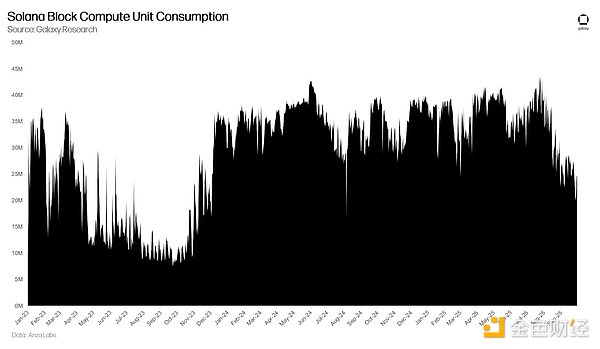
Besides improving network performance, increasing the block CU limit can also boost validator profitability. A recent study by validator service provider Rated suggests that doubling the CU limit to 100 million could increase the daily revenue of the top ten validators on Solana by 172 million to 460 million SOL. This is a rough estimate, as simply increasing the CU limit does not guarantee that blocks will be fully packaged in situations of insufficient network demand, nor does it guarantee that transaction fees will remain constant as the block supply increases. As shown in the graph above, despite recent increases in the CU limit, the number of CUs per block remains around 40 million. However, validators can expect to earn even more if these limits begin to be fully utilized.
At the same time, increasing the CU cap also presents some operational challenges. Currently, raising the CU cap to the recommended level primarily requires software optimization so that validator nodes can handle the increasing computation and block propagation demands. To date, upgrades have been kept within safe limits to avoid negatively impacting the existing technology stack, and auxiliary service providers have updated their systems to keep pace. However, in the long term, if block capacity grows too rapidly, validator nodes may need to upgrade their hardware to handle the increased computational load, and RPC providers and centralized exchanges (CEXs) will also need to keep up. Another bottleneck is block distribution: ensuring that complete blocks are delivered from the leader node to other nodes in the cluster in a timely manner. The Anza team is addressing this issue by introducing a network enhancement called XDP to optimize block propagation and ensure that block packaging prioritizes critical resources while avoiding network overload (as described in the Alpenglow section above).
Computational unit efficiency
In addition to increasing the CU limit, Anza is also optimizing CU efficiency to increase the number of transactions that can be included within a given CU limit. In early 2025, Anza released the Pinocchio library, a streamlined Solana development framework optimized for CU. Think of it as an efficient guide to developing Solana blockchain applications. Written in a clean and lightweight style, it eliminates redundant code, thus speeding up application execution and reducing Solana's computational resource consumption. The Pinocchio library replaces the original Solana Library (SPL), helping developers build smoother, more efficient applications and avoiding slowing down network speeds.
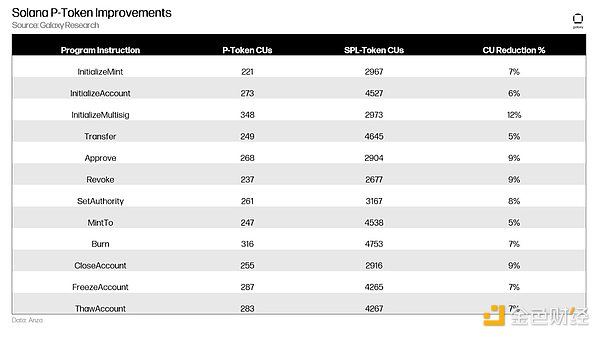
To support this effort, Anza developers are working on P-token, which utilizes the Pinocchio library to implement a new token procedure. P-token can reduce the computational resource consumption of program calls by more than 90%. An audit by Neodyme revealed that during a week-long test in August, using P-token reduced total CU usage by approximately 12%.
These upgrades collectively highlight two complementary strategies. On one hand, Solana expands the block space supply by increasing the CU limit, enabling each block to hold more transactions. On the other hand, Anza simultaneously improves block space utilization efficiency through tools such as the Pinocchio library and the upcoming P-token program. This two-pronged strategy means that Solana not only expands the original capacity but also ensures that each unit of capacity is utilized more efficiently.
6. Internet Capital Market Infrastructure
Over the past year, advancements in the Solana network architecture have significantly improved the overall chain performance. However, this has also exposed some constraints within the system that need to be addressed, and these constraints are crucial for Solana to realize its vision of an "Internet Capital Markets." Specifically, in addition to IBRL, Solana's core and application developers are currently working to improve Solana's market microstructure. As outlined in Solana's "Internet Capital Markets Roadmap" released in July, these updates focus on: making Solana the most liquid market platform globally; reducing transaction confirmation times and improving transaction finality; building a geographically decentralized validator set that does not impact network performance; and implementing Application Control Execution (ACE).
The above has described some of the updates required to realize this vision, including updates to the Anza client, the introduction of Firecanver, and the launch of Alpenglow. Other updates/integrations under development include:
DoubleZero
DoubleZero is a next-generation communication infrastructure built specifically for blockchains, bypassing the public internet to provide faster, more reliable connections between validators. Instead of routing messages through traditional, unpredictable internet paths, DoubleZero operates on a dedicated network of fiber optic and network links optimized for high throughput and low latency. Its design aims to revolutionize how data is transmitted within the validator layer, thereby improving the efficiency of block propagation, voting, transaction delivery, and consensus coordination.
Key capabilities and innovations include:
Filtering : DoubleZero filters out redundant or invalid transactions before they reach the validator, thus reducing the burden on signature verification and avoiding wasted computing resources. In fact, duplicate traffic accounts for a large portion of inbound data; in some tests, approximately 75% of inbound transactions were duplicates.
Lower latency and jitter : DoubleZero reduces average message latency and jitter by replacing public internet paths with high-performance fiber optic cables. This allows for more precise consensus timing, faster vote propagation, and more compact time-slot scheduling.
Support for larger blocks : As Solana increases the CU limit per block, the block size (in bytes) also increases. On public internet paths, the distribution time for large blocks can be too long, impacting throughput. DoubleZero's bandwidth is designed to accommodate larger blocks, thus eliminating one of the obstacles to throughput scaling.
Expanding geographical coverage : Validators in regions with weak internet infrastructure (such as parts of Africa, Latin America, and Asia) often face latency penalties or network instability. DoubleZero's direct connectivity helps enable these regions to function properly as well, thus supporting broader decentralization.
Multicast routing : Multicast supports efficient one-to-many data distribution among validator nodes. Instead of sending the same data packet from one validator node to multiple nodes (thus avoiding bandwidth reuse) as in traditional methods, it allows a single data packet to propagate through the network and its branch paths, minimizing resource waste. In practice, this means that block data, votes, and transaction messages can reach all validator nodes faster, and redundant traffic is significantly reduced. Its advantages include reduced network load, reduced block propagation latency, and improved bandwidth utilization of validator nodes.
RPC and MEV infrastructure improvements : Auxiliary participants such as RPC and MEV providers, as well as searchers, can benefit from faster and more stable communication. For example, multicast routing and reduced bandwidth waste ensure more efficient transmission of transaction packets and data.
Validators using DoubleZero will be charged an initial fee of 5%, payable in SOL (Signal in Validation) and including validator block signing rewards and priority fees. After launch, if DoubleZero can prove that its use increases validators' Jito tips by 5%, an additional 5% fee may be charged on Jito tips. The team believes the performance improvements brought by DoubleZero will generate value far exceeding the cost of joining.
However, as with all new system integrations, the full adoption of DoubleZero by the Solana network poses a risk to Solana's resilience. A failure of DoubleZero could disrupt Solana's normal operation. DoubleZero has implemented several security measures to prevent this, such as a fallback mechanism for validators to the public internet in the event of a DoubleZero failure (this backup plan has been successfully tested). Nevertheless, Solana's developers remain cautious about relying on a network protocol architecture that is still in its early stages of development.
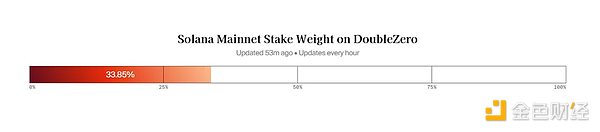
DoubleZero launched on the mainnet on October 2nd and has already attracted over 30% of the total Solana staking. Validators using DoubleZero will immediately experience performance improvements, regardless of the amount of staking on the network (thanks to the filtering advantages mentioned above). However, the key is that only when they obtain more than two-thirds of the Solana staking can the Solana core developers begin to improve protocol constraints, such as shortening slot times and increasing block sizes.
asynchronous program execution
Asynchronous Program Execution (APE) separates block voting from transaction execution, thereby reducing protocol latency. Currently, validators must validate and execute all transactions in a proposed block before they can vote on it. This creates a bottleneck because the execution process is computationally intensive and must be completed before voting and propagating the results to other validators. APE eliminates this requirement, allowing validators to vote only after confirming that the transactions are in the correct order and structurally valid—a much less resource-intensive process—while also allowing transactions to be executed asynchronously.
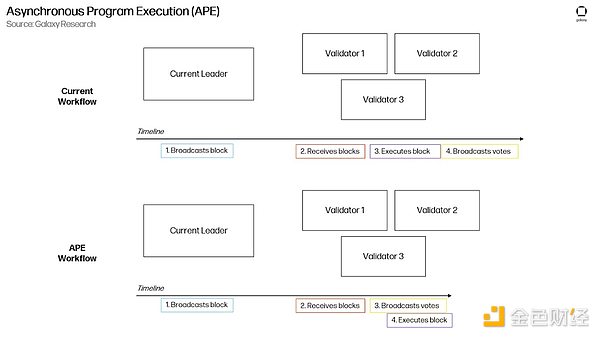
By offloading execution operations from the consensus critical path, APE can improve Solana's overall throughput and resilience under load. In the current synchronous model, computationally intensive transactions (such as those approaching or exceeding the 60 million CU limit) delay block generation, leading to missed block slots and network congestion during peak events such as high-profile token launches. APE aims to address this issue by allowing validators to reach consensus first, then utilizing available computational resources to process subsequent executions. While the effectiveness of this model depends on demand, the actual TPS can be boosted to near Solana's theoretical maximum of over 65,000 because the execution backlog can be processed asynchronously without disrupting the network.
Beyond performance improvements, APE also facilitates greater decentralization and validator access within the Solana ecosystem. Synchronous execution requires high-end hardware to keep up with real-time processing speeds, which benefits large operators. APE's lightweight consensus phase lowers these barriers, allowing even low-end hardware to participate. APE is still under development, with several key SIMD instruction sets (0159, 0191, 0192, 0290, 0295, 0297, 0298, 0301) under development. APE is expected to launch on the mainnet after the Alpenglow release in 2026, but the exact timing may be adjusted as the Solana core developers are still discussing its specific implementation.
Application control execution
As Solana shifts its focus from optimizing raw speed to addressing deeper market design challenges, Application Control Execution (ACE) has become one of its primary areas of focus. ACE aims to empower applications with control over transaction ordering and settlement logic, rather than leaving ordering entirely to validators and block producers, thereby enabling entirely new on-chain market microstructures.
When multiple applications are built on the same L1 block, they compete for the right/priority to include transactions within the same block. This introduces complexity for applications with specific requirements regarding transaction ordering or inclusion, making them difficult to operate efficiently. A common example on the Solana chain is the risk faced by market makers, who cannot deterministically cancel orders before takers accept them. This exposes them to potential losses and forces them to widen spreads.
Currently, two main ACE solutions are being implemented, developed by Jito and Temporal respectively. Both solutions are independent of the Solana core protocol. However, in the future, ACE may be integrated into the core protocol and designed by companies such as Anza or Firedancer.
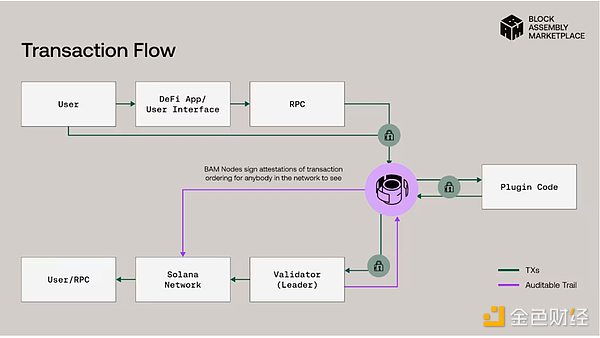
Block Assembly Market (BAM): BAM is a novel block building architecture developed by Jito. It requires a set of independent BAM node operators that run in parallel with Solana's validator set and are responsible for transaction ordering, rather than the validators themselves. BAM nodes utilize a Trusted Execution Environment (TEE) to hide incoming transactions from external observers while providing proof of the exact order in which they receive transactions and the final ordering. This transparency helps address malicious MEVs on the network because it highlights validators engaging in malicious MEV behavior, such as front-running or sandwich transactions. To achieve ACE, BAM introduces the concept of plugins, software features that allow applications to specify ordering logic for transactions processed by BAM nodes. This allows applications (rather than validators) to determine the order of transactions, thus achieving ACE. The initial implementation of BAM went live on the Solana mainnet on September 25th. Initial plugins supporting ACE are expected to be released in the coming months.
Application Marketplace Queues (AMQ): Developed by Temporal, a Solana subsidiary, AMQ allows applications to choose their own execution mechanism before submitting to the block leader. Applications using AMQ queue predefined transaction types instead of executing them immediately, allowing for batch processing of transactions within a set time period and prioritization before block submission. This introduces a slight execution latency, initially set at one time slot, but planned to be reduced over time.
ACE, as a concept, is still in its early stages of development and implementation. Extensive testing is needed to understand its downstream impact and practical effects. It is worth noting that if ACE is implemented as an off-protocol solution, it could lead to fragmentation. If a particular ACE solution (such as BAM nodes) fails to gain widespread adoption, applications may only benefit from ACE for a limited period, i.e., when validator nodes running a specific ACE software are in the lead. While competition between ACE standards is crucial for determining the best solution, this could add additional development costs to applications hoping to leverage market structure improvements, as these applications must update their application logic to accommodate all the different ACE solutions deployed. However, if successful, ACE will address a major problem for Solana applications—the elimination of the need to provide their custom sorting logic on a common L1 layer.
Multi-node parallel leader
Multi-Node Parallel Leader (MCL) is one of the most ambitious upgrades to the Solana protocol. Its core objective is to break the bottleneck of single-node parallel block production, allowing multiple validators to simultaneously propose portions of a block. This parallelization reduces latency, increases throughput, and weakens the influence of a single leader on transaction ordering. From a resilience perspective, MCL can reduce censorship risk. If a leader withholds or filters transactions, other simultaneously proposing leaders can ensure that these transactions are eventually included in the block.
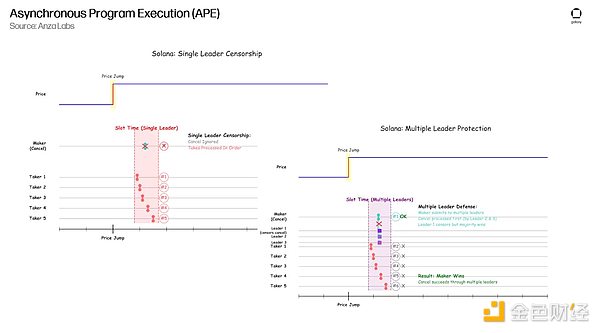
MCL is a long-term upgrade plan, both due to its technical complexity and the ongoing debate surrounding its inclusion in the protocol roadmap. The latest roadmap indicates that integration may not be achieved until 2027 or later. Currently, developers are focusing on implementing Alpenglow and advancing the production deployment of ACE. These steps will lay the foundation for MCL implementation by strengthening the consensus mechanism and enabling richer market microarchitecture. Once these recent upgrades are validated in production environments, more details regarding design and deployment are expected to be released.
Confiscation
Slashing is one of the main punitive mechanisms used in Proof-of-Stake (PoS) systems to prevent malicious validator behavior. Simply put, validators who violate the protocol rules may lose some of their stake (i.e., be "slashed"). Although Solana also uses a PoS mechanism, it has not formally implemented slashing since its launch, instead relying on "social slashing" (excluding and blacklisting violating validators) to ensure accountability.
However, over the past year, Anza's developers have begun laying the groundwork for a formal staking mechanism on Solana, proposing three Single Instruction Multiple Data Files (SIMDs) – 180, 204, and 212. These SIMDs will collectively standardize the process of identifying the relationship between validators and their staking, verifying stakingable violations, and determining the amount of staking due. All three SIMDs related to the staking mechanism are under review, currently undergoing testnet trials, and may be officially implemented in 2026.
Implementing a slashing mechanism on Solana would enhance cybersecurity by introducing direct economic penalties for malicious or negligent validator behavior, such as double-signing or failing to validate blocks, thereby deterring attacks and bringing the incentive mechanism closer to standard PoS mechanisms on chains like Ethereum. This should increase overall trust in the protocol. However, if the penalties are too harsh or lead to correlated slashing events (e.g., penalizing multiple operators simultaneously causing widespread outages), it could reduce validator participation and increase the operational risks and costs for smaller validators.
7. Technology Outlook
Without close observation, it's easy to overlook the massive development and experimentation taking place within the Solana technology stack. It's worth noting that this isn't solely driven by improvements from core development teams like Anza. The validator operator and developer ecosystem is maturing, and opportunities to increase revenue and profitability are incentivizing non-core developers to innovate and launch their own solutions. Everyone is committed to the same goal: making Solana the best-performing and most user-friendly application chain, thereby driving its widespread adoption.
If successful, the core protocol of Solana a year from now could be drastically different from what it is today. Validators will face stricter penalties (such as slashing); transactions will be executed asynchronously, reducing the need for validators; applications (rather than validators) will control the order of transactions; and the network will run on dedicated pipes instead of the public internet. These improvements should significantly boost Solana's performance. By this time next year, Solana's slot times could likely be reduced to 200 milliseconds, the number of transactions per second (TPS) for non-voting transactions would increase from 1000-2000 to 2000-4000, and the final confirmation time would decrease from 12.8 seconds to 150 milliseconds.
This transformation is not without risk. Each new deployment increases the complexity of the system, requiring adjustments from infrastructure providers across all layers of the technology stack. While Solana has largely overcome the negative impact of outages, the risk of outages remains a primary concern, and the possibility that new deployments might actually decrease rather than improve network performance is equally worrying. This might be alarming if this were Solana's first major transformation. However, the ecosystem has undergone dramatic changes in the past, and each time it has emerged stronger.
Crucially, while these technological upgrades are impressive, they haven't addressed the demand-side issues. Below, we'll delve into Solana's dynamics and assess the development of the application layer, as it's a necessary driver of Solana activities.
II. Overview of Solana Activities
As Solana's core developers advance the upgrade of its underlying technology stack, benchmarking the Solana network's performance relative to other leading blockchains is crucial. The following sections outline key metrics, including decentralized exchange (DEX) trading volume, network fees, application fees, total value locked, and stablecoin market capitalization compared to other leading blockchains. As part of the analysis, we also highlight key developments that may impact various verticals. This analysis helps clarify Solana's position within the broader blockchain ecosystem ahead of its next major upgrade.
1. DEX Trading Volume
In 2022 and 2023, Solana's average monthly trading volume accounted for less than 5% of the total trading volume of decentralized exchanges (DEXs). On-chain outages, its association with the collapsed FTX exchange, and the plunge in non-fungible token (NFT) trading volume all exacerbated doubts about the chain's sustainability and long-term viability. However, those closely monitoring the chain saw a completely different picture: core developers were deeply involved in researching and deploying updates to the network and execution stack to improve performance. All that was needed was a catalyst, and that catalyst arrived at the end of 2023, with Memecoin becoming the core driving force behind all blockchain activity.
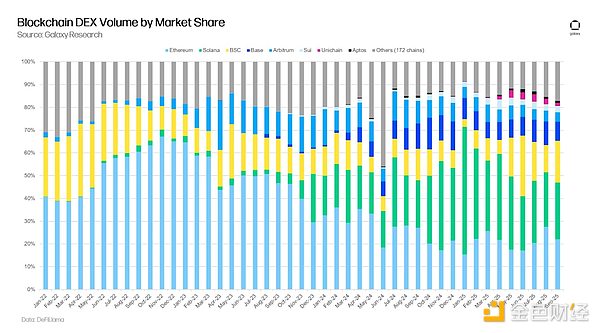
Leveraging its upgraded technology stack, Solana quickly found a perfect fit between its product and the market, becoming the preferred blockchain for low-cost, fast transactions. In July 2024, Solana's total decentralized exchange (DEX) trading volume surpassed all other blockchains for the first time. Since then, Solana has continued its rapid growth, consistently ranking among the top two in DEX trading volume, and holding the top spot for seven out of the nine months so far in 2025. In 2024, Solana's share of the total monthly DEX trading volume across all blockchains averaged over 25%, climbing to over 30% in 2025. The ratio of DEX trading volume to fully diluted valuation (FDV) effectively reflects the efficiency with which blockchain market capitalization translates into actual economic activity. High trading volume relative to FDV indicates that the blockchain's valuation is supported by genuine trading demand and liquidity depth; while low trading volume relative to FDV may indicate speculative pricing, disconnected from practical applications.
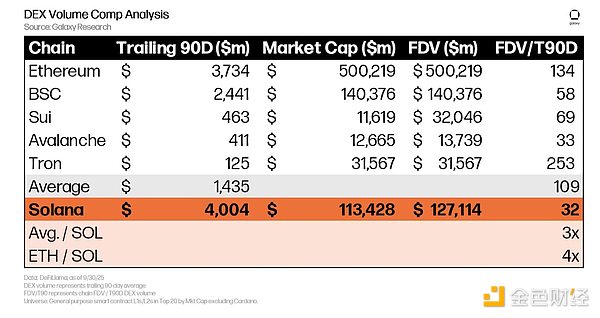
Despite Solana's leading decentralized exchange (DEX) trading volume, its price-to-earnings ratio (P/E ratio) is significantly lower than its peers. Over the past 90 days, Solana's daily DEX trading volume has reached $4 billion, ranking first among all blockchains. However, Solana's DEX trading volume to final market capitalization (FDV) ratio is only 32, just one-third of the average of 109 for similar projects and one-quarter of Ethereum's. It's worth noting that this is not a coincidence. For the past two years, Solana's P/E ratio has consistently lagged behind other projects.
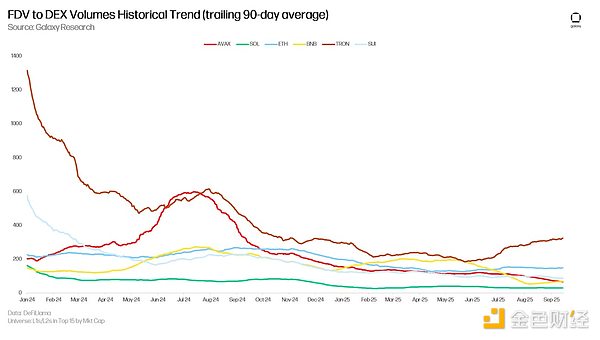
Skeptics argue that Solana's low price-to-earnings ratio reflects speculative decentralized exchange (DEX) trading volume driven by Memecoin activity, which may lack the stability of other types of DEX trading. This concern is not unfounded, as evidenced by the sharp drop in trading volume following the 2021 NFT boom. Indeed, while Solana's DEX trading volume has grown significantly over the past year, monthly volatility highlights the continued speculative nature of this activity. Recent growth has been primarily driven by Memecoin trading and a large influx of retail users, which tends to boost volume but does not guarantee long-term stability.
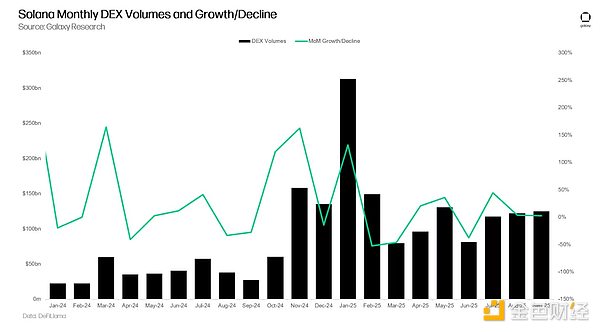
However, speculative frenzy isn't always a weakness. Ethereum's early trading volume primarily came from Initial Coin Offerings (ICOs), while Binance Smart Chain thrived thanks to decentralized finance (DeFi) yield farms. Many users who joined for speculative purposes eventually stayed because of the more sustainable applications. However, if trading volume becomes overly reliant on hype cycles, speculation itself can create vulnerability.
Solana's next phase of growth hinges on its ability to translate this speculative fervor into sustained cash flow. A shift towards more stable trading methods, such as stablecoin swaps, perpetual contracts, and other DeFi primitives, would signal that the ecosystem is moving beyond short-term speculation and maturing. Until then, Solana's DEX trading volume is best understood as dynamic but volatile—reflecting the chain's growing importance and the speculative nature of its user base.
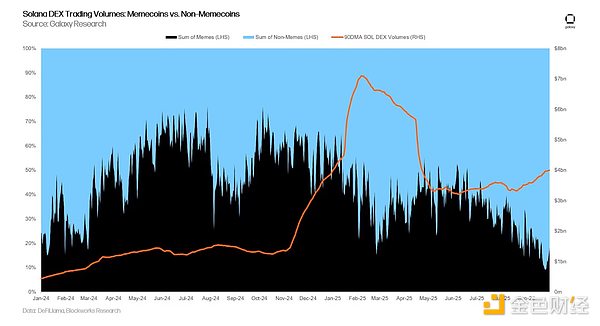
This maturing trend may be unfolding in real time. While Solana's total trading volume continues to grow, memecoin's share of trading volume is shrinking. Memecoin's share of total trading volume on the Solana DEX has declined from over 50% in Q4 2024 to 20%-30% in Q3 2025. Instead, swap transactions on the SOL/USDC DEX account for a larger share of on-chain trading. In fact, Solana is the only blockchain whose token-USD trading pair has a higher on-chain trading volume than Binance's.
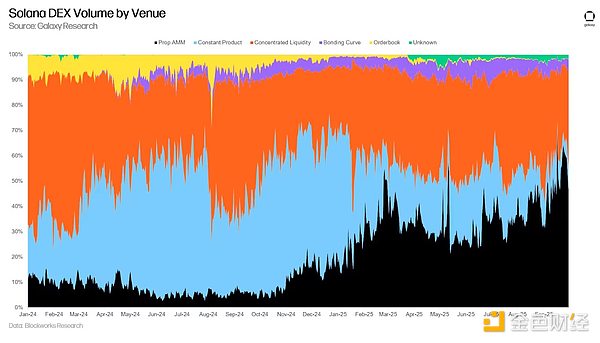
The significant growth of the SOL-USD trading pair is primarily attributed to Solana's unique new trading mechanism – the "prop AMM" (or "prop AMM" for short). A prop AMM is a decentralized exchange (DEX) that uses private, protocol-owned liquidity, typically managed by professional trading firms, rather than relying on public liquidity providers like traditional AMMs (such as those using constant product or centralized liquidity models). Unlike deterministic on-chain binding curves, prop AMMs employ a dynamic off-chain pricing engine that monitors external markets, oracles, and market conditions to generate timely signed quotes. These quotes are then embedded into trades via Solana aggregators (such as Jupiter or Titan). Since a large portion of Solana DEX trading volume is routed through aggregators, prop AMMs can be seamlessly integrated and capture market share by providing optimal execution. This mechanism enables proactive liquidity provision, with prices adjusting almost in real-time and unaffected by trading volume, typically concentrating liquidity around oracle prices for efficiency.
Furthermore, Prop AMM addresses a significant market microstructure issue faced by Solana market makers—the inability to prioritize canceled orders over take orders. As discussed in the technical section above, this is a key focus of the ACE protocol's continuous updates. This is crucial for maintaining smaller spreads (and is already embedded as default logic in leading Prop platforms like Hyperliquid). Prop AMM achieves this by cleverly optimizing oracle updates. Transaction priority on Solana depends on its priority fee or tip per CU. Prop AMM significantly reduces the number of CUs required for oracle updates, allowing it to bid for higher priority fees/tips without exceeding its own costs and increasing the chance of securing top block positions. This is highly effective in reducing spreads for trading pairs like SOL-USDC (click here to see a live spread estimate for this pair).
Proprietary AMMs are still in their early stages of development, and their impact on the Solana market structure is constantly evolving. While they are primarily used for aggregator-driven trading flows, future applications may include the perpetual contract market. Furthermore, other platforms have begun leveraging proprietary AMMs to further improve efficiency. For example, Solana DEX aggregator DFlow launched a new trading type in September that routes trades to the best proprietary AMM at execution time (rather than at commit time).
Outlook
Solana has firmly established itself as the leading on-chain trading platform in terms of trading volume for decentralized exchanges (DEXs). This growth is primarily driven by the explosive increase in memecoin trading activity over the past two years, and this activity is likely to remain a major driver in the short term. The memecoin boom has brought broader benefits to the entire ecosystem. It stress-tested Solana's infrastructure, demonstrating a significant improvement in reliability compared to previous cycles. Crucially, memecoin trading activity has also attracted developers. The team wants to develop where users are, whether it's deploying applications or creating more accessible entry points and tools to lower the barrier to entry. From this perspective, memecoin-driven trading activity is less of a distortion and more of an accelerator. By attracting capital, users, and existing developers into the ecosystem, memecoin trading activity helps solidify Solana's position as the preferred platform for low-fee, high-throughput trading.
2. Perpetual Contracts
While Solana dominates spot DEX trading volume, it has failed to achieve a similar advantage in the perpetual contract trading arena. This contradicts the protocol founder Anatoly Yakovenko's initial vision of Solana as an "on-chain Nasdaq." Liquidity drain as traders migrate to non-AMM perpetual contract trading venues highlights Solana's structural problems.
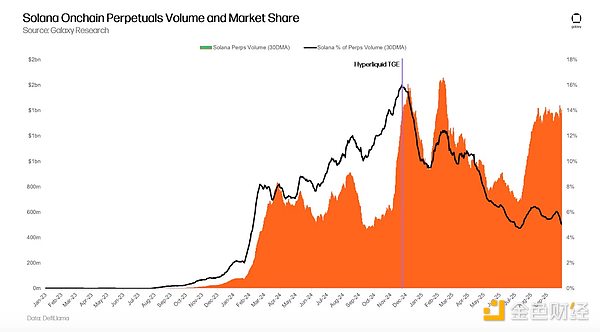
The chart above highlights the severity of the problem. Solana's share of on-chain perpetual contract trading volume peaked at the end of 2024, but plummeted after Hyperliquid's token generation event (TGE) on November 29th. Since then, Solana's perpetual contract market share has shrunk from approximately 17% to around 6%, although the absolute trading volume of perpetual contracts on Solana continues to climb. Hyperliquid's liquidity depth and centralized exchange-like execution efficiency have created a flywheel effect that Solana's native exchange has struggled to compete with. The perpetual contract market is liquidity-driven. Once an exchange's order book depth reaches saturation, it attracts more traders, further deepening liquidity. This liquidity flywheel effect forms a moat that challengers find difficult to overcome, even with more advanced technology or incentives.
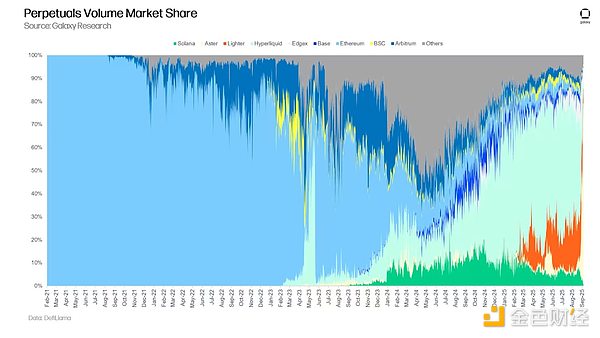
The threat is most evident in July when Phantom, Solana's leading wallet provider, announced a direct integration with Hyperliquid (reported by Galaxy Research). Phantom has long been a mainstay of the Solana ecosystem and a primary distribution channel for retail users. Although Phantom's business has long expanded beyond Solana, its choice of Hyperliquid as the default trading venue for perpetual contracts within its wallet reflects two points: (1) Hyperliquid offers superior liquidity and execution speed compared to Solana's native trading venue; and (2) Hyperliquid's robust code-building program allows third-party applications to seamlessly share profits by accessing its liquidity layer.
Since its integration, Phantom has facilitated nearly $12 billion in perpetual contract trading volume through Hyperliquid, generating over $6 million in fees, representing more than 10% of Phantom's total fees during the same period. Phantom is not alone. Leading Telegram trading bots like Axiom, which account for a significant portion of retail memecoin trading volume, have also integrated Hyperliquid as their default perpetual contract trading platform. This substantial trading volume would otherwise have flowed into Solana's native trading platform. The integration of Phantom and Hyperliquid also demonstrates how liquidity advantages can be self-reinforcing. Phantom's integration has driven more funds to Hyperliquid, deepening its order book and attracting even more traders.
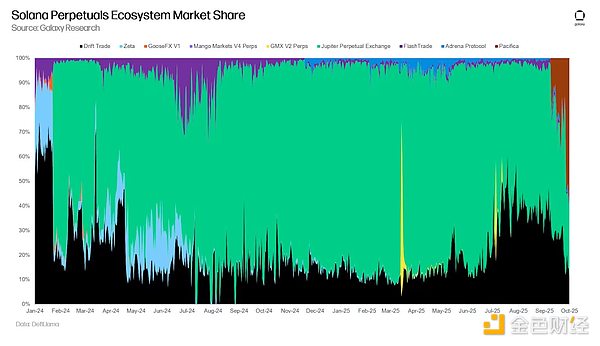
Competition among trading platforms is equally fierce within the Solana ecosystem. The two leading players are Jupiter and Drift. Jupiter, employing a liquidity pool model, has maintained a dominant market share since its launch in January 2024, while Drift has rapidly risen to prominence with its hybrid Centralized Limit Order Book (CLOB) model and zero-fee campaigns. Smaller players struggle to gain a stable market share. As a result, Solana's trading platform liquidity is primarily concentrated in these two exchanges, even as the ch