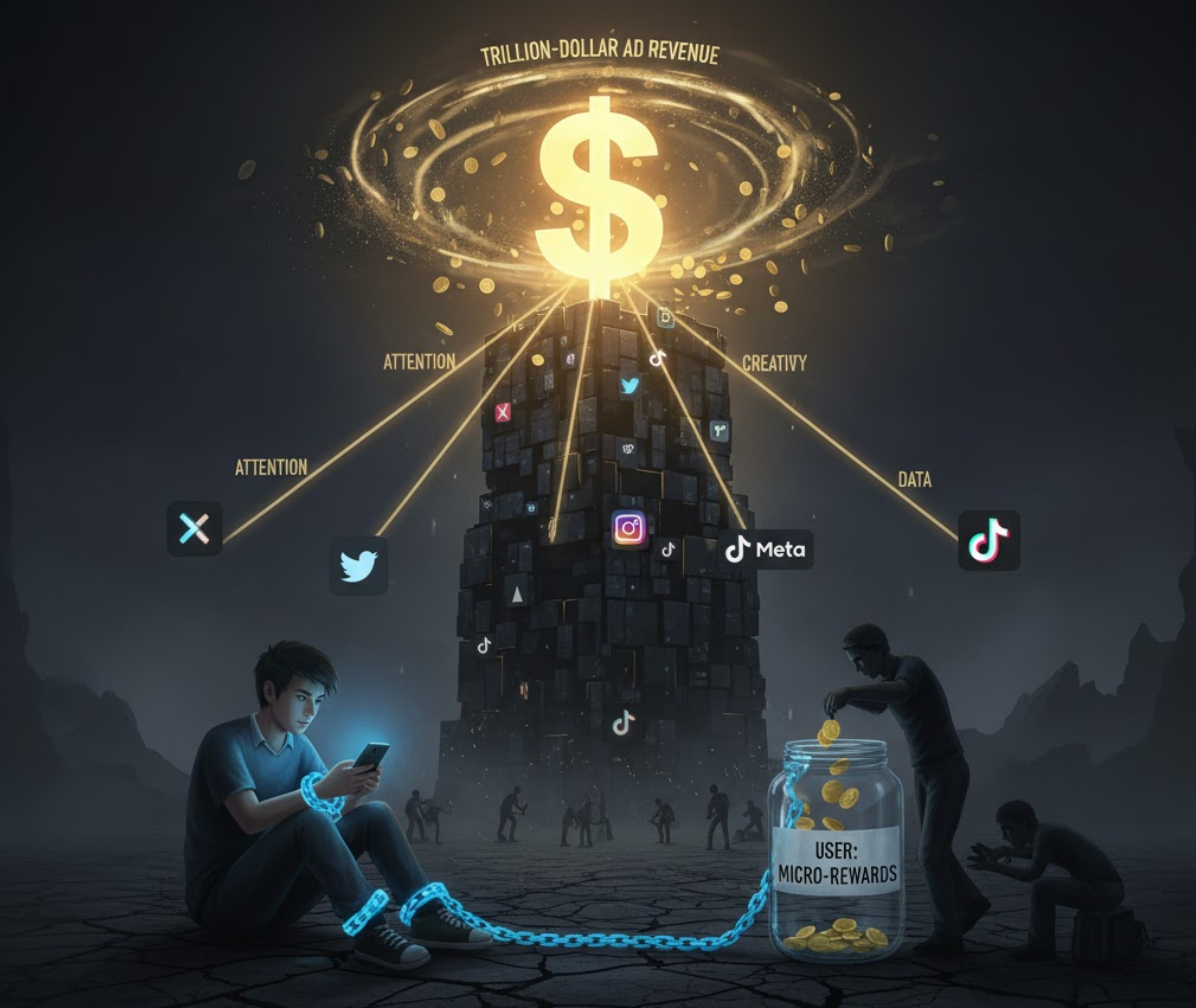
We are living in an era of unprecedented digital abundance. Information is being created, disseminated, and consumed at an unprecedented speed. However, beneath this facade of prosperity, a profound economic paradox is becoming increasingly apparent: as core participants and value creators of this digital civilization, the vast majority of us are systematically marginalized in this trillion-dollar economy.
We are like medieval tenant farmers, allowed to cultivate the "land" (the platform) of the "lord" (the platform provider). We "labor" with our most valuable assets—attention, creativity, and data. In return, we gain the "right" to use the land (free access to the service). But all the "harvest" (advertising revenue, data value) belongs to the lord; we receive nothing, or only a paltry reward.
I. Digital Exploitation: A Trillion-Dollar Value Mismatch
To understand the extent of the imbalance in this system, we must first look at the data. Numbers are not cold and impersonal; they are the most honest recorders of the flow of value.
Let's take the 2024 financial data as an example. Meta alone (which owns Facebook, Instagram, and WhatsApp) had annual advertising revenue of approximately $134 billion; Alphabet (Google's parent company, which mainly relies on search and YouTube ads) had advertising revenue of approximately $238 billion; and X (formerly Twitter), even amidst turmoil, still had its advertising business as its core lifeline, with annual revenue estimated at several billion dollars.
This is a global digital advertising market dominated by a few tech giants, with an annual output value exceeding one trillion US dollars. And the core product of this market is "you"—more precisely, "your predictable behavior" and "your attention".
Advertisers are willing to pay huge sums because platforms promise them precise targeting. How do platforms achieve this precision? By collecting, analyzing, and packaging the personal data, interests, and social graphs of our billions of users. The content we create, the emotions we express, and the relationships we interact with collectively form the "traffic pool" that attracts advertisers.
So, as the real "miners" of this trillion-dollar gold mine, how much have we—content creators and ordinary users—received? The answer is: negligible.
YouTube is relatively "generous" in this model, giving creators 55% of its advertising revenue. But that's the ceiling. Within the Meta ecosystem, actual creator incentive programs are known for their opaque and unstable "bonus pool" model, with the total amount distributed to creators being negligible compared to its hundreds of billions of dollars in revenue. As for Platform X, its high-profile "ad revenue sharing program" announced in 2023, with its high barriers to entry and narrow coverage, makes it more like a marketing campaign than a structured profit distribution.
And what about ordinary users who don't produce content? We contribute the most basic and widespread "attention"; we are the consumers and interactors of all content, the foundation upon which the algorithm operates. What we receive, aside from "free usage rights," is virtually nothing economically.
This is the stark reality: an economic model where 99% of people provide the fuel, and 1% of platforms capture the value. This is a systemic misallocation of value, a massive "digital exploitation" in human history disguised as "free".
II. The root cause of value mismatch: "You are not the user, you are the product."
Why has this extremely unfair distribution become the norm? Why do billions of people willingly accept this model?
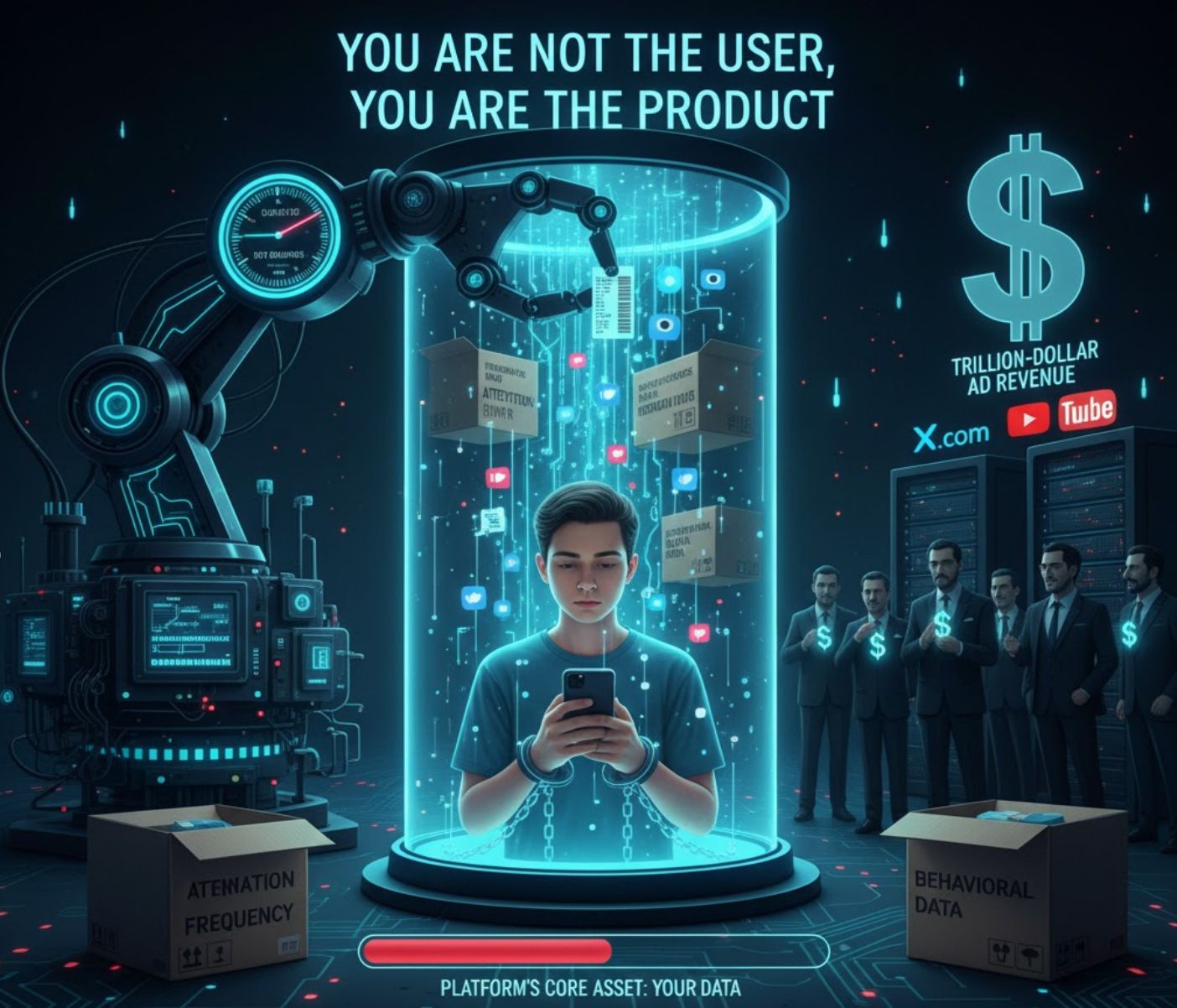
The answer lies in the underlying design of the Web2 business model. We must be clearly aware that in this system, you are never a "user" or "customer," but a "product" that is packaged and sold; the real "customers" are the advertisers who pay for your attention.
On the one hand, the design goal of algorithms has never been your "well-being," "efficiency," or "truth." Its sole objective is to maximize your "stay time" and "interaction frequency." Because every second you stay and every click you make is an "inventory unit" that can be packaged and sold to advertisers.
The platform doesn't care whether you gain valuable information; it only cares whether you contribute monetizable actions. Under this logic, the value of "truth" is far lower than "traffic," and the value of "depth" is far lower than "stimulation." Your dopamine is precisely manipulated by algorithms; you think you're "consuming" content, but in reality, your cognition and time are being "consumed."
On the other hand, all our digital activities are transformed into data, becoming the platform's core asset. We are the producers of this data, but we have neither ownership nor control over it, nor the right to profit from it.
Your social graph, your content library, and your reputation record are all locked within the platform's "walled garden." You cannot take them with you, cannot transfer them to other platforms, and certainly cannot license them to third parties to create value for yourself.
You are like data fuel; your only "right" is to continuously burn yourself to power the platform's growth engine. You are encouraged to constantly post, interact, and share, because every action adds value to the platform's "data balance sheet" free of charge.
This business model, which instrumentalizes "people" and commodifies "attention," is the cornerstone of Web2's enormous commercial success and the fundamental reason why the "digital sharecropper" system can be sustained.
III. Breaking Free from the "Gilded Cage": How Web3 Can Rebuild Value Sovereignty
Web3 is a revolution precisely because it fundamentally restructures this sovereign relationship. It is not a patchwork of Web2, but a complete subversion of the value distribution paradigm. It provides "digital tenants" with the weapon to reclaim their sovereignty.
First, Web3 combats "black box algorithms" with "open protocols." In the world of Web3, we replace "platforms" with "protocols." Protocols are open-source, transparent, and community-driven. How value is defined, allocated, and transferred—all the rules are written in smart contracts, making them public, transparent, auditable, and tamper-proof. This fundamentally solves the "black box" problem.
More importantly, the goal of Web3 protocols is no longer to maximize "stay time," but to maximize "verifiable value." An open protocol can be designed to reward "truth," "depth," or "originality," rather than "excitement" and "conflict." For the first time, users' "cognitive sovereignty" can be guaranteed by technology—you are no longer manipulated by an algorithm that aims to exploit you; you are simply participating in an open system that aims to incentivize value.
Secondly, Web3 counters "data fuel" with "identity sovereignty." Your wallet address, your ENS domain, and your decentralized identity (DID) together constitute your "sovereign identity." This key is in your hands, not in the hands of the platform. All your on-chain activities, your assets, and your achievements (such as POAP or SBT) are attached to your sovereign identity, not to a platform's database.
This means that your "influence" on X and your "professional reputation" on LinkedIn—these "intangible assets" that should belong to you—will no longer be liabilities that platforms can arbitrarily strip away or "zero out" in Web3. Instead, they will be "reputation assets" that you can truly own, carry, and combine. You are no longer "fuel"; you have become the "owner."
This is Web3's positive response to the "digital sharecropping" system: it uses code and cryptography to wrest economic and identity sovereignty back from platforms and return them to each individual. This is a new continent that no longer needs "lords" and "land," a future where we can not only "cultivate," but also "own" and "build."