On November 5, 2025, the US federal government shutdown entered its 35th day, tying the longest shutdown in history. This deadlock stems from a disagreement between congressional Republicans and Democrats over the budget bill. Democrats demanded an extension of the Affordable Care Act subsidies, while Republicans refused to compromise, leading the Senate to reject the House-passed temporary funding bill 14 times. During the shutdown, taxes continued to be collected, but federal spending was largely frozen. Approximately 700,000 employees were furloughed without pay, airport security delays affected 3.2 million passengers, the SNAP food assistance program only disbursed 50% of its benefits, and the Head Start children's program was partially closed. The economic impact is already evident: the Congressional Budget Office estimates a weekly loss of approximately $1.4 billion in GDP. If the shutdown continues, a liquidity crisis will become the biggest concern.
Signs of strain have appeared in the financial system's "pipelines".
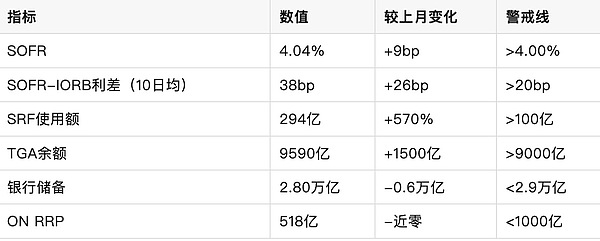
The U.S. financial system's short-term funding market relies on approximately $3 trillion in overnight repurchase agreements (repo) transactions. These transactions are secured by Treasury securities, with banks, money market funds (MMFs), and primary dealers lending dollars to each other daily to ensure smooth payment and settlement. The key indicator is the Secured Overnight Funding Rate (SOFR) , which reflects actual borrowing costs. On November 3, 2025, the SOFR was 4.04%, 4 basis points higher than the Federal Reserve Reserve Balance Interest Rate (IORB, capped at 4.00%), having exceeded the cap for six consecutive days, with a 10-day moving average spread of 38 basis points.
The Federal Reserve does not set a single interest rate, but rather a corridor: the lower limit is the ON RRP rate (4.00%), and the upper limit is the IORB and Standing Repurchase Facility (SRF) rates (4.25%). Normally, the SOFR should fluctuate below the upper limit. However, since September 2025, the SOFR has repeatedly exceeded the upper limit. On October 31st, the single-day SRF usage reached a record $50.35 billion, and on November 3rd, it reached another $29.4 billion, indicating that the private market is unwilling to lend, forcing institutions to seek assistance from the Fed.
The unsecured side is also under pressure. The Federal Funds Rate (EFFR) is trading at an average of $8-9 billion per day, with the October moving average 12 basis points higher than the ON RRP. Dallas Fed President Logan warned on October 31 that "if the recent rise in repo rates is not temporary, the Fed will need to launch asset purchases (QE)." Chairman Powell also specifically mentioned "pipeline strain" in his November speech.
The Treasury General Account (TGA) has become a liquidity "black hole."
The Treasury's Checking Account (TGA) is the Treasury's "checking account" at the Federal Reserve. In a normal year, the TGA's target balance is $850 billion, with tax revenue inflows being quickly spent to replenish bank reserves. Before the 2025 government shutdown, the Treasury Secretary had increased the TGA from $300 billion to $850 billion, exhausting the ON RRP buffer (leaving only $15 billion). After the shutdown, with tax revenue flowing in at an average of tens of billions of dollars daily, while spending was almost zero, the TGA surged to $959 billion (weekly average as of October 29), a surge of $150 billion compared to before the shutdown.
Every dollar increase in TGA means a dollar is withdrawn from the banking system's reserves. From July to October 2025, bank reserves fell from 3.4 trillion to 2.8 trillion, dropping to 13% of M2 – the last time this level was reached was in 2023 when three large banks, including Silicon Valley Bank, collapsed. ON RRP is nearly exhausted (only 51.8 billion on November 3rd) and can no longer act as a "shock absorber."
Triple squeeze: QT + new debt + closure
Quantitative Tightening (QT)
The Fed is reducing its asset holdings by $95 billion per month, resulting in a continuous outflow of reserves. On October 29, the FOMC announced the end of the quantitative easing (QT) on December 1, but it was too late.
Huge bond issuance
The deficit for fiscal year 2025 is $2.1 trillion, requiring the issuance of tens of billions of dollars in government bonds daily. Buyers will need to prepare US dollars in advance, further depleting reserves.
Door closing amplifier
If TGA increases by another 50 billion per week, it will drain 200 billion of reserves in a month. The tax season (January-April) will only make matters worse.
The Fed's net liquidity indicator (balance sheet - ON RRP - TGA, inverted) has surged for two months, while the DXY dollar index has risen to 108 during the same period, and the 10-year US Treasury yield is approaching 4.8%. Bitcoin and the S&P 500 fell 1.1% and 0.8% respectively this week, and the VIX rose to 21.
Crisis transmission path
Phase 1: Repurchase Out of Control. If SOFR rises to 4.30% (SRF cap + 5bp), primary dealers will flock to SRF, with daily usage potentially exceeding 100 billion, exposing reliance on the "lender of last resort".
Phase Two: Reserve Shortage - As the reserve-to-GDP ratio falls below 11%, banks will reduce on-balance-sheet leverage and decrease government bond underwriting. Regional banks will bear the brunt of the pressure – by 2025, three small and medium-sized banks already had non-performing loan ratios exceeding 5%.
Phase Three: Credit Freeze, Money Market Fund Redemption Wave → Private Repurchase Halt → Payment Chain Break. The probability of a repeat of the SVB event in March 2023 rises to 30% (Goldman Sachs model).
Phase Four: Systemic Shock. The Federal Reserve was forced to restart QE, purchasing $200 billion in bonds per month. The 10-year yield plummeted by 50 basis points, the dollar index collapsed below 100, and inflation expectations were disrupted.
Latest data overview (November 4, 2025)
Federal Reserve Contingency Plan
Restart QE immediately
Purchase 150 billion yuan in bonds every month until reserves reach 3.2 trillion yuan.
Reduce IORB by 25bp
Stimulating bank lending and lowering SOFR.
Expanding SRF adversaries
Incorporate more MMFs and foreign banks.
Suspension of new bond issuance
The Ministry of Finance has invoked special measures (partially implemented in October).
Path to a Congressional Breakthrough
Most optimistic scenario: On November 6, Senate Majority Leaders Thune and Schumer reached a compromise, the House of Representatives reconvened on November 10, and temporary funding was allocated until January 2026. Most pessimistic scenario: The shutdown drags on until December, TGA exceeds $1.1 trillion, SOFR surges to 4.50%, triggering a "flash crash".
Investors should respond
Cash is King
Increase holdings of 3-month Treasury bills (yield 4.15%).
Hedging tail risk
Buy VIX call options and gold ETFs.
Focus on trigger points
If SOFR falls below 4.10% or SRF exceeds 50 billion in a single day, it indicates a reduction in holdings of risky assets.
The government shutdown, initially a political farce, has escalated into a systemic threat against the backdrop of a liquidity crunch. The Federal Reserve has already raised red flags: SRF usage on November 3rd hit a record high since the pandemic. If Congress drags its feet for another week, TGA will drain another $100 billion in reserves, and SOFR could spiral out of control. History tells us that the 35-day shutdown in 2018 only resulted in a 0.1% loss in GDP, but today reserves are only 70% of what they were then, and the ON RRP buffer is exhausted; any slight disturbance could ignite a powder keg. Reopening the government is the only key to preventing a crisis.