
With the widespread adoption of large-scale models, we are seeing a shift in the creative focus from humans to algorithms: code is automatically generated by AI, application templates can be combined in real time, model parameters are constantly iterated, and Prompt engineering has even evolved into a new "software design language." In this system, code is becoming the intelligent asset of AI systems, determining the core quality of model behavior, application logic, and content output.
However, this trend contrasts sharply with the lagging underlying infrastructure. Over 100 million developers worldwide still rely on GitHub as their primary code hosting platform, even though GitHub was originally designed as a collaboration tool, not an asset system. This leads to a series of unavoidable structural limitations: repository ownership is controlled by the platform; content may be taken down or frozen due to policy, geopolitical, or censorship reasons (such as the sanctions imposed on developer repositories in multiple locations in 2022); development records cannot be verified on-chain, code lacks independent proof of ownership, and cannot be traded, licensed, or priced like on-chain assets.
In an era where AI dominates content production, these issues are no longer merely bottlenecks in tool experience, but directly determine whether content can truly become an asset. Today, a data processing pipeline, a Prompt module, a piece of plugin logic, or a model fine-tuning result can all become highly valuable content components. However, in the centralized environment of Web2, these achievements are difficult to authorize, cannot circulate, and cannot be incorporated into an open economic system. They exist, but lack "identity"; they have value, but cannot "become assets."
Meanwhile, "on-chain creation" is rapidly becoming mainstream. Data networks such as Arweave and Greenfield provide verifiable and permanent storage capabilities; AI applications run on-chain in the form of contracts; model products are being discussed as quantifiable digital assets; and various CodeMarketplaces are taking shape. The industry is increasingly focusing on new trends such as "model assetization," "content tradability," and "on-chain self-creation networks."
This signifies the emergence of a new technological dividing line: in the AI era, content is transforming from files into tradable on-chain assets. Of course, once content acquires asset attributes, a fundamental problem arises: the on-chain world lacks a truly trustworthy, verifiable, and authoritative code storage and version control system.
Against this backdrop, CodexField is building a complete future-oriented content asset economic framework: from creation, rights confirmation, and storage to publishing, circulation, licensing, collaboration, revenue sharing, and governance, everything is organized around "content" as the basic unit.
In this system, content must possess a stable on-chain identity, a clear version record, a verifiable contribution history, and a structured asset form that can be authorized, invoked, and priced. To achieve this, the underlying infrastructure must be redefined. Therefore, CodexField built its own core modules at the system's lowest level—one of which is Gitd for content storage and version management. It allows content to have a verifiable source, enabling the entire content asset economy to exist: without a credible creation record, reliable application development, open market circulation, and an effective incentive system cannot be formed. Gitd provides the underlying foundation for CodexField's pursuit of an on-chain content economy that is ownership-verifiable, traceable, and tradable.
Gitd: The underlying standard for CodexField's on-chain content system.
In the CodexField system, content possesses the attributes of on-chain assets from the moment it is created—it can be identified, tracked, combined, and distributed. Whether it is an AI-generated application, model parameter, or plugin logic, or manually written code and templates, they all need to have an independent and verifiable on-chain identity to maintain a transparent and trustworthy record throughout their entire lifecycle of creation, modification, authorization, and circulation.
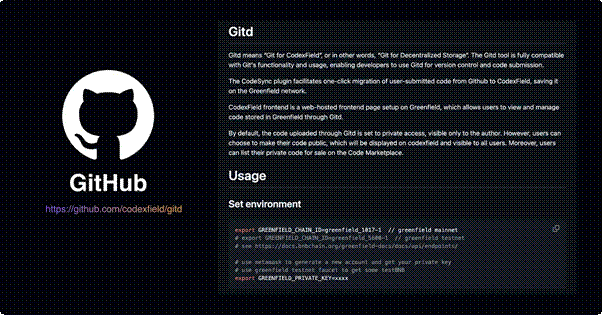
To support this asset structure, CodexField built Gitd at the underlying layer: a version control system that combines decentralized storage capabilities with a complete Git workflow. It continues the collaboration methods most familiar to developers, while incorporating the writing and updating of content into a verifiable and immutable on-chain framework. In other words, Gitd retains the collaborative advantages of the Git ecosystem while giving content a native on-chain ownership structure.
Gitd records all creation and modification in a standardized way as versions, including the fine-tuning trajectory of AI models, the iteration of application logic, the update of plugin content, and the evolution path of scripts. This fine-grained on-chain traceability mechanism makes Gitd the core foundation of CodexField: whether it's the source of assets in the Marketplace, the application building and remixing in the Playground, the verification of PoA contributions, or the future mapping of RWA digital content, all rely on Gitd's version layer as a trusted source.
Gitd works in the same way as GitHub and GitLab. Operations such as clone, pull, push, branch, and merge require no migration costs, allowing creators to collaborate and commit in a familiar way. All content is ultimately stored on Greenfield, a decentralized data network, where each commit generates a verifiable on-chain record, naturally possessing the characteristics of being resistant to freezing, traceable, and uncensorable compared to centralized platforms.
Content Path from Git to Greenfield
For content to possess an on-chain identity and value history, a stable and reliable bridge must be established between the development experience and the blockchain architecture. Gitd's technical structure serves as this bridge, forming a complete content chain extending from the Git workflow to the Greenfield decentralized storage network.
Gitd's first layer is full compatibility with the Git command system, ensuring creators can seamlessly integrate code, templates, or model projects into the on-chain environment. Based on this, CodexField integrates the CodeSync module into Gitd, enabling content to be automatically synchronized from GitHub to Greenfield. Synchronization supports incremental pushes and differential recording, providing a secure and efficient technical foundation for multi-repository management, model updates, and cross-platform projects.
The storage layer is crucial to Gitd. Greenfield, as the data chain of the BNB Chain, features cross-chain calls, data sharding, versioned storage, and on-chain timestamps, providing verifiable ownership records for each content commit. This structure not only ensures the immutability of content but also provides a robust data foundation for CodexField's asset valuation, contribution calculation, and PoA reward mechanism.
To balance privacy and circulation, Gitd has built a flexible permission system. Content is stored privately by default, but creators can make it public at any stage, instantly creating displayable, experienceable, or circulated assets in the CodexField Marketplace. Public repositories also serve as the basic entry point for others to remix, collaborate, or extend development in the Playground, providing structured support for open innovation.
From development experience to storage architecture, from cross-platform synchronization to access control, Gitd's technology chain covers the entire process of content generation, migration, ownership confirmation, access, and publishing on the blockchain. This not only ensures the transparency of the content lifecycle but also lays the technological foundation for CodexField to build a trustworthy content economy.

The starting point of the content economy
In fact, within CodexField's overall architecture, Gitd is the starting layer upon which the entire content economy operates. Whether it's asset circulation, application building, incentive distribution, or collaborative governance, all on-chain activities rely on the verifiable content source provided by Gitd.
In the Marketplace, Gitd is the source of all assets. AI applications, model plugins, code templates, and other content have clear version histories and ownership records before release, ensuring the credibility of authorized calls, revenue sharing mechanisms, and contribution calculations.
At the creation layer, Gitd and AI Playground form a stable content loop. Content is read into the Playground for users to create, and after modification, it is written back to Gitd, automatically generating a new on-chain version, making every build and remix traceable. This allows CodexField's collaborative experience to both follow the familiar Git workflow and possess on-chain transparency and assetization capabilities.
At the incentive layer, Gitd serves as the data source for the PoA mechanism. Every clone, pull, or push constitutes a verifiable participation action, providing real data for contribution calculation, content value mapping, and the future on-chain incentive system.
At the assetization layer, Gitd provides content with a standardized asset structure. Each repository has a traceable version history, a clear creator identity, and complete permission records, which can further support various assetization forms such as licensing, renting, and calling, and also provides a mapping basis for future RWA content ownership confirmation.
By integrating the four dimensions of creation, distribution, collaboration, and incentives, Gitd plays a pivotal role in the content economy within the CodexField ecosystem. All value creation and dissemination ultimately points to this verifiable, authorizable, and composable underlying structure.
Conclusion
As Gitd continues to improve, the on-chain, verifiable, and composable nature of content will further enhance the freedom of developers and creators. Clearer version history, more standardized content structures, and more open collaboration paths will enable AI applications, models, and plugins to flow, reuse, and evolve on-chain at a higher density. Gitd is not just a technical tool; it is becoming the fundamental entry point for content to gain "economic identity" on-chain.
Looking to the future, CodexField will build a more complete content asset system around Gitd: from creation and storage to circulation, licensing, revenue sharing, and incentives, all will continuously interact and expand within the same structure. Only when content possesses verifiable origins, traceable evolution, and definable value can a more open and collaborative on-chain content network truly thrive. Gitd is the starting point of this network, and CodexField's future will continue along this path of content assetization.