Key Insights
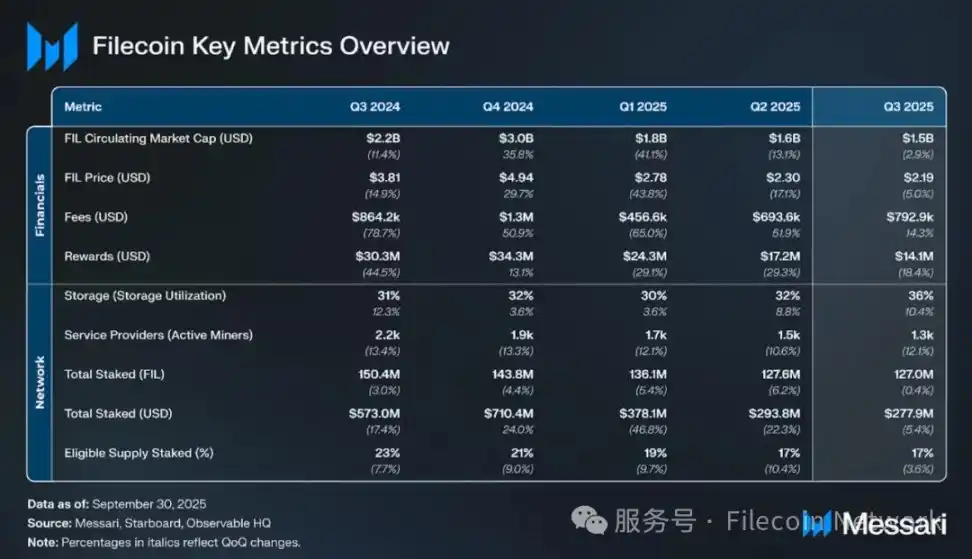
• Network utilization rose to 36% (up from 32% in Q2), while total network storage capacity decreased by 10% quarter-over-quarter to 3.0 EiB. This reflects the exit of some service providers and improved network efficiency following the network v27 "Golden Week" upgrade.
Total network costs increased 14% quarter-over-quarter to $793,000, with the growth almost entirely driven by penalties (99.5%). With the removal of the legacy sector methodology, batch fees and base fees have been reduced to near zero.
• Active storage demand remained stable, with total stored data volume decreasing only slightly by 1% quarter-over-quarter to 1,110 PiB. This was despite storage providers and allocators adapting to the new Fil+ path and operational adjustments, resulting in a 19% decrease in average daily new transaction volume.
• The number of real-world datasets available online increased by 3% month-over-month to 2,491, of which 925 datasets are larger than 1,000 TiB, indicating a continued growth in the adoption of large-scale, persistent storage by enterprises and research institutions.
The Filecoin Foundation, together with the GSR Foundation, funded an impact project group that includes The Starling Lab and CROSSLUCID’s Oceanic Whispers project, further solidifying Filecoin’s key role in the field of verifiable, socially driven data preservation.
Project Overview
Filecoin (FIL) aims to build a decentralized marketplace for data services, with its first core service being data storage based on the InterPlanetary File System (IPFS). Filecoin employs a market-driven model, allowing users to negotiate variable-priced storage deals with storage providers. A storage deal is similar to a service agreement, where users pay providers to store their data for a specific period.
Filecoin uses a cryptographically proven incentive model—Proof of Replication (PoRep) and Proof of Spacetime (PoSt)—to verify that storage providers reliably store customer data throughout the protocol. Additionally, Proof of Data Possession (PoDP)¹, launched in May 2025, adds continuous, lightweight verification of stored data and provides a hot storage layer for high-speed data availability. Providers earn the network's native token, FIL, as a reward for participating in storage transactions. If a storage provider fails to provide reliable online time or engages in malicious behavior against the network, its staked FIL will be slashed.
In terms of data retrieval, Filecoin users pay retrieval providers to obtain data. Unlike storage transactions that occur on-chain, retrieval transactions are settled off-chain using payment channels for faster retrieval speeds. Beyond storage and retrieval, Filecoin aims to provide an open marketplace where computing power can be directly invoked on top of data, offering a more efficient alternative to traditional centralized systems. Key protocol upgrades enabling compute-over-data services include smart contracts (Filecoin Virtual Machine - FVM) and scaling solutions (Interplanetary Consensus - IPC). With the upcoming launch of Filecoin Onchain Cloud, the network's infrastructure will be further expanded to support full on-chain cloud services.
Key Indicators
Performance Analysis
Filecoin's primary purpose is to achieve decentralized data storage through two parties:
• The demand side, i.e., the storage users who need data storage.
• The supply side, namely the storage provider with idle storage capacity.
The metric for measuring Filecoin storage demand is the total amount of data in effective storage transactions between users and storage providers.
Storage transactions
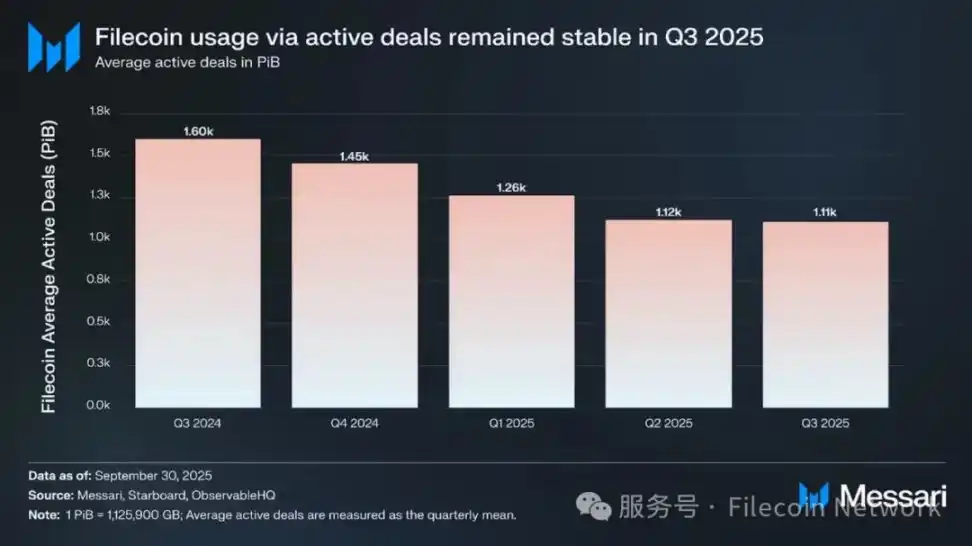
In Q3 2025, the total amount of data stored on Filecoin through active exchanges reached 1,110 PiB, a mere 1% decrease from 1,120 PiB in Q2, indicating that overall on-chain storage demand remained stable. The average number of active transactions decreased slightly by 1% to 35.2 million. Despite the continued shrinking of total network capacity, this small decrease in data volume highlights Filecoin's ongoing transformation from maximizing raw storage supply to supporting higher-value, enterprise-grade, and proven data workloads.
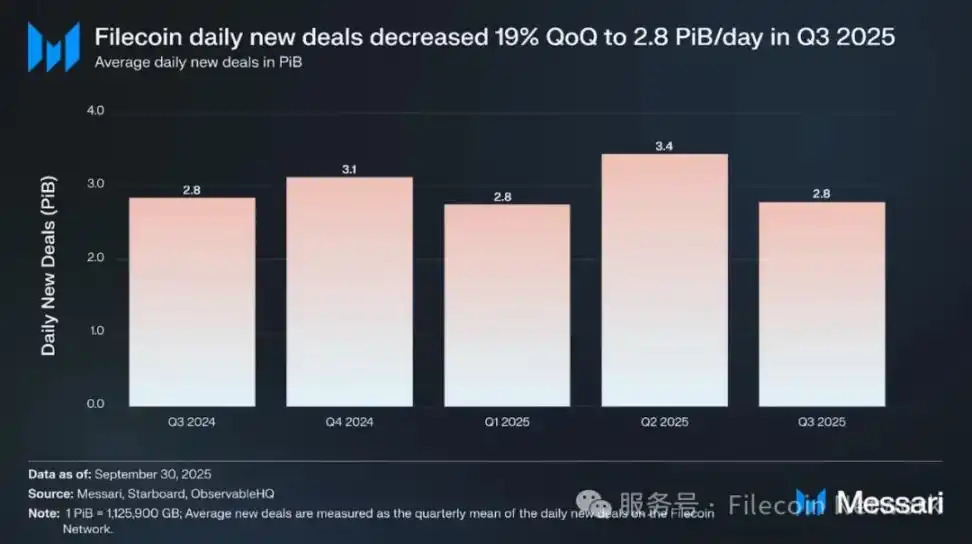
In Q3 2025, Filecoin's average daily new storage transactions decreased by 19% quarter-over-quarter, from 3.4 PiB to 2.8 PiB. This trend, contrary to the growth of the previous quarter, reflects a cooling of new data coming online, although total active storage remained largely stable (decreasing only from 1,120 PiB to 1,110 PiB). This divergence suggests that the pace of new data coming online has slowed, but existing verified datasets have remained stable.
Launched at the end of Q2 2025, Filecoin Plus (Fil+) Allocator Pathways prioritized serving large, verified data clients and streamlined the onboarding process for enterprise users. This resulted in a decrease in the number of transactions, but higher value per transaction. Currently, verified storage dominates total network activity, while smaller, shorter-term transactions have virtually disappeared. Meanwhile, the network v27 "Golden Week" upgrade simplified SP operations and deprecated several older encapsulation and aggregation methods, temporarily leading to a decrease in new transactions as storage providers needed time to adapt to the new toolset. Miner consolidation is another reason, with many smaller operators opting to exit due to stricter efficiency standards and increasing staking requirements.
Despite a short-term decline in new transaction volume, overall utilization improved as existing validated datasets remained active. These datasets are particularly relevant to long-term archiving, research, and enterprise use cases introduced through projects such as the "Culture and Science Conservation Programme" launched in the third quarter.
Utility vs. Capacity
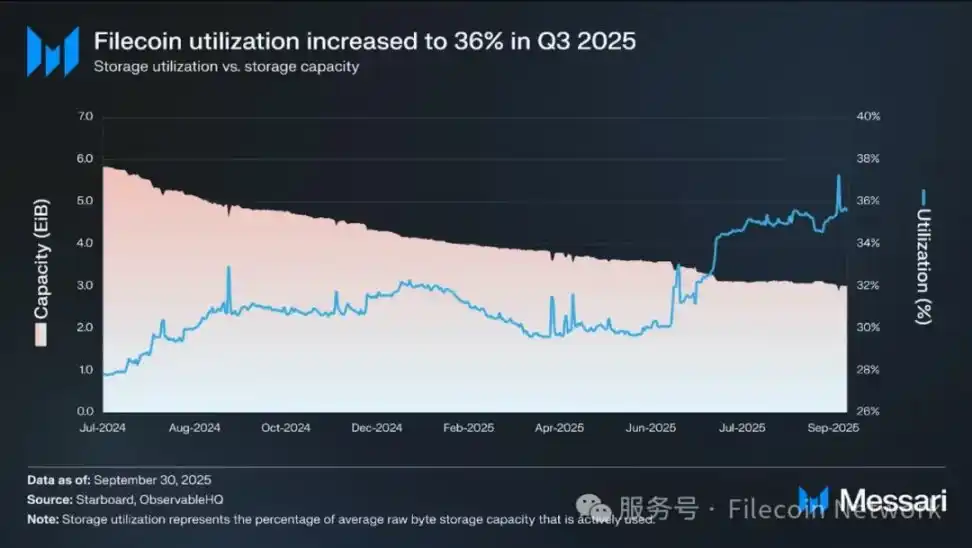
In Q3 2025, Filecoin's storage utilization rate rose to 36% from 32% in Q2, while the total committed network capacity decreased by 10% quarter-over-quarter, from 3.3 EiB to 3.0 EiB. This inverse trend reflects the ongoing SP consolidation and right-sizing of the network. The decrease in total capacity was primarily due to the exit of some smaller or underperforming storage providers from the network following the introduction of stricter operational and staking requirements in the network v27 "Golden Week" upgrade. This upgrade, through proposals such as FIP-0101, FIP-0103, and FIP-0106, simplified sector encapsulation and maintenance processes, abandoned outdated and inefficient workflows, and prompted some SPs to scrap their obsolete infrastructure. Simultaneously, the average daily number of new transactions added decreased by 19% quarter-over-quarter, reducing the inflow of new data. Therefore, despite the shrinking total network capacity, the remaining storage space was utilized more efficiently, thus increasing utilization despite the smaller network size.
client
Filecoin currently targets enterprises and developers, providing cold storage solutions (e.g., data archiving and recovery). Its low storage costs help attract traditional businesses seeking cost-effective alternatives to archive massive amounts of data.
DeStor, a Filecoin service provider connecting customers and storage providers, has partnered with Qamcom's Decentralized Data Security (DDS). Potential data clients for this partnership include YayPal, a Web3 game studio with over 500,000 users, and Fieldstream, an AI-powered marketing analytics platform. Other examples of client-side solutions are as follows:
GhostDrive: Focuses on enhancing privacy and security through encryption, decentralization, and innovative storage optimization technologies;
• CIDGravity: Focuses on enterprise-grade integration with open-source platforms such as Nextcloud.
In addition to cold storage, projects such as Lighthouse, Akave, and Storacha are also driving the development of other storage solutions.
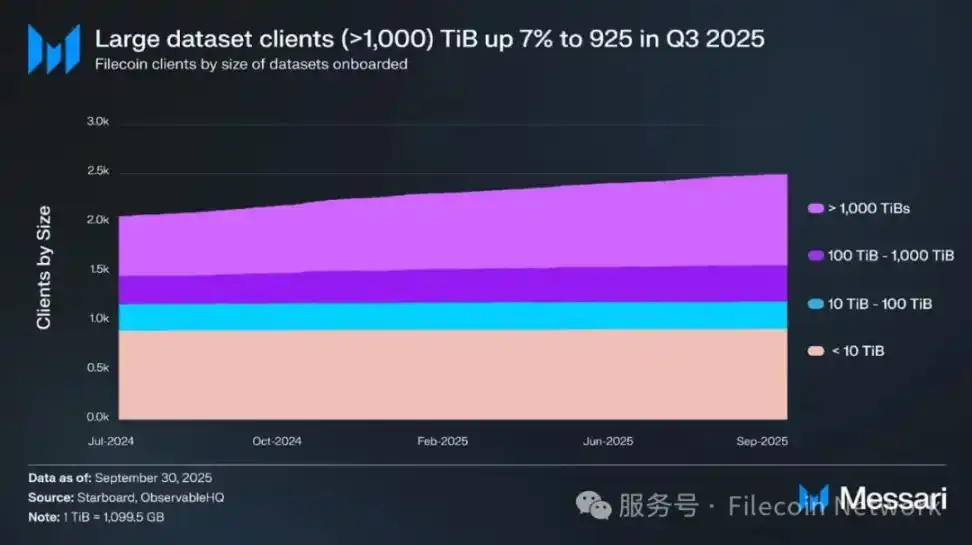
As of the end of Q3 2025, Filecoin hosted 2,491 live real-world datasets, a 3% increase from 2,416 in Q2. Of these, 925 datasets exceeded 1,000 TiB, a 7% increase from 864 in Q2, highlighting the continued adoption of high-capacity, persistent storage. This growth was driven by ongoing Filecoin Plus launches, new on-ramp integrations (lowering the barrier to entry for datasets), and increased enterprise and research workloads.
The development momentum of FVM
The Filecoin Virtual Machine (FVM) allows developers to deploy Ethereum-like smart contracts directly on top of Filecoin's storage layer, enabling them to build applications that automate processes such as data uploading, pricing, retrieval, and computation coordination.
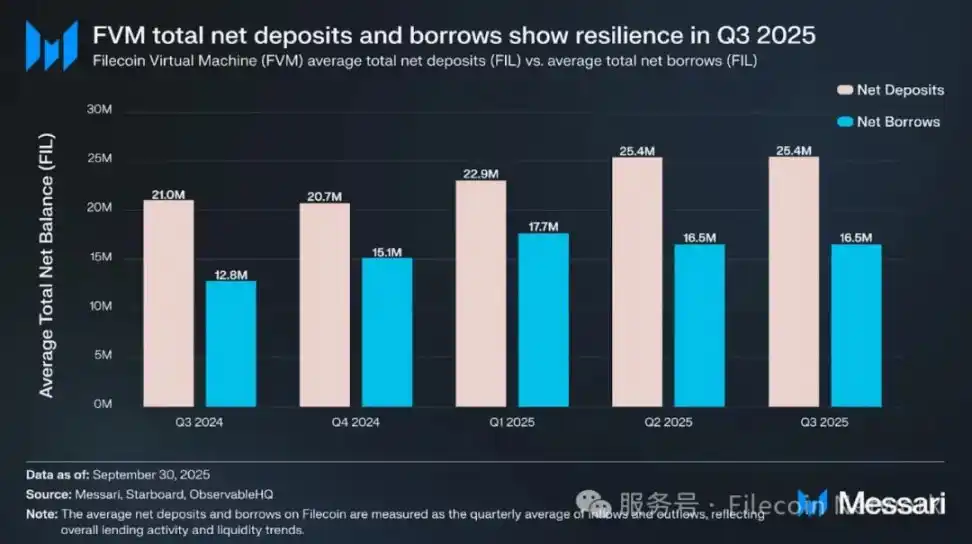
In the third quarter of 2025, Filecoin's total inflows (net deposits) were $62.4 million, a 6.5% decrease from $66.8 million in the second quarter; while total outflows and lending decreased by 6.8% during the same period, from $43.4 million to $40.5 million.
However, when measured in FIL, token activity shows the opposite trend: inflows increased slightly by 0.16% quarter-over-quarter, from 25.39 million FIL to 25.43 million FIL; while outflows decreased slightly by 0.03%, from 16.53 million FIL to 16.52 million FIL. This difference is due to a 5% drop in the price of FIL this quarter (from $2.30 to $2.19), which reduced the dollar-denominated value of what should have been a stable flow of on-chain tokens.
Financial Overview
Filecoin's revenue model is similar to Ethereum's because it employs a gas mechanism inspired by EIP-1559, where a portion of network fees is burned to alleviate network congestion. However, unlike Ethereum, Filecoin's economic model is storage-driven, with storage users paying fees and storage providers earning revenue while managing collateral and penalties.
Internet fees
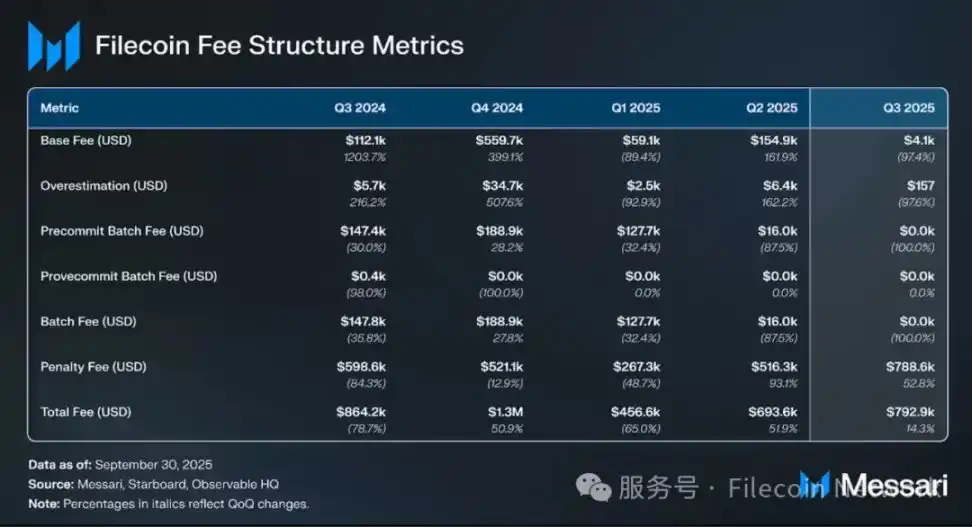
According to Messari's revenue analysis, Filecoin's fees are structured as follows:
• Base Fees: Determined by the congestion level of the block space, any storage proof must be paid.
• Batch Fees: Used to bundle multiple storage proofs to optimize costs.
• Overestimation Fees: Fees paid to optimize gas usage.
Penalty Fees: Fees levied due to storage provider failures or violations.
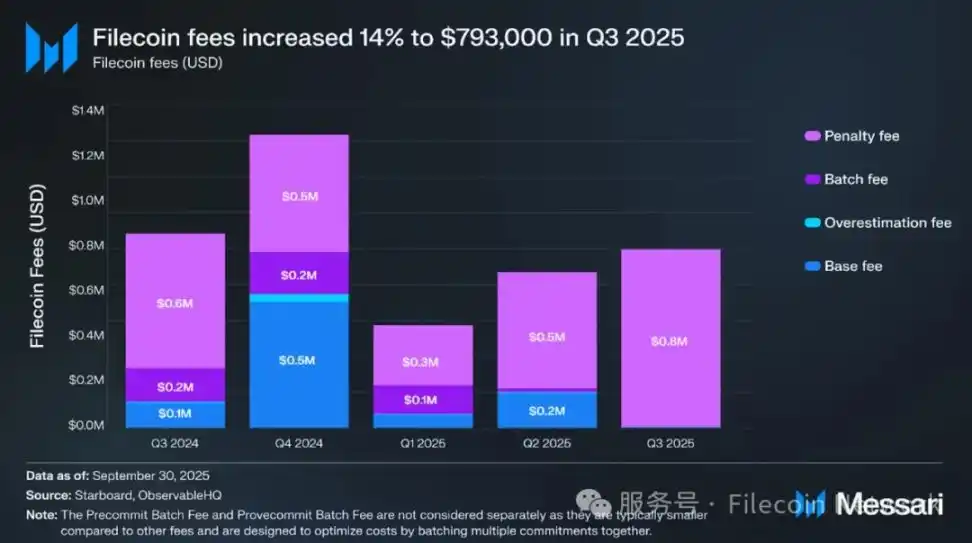
In the third quarter of 2025, Filecoin's total network fees reached $792,900, a 14.3% increase quarter-over-quarter from $693,600 in the second quarter of 2025. This increase was almost entirely driven by penalties, while base fees and volume-related fees had largely collapsed following the protocol-layer changes introduced in the network v27 upgrade.
• Base fees: Plunged 97% quarter-over-quarter to $4,100. This decrease reflects a reduction in on-chain transaction throughput following the deprecation of several sector-related methods (FIP-0103, FIP-0106, FIP-0101), rather than a decrease in network demand.
• Bulk fees: decreased by 100% quarter-over-quarter to $0. This is consistent with the trend of reduced sector liveness and a continued decline in total active storage, resulting in a significant decrease in bulk pre-commit transactions submitted by SPs.
• Excess estimated costs: plummeted 98% sequentially to just $157 (compared to $6,400 in the previous quarter), reflecting a corresponding decrease in gas-related activity as overall transaction frequency declined.
• Penalties: Surge 53% month-over-month to $788,600, representing approximately 99.5% of total network fees. This surge likely reflects an increase in slashing incidents during network restructuring and miner exits under stricter operational requirements.
The third quarter was a transitional period for Filecoin's economic model, with the network streamlining operational processes under version v27. The reduction in batch and base fees reflects the network's shift from a high-volume, short-cycle launch model to a smaller but larger volume of verified transactions. Meanwhile, the surge in penalties highlights the operational pressure on smaller providers due to stricter quality standards. These trends indicate that the network is undergoing a consolidation phase, with reduced fee activity from expansion but increased execution and efficiency from existing participants.
Market capitalization
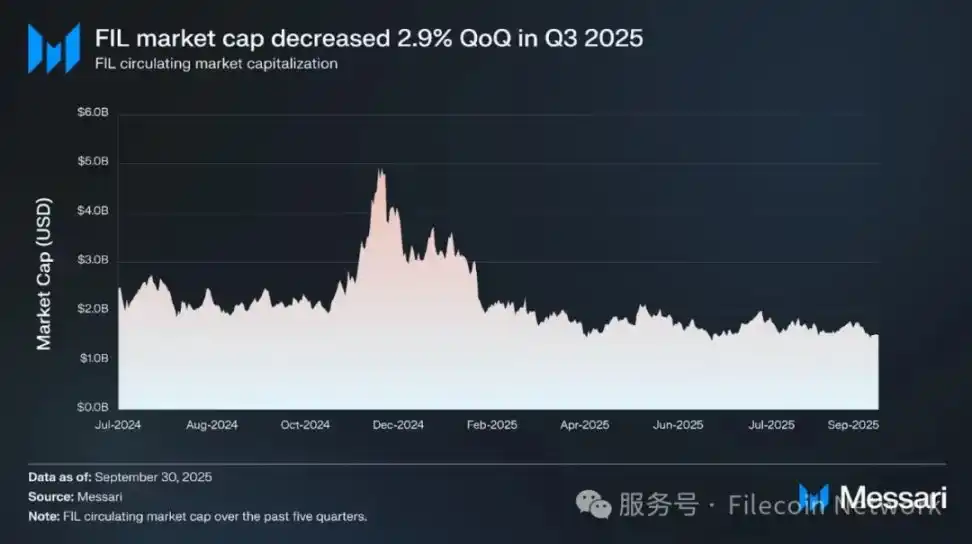
In the third quarter of 2025, FIL's circulating market capitalization decreased by 3% quarter-over-quarter to $1.5 billion, down from $1.6 billion in the second quarter of 2025. This decline was primarily driven by a 5% quarter-over-quarter drop in the FIL token price (from $2.30 to $2.19), while the circulating supply increased by 2.2% quarter-over-quarter to 692.4 million FIL, consistent with the previous issuance rate.
DeFi ecosystem
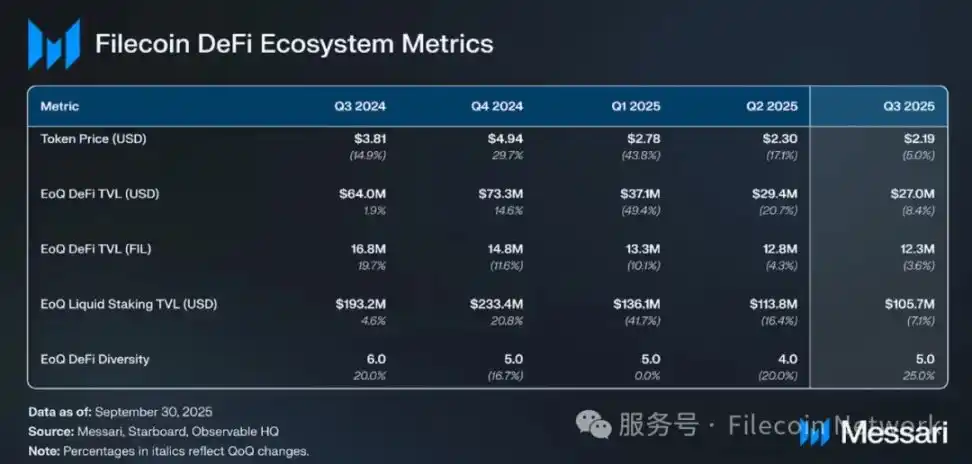
In the third quarter of 2025, total FIL pledged decreased slightly by 0.4% quarter-over-quarter, from 127.6 million FIL to 127.0 million FIL, marking the fifth consecutive quarter of decline. In USD terms, the total value of pledged assets decreased by 5.4% to $277.9 million, primarily due to a 5% drop in FIL prices during the quarter, rather than a significant change in staking activity.
The eligible supply collateral ratio remained stable at 17%, unchanged from the second quarter, but lower than the 19% in the first quarter of 2025, reflecting stable but relatively low network participation. Meanwhile, the annualized nominal yield dropped sharply from 52% to 24%. This is because the short-term yield surge in the second quarter due to decreased collateral participation and inflation-driven reward payouts has returned to normal levels after collateral activity stabilized.
TVL Trends
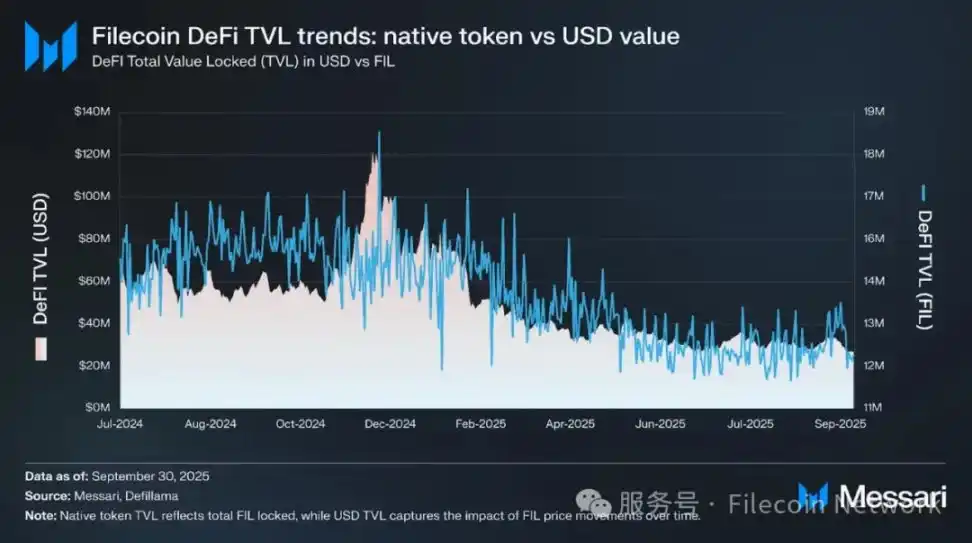
In the third quarter of 2025, Filecoin's DeFi activity continued to contract, extending the downward trend that began in early 2024. The total value locked (TVL) in DeFi at the end of the quarter decreased by 8.4% quarter-over-quarter to $27 million, down from $29.4 million in the second quarter, marking the fifth consecutive quarter of decline. When measured in FIL, the decline in TVL was much more moderate, decreasing by 3.6% quarter-over-quarter to 12.3 million FIL, indicating that most of the value decline was caused by a 5% drop in the price of FIL, rather than a substantial capital outflow.
TVL for liquidity staking also showed a similar trend, declining 7.1% quarter-over-quarter to $105.7 million. This was due to staking rewards returning to normal after the surge in yields in the second quarter, while network incentives gradually weakened. In FIL terms, core liquidity products and staking participation remained stable, indicating that even with a decline in user dollar-denominated metrics, user and network engagement remained healthy.
Stablecoins
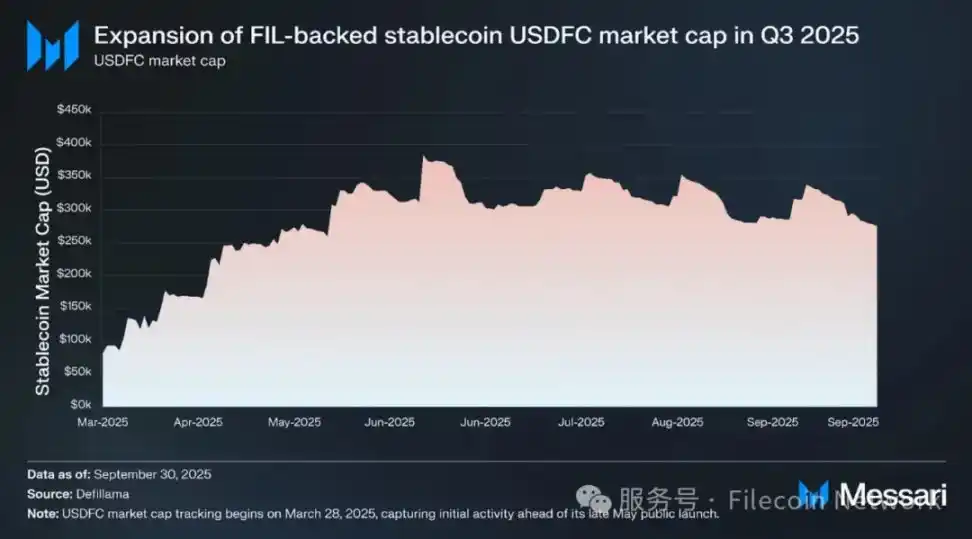
USDFC is a FIL-backed stablecoin launched by Secured Finance in early 2025. It aims to increase liquidity within the Filecoin economy by allowing FIL as collateral and reducing selling pressure on FIL. It provides a native, USD-pegged asset for trading, lending, and DeFi applications, accessible to users without leaving the Filecoin network.
In the third quarter of 2025, the circulating supply of USDFC decreased by 8.5% quarter-over-quarter, from $301,000 at the end of the second quarter to $275,000 on September 30, marking its first contraction since its launch. After peaking at nearly $355,000 in mid-August, the stablecoin's circulating supply declined modestly throughout September as DeFi activity and yield opportunities cooled.
This pullback was market-driven, not a structural issue. The 5% drop in FIL price reduced the value of collateral supporting new issuances, while staking and DeFi yields returned to a normal level of 24% from a short-term peak of 52% in Q2, reducing the incentive for liquidity providers and borrowers to mint. Following the network v27 "Golden Week" upgrade, participants prioritized protocol stability, also leading to a broader reduction in on-chain liquidity.
Despite this mild contraction, USDFC has maintained full anchor stability and healthy circulation, demonstrating stable confidence among storage providers and DeFi participants. This contraction is not a sign of weakness, but rather a natural consolidation phase following rapid expansion in the second quarter, laying the foundation for more robust growth as the FIL-based market and FVM-based integration solutions mature in 2025.
Qualitative analysis
Protocol upgrade
Filecoin Network v27 Upgrade (Codename: "Golden Week"): The Filecoin Network v27 upgrade (codename: "Golden Week") was successfully deployed at block height 5,348,280 on September 24, 2025, and officially completed the following day (September 25). This version focuses on simplifying the operations of storage providers (SPs), improving EVM compatibility, and reducing technical debt.
Key Filecoin Improvement Proposals (FIPs) implemented include:
• FIP-0105: Introduces the BLS12-381 pre-compiled contract (equivalent to EIP-2537) for Filecoin EVM to support efficient BLS signature verification and achieve cross-chain interoperability with Ethereum-based Rollup solutions.
• FIP-0077: Introduces a deposit requirement for newly created Storage Provider (SP) IDs, amounting to 10% of the initial pledge amount for 10 TiB of storage capacity (approximately 4 FIL at current rates), designed to curb the creation of spam accounts and improve network state efficiency.
• FIP-0103 / FIP-0106 / FIP-0101: Removed deprecated methods (such as "extend sector lifecycle", "proof copy update", "proof aggregation commit") to streamline the logic and maintenance of SP Actors.
• FIP-0109: Enables smart contract notifications for the Direct Data Publish (DDO) feature, allowing on-chain applications to subscribe to storage events and programmatically trigger corresponding workflows.
• FRC-0108: Extends the snapshot format to include Fast Finality (F3) certificates, thereby reducing node synchronization time and bandwidth requirements for new participants.
All major client implementations (Lotus, Venus, Forest, Curio, Boost) released compatible versions prior to the upgrade activation. This upgrade enhances developer tools and aligns the Filecoin Virtual Machine with the Ethereum standard, laying the foundation for a market of programmable data services and retrieval.
Cultural and scientific data storage on Filecoin
On September 30, 2025, the Filecoin Foundation announced a new batch of partners who will preserve cultural and scientific archives on the Filecoin network. This initiative builds on earlier collaborations with several prominent institutions and highlights Filecoin's growing role as a decentralized physical infrastructure network (DePIN) in persistent, verifiable, and censorship-resistant data storage. The new datasets to be preserved on Filecoin include:
• Digital Public Library (DPLA): A pilot project designed to store a selection of materials from its more than 50 million cultural collections, such as photographs, oral histories, and government documents.
• Earth Species Project (ESP): Preserves the BEANS-Zero benchmark dataset, which was used to train NatureLM-audio—an audio language model for animal vocalizations—to ensure that researchers worldwide have flexible access to this data.
• Prelinger Archives: Tens of thousands of archival films documenting American social and cultural history, including Rick Prelinger's Lost Landscape series.
• Rohingya Project: A community-led archive that aims to preserve the cultural identity and oral history of stateless Rohingya communities.
• CROSSLUCID's "Oceanic Whispers": Partially developed in collaboration with RadicalxChange, it is an experimental data trust that stores datasets from marine protected areas on Filecoin and transforms them into an AI-generated, interactive experience with a fractional ownership revenue model.
These collaborations collectively demonstrate how decentralized storage can support the preservation of open science and culture through verifiable and tamper-proof archiving.
Ecological integration and cooperation
Filecoin Foundation and GSR Foundation Impact Cohort: On July 23, 2025, the Filecoin Foundation announced a partnership with the GSR Foundation to launch the Impact Cohort. This joint initiative aims to support five blockchain-based public welfare projects within the Filecoin ecosystem. The GSR Foundation, the philanthropic arm of digital asset market maker GSR, has partnered with the Filecoin Foundation to fund The Starling Lab for Data Integrity, the Easier Data Initiative, the Transfer Data Trust, Akashic, and CROSSLUCID's "Whispers of the Ocean." Each project applies decentralized storage to areas of social impact, such as digital truth preservation, geospatial data access, arts governance, and environmental management. This collaboration underscores Filecoin's crucial role as a core technological infrastructure supporting social impact and real-world applications.
S3-Compatible Object Storage with Akave Cloud: On September 16, 2025, Akave announced the launch of a Filecoin-powered, S3-compatible object storage service designed for enterprise and DePIN applications. This integration allows developers and organizations to store and access data using the standard S3 API, while benefiting from Filecoin's verifiable storage and retrieval guarantees. Akave's release aims to connect traditional cloud tools with decentralized infrastructure, simplifying the migration process for enterprises to blockchain storage and enabling verifiable, low-latency "warm" data use cases by supporting proof-of-data ownership (PDP).
Storacha's Bluesky Backup Application: Storacha is a decentralized hot storage network built on Filecoin and IPFS, which launched bsky.storage on June 12, 2025 (its adoption continued to expand in Q3). This is a user-facing application that automatically backs up Bluesky social data hourly. The tool enables users to independently export and restore their own posts and identity keys, further reinforcing Filecoin's grand vision of achieving data portability, user ownership, and self-sovereign digital identity.
Developer Programs and Community Growth
The 7th Filecoin Developer Summit (FDS-7): Announced in September 2025, the 7th Filecoin Developer Summit will be held online from October 16-17, with an in-person event in Buenos Aires from November 13-15 during DevConnect Argentina. This summit will focus on scaling Filecoin to accommodate enterprise-grade and data-intensive applications and will explore advancements brought by network version v27, including Direct Data on Deployment (DDO), BLS precompiled contracts, and Fast-finality snapshots, as well as new retrieval marketplaces and AI data workflows.
Filecoin Onchain Cloud (Alpha Project): On August 12, 2025, FIL-Builders and FilOz launched the Onchain Cloud Alpha Cohort. This initiative introduces modules such as on-chain payments, warm storage, standardized retrieval interfaces, and service level agreements (SLAs) based on smart contracts, enabling developers to easily deploy decentralized data services as if using smart contracts.
PL Genesis Hackathon – “Hack the Sovereign Data Layer with Filecoin”: As part of Protocol Labs’ “Modular World” series, this hackathon began in early June and ran until July 6, 2025. The event invited developers to experiment with decentralized data ownership and retrieval using Filecoin’s on-chain technology stack, exploring new applications for programmable storage and verifiable data access. The winning projects, announced on September 5, 2025, showcased innovations such as smart contract-based retrieval logic, verifiable AI datasets, and developer tools for Data DAOs. With a total prize pool of $15,000, the hackathon enhanced developer engagement within Filecoin’s evolving on-chain cloud ecosystem.
Orbit Program and Community Events: Throughout September 2025, the FIL Builders Orbit Program expanded its global developer reach with a series of community workshops and hackathons. Highlights included the FIL Warsaw (September 5) and ETHAccra (September 4-6), featuring AI and DeFi bounty challenges; Code & Corgi workshops in Pune (September 12) and Delhi (September 25); and Decentralized Storage 101 (September 18), co-hosted with Pacific Meta in Japan. These events focused on developer education surrounding the Filecoin Virtual Machine (FEVM), data deployment tools, and community-led open-source development.
Key Governance Progress
ProPGF Batch 1: On August 11, 2025, Protocol Labs completed its first Filecoin Public Goods Funding (ProPGF) allocation, distributing $3.68 million to 14 ecosystem projects, including IPNI, CID Gravity Gateway, Curio Storage, Fil Ponto, and FilCDN Retrieval Services. This program supports forward-looking infrastructure and developer initiatives to strengthen Filecoin's core ecosystem and long-term sustainability.
RetroPGF Round 3: On August 25, 2025, the third round of RetroPGF (Retrospective Public Goods Grant) was launched, allocating 585,000 FIL to retrospectively fund contributors who have delivered verifiable impact across the ecosystem. This round adopts an Optimism-style public goods grant model, rewarding open-source contributions in infrastructure, tools, research, and customer launches, reinforcing Filecoin's commitment to sustainable, impact-driven ecosystem growth.
Filecoin Plus (Fil+) Allocator Path: As of September 2025, the Fil+ governance team reviewed over 140 allocator applications, with an approval rate of approximately 75%, and distributed over 450 PiB of DataCap (data quotas). A new meta-allocator path was introduced to streamline enterprise onboarding processes and automate allocation tools. Regular governance calls in August and September, along with released recordings, improved transparency, accountability, and operational efficiency within the program.
Summarize
In the third quarter of 2025, Filecoin's circulating market capitalization decreased by 3% quarter-over-quarter to $1.5 billion, primarily due to a 5% drop in the price of FIL to $2.19, while the circulating supply increased by 2.2%. Network activity remained stable, with active storage decreasing slightly by 1% to 1,110 PiB, and network utilization increasing from 32% to 36% due to a 10% capacity contraction caused by SP consolidation.
The network v27 "Golden Week" upgrade simplified storage operations, deprecated the old sector method, and enhanced FVM compatibility. While this temporarily slowed the formation of new transactions, it improved long-term efficiency. Economic activity returned to normal, with total network fees increasing by 14% quarter-over-quarter to $793,000, primarily driven by penalties; staking participation remained at 17%, and yields fell from 52% to 24%. As on-chain yields cooled, DeFi TVL decreased by 8% to $27 million, and the FIL-backed stablecoin USDFC contracted by 8.5% to $275,000.
On the ecosystem front, the Filecoin Foundation advanced cultural and scientific preservation efforts and launched a joint funding project group with the GSR Foundation; Akave and Storacha announced new applications for the network; and FIL-Builders and FilOz expanded their developer programs through the On-Chain Cloud Alpha project group and the PL Genesis hackathon. The team also announced FIL Dev Summit 7, scheduled to be held in Buenos Aires in November 2025 during DevConnect Argentina, to showcase Filecoin's evolution towards a verifiable, programmable data infrastructure.
Overall, the third quarter reflected a consolidation phase, with the network becoming leaner and more efficient, focusing on validated data, enterprise storage, and laying the foundation for compute-over-data services.
Click to learn about BlockBeats' job openings.
Welcome to the official BlockBeats community:
Telegram subscription group: https://t.me/theblockbeats
Telegram group: https://t.me/BlockBeats_App
Official Twitter account: https://twitter.com/BlockBeatsAsia