Roma Protocol recently successfully passed a comprehensive audit by CertiK , the world's leading blockchain security organization. This achievement marks the fact that its core architecture has reached industry standards in terms of security and stability. As the DeFi industry transitions from being dominated by speculation to being driven by technology, security, sustainability, and cycle resilience are becoming the key competitive competencies of new-generation protocols, and Roma Protocol has demonstrated its unique value in this context.
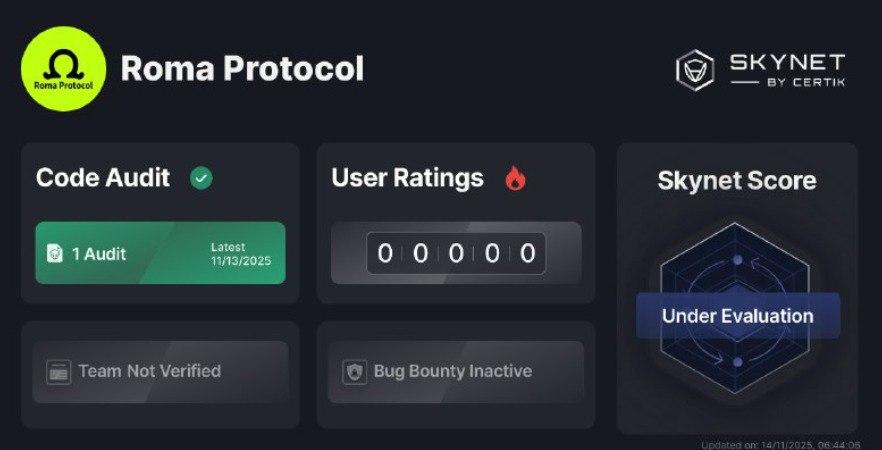
After completing the audit, the outside world focused more on how its core mechanisms support the long-term growth of the ecosystem. Overall, the system built by Roma Protocol revolves around four core goals: stabilizing liquidation, curbing short-term speculation, promoting value return, and implementing DAO- based decentralized governance. These designs together form a full- chain value engine that fits the needs of DeFi4.0 .
First, in terms of Token economics, the ROMA Token adopts a fixed total supply model, driven by deflation, and allocates the majority of Token to the treasury reserve, Pool LP , and Node incentives. By deeply linking Token value growth with ecosystem expansion, Roma Protocol has built a solid long-term value foundation.
Second, the Roma Protocol 's permanent LP market-making structure ensures the stability of liquidation sources. After users Stake , the system automatically completes the purchase of ROMA and builds LP shares, and the liquidation is deposited by the blackhole address , eliminating the risk of manipulation and withdrawal of liquidation by the mechanism. Profit, buyback and burn are completely implemented by smart contracts , forming a continuously reinforced "Stake - value growth - deflation" cycle.
In order to improve the price stability of the secondary market, Roma Protocol has established a trading mechanism to limit short-term speculation, including the design of Timelock/Locktime and trading constraints, to minimize the impact of short-term selling pressure. The proceeds from the buying and selling slippage are used for buyback and burn , enhancing liquidation and rewarding Nodes , further consolidating the Token circulation structure and price safety boundary.
At the governance level, Roma Protocol puts all community and funding decision-making power on-chain through DAO . Profit Tax allocation, operating incentives, and Node rewards are all decided by on-chain voting, ensuring the protocol operates transparently while giving ecosystem participants true governance power, embodying the core spirit of decentralized finance.
Overall, the mechanism design of Roma Protocol adheres to the principles of leanness, transparency and risk-resistance. Through the coordination of Token model, LP structure, transaction mechanism and DAO governance, it has created a sustainable growth architecture that can adapt to the needs of the DeFi4.0 era. In the trend of the industry gradually moving towards rational construction, value accumulation and cross-chain integration, such platform logic and technical design will become a highly competitive basic construction.
Roma Protocol Aims for a Safer, More Open, and More Everlasting DeFi4.0 Future
By successfully passing the CertiK audit, Roma Protocol has completed the most important first step in the DeFi4.0 era—consolidating the "safe foundation." In the future, along with the expansion of the Node system, the implementation of Multi-Chain interoperability, the integration of RWA (Real World Assets), and increasingly mature autonomous governance, Roma Protocol will further expand its layout in the DeFi field.
Not only does it have the potential to become a core bridge between on-chain and off-chain values, but it can also propel the new generation of decentralized finance towards a new stage of safety, transparency, and long-termism.
Roma Protocol 's path is still being unfolded, but the direction it is building is becoming a blueprint for the new order of DeFi4.0 . And in this journey towards the future, every participant is a co-builder of this "digital Rome".
Official Twitter: @RomaProtocol