Author: Tian Daxia (@Web3Donny)
On the day I interviewed Guo Yu, he had just returned to Tokyo from Hokkaido.
It was May of this year, just as Tokyo's rainy season was beginning. In the video interview, he spoke of Hokkaido's summer with a rare lightness in his voice.
"I prefer Hokkaido in the summer to winter."
Guo Yu said that Furano is crowded with tourists looking at Christmas trees in winter, while in summer Furano is only covered with rolling green hills. He and his friends drove through undisturbed roads, hiked, and soaked in hot springs, briefly escaping the humidity of Tokyo in the dry and cool air.
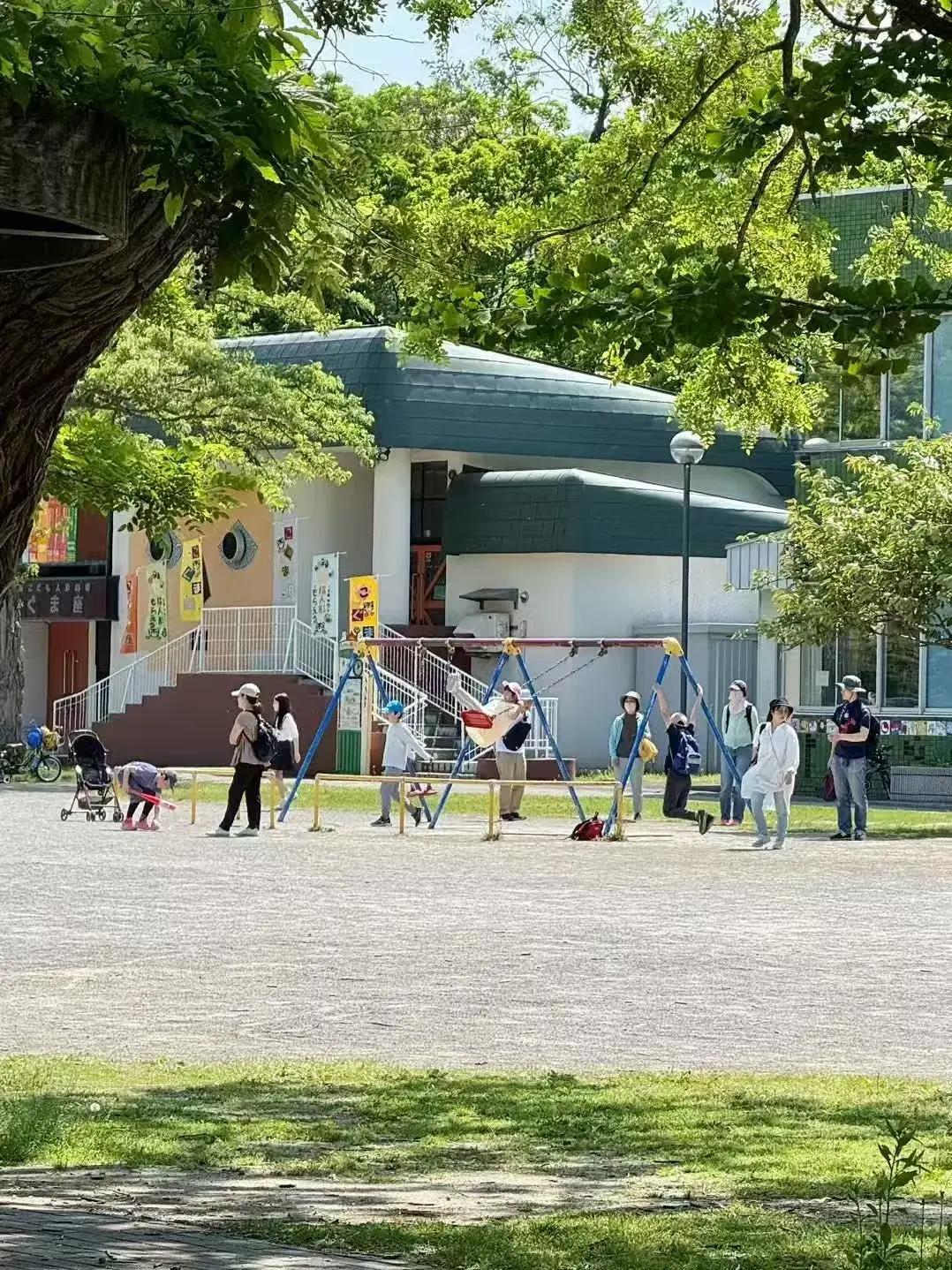 Guo Yu's trip to Hokkaido
Three months after the interview, Guo Yu's travels extended to Tanzania, Sri Lanka, and his "happy hometown" Maldives. After he finished his Middle East trip, I contacted him again.
Travel has become a part of his daily life, and he seems to have gotten used to marking the passage of time with new geographical coordinates.
This former internet entrepreneur and digital nomad seems to be forever on the move. More than five years into his retirement, his understanding of "freedom" appears to have become even clearer:
“In the past, I thought that financial freedom meant absolute freedom, but that was a wrong judgment… The most important thing is that we need to realize this issue and its importance very early in life.”
 Guo Yu
Who is Guo Yu?
Guo Yu became known to the public in 2020. That year, he wrote the following sentence in a resignation letter—
"I chose to retire at the end of my 28th year to embrace the mountain springs and the wind in the valleys, and to experience the spring, autumn and winter seasons."
Four months later, the letter was suddenly unearthed, quickly igniting a discussion across the internet: some people were envious, some questioned it, and some regarded him as a representative of "lucky ones in the internet entrepreneurship boom".
The words "young," "retired," and "financially free" have become his labels. He has become the "escape template" that countless young people imagine.
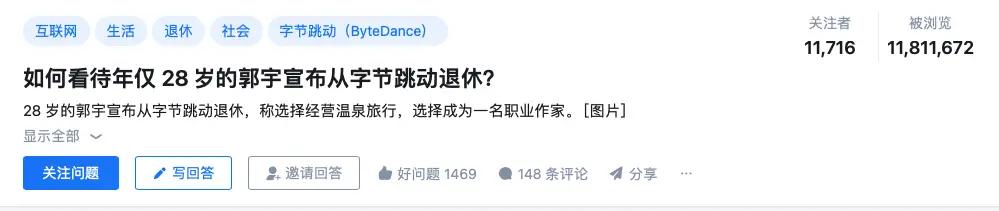
At that turbulent juncture in the post-pandemic era, he became the most vivid "reverse example" on social media— a person who turned away from the tide of the times.
Childhood and Growth
Guo Yu spent his childhood in the mines of Jiangxi. As a left-behind child, his summer and winter vacations were often extremely lonely. His only solace came from the Christian books left to him by his grandmother and the self-expression that writing brought him. These words and faith became the most important spiritual outlet in his early life.
Later, he came to Shenzhen Senior High School to study. The education there made him realize for the first time that "choice is more important than effort".
In this school, many students were children of entrepreneurs, anxious that "if they don't get into an Ivy League school, they'll have to go back and inherit the family business." Guo Yu, however, was facing the reality of his father being bedridden. Shenzhen's open atmosphere and diverse values shaped his "never accepting fate" character.
For him, fate is not predetermined, but rather a process that can be constantly rewritten through choices and actions.
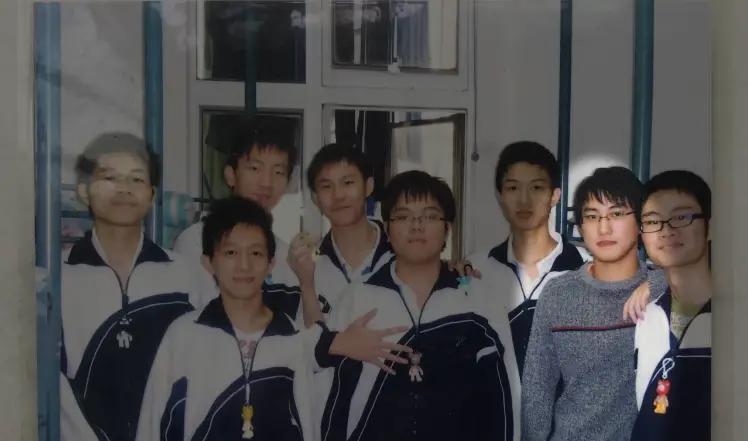
Guo Yu during high school
Later, he was admitted to Jinan University, majoring in Politics and Public Administration. However, Guo Yu soon realized that this major would not be enough to support his future livelihood. So, he began to teach himself programming.
"At that time, there was no other way to go, and I had to find a way to support myself." With this persistence, he successfully joined Alipay, a subsidiary of Alibaba, after graduation, where he accumulated his initial industry experience.
During the golden age of the internet, Guo Yu seized his own opportunity and became part of the "options myth".
In 2014, Guo Yu's startup was acquired by ByteDance, and he officially joined this startup, which was valued at only $500 million at the time. From then on, his life was propelled into a frenzy of wealth and dreams.
As an early employee, he devoted himself wholeheartedly to the development of the company's core projects. ByteDance's valuation skyrocketed a hundredfold in six years, and the stock options Guo Yu acquired early on increased in value accordingly.
Investment and Crypto Experience
Over the past decade, he first rode the wave of the internet to achieve financial freedom, and then turned into a calm observer of the crypto field, witnessing several rounds of rise and fall in the crypto market. Now, his perspective is becoming increasingly clear.
His recent tweet has resonated widely in the crypto community.
He wrote: "Many friends in the crypto have no concept of money. All In this today and all in on that tomorrow. Constantly trading, staring at the screen, and sitting in front of the computer can easily detach them from reality. I still recommend that everyone read extensively and travel widely. Spend your money on life experiences. Luxury goods can be bought, money can be earned, but don't get hopelessly addicted."
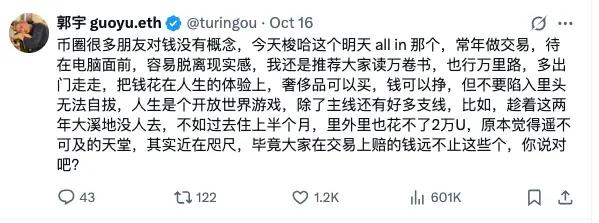
This short sentence resonated with people both inside and outside the industry. Following the black swan event of October 11th, many lamented that they seemed to have lost their sense of reality, forgetting that money could still be spent on "living." Money can never be fully spent or earned, but a life lost can never be regained.
Guo Yu's crypto journey began in April 2013, when he was working at Alipay. He was drawn to the buzz on Hacker News about Bitcoin breaking $100 and discussed it at an internal technical sharing session.
At that time, most transactions were completed through Taobao's OTC channel. He joked that he even bought Ripple, which was being promoted by Justin Sun at the time.
During the ICO boom of 2017, he first attempted to write smart contracts. Even after "retiring" from ByteDance and moving to Japan in 2020, he still published a long article on the Mirror platform in 2021, reflecting on the technological trends he had missed.
If ByteDance's wealth allowed him to "retire" early, then the crypto world was his mental playground, where he maintained his technological acumen and intellectual vitality both before and after retirement.
Now, he is more like an observer and recorder who has stepped back from the spotlight. He admits that he did not participate in the new generation's craze for meme coins like Trump Token, but he "wanted to record these things" because the younger generation is far more sensitive to opportunities than his peers.
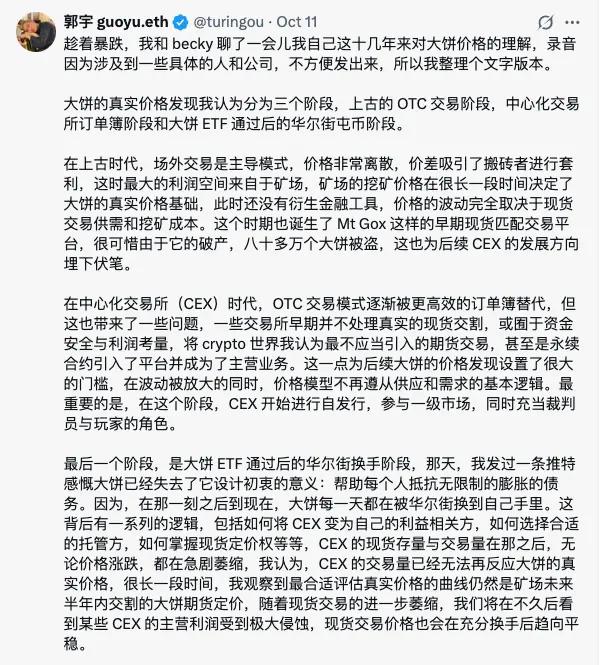
On October 11, a sharp drop in the cryptocurrency market prompted Guo Yu to once again systematically elaborate on his observations of the industry over the past decade on Twitter. He systematically explained his understanding of Bitcoin's price discovery mechanism, dividing the process into three stages.
The first is the "ancient OTC trading phase." He personally experienced that period, when over-the-counter trading was the dominant model, prices were highly dispersed, and for a long time, the mining cost of mining farms determined the true price basis of Bitcoin.
The second phase is the "centralized exchange order book phase." OTC trading was replaced by more efficient order books, but this also brought problems. Some exchanges introduced futures or even perpetual contracts as their main business, and price models no longer followed the basic logic of supply and demand.
The third is the "Wall Street reshuffling phase after the Bitcoin ETF is approved".
Guo Yu believes that from that moment on, Bitcoin lost its original design purpose: "to help everyone resist the unlimited expansion of debt." Because, since that moment, BTC has been being traded by Wall Street every single day.
He observed a sharp decline in spot holdings and trading volume on CEXs afterward, with trading volume no longer reflecting the true price of BTC. He predicted that Wall Street's next step would be to convert mainstream tokens into interest-bearing assets, leading to price stabilization.
"I believe the story of the BTC has come to an end, and the four-year cycle has come to a close."
He wrote his conclusion on the night of the crash: "Unfortunately, this was not what it was really designed for. But it's still a good story."
Unlike many short-term profit-seeking players, Guo Yu still holds onto the crypto assets he bought early on and has never cashed them out.
He laughed and said the reason was actually very simple: "It's too troublesome to pay taxes on cashing out, and I have enough money to spend."
Travel, romance, everyday life
If the crypto world is his "mental playground" in retirement, then his real-world journey is his way of achieving freedom.
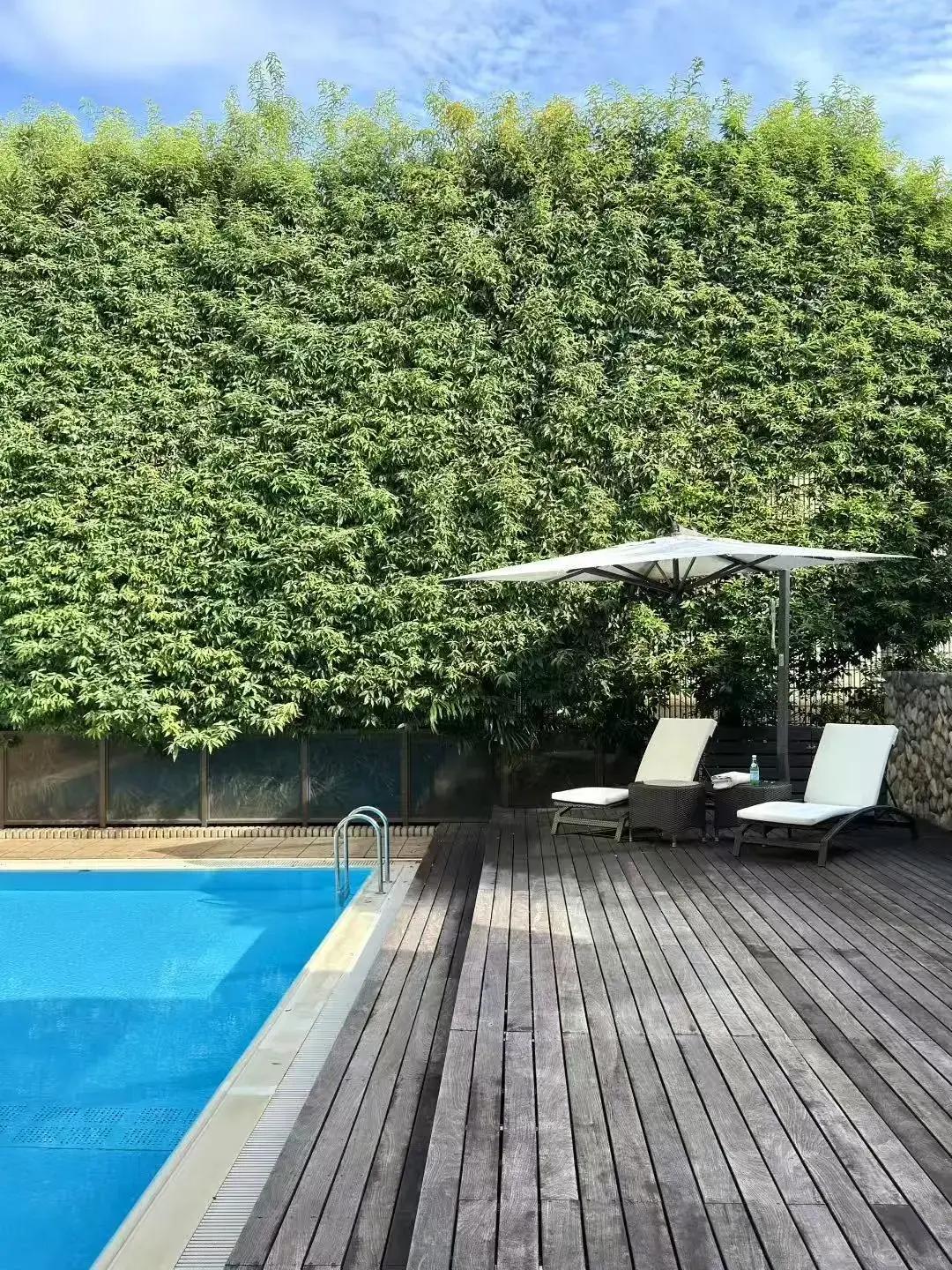
Travel and hot springs are important parts of his life. During the pandemic, he traveled almost all over Japan and stayed in 530 hot spring inns. When talking about the characteristics of different places, he seemed to be dissecting a precise algorithm: Kurokawa Onsen in Kyushu is known for its scenery, Kusatsu Onsen is known for its pH value and minerals, and the mixed bathing culture dates back to the Meiji era.
In Tokyo, he maintained a state of "comfortable detachment": cleaning his room in the morning was like meditation, and he limited himself to watching the stock market for two hours in the evening; when traveling, these routines would be completely broken.
Writing has always been a consistent habit of his. From childhood diaries and high school essays to his current Twitter posts, the form may have changed, but the essence of recording and reflection remains the same. He once wrote for *City Pictorial*, documenting stories of Japanese hot springs. He even openly wrote a "love diary," frankly discussing open relationships.
2020 was the year he faced the most online controversy, with a deluge of comments causing him considerable distress. Now, he has developed a coping mechanism: "Unless it involves family or a partner, I generally don't respond."
This shift can be seen as a strategic form of self-protection. While living in Tokyo, he enjoyed being "invisible": self-checkout at convenience stores, registering under a pseudonym at hot spring hotels, and no one paid attention to his identity.
His MBTI is INFJ. Introverted and reserved, but not in a way that shuts him off in his room. On the contrary, his to-do list is full of "playful plans": getting a sailing license, learning to ride a motorcycle, and trying some adventures he never imagined.
Freedom and Arrival
He said he was not born a "lucky one," but rather built his own path to financial freedom step by step through self-taught programming, seizing industry opportunities, and making rational investments.
That's why he decided to say goodbye gracefully at the age of 28, settle in Japan, and start a different life of writing, traveling, and living.
Now 34 years old, Guo Yu is still on the road. You can see on social media that his journey has never stopped.
The difference is that he is no longer fixated on pursuing the "next destination".
For him, every journey is not about escaping the past, but about reaching a more authentic self.
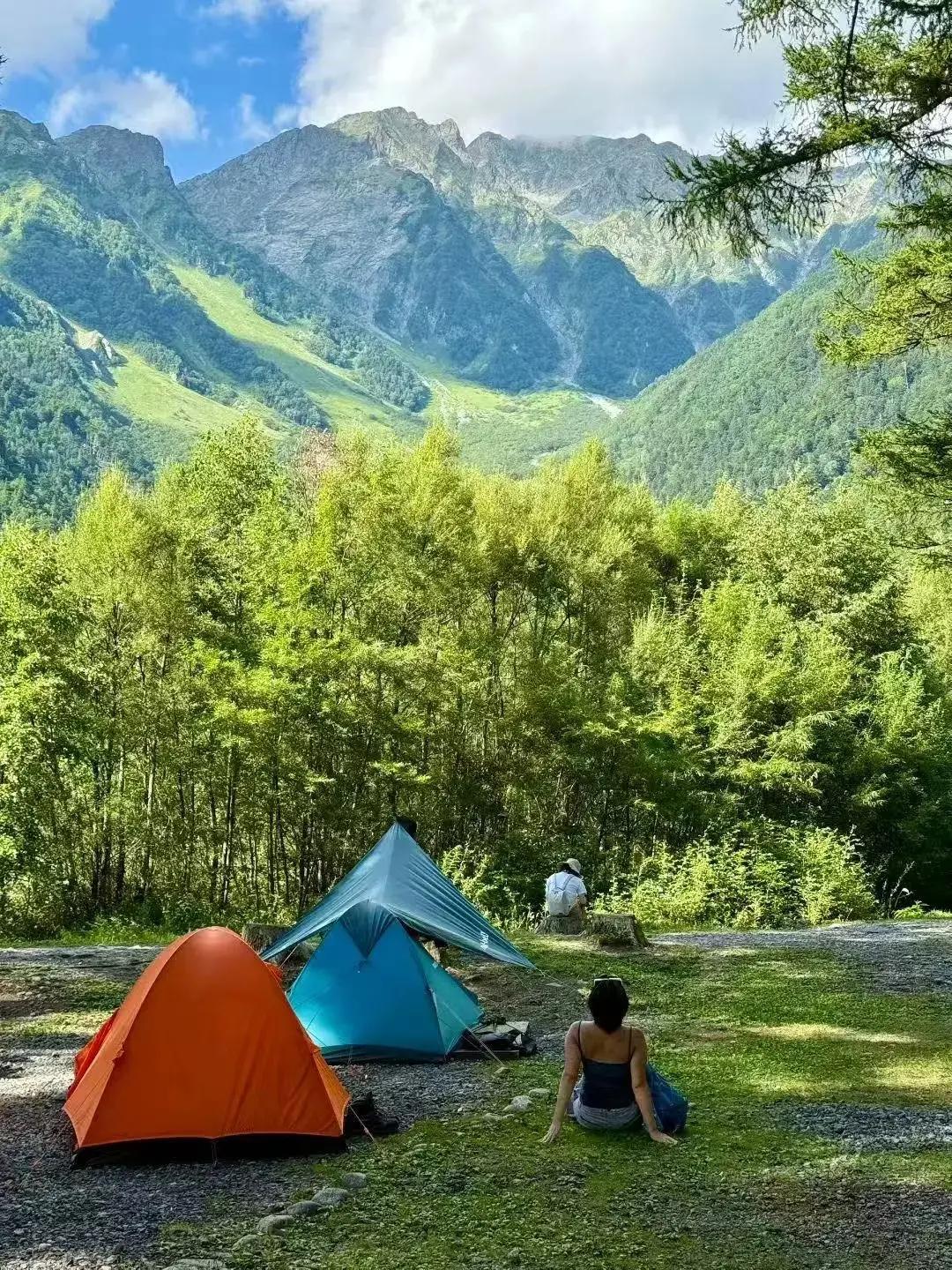
In his "retirement" utopia, he uses freedom as his sole compass, incorporating wealth, technology, travel, and intimate relationships into a flowing trajectory.
On this route, he is not only looking for his own wave, but also for a way of being that transcends time and identity.
This is the true meaning of freedom: it is not about getting rid of something, but about learning to find your place in the process of constantly arriving at something new.