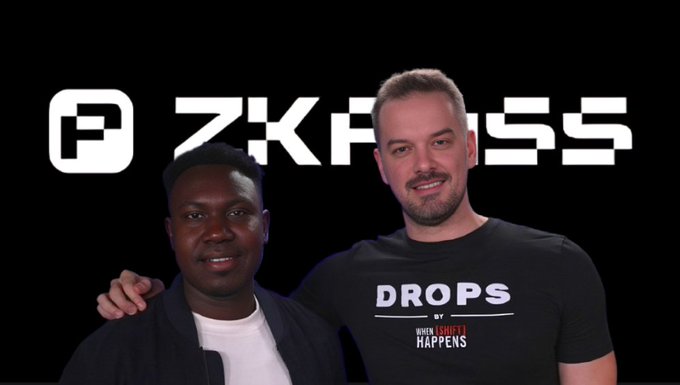
How ZKPass Makes The Internet Verifiable Without Exposing Your Data – Francis Berwa In this episode of DROPS, I sit down with Francis Berwa, co-founder and head of growth at @zkPass, to discuss what eight failed startups taught him about resilience, why private data is becoming the next trillion-dollar battlefield, and how ZK-TLS could turn the entire HTTPS internet into something you can finally verify instead of just trust. From Bow Ties to Building in Crypto @Francis_Berwa story begins far from cryptography. Born in Rwanda, raised in Congo and Zambia, and later moved to Ohio at twelve, he grew up constantly adapting to new cultures, languages, and environments. By the time he settled in the United States, he spoke four languages and had already developed the survival instincts and curiosity that fuel many entrepreneurs. His first real business was a bow tie brand he launched in college. He loved suits, calling them “your armour to a degree”, and began experimenting with unusual fabrics. Students asked to buy his designs, stores in Brooklyn picked them up, and he even saw a couple of celebrities wear his designs on TV. Although the business folded eventually, it taught him something more valuable than the revenue: how to build trust, how to listen to customers, and how to move from hobbyist to founder. Eight Failures, Panic Attacks, and Why He Never Quit Between 2014 and today, Francis says he “failed eight times”, though he emphasises they were never the same mistake twice. Sometimes the founder mix was wrong. Sometimes, capital ran out before product–market fit. Sometimes the idea was so early that investors could not understand it, like his STO platform in 2017, which now looks obvious in the RWA wave. But those failures were not clean learning curves. At one point, stress sent him to the hospital with chest pains that turned out to be panic attacks triggered by work meetings. “At those times of those failures, I felt like the world was over,” he says. What pushed him through was a deep internal drive to test his limits. Having grown up between countries, he had already seen many versions of life. Settling felt more painful than trying and failing. Small wins, like a modest acquisition, a project that worked, a moment of validation, also kept him going. And most importantly, every failure brought people into his life: founders, colleagues, and friends who stayed even when the companies didn’t. “I would repeat the entire path,” he says, “if it means that I am keeping the same people that I met.” Those long-term relationships form the backbone of zkPass today. Many members of the team have known each other for five to fifteen years. Some studied together, some worked together, and others failed together. That shared history shaped the trust required for the next chapter. How ZK-TLS Became the Frontier Francis’ path into crypto began with the STO project mentioned earlier. When it failed, he and his co-founder, Joshua Peng, went their separate ways but stayed close. Years later, around 2022, they reconnected around an emerging idea that almost no one understood at the time: ZK-TLS. This was not a hype-driven move. There were no public libraries, no mature frameworks, just theoretical papers. But the team had seen enough cycles to recognise that data verification and privacy were becoming real pressure points. If almost everything online sits behind HTTPS, what would it mean to make that layer verifiable? That question became the foundation for zkPass. Zero Knowledge and ZK-TLS, Explained Simply Zero-knowledge proof (ZKP) sounds like advanced cryptography, and it is, but Francis explains it in plain terms: ZKP lets you prove something is true without revealing the underlying data. This matters because almost everything online is now data. Public data has value, but private data, the information behind login screens, is far more valuable and also far more vulnerable. “There is way more private data than public data,” Francis notes. TLS, the other half of ZK-TLS, is the secure transport layer of HTTPS. It is how banks, social networks, and email providers verify you. Francis frames the core issue simply: “Everything on the internet is visible, but nothing is verifiable.” Screenshots can be faked, numbers can be edited, and we rely far too heavily on trust. ZK-TLS flips that. It makes HTTPS data verifiable without exposing it. Turning the Web Into Something You Can Verify Today’s verification systems mostly rely on APIs, which means they only reach a tiny slice of the internet. Francis highlights the scale problem: there are 170 billion HTTPS websites, but only about 20,000 are API compatible. Most data stays locked in Web2 silos. zkPass solves this by attaching a lightweight node—via a browser extension—when you log into a site. It generates a cryptographic proof locally, based on the specific criteria a verifier wants, and returns only a simple output. As Francis puts it: “The output is a yes, no. You, as a user, do not have to change how you interact.” The verifier never sees the raw data, but they can trust the proof because it comes from cryptography and the underlying TLS session. You keep control and reveal nothing more than necessary. Use Cases: Crypto and Beyond Once you understand the mechanism, the use cases are obvious. You can verify track record or income without collateral or exposing bank statements, log into a .edu portal and produce proof instead of uploading transcripts, protect health data that hospitals and insurers constantly leak, link traditional banking to blockchain infra without leaking sensitive financial data, and so much more. Building the First Commercial ZK-TLS Stack zkPass was the first team to commercially deploy ZK-TLS. When they began, there were no tools, so they built their own libraries and kept shipping demos until sceptics changed their minds. They continue to optimise performance with techniques like Volley, which reduces file sizes and speeds up computation. The vision is simple: become a quiet, durable standard. Francis says it clearly: “We do not want to be big. We want to be a fundamental, functional standard.” The Larger Message For Francis, the theme behind all of this is control. Data already shapes every part of our lives, and private data will outgrow public data in value. “We should take good acknowledgement of private data and our own data and what is out there and what is not,” he says. The internet may be visible. zkPass wants to make it trustworthy and verifiable, without forcing you to give anything away. 👉If you enjoyed reading the summary, head over to When Shift Happens on YouTube or your favorite podcast platform to access the full convo.

From Twitter
Disclaimer: The content above is only the author's opinion which does not represent any position of Followin, and is not intended as, and shall not be understood or construed as, investment advice from Followin.
Like
Add to Favorites
Comments
Share
Relevant content