
Hi everyone, I've been scrolling through my phone a lot these past two days.
The crypto is in an uproar—Bitcoin had just staged a dramatic plunge, falling from $110,000 to below $86,000, when Wall Street giant JP Morgan delivered the final blow, issuing a direct warning:
MicroStrategy (MSTR), which holds a massive amount of Bitcoin, may be kicked out of the MSCI World Index!

Wow, the crypto community exploded the moment this report came out.
Some say this is JP Morgan short Saylor's empire.
Some people even launched a "boycott JPMorgan Chase across the internet" campaign.
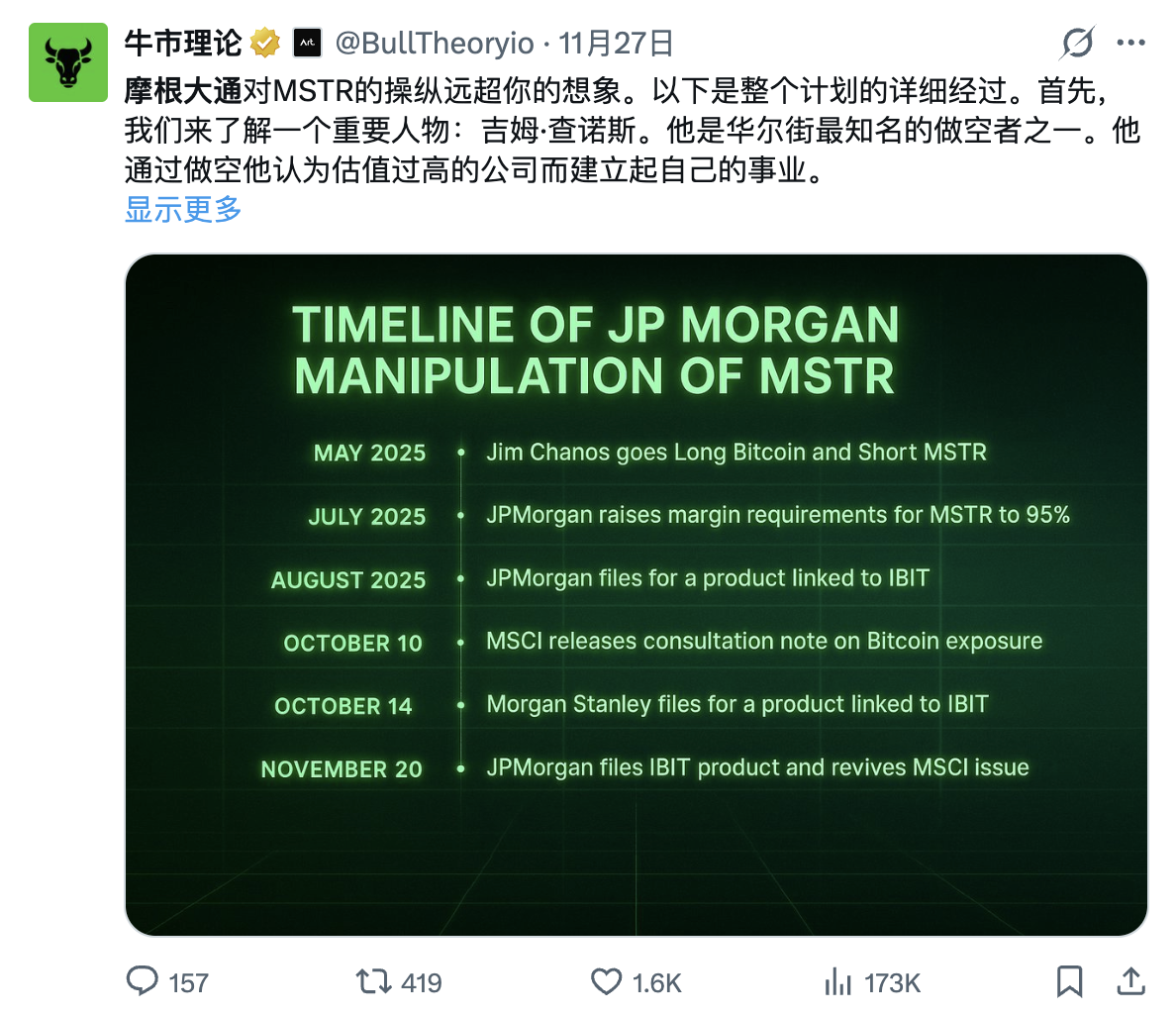
Influential KOL Max Keiser went even further, saying that if the bank's short positions were wiped out by MSTR by 50%, it could go bankrupt on the spot...
Wait, what's going on here??
Is the consequence of being "kicked out" really that serious?
Simply put, it could trigger a "passive" sell-off of tens of billions of dollars.
The MSCI index is like a "global list of top universities." Index funds (such as ETFs) around the world buy their stocks according to this list. Once a company is removed from the list, all the passive funds tracking the index are forced by the system to sell its shares, regardless of whether the company itself is good or bad.
For MSTR, this means the potential loss of billions in buying support in an instant, with its stock price facing immense mechanical selling pressure. This isn't because people are pessimistic about it, but because "the rules have changed," making this an openly known crisis of capital flight.
How can a brokerage report have such power?
Is this just a Wall Street conspiracy theory, or is MSTR really in deep trouble?
Today, let's delve into the truth behind this "index assassination"—who is lying and who is standing up for themselves?
1. JP Morgan's "danger warning": Is it a precautionary measure or a precise strike?
To be honest, this is quite a story.
Rewind to November 21st, when Bitcoin had just fallen to $80,553, hitting a new low since April.
Market sentiment is incredibly fragile, like glass, it shatters at the slightest touch.
At this critical juncture, JP Morgan strategist Nikolaos Panigirtzoglou released a report:
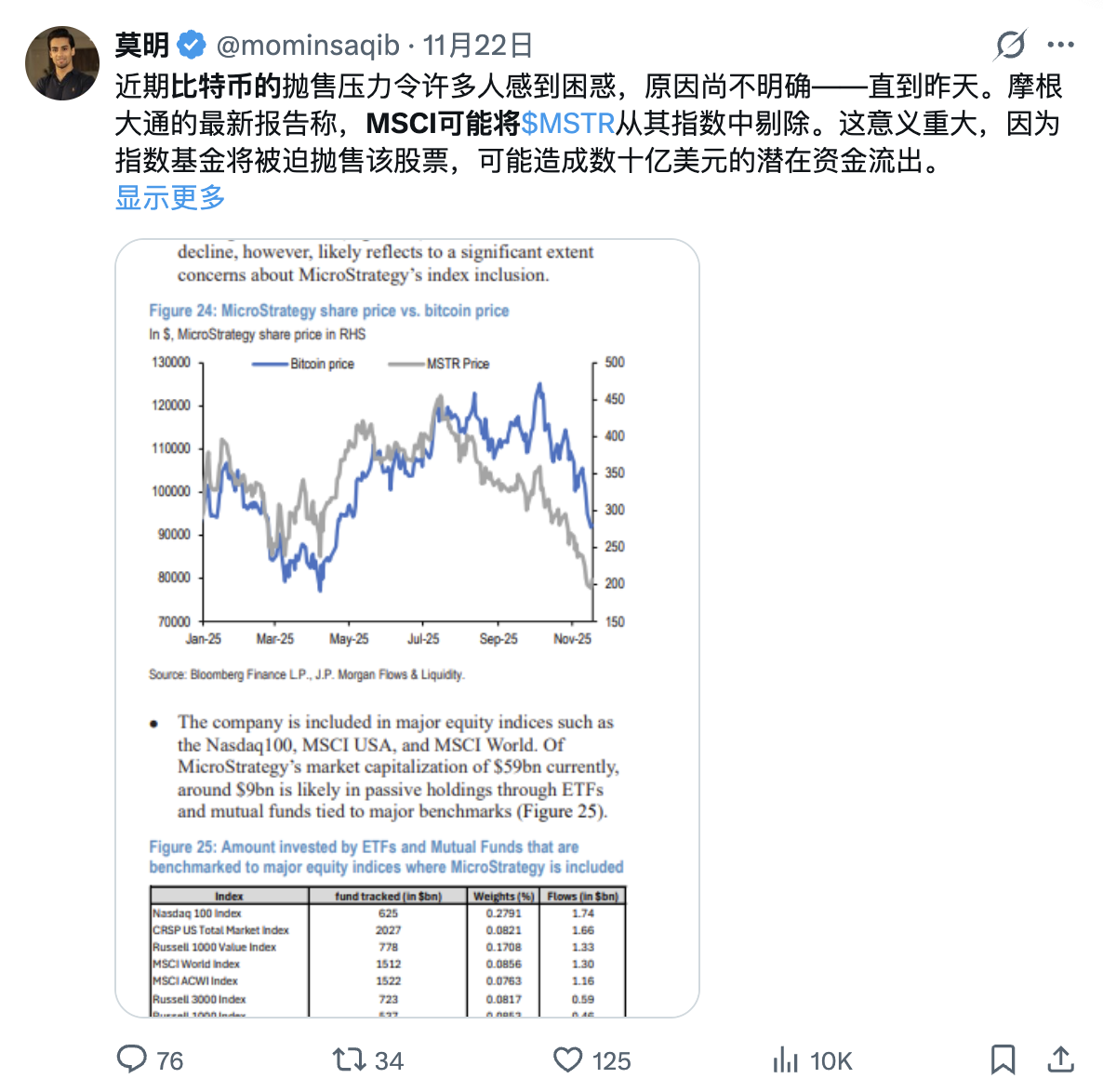
It's said that MSCI is considering removing companies with large amounts of Bitcoin on their balance sheets from its major stock indices.
MSTR was the first to be affected.
The report also included a calculation: if MSTR were to be removed from the MSCI USA index, it could trigger a passive capital outflow of $2.8 billion.
If other indices follow suit, the total outflow could reach $8.8 billion, or even $11 billion!
But why did MSCI have to "invite people out"? Behind this lies the "classification anxiety" of traditional finance.
In the traditional financial system, companies are clearly categorized: technology companies, banks, energy companies, etc. But companies like MSTR, whose main business is software but whose largest asset is Bitcoin, have become a "hybrid".
- For index companies: It undermines the "purity" of the index. For example, if a company primarily driven by Bitcoin prices is included in a "technology index," how can that index accurately reflect the performance of the technology sector?
- Therefore, MSCI's consideration of revising its rules is aimed at maintaining order in the traditional financial world. However, for MSTR, this directly undermines its foundation in the mainstream capital market.
But the "MSCI rule review" mentioned in the report is actually "old news" that has been publicly discussed for 42 days.
Why bring up old news at the height of market panic?
Adrian, an analyst at Bitcoin for Corporations, bluntly criticized the situation, calling it a "man-made crash."
Some people are even bringing up old grievances, saying that JP Morgan quietly raised MSTR's margin requirements in July , causing quite a stir in the market.
Let's talk about what kind of drastic measure is "raising margin requirements".
This trick is specifically designed to counter leveraged trading . For example, if you borrow money to buy stocks (using leverage), the brokerage firm will require you to deposit a "margin" as collateral to ensure that you don't lose money and can't repay it.
If JP Morgan, as a large brokerage firm, quietly raises the margin requirement for MSTR stocks , for example, from 30% to 50%, it means:
- All investors who bought MSTR with leverage must immediately add more cash as collateral.
- This can trigger a chain reaction when the market falls: stock price falls → triggering liquidation → forced selling → stock price falls further. JP Morgan's operation in July was seen as adding fuel to the fire of MSTR's decline, which is why this report is seen as a "repeated trick".
Trading firm Empire Digital even publicly questioned: Is this not a risk warning, but clearly a "targeted crackdown"?
The debate on X was absolutely raging.
Someone posted: "JP Morgan warns of risks to the MSTR index, with a potential outflow of $2.8 billion... Is this paving the way for short selling?"
The responses below were all the same: "BOYCOTT JPMORGAN! Transfer the money out of your account right now!"
Some even sarcastically remarked, "Wall Street is using its old tricks to control MSTR again."
But to say it's truly going to kill MSTR isn't entirely true.
JP Morgan itself announced in October that it would accept BTC and ETH as collateral for loans.
While simultaneously predicting a downturn, they're also making strategic moves—a typical Wall Street "two-faced" individual.
Therefore, upon closer examination, this so-called "danger warning" seems more like a psychological warfare tactic used as a pretext.
By using an expired report, they rub salt into the market's wounds and, incidentally, test the limits of retail investors.
II. Saylor's Confidence: MSTR is not a "Bitcoin gambler," but a "next-generation asset holding company."
Michael Saylor didn't back down in the face of JP Morgan's "attack".
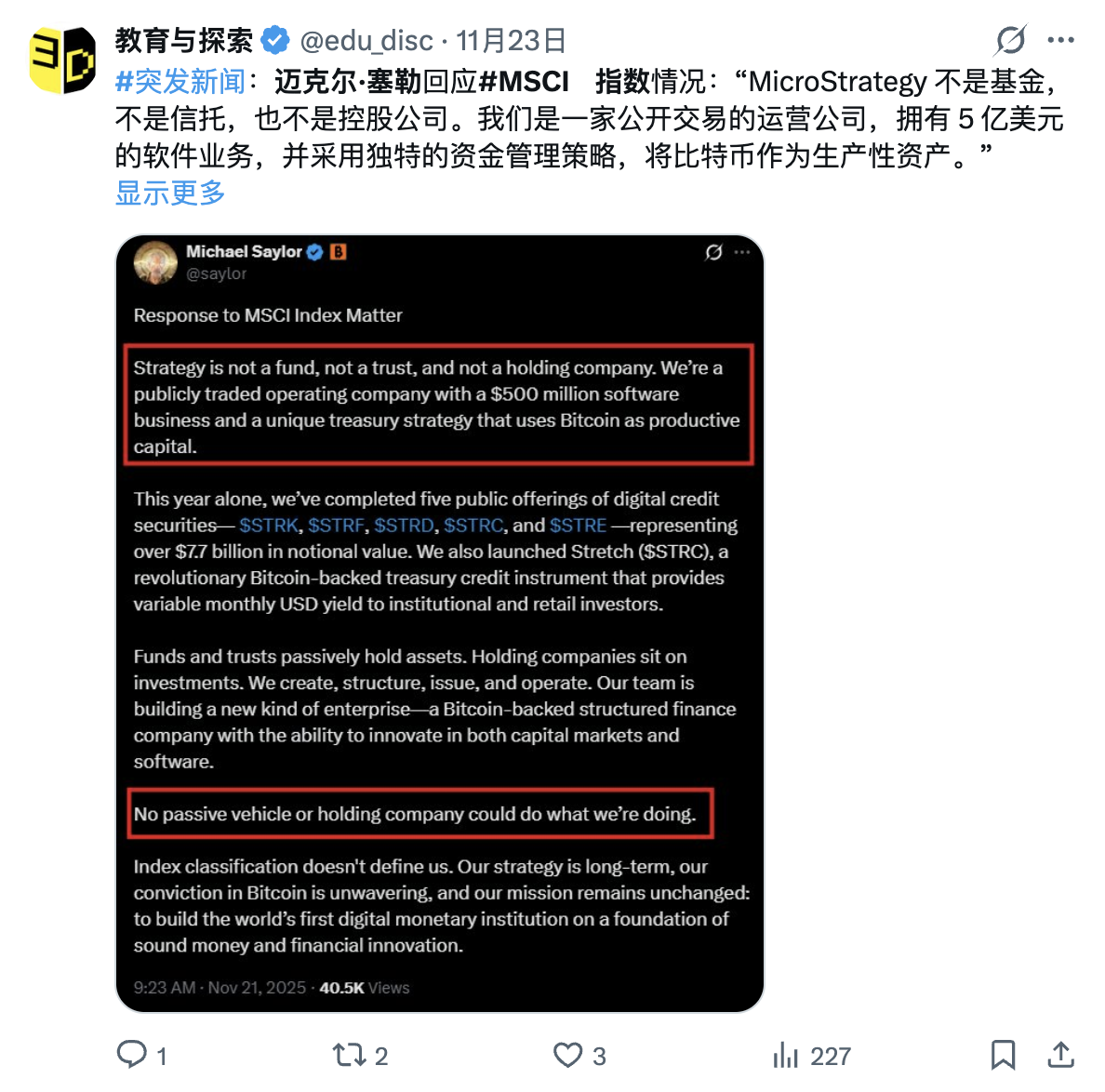
On November 21st, he published a lengthy article titled "Response to the MSCI Index Issue," directly addressing the issue head-on.
"We are not a fund, trust, or holding company!"
"We are an operating company with annual revenue of $500 million and holding $7.7 billion worth of BTC-backed credit products!"
"MSCI's classification cannot define us at all!"
These words caused MSTR's stock price to rebound instantly, greatly boosting community morale.
Why is Saylor so assertive? Just look at the data:
On November 17th, MSTR spent another $835 million to buy 8,178 BTC.
Total holdings have surged to 649,870 units, with a market capitalization of $54.37 billion, a 12% increase from last month.
Moreover, the company's leverage ratio is only 10%, and there is no pressure from the maturity of perpetual preferred shares.
It's far from the "Ponzi scheme" some people are fantasizing about.
Analysts like Jeff Walton also believe that even if MSTR is removed from the index, its software business and BTC reserves can withstand the impact.
On X, Saylor's fans transformed into an "anti-JP army."
Some joked, "JP Morgan short MSTR? Saylor will make it the 'short position disgrace of the year'."
Some people even turned the parody post "$MSTR delisted, BTC crash, Saylor liquidated" into a meme, which was then widely shared.
To put it bluntly, the core of this information war is no longer simply about stock price fluctuations.
Rather, it's a clash between two asset allocation paradigms:
Should we continue to blindly believe in traditional financial valuation models, or embrace a new corporate treasury management philosophy based on Bitcoin?
Saylor's confidence stemmed from his willingness to choose the latter.
III. Macroeconomic Reversal: The Federal Reserve May Already Have the "Golden Key" in Its Hands
However, what determines the long-term trend of the market is never a report from any particular investment bank.
Rather, it's about the larger macro narrative—for example, whether or not the Federal Reserve should cut interest rates?
In the last few days, the market sentiment has suddenly changed.
The probability of a Federal Reserve rate cut in December has surged to over 85%.
Fed Governor Chris Waller also voiced his support, and the market immediately went wild.
Historical experience tells us that expectations of loose liquidity are the most potent catalyst for risky assets.
Bitcoin prices rebounded immediately, surging back to $91,000 on November 28, a daily increase of 4.35%.
Bitcoin spot ETFs also saw net inflows again, with Blackstone's IBIT attracting $42.8 million in a single day.
Even JP Morgan itself changed its tune in another report:
The long-term target for BTC is $240,000!
Even more outrageous is the rumor that former White House economist and staunch advocate of interest rate cuts, Kevin Hassett, may succeed as Fed chairman.
Let's talk about why the change of chairman is such a "game-changing" piece of news.
The Federal Reserve Chairman's stance will directly determine whether monetary policy will be loose or tight in the coming years.
- Current Chairman Powell : Relatively neutral, with the goal of balancing inflation and employment.
- If Hassett does indeed take office, it means the Federal Reserve may rapidly shift from an "anti-inflation" mode to a "growth-promoting" mode, initiating a longer and more significant interest rate cut cycle. This would be an epic boon for the entire risk asset market (stocks, cryptocurrencies). The market will trade this expectation in advance, and a large amount of capital will flow into assets such as Bitcoin. Therefore, the power of this rumor is far greater than that of a bearish report.
So you see, JP Morgan's report is practically a minor episode in the face of the overall macroeconomic trend.
Panic will eventually subside, but the underlying logic of Bitcoin has never changed.

Conclusion: Lessons from the Eye of the Storm – Anchoring Value Amidst the Noise
On the surface, this "JP Morgan index crisis" is another clash between Wall Street and the crypto world. But thinking deeper, it's more like a mirror, reflecting the anxieties of traditional finance and the evolution of the Bitcoin narrative. For short-term traders, the volatility of MSTR and the risk of index adjustments are indeed something to be wary of. But for long-term players, this turmoil has actually validated the resilience of the Saylor model—it's not betting on the price of cryptocurrencies, but rather building a position in "digital gold." So don't be fooled by JP Morgan's smokescreen. After the storm, the sea level will only be higher. Are you ready to board the ship?
🎉Let 's explore everything about beraBTC, BVT, and BearChain together .
Welcome to follow ⭐️ Batoshi