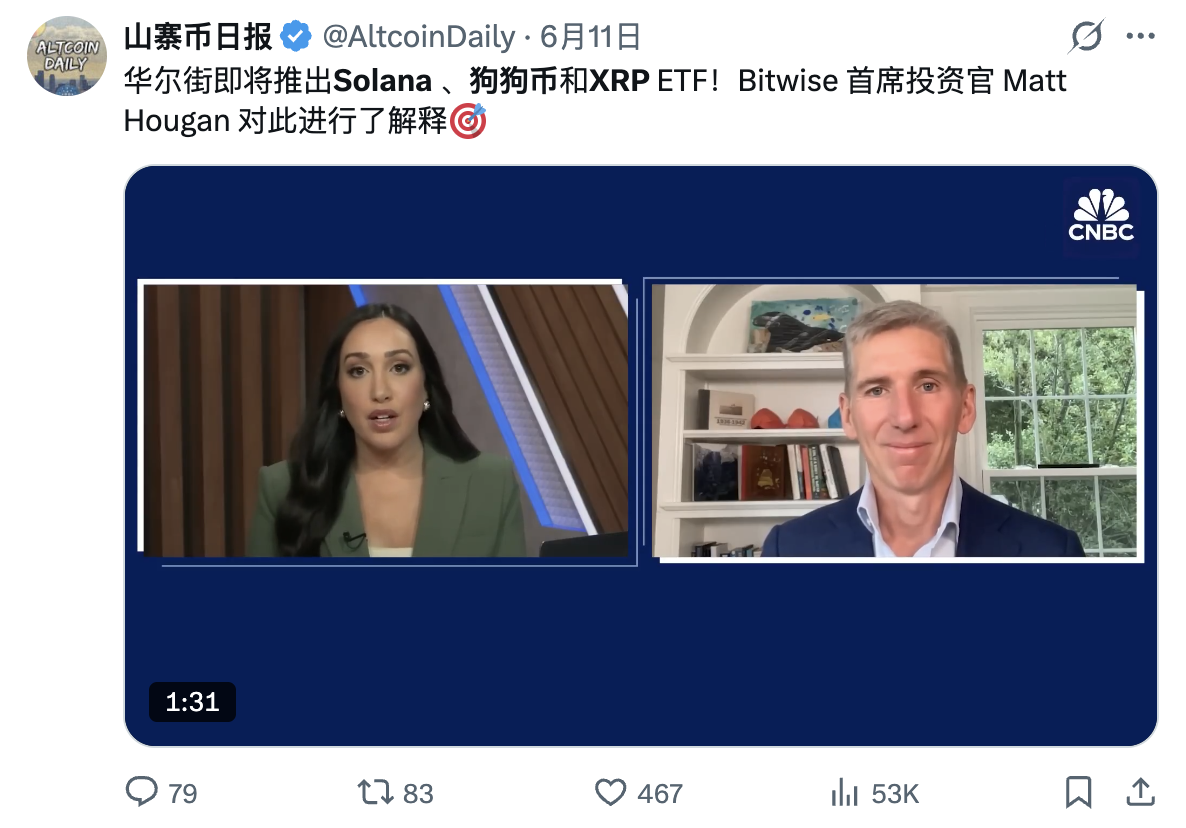
Goodness, it took Bitcoin ETFs ten years to gain access to Wall Street, while a bunch of Altcoin, like Solana, XRP, and Dogecoin, have made it in less than six months.
Can you believe it?
By the end of 2025, these codes, once regarded as "electronic waste" by traditional financial giants, appeared on the screens of the New York Stock Exchange and Nasdaq.
But this wasn't some sudden act of kindness from the SEC (Securities and Exchange Commission); it was a meticulously planned "lightning raid" that exploited loopholes in the rules.
By the time everyone realized what was happening, the rules of the game had completely changed.
I. How were the rules "substituted"?
We need to know how high the threshold used to be. In the past, every cryptocurrency ETF application had to be reviewed on a case-by-case basis by the SEC, which could take up to half a year, and in the end, it would most likely be rejected with the reason that "the market is susceptible to manipulation".
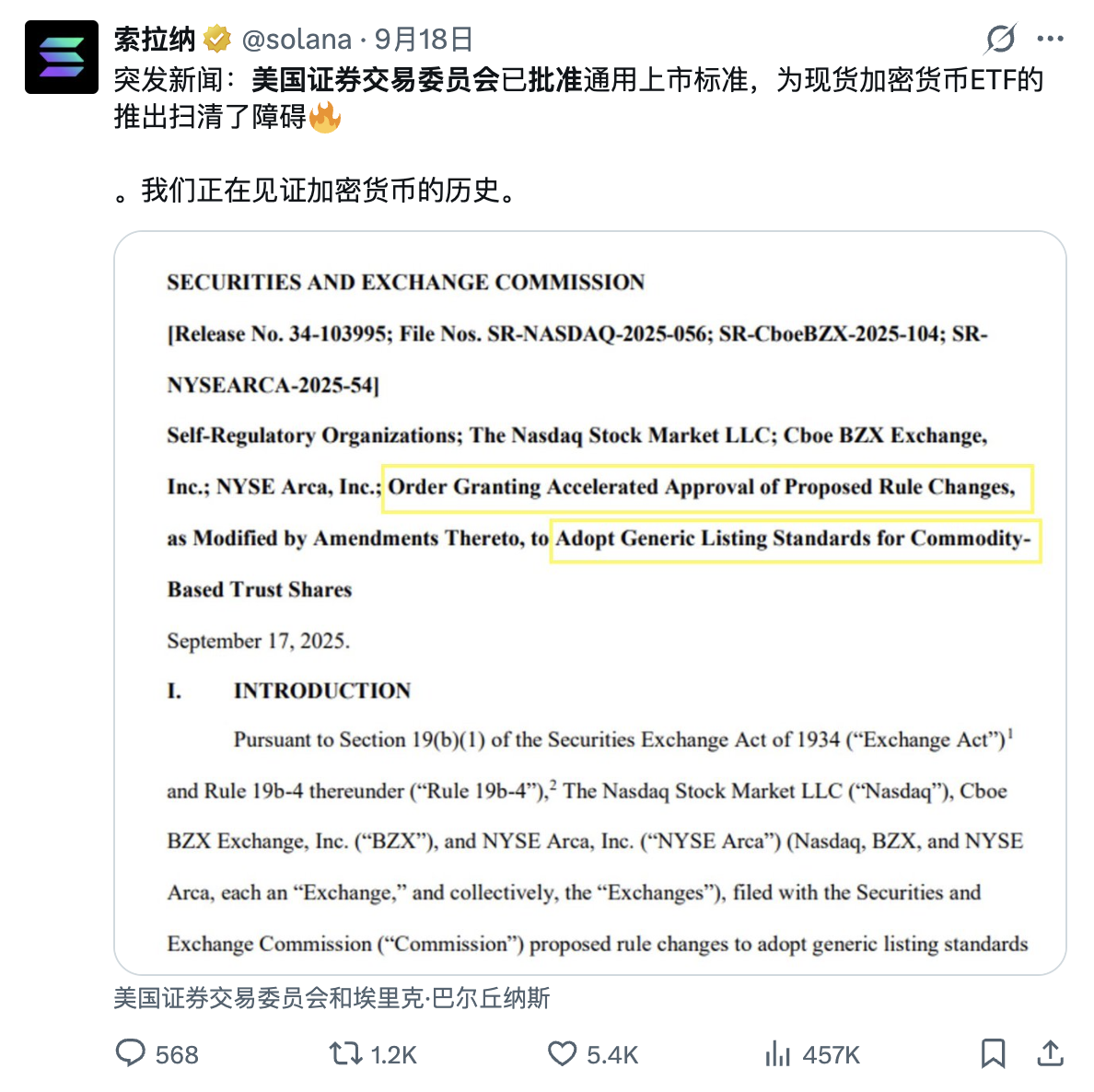
But on September 17, 2025, something big happened quietly: the SEC approved something called "General Listing Standards" .
What does this thing even mean?
It's like how getting into Wall Street used to be like going through a VIP channel, where every applicant had to be questioned from head to toe by security guards (the SEC). Now? It's been replaced by an automated access control system . As long as you meet the requirements, "beep," and the door opens automatically.
The conditions are not complicated; you only need to meet one of the two conditions:
- Futures Channel: Your coin needs to have been traded in a futures market (such as the Chicago Mercantile Exchange, CME) under the protection of the CFTC (Commodity Futures Trading Commission) for at least 6 months.
- Precedent path: There is already an ETF on the market that holds more than 40% of your coin's assets.
Solana and XRP, among others, have conveniently secured their positions. This effectively changes the SEC's regulatory model from "strict front-end control" to "handling things from the back end," a move that can be described as a "strategic retreat."
II. The SEC's "Ultimatum": Section 8(a) is the real killer weapon
If the "universal standard" has opened the door, then the publishers' next move is to step on the gas pedal.
They unearthed a long-forgotten legal weapon— Section 8(a) of the Securities Act of 1933. Normally, ETF applications include a "delayed approval" clause, essentially giving the SEC an "indefinite review warrant." But these guys at Bitwise were incredibly bold; they simply removed that clause from their application!
What makes Article 8(a) so harsh?
Simply put, without the "delayed effect" as a safeguard in the application documents, it automatically takes effect 20 days after submission! If the SEC wants to stop it, it must produce irrefutable evidence and issue a "stop order" within 20 days, which is extremely difficult.
Isn't this just giving the SEC an ultimatum: either you find a solid reason to kill me within 20 days, or you just watch me go public.
The irony is that at this time, the SEC was facing a government shutdown, staff shortages, and the resignation of its chairman, Gary Gensler, earlier in the year, leaving it in a state of "leaderlessness".
Faced with hundreds of such "ultimatum" documents, the SEC simply couldn't handle them all. Publishers perfectly seized this window of opportunity and launched a brilliant blitzkrieg.
III. What will happen to the market when money pours in?
Once the rules were broken, money poured in like a flood. But this water didn't flow evenly; it specifically targeted the "small ponds."
There's a key concept here called the "crypto multiplier" effect . It means that for a "large reservoir" like Bitcoin, throwing in hundreds of millions might only cause a slight ripple.
But for smaller players like Solana and XRP, the same amount of money invested could cause the price to skyrocket.
The institutional buying brought by ETFs is like a water pipe that is constantly pumping water.
Why aren't prices soaring now? Instead, it feels like "all the good news has been priced in, so it's bad news now."
That's because market makers initially need to hedge their risks, temporarily suppressing prices. But in the long run, ETFs act like a pump, running 24/7, and will gradually drain the spot liquidity from the exchange.
This means that the prices of these Altcoin with ETFs may become more volatile in the future: with ETFs supporting them, they are less likely to fall; and with supply becoming increasingly tight, they may rise even more wildly.
IV. The New Order: Those with "household registration" and those without "household registration" will now live in two completely different worlds.
Once this ETF storm is over, the crypto world will be completely stratified.
- The first tier consists of cryptocurrencies with official "registration" (such as BTC, ETH, SOL, XRP, and DOGE). These have obtained compliance status, allowing pension funds and large institutions to legitimately channel their money in. This results in a "compliance premium."
- The second tier: those without official backing (other public chains and DeFi tokens). They still need to operate within their original circles, relying mainly on retail investors. In the future, they may find themselves unable to compete with the first tier and may even gradually be marginalized.
So you see, the valuation logic of the crypto market has completely changed.
Previously, the competition was about who could tell the best story and generate the most buzz in the community; in the future, the competition will be about who gets the "compliance certificate" first and who can connect to the arteries of traditional finance first.

So, what should we do?
The rules were torn open, and an opportunity was presented to us.
Stop just watching, buddy, let's get moving.
1. First, we know the threshold is gone.
Buying cryptocurrency used to involve dealing with exchanges, remembering passwords, and being afraid of hackers.
To buy SOL/XRP now: Open your stock trading software, enter the code, and you're done.
The Wall Street bigwigs have paved the way; we can just haile a taxi and get on.
2. The gameplay has changed.
ETFs are essentially "locked-up" positions held by institutional investors.
Their buying spree is essentially setting the bottom for prices.
The potential for a sharp drop has decreased.
The profits are still fluctuating.
3. Wind direction, got it!
When reviewing projects in the future, I'll look at a few things first:
Where is its ETF?
This is the strongest certification, more effective than any white paper.

remember:
The old path to wealth is through civil service exams and postgraduate entrance exams.
The new path to wealth is to understand the changing rules and act ahead of the curve.
This quiet revolution,
Are you going to continue being a spectator?
Or should I step into the game and become a player?
(Is your stock account ready?)
🎉Let 's explore everything about beraBTC, BVT, and BearChain together .
Welcome to follow ⭐️ Batoshi