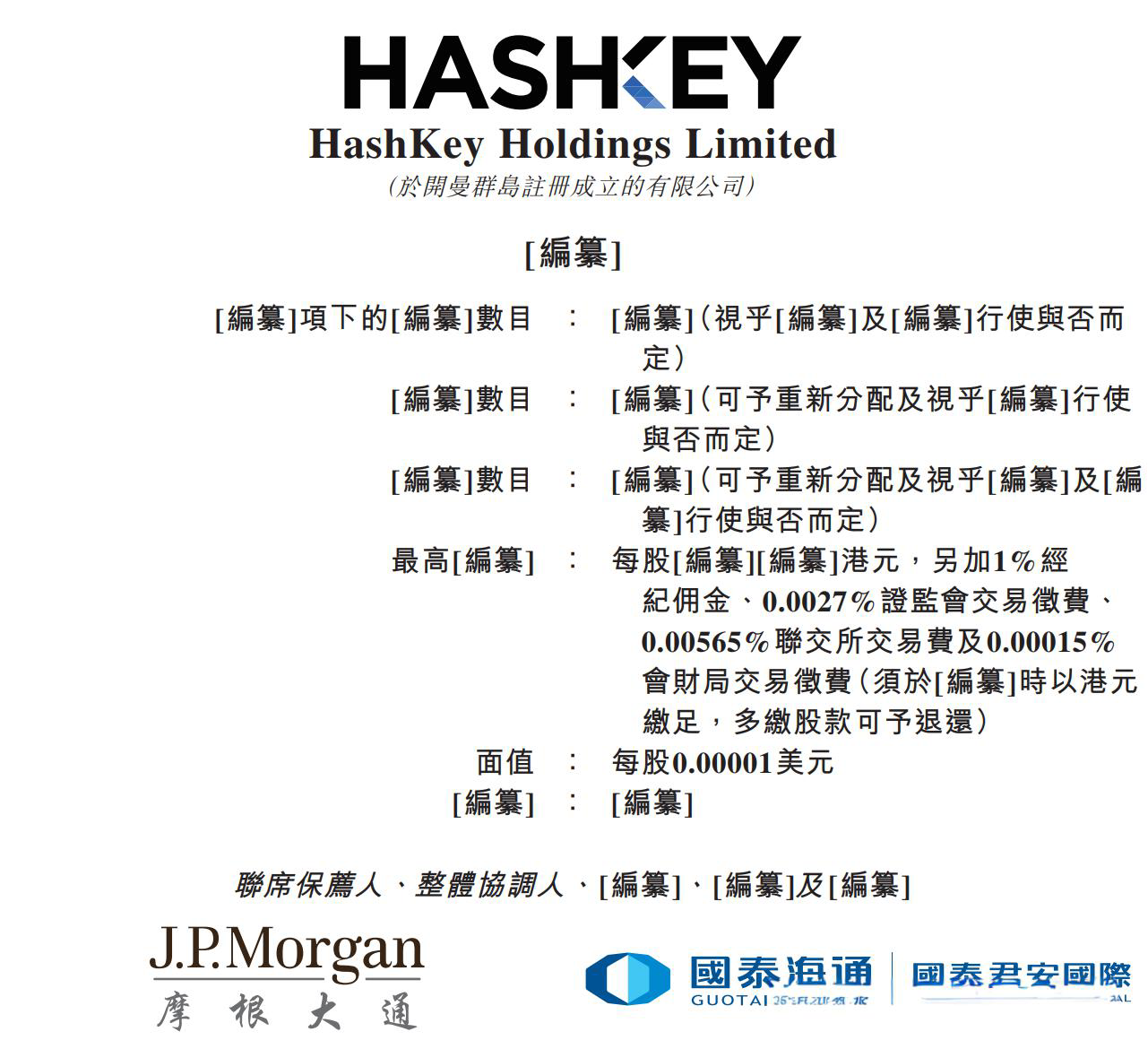
On December 1, 2025, information disclosed by the Hong Kong Stock Exchange showed that HashKey Holdings Limited had officially passed the listing hearing on the main board, with JPMorgan Chase, Guotai Haitong Securities, and Guotai Junan International acting as joint sponsors. This announcement, like a beacon in the winter night, illuminates the future path of Hong Kong's virtual asset industry.
This name, which has emerged from the "regulatory pilot era," is now standing in the spotlight of the capital market for the first time. It is not only the first listed company in Hong Kong with an exchange as its core business under the specific regulatory framework for virtual assets, but also a real-world test of whether compliance and innovation can coexist. At the crossroads of the accelerating integration of traditional finance and digital assets, how will HashKey's capitalization reshape the industry ecosystem? Can it find a sustainable business model amidst continuous losses and strong cyclicality? The outcome of this experiment may determine the future landscape of Hong Kong as an international virtual asset center.
First, the exchange is just the entry point; it's there to tell a bigger story.
To simply define HashKey as an exchange misses the core of its business logic. HashKey's prospectus shows that as of September 30, 2025, its cumulative spot trading volume reached HK$1.3 trillion, firmly ranking first among regional onshore platforms in Asia. However, the trading business is more like an entry point to an ecosystem; its true value lies in the "trading-on-chain-asset management" triangular closed loop it has built.
In terms of business structure, HashKey Exchange adopts a unique dual-track operating model. Retail users can only trade five mainstream tokens, such as BTC and ETH, while professional investors can access 80 digital assets, including SOL and LINK. This differentiated management, while limiting user growth, precisely aligns with Hong Kong's regulatory logic of "investor protection first." Its over-the-counter trading service uses a commission model, primarily generating revenue through price spreads, which is accounted for as commission income on a net basis in its financial statements—a stark contrast to the market maker model of traditional exchanges.
In terms of technical architecture, HashKey has invested heavily in building an institutional-grade security system. Its custody solution employs multi-signature and a cold/hot wallet separation design, seamlessly integrating with order book trading and OTC services. Notably, HashKey is one of the few exchanges offering fully compliant 24/7 deposit/withdrawal services, a characteristic that gives it a unique advantage in attracting traditional financial institution clients. In contrast, Coinbase primarily serves the North American market, with its technical architecture focusing on standardized products, while HashKey has cultivated the Asian market, building a differentiated advantage through compliant customized services.
II. In Hong Kong's regulatory framework, HashKey is at the forefront.
HashKey's development is a microcosm of the evolution of virtual asset regulation in Hong Kong. From the Hong Kong Securities and Futures Commission's release of a conceptual document on the virtual asset regulatory framework in 2018 to HashKey becoming one of the first VATPs approved to provide services to both professional and retail investors in August 2023, this regulatory path has taken a full five years.
The trust endorsement brought by a licensed identity is difficult to quantify but crucial. According to Forbes' 2025 list of "World's Most Trusted Cryptocurrency Exchanges," HashKey Exchange ranks 14th globally, the only Hong Kong platform on the list. However, the cost of compliance is equally significant. Market analysis indicates that the application fee for a single VASP license can be as high as HK$20 million to HK$5 million, and licensed institutions need to employ multiple responsible personnel, with an average annual salary of approximately HK$2 million to HK$5 million per person. This is directly reflected in its financial performance: the prospectus shows that although revenue reached HK$721 million in 2024, losses widened to HK$1.19 billion in the same year.
A comparison with major global regulatory jurisdictions further illustrates the point. In the US, Coinbase follows a state-based money servicer licensing system; in Singapore, the MAS employs a tiered licensing system; while Hong Kong's VASP license requires exchanges to fully comply with the Anti-Money Laundering Ordinance and SFC regulations. This comprehensiveness, while increasing compliance costs, creates a scarcity value for licensed institutions. In November 2025, the Hong Kong SFC issued new regulations allowing licensed platforms to share liquidity with their overseas affiliates. This directly benefits HashKey, which has already established an exchange network in Hong Kong, Bermuda, and the Middle East, marking a shift in Hong Kong's regulatory approach from conservative to open.
III. International Benchmarking: Three Paths, Three Destinies
Looking at the capitalization paths of global cryptocurrency exchanges, HashKey has chosen a different route. Unlike Coinbase, which went public on Nasdaq in 2021, HashKey chose to list on the Hong Kong Stock Exchange's main board; and compared to OSL, which went public through a reverse merger as early as 2020, HashKey has built a more complete business ecosystem.
Coinbase's IPO represents the US model—leveraging a large user base to gain a valuation premium in a relatively mature regulatory environment. However, subsequent significant stock price fluctuations exposed the vulnerability of over-reliance on transaction revenue. OSL, on the other hand, illustrates the predicament of early adopters—despite being the first to obtain a license from the Hong Kong Securities and Futures Commission, its business model was too singular, resulting in continuous losses and multiple rounds of layoffs in 2024-2025 (data source: OSL Group financial report). HashKey, meanwhile, attempts to forge a third path: reducing its reliance on transaction fees through a three-pronged architecture of "trading + on-chain + asset management," a model with no successful precedent in the Asian market.
From a valuation perspective, Coinbase's price-to-earnings ratio has consistently been higher than that of traditional exchanges, reflecting the market's recognition of the growth potential of the digital asset industry. However, HashKey faces a different valuation environment—Hong Kong investors remain cautious about the concept of virtual assets, and its continued losses may make it difficult for it to obtain a valuation premium similar to Coinbase's. This difference essentially reflects the different levels of understanding of digital assets between the Asian and North American markets.
IV. RWA is not just a business function, but the backbone of HashKey's future narrative.
In the historic wave of integration between traditional financial assets and blockchain, HashKey sees the tokenization of real-world assets as its ultimate battleground. This strategy is not only about business diversification, but also determines whether it can break through the cyclical constraints of the trading business.
HashKey Chain, a compliant financial network designed specifically for RWA (Responsive Financial Transactional) transactions, employs a leading Layer 2 solution in its technical architecture. Its core innovation lies in its embedded compliance module, allowing issuers to set transaction rules and permissions, improving asset transfer efficiency while meeting KYC/AML requirements. In June 2025, HashKey partnered with GF Securities to issue Hong Kong's first daily redeemable tokenized security. This product achieved T+0 settlement and automatic on-chain dividends, demonstrating the technological maturity of HashKey Chain. HashKey's prospectus shows that as of September 30, 2025, the total value of RWA on the chain reached HK$1.7 billion.
Hong Kong's forward-thinking approach to RWA regulation provides HashKey with a regulatory advantage. Compared to the US SEC's cautious approach to tokenized securities, the Hong Kong Securities and Futures Commission has adopted a more open regulatory framework, clearly defining the legal status and issuance requirements of tokenized securities. This institutional innovation has placed Hong Kong at the forefront of the global RWA field. The Boston Consulting Group predicts that the on-chain RWA market will reach $18.9 trillion by 2033, with an annualized growth rate of 53%. HashKey is attempting to leverage its dual advantages in technology and compliance to secure a core position in this trillion-dollar market.
V. Going public is the starting point, and also the beginning of stress testing.
While HashKey's successful hearing has garnered market attention, its real challenges are just beginning. The triple pressures of profitability, industry cycles, and intensified competition will test the resilience of this pioneering company.
Financial data reveals a worrying trend. The prospectus shows that while HashKey's revenue continued to grow from 2022 to 2024, its losses widened simultaneously. In the first half of 2025, revenue declined by 26% year-on-year, primarily due to reduced retail transaction volume caused by the market downturn. This exposes the vulnerability of its revenue, which is highly dependent on transaction fees. Meanwhile, gross margin fell from 97.2% in 2022 to 65.0% in the first half of 2025, reflecting rising operating costs during business diversification. Referring to the operating situation of the OSL Group—which briefly turned profitable in 2024 before falling back into losses in 2025—the profitability stability of virtual asset exchanges remains to be seen.
The strong cyclicality of the cryptocurrency market hangs like a Damocles' sword. Trading volume declined by 38% year-on-year in the first half of 2025, directly leading to a drop in revenue. Meanwhile, the entry of traditional financial institutions is changing the competitive landscape—currently, 41 institutions have upgraded to "license number one" to support virtual asset trading, while tech giants like JD.com and Ant Group are also making progress in tokenization. Compared to these competitors with native application scenarios, HashKey needs to continuously strengthen its compliance and technological advantages to maintain its leading position.
The prospectus indicates that the funds raised will primarily be used for technology iteration, market expansion, and risk management. If HashKey can establish standards in the RWA infrastructure field and successfully develop on-chain services into a second growth curve, it is expected to break through its current growth bottleneck. However, this path is fraught with uncertainty—can the high compliance costs be amortized through scaling? Will traditional financial institutions choose to build their own infrastructure rather than partner with others? The answers to these questions will determine whether HashKey can successfully navigate this uncharted territory.
Conclusion: Hong Kong's Financial Repositioning and the Beginning of a New Narrative
The story of HashKey goes far beyond the listing of a single company. It is a key move in Hong Kong's efforts to reshape its status as an international financial center, and an important experiment in the evolution of global virtual asset regulation.
From a broader perspective, Hong Kong is showcasing its new path of financial development, emphasizing both stability and innovation, to the world through benchmark companies like HashKey. Amidst increasingly fierce competition among traditional international financial centers, virtual assets offer Hong Kong a breakthrough for differentiated competition. HashKey's successful listing signifies that Hong Kong has taken a leading position globally in digital asset regulatory systems, a victory not only for financial innovation but also a symbol of institutional innovation.
Whether this stock can truly become the "first Hong Kong digital asset stock" will ultimately be determined not by regulators, but by time. In the historical process of the accelerated integration of traditional finance and the crypto world, HashKey is both a participant and a pathfinder. Every step it takes is drawing a map for those who follow. Regardless of the outcome, this experiment, which began in the winter of 2025, will leave a profound mark on the annals of Hong Kong's financial history.
Some of the information comes from the following sources:
HashKey Exchange retains its position as the world's most trusted cryptocurrency exchange on Forbes' list, maintaining its number one ranking in Hong Kong.
• "Hong Kong's First Crypto Asset Stock is Coming! HashKey Passes Hong Kong Stock Exchange Hearing, Becoming Hong Kong's Largest Licensed Virtual Asset Exchange"
• HashKey passes Hong Kong Stock Exchange hearing
• HashKey interprets the latest guidance from the Hong Kong Securities and Futures Commission: Open interconnection, building a sustainable digital asset ecosystem.
Author: Liang Yu; Editor: Zhao Yidan