Deng Tong, Jinse Finance
On December 5th, Moore Threads surged nearly 470% on its first day of trading on the STAR Market, pushing its market capitalization above 300 billion yuan. It immediately attracted widespread attention, but many more focused on the financial dispute between Li Feng, the dean of Moore Academy, and Star, the founder of OKX.
In 2018, OKX founder Star publicly accused Li Feng of failing to repay a loan of 1,500 bitcoins on time, and stated that legal proceedings had been initiated in both China and the United States. The loan agreement shown by Star at the time indicated that the two parties initially signed the agreement in 2014, and it was renewed in 2017 due to extension requests, but ultimately a default occurred. Due to cross-border enforcement and legal issues regarding virtual assets, the dispute remains unresolved. Based on bitcoin prices in December 2025, this debt is now valued at approximately $135 million (compared to $80 million at the time).
On December 7th, Star responded on social media to the topic of "Moore Threads co-founder Li Feng borrowing 1500 BTC from Star and then disappearing without returning it," stating, "People cannot dwell in the shadow of a negative past. Let's look to the future and contribute more positive energy. Let the law handle debt issues. Best wishes to every entrepreneur."
Media reports generally indicate that Li Feng is a co-founder of Moore Threads, but Tianyancha (a Chinese business information platform) shows that Li Feng is not among the key personnel of Moore Threads Intelligent Technology (Beijing) Co., Ltd. Furthermore, the person most closely resembling "Li Feng" on the Moore Threads official website is "Teacher Li F"—the current dean of Moore Threads Moore Academy. Therefore, Li Feng's claim of being a "co-founder" may be inaccurate.
Perhaps Zhang Jianzhong, as the founder of Moore Threads, is the one who should receive the most attention.
I. The founder of Moore's Threads witnessed the entire Ethereum mining boom.
Zhang Jianzhong is the founder, chairman, and general manager of Moore Threads. According to Tianyancha, from May 1990 to March 1992, he served as a senior researcher in the National Computer Laboratory of the Metallurgical Automation Research and Design Institute; from April 1992 to May 2001, he served as the product general manager of Hewlett-Packard China; from June 2001 to March 2006, he served as the general manager of the Global Customer Department of Dell (China) Co., Ltd.; from April 2006 to September 2020, he served as the global vice president and general manager of Greater China at NVIDIA; after Moore Threads began operations in October 2020, he participated in the company's operation and management as the actual controller; from November 2023 to the present, he has served as the general manager of Moore Threads; and from December 2023 to the present, he has served as the chairman of Moore Threads.
Perhaps it was the value brought by the "mining boom" that Zhang Jianzhong witnessed during his tenure at Nvidia that ultimately led to the birth of Moore's Threads.
Around 2018, Ethereum experienced a mining boom, fueled by Ethereum's soaring price and igniting demand for GPU mining, resulting in phenomenal profits for hardware manufacturers like Nvidia. Ethereum's Ethash algorithm heavily relies on the parallel computing power of GPUs, making GPU mining far more efficient than other devices. This led to a massive influx of investors and miners purchasing GPUs to build mining rigs. At the time, not only did individual miners hoard GPUs, but large-scale mining farms also purchased equipment in bulk, creating a frenzy of mining and directly driving explosive demand for GPUs from manufacturers like Nvidia.
Benefiting from the cryptocurrency mining boom, Nvidia's revenue for fiscal year 2018 reached a new high of $9.7 billion, with gaming chips, including mining cards, contributing $5.5 billion, accounting for more than 50%. Nvidia's market capitalization also skyrocketed, rising from $14 billion in 2016 to a peak of $175 billion in 2018, more than tenfold in two years.
Zhang Jianzhong worked at NVIDIA for 14 years, a period that coincided with NVIDIA's transformation from a graphics chip company into an AI computing giant. During his time at NVIDIA, Zhang Jianzhong gained a deep understanding of the technological value of full-featured GPUs.
A GPU (Graphics Processing Unit) is a high-performance chip specifically designed for parallel computing. Its core function is to efficiently process large-scale concurrent data. Originally created to support graphics rendering, it has now become a core computing power pillar in fields such as AI computing, scientific research, and industrial manufacturing. Together with the CPU (Central Processing Unit), it forms the "dual core" of the modern computing system.
The development history of GPUs can be divided into three main stages:
Phase 1: The Dedicated Era of Graphics Rendering (1990s-2000s) Initially, the core function of GPUs was processing graphics data: converting geometric models and texture information transmitted from the CPU into pixels on the screen through parallel computing, supporting scenarios such as games, video editing, and 3D design. A representative company of this phase was NVIDIA (which launched its first GeForce 256 in 1999, first introducing the concept of "GPU"), and the core demand was "smoothness and image quality in graphics processing."
Phase Two: The Rise of General-Purpose Computing (2010s) As computing power demands increased, it was discovered that the parallel architecture of GPUs could be used for non-graphics tasks. In 2007, NVIDIA launched CUDA (General-Purpose Parallel Computing Platform), allowing developers to programmatically utilize GPU computing power. Subsequently, GPUs began to enter fields such as scientific computing, cryptography, and AI training, evolving from "graphics chips" to "general-purpose computing chips."
The third stage: The core period of AI computing power (2020s to present). The explosion of large-scale models and generative AI has made GPUs a "computing power necessity." AI training is essentially a massive matrix operation, which perfectly matches the parallel advantages of GPUs—for example, NVIDIA A100/H100 GPUs have become the "standard configuration" for large-scale model training, directly determining the training speed and iteration efficiency of AI models. In this stage, GPUs have become the "core infrastructure of the digital economy," and have also spurred the rise of Moore's Threads and other technologies.
Therefore, for Moore Threads, founder Jianzhong Zhang is the most important person in its rise. Jianzhong Zhang witnessed the evolution of GPUs and, in his subsequent entrepreneurial journey, identified the GPU sector and led his team to cultivate it deeply.
II. What products has Moore Threads launched?
According to Moore Threads' official website, Moore Threads was founded in 2020 and focuses on full-featured GPUs. It is committed to providing the world with accelerated computing infrastructure and one-stop solutions, offering powerful AI computing support for the digital transformation of various industries. Its goal is to become a leading internationally competitive GPU company, creating advanced accelerated computing platforms for the digital world that integrates artificial intelligence and digital twins.
In March 2022, Moore Threads held a spring launch event, releasing the new MUSA unified system architecture and launching multiple MTTS series graphics cards, the AlphaCore physics engine, and the DigitalME digital human solution.
In November 2022, Moore Threads held its autumn launch event, releasing its second full-featured GPU chip, "Spring Dawn," as well as China's first gaming graphics card, the MTT S80, the MCCX meta-computing all-in-one machine, and the "Mobi Maliang" series of GPU software stacks and application tools AIGC creation platform. Although the full-featured GPU was unable to function in the field of crypto mining after Ethereum merged into Proof-of-Stake (PoS), the release of ChatGPT at the end of 2022 gave GPU computing power new applications.
In May 2023, Moore Threads held a summer press conference, launching DirectX 11 drivers, the complete machine "Smart Entertainment Moore Cube", MCCXVDI cloud desktop all-in-one machine, and releasing the MUSAToolkit 1.0 software toolkit and code porting tool MUSIFY, among other things.
In September 2023, Moore Threads held its autumn launch event, releasing the new generation of full-featured GPU chip "Quyuan", as well as the large-model intelligent computing accelerator card MTT S4000, the KUAE kilocal computing cluster, and the computing power management platform MCC Platfomm.
In December 2023, the first domestically produced training platform for 1,000-kilocal-powered, 100-billion-model systems—KUAE Computing Center—was unveiled, marking the official launch of the first large-scale computing power cluster in China based on full-featured GPUs.
In July 2024, Moore Threads announced a major upgrade to its flagship AI product, the Quao Computing Cluster Solution, expanding it significantly from the current kilocalorie level to the 10,000-kilocalorie scale.
In September 2025, Moore Threads released and open-sourced SimuMax version 1.0, a distributed training simulation tool for large language models (LLMs). SimuMax is a simulation tool designed specifically for distributed training workloads of large language models (LLMs), providing simulation support for single-card to multi-card clusters.
Moore's Threads' continuous and frequent launches of new products since its inception are a testament to the rapid development of China's chip industry. China's chips not only include GPUs but also CPUs—supporting the core computing power of terminal devices such as mobile phones, PCs, and servers. This necessitates rewinding to two years ago, to the release of the Huawei Mate 60 Pro.
III. From "No Chips Available" to "Domestic 7-Nano Chips"
On August 29, 2023, Huawei released the Mate 60 Pro, a new smartphone powered by its self-developed Kirin chip, which undoubtedly challenged the US's efforts to contain China's semiconductor industry. Bloomberg's teardown of the Mate 60 Pro revealed that the 7-nanometer chip was manufactured by SMIC, China's largest chipmaker.
Just days after U.S. Commerce Secretary Gina Raimondo's visit to China, news broke of China's domestically produced 7-nanometer chip. This prompted U.S. National Security Advisor Jack Sullivan to announce that the U.S. would seek more information on the details of this new technology: the exposure of China's domestically produced 7-nanometer chip indicates that there are loopholes in the U.S.-led semiconductor blockade, which could potentially be exploited.
On September 14, 2020, TSMC completely cut off its chip supply to Huawei. From "no chips available" to "domestic chips," it took 1,081 days.
Just over a month before Huawei's new product launch, in July 2023, Reuters reported that Huawei's EDA software could be combined with SMIC's N+1 manufacturing process to produce chips equivalent to 7-nanometer technology. This powerful semiconductor is typically used in 5G mobile phones.
In September 2023, semiconductor research firm TechInsights confirmed that the Mate 60 Pro smartphone did indeed use a chip based on SMIC's N+2 7-nanometer process, which is the second generation product after the N+1 7-nanometer chip that only began mass production in March 2020.
SMIC manufactures chips using deep ultraviolet (DUV) lithography, a technology that allows chipmakers to print integrated circuits onto semiconductors using a beam of light. However, manufacturing 7-nanometer chips using DUV lithography is an extremely challenging process, facing two major problems: low yield and high equipment utilization. When DUV lithography machines are used in this way, process defects can occur, resulting in a wafer yield that can be as low as 15%. The lower the yield, the higher the market cost of the chip, thus hindering its commercialization. Furthermore, because DUV lithography machines have limited precision in printing patterns on semiconductor surfaces, multiple passes are required to achieve process nodes smaller than 14 nanometers.
Previously, some research institutions indicated that Huawei was expected to use SMIC's N+1 process, but due to the estimated yield rate of usable chips being less than 50%, the shipment volume of 5G chips would be limited to only around 2 to 4 million units. Another research institution estimated that the shipment volume could reach 10 million units.
High yield is the core prerequisite for the large-scale application of 7-nanometer chips in mobile phones. The fact that the Mate 60 series can be sold openly and achieve commercial success also proves that the yield of the N+2 process chip it uses has been improved to a reasonable level.
But how is chip yield improved? Who provides the trial-and-error costs?
IV. Crypto Miner's "Single-Handed Rescue"
From completely cutting off Huawei's chip supply to the global shock of the Mate 60 Pro launch, how did cryptocurrency miners stage a legendary "single-handed rescue" in these 1081 days?
Semiconductor wafer foundries need time and sufficient wafer orders to refine and improve their new chip processor product lines. Bitcoin mining hardware manufacturers were among the first customers to test Bitcoin ASIC chips on SMIC's N+1 process and increase their order volume.
The second half of 2020 saw a surge in cryptocurrency mining, with mining machine manufacturers even selling futures orders until the end of 2021.
On August 31 of that year, Canaan Technology Chairman Zhang Nangeng confirmed in an earnings call that the company had successfully completed the tape-out of SMIC's first-generation N+1 chip, adding that it was "one of the first N+1 chips successfully tape-out by SMIC. In late August, we received the N+1 chip provided by SMIC, and its test performance exceeded our expectations."
In September, Canaan Technology launched the Avalon 1246 model based on N+1 chip technology. Canaan Technology disclosed in its 2020 annual report that SMIC's wafer purchases accounted for 22.7% of its total wafer purchases that year.
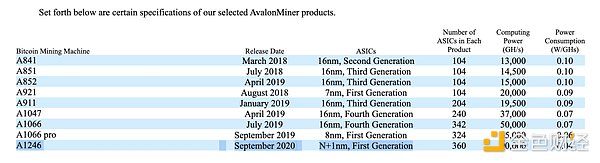
Canaan Technology 2020 Annual Report
According to Zhang Nangeng's statement during the September 2021 earnings call, the increase in wafer orders also helped Canaan Technology and SMIC improve the yield of the A1246 to over 90%. Furthermore, this model became one of Canaan's main products in 2021; almost all of the 22.34 EH/s of hashrate sold by Canaan that year came from this mining machine equipped with chips manufactured by SMIC.
Starting in July 2021, SMIC began manufacturing Bitcoin mining chips for MinerVa. In August 2022, TechInsights analyzed the MinerVa7 ASIC chip and confirmed that it used SMIC's N+2 process (equivalent to 7nm). The chip's transistor density reached 89 million transistors per square millimeter, very close to TSMC and Samsung's first-generation 7nm process. This demonstrates that SMIC has gradually improved its mass production capabilities of advanced processes through mining chip manufacturing.
Conclusion
The story of crypto miners "single-handedly saving the day" may seem insignificant in the grand "chip war," but during periods of technological blockade, they undeniably helped domestically produced chips break through with real money. The industry's perseverance and the synergistic effect between traditional industries and the crypto ecosystem not only enabled companies like Moore's Threads, Huawei, and SMIC to break through and establish themselves amidst technological embargoes, but also forged the foundation for China's chip industry to grow against the odds under technological blockade.