Author: Dankrad Feist , former Ethereum Foundation researcher and current Tempo researcher; Translated by: Jinse Finance
I am not a trader. This article represents only my personal views and does not constitute investment advice.
Currently, some interesting phenomena are occurring in the valuation of L1 tokens: while on-chain activity continues to grow, many tokens are struggling to maintain their previous price levels. This disconnect suggests that the fundamental value proposition of these tokens may have shifted. Here are my thoughts on the current situation.
ETH was once a currency
There has been much debate about whether ETH is a currency, but if we examine the facts, the reality is that ETH was once a currency .
In 2017, the first major Product-Market Fit (PMF) for the Ethereum public blockchain was the ICO. It was a crazy year, filled with optimism, but most importantly, the investments raised through ICOs were in the form of ETH. Since ETH seemed to only rise and never fall at the time, individuals and institutions held the majority of their investments in ETH, even using it as the primary way to measure the value of their asset reserves.
2020/2021 brought another wave of adoption centered on DeFi and NFTs. ETH once again became central—remember when Christie's and Sotheby's started pricing in ETH?
Looking back, that was the peak of ETH's adoption as a currency. In some respects, it had already achieved the "three elements of money":
Accounting Unit (mainly for NFTs)
Store of value
medium of exchange
According to the velocity of money equation (MV = PQ, where M is the money supply, V is the velocity of money, P is the price level, and Q is the total quantity of goods and services), we can conclude that when ETH is used as currency, its market capitalization (proportional to M) should be proportional to the on-chain GDP (PQ) (assuming the velocity of money V remains relatively constant). In other words, as Ethereum's economic activity grows, if ETH continues to serve as the primary medium of exchange, its valuation should also increase.
ETH replaced by stablecoins
Since 2021, time has not been kind to ETH : NFTs have lost a lot of value, and their status as a medium of exchange has been largely replaced by stablecoins.
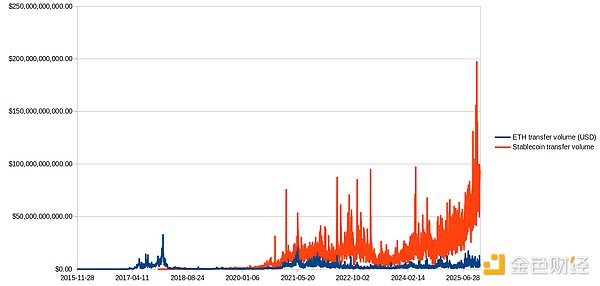
Compared to the period from 2017 to 2021, Ethereum is now rarely used as a medium of exchange or unit of account. This may explain why, despite continued growth in adoption, the appreciation of ETH appears to have stagnated.
The Road to the Future
ETH can overcome its difficulties in the following ways:
It has transformed into a "meme-like store of value" that mimics gold (and now Bitcoin). However, this largely decouples it from the success of the Ethereum chain itself, and it remains unclear whether it will be considered superior to Bitcoin; the value of a meme-like store of value is primarily driven by brand rather than technological attributes.
Drive large-scale activities to re-establish ETH's monetary function in lost territory.
The focus is on generating revenue and burning fees, with a target of at least tens of billions of dollars in revenue. This will require transforming the Ethereum Foundation (EF) into a highly effective research and development (R&D) and business development (BD) organization, and finding ways to sustainably fund these efforts.
Many L1 tokens will face the same problem. While their tokens lack a history of being used as currency, their valuations largely stem from being seen as potential alternatives to Ethereum, implicitly assuming that their tokens will also be used as a medium of exchange. Solana experienced brief success during the Memecoin craze in early 2025, but this success was far more short-lived than the driving forces behind Ethereum's past.
in conclusion
The challenge facing L1 tokens is that their historically high valuations have largely depended on their use as currency (especially as a medium of exchange). The velocity of money equation suggests that when a token fulfills this function, its valuation will follow on-chain economic activity. However, the shift towards stablecoins has disrupted this connection for most L1 tokens.
This raises a valuation question: if tokens are no longer used as currency, what drives their value? There are only three options: either reclaim the monetary function, shift to a store-of-value narrative (competing with Bitcoin), or fundamentally change the value proposition by generating substantial revenue through transaction fees and token burning. The latter requires a different type of organization: one focused on business development and sustainable revenue generation, not just protocol development.