Source: Messari; Compiled by: Jinse Finance
Kalshi's recent growth has been rapid and well-documented. Over the past six months, its monthly notional trading volume has increased by 775%, from $664.4 million in May to $5.81 billion in November. During the same period, open interest (OI) increased by 266%, from $91.6 million on May 31 to $335.3 million on November 30.
Kalshi didn't surpass Polymarket in weekly trading volume until August, but has maintained its lead ever since. In the past 14 weeks, Kalshi has held the top spot for 12 weeks. This run of dominance is closely linked to a key factor: on August 19th, Kalshi partnered with Robinhood, allowing users to directly trade NFL and college football game results through Robinhood's Predict Market Center.
This collaboration represents a breakthrough in two key areas. First, it increases engagement among non-crypto users, enabling them to trade prediction markets directly through their Robinhood accounts without any on-chain experience. Second, it provides US users with a legal and regulated way to trade sports event results through prediction markets, a service not offered by Polymarket at the time.
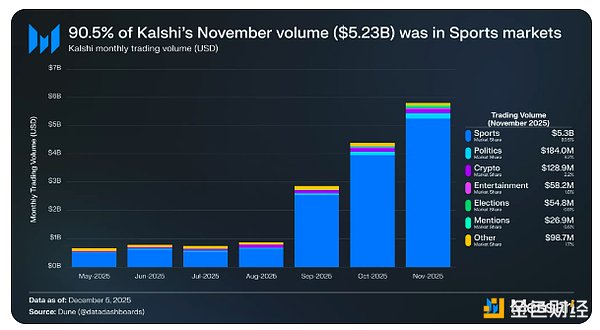
However, a more significant change occurred at the underlying level. The surge in trading volume was not partly driven by sporting events, but almost entirely by them. In November , 90.5% ($5.23 billion) of Kalshi's trading volume came from the sports market. Open interest (OI) showed the same trend: as of November 30, 44.6% ($149.4 million) of OI came from the sports market , making it the largest segment among the platform's two metrics.
There's nothing inherently good or bad about this. The sports market is deeply ingrained in American culture, and Kalshi earns commissions from market orders, regardless of the specific sector the market belongs to. However, sports trading is seasonal, with the biggest driver—American football—having the shortest peak season. Kalshi's explosive growth coincided with the peak of the football season, raising the question: can it maintain this momentum after the season ends?
The team has begun expanding its business outside of the rugby field.
On October 17, Robinhood expanded the product range of its Kalshi prediction market to include political and macroeconomic markets such as tariffs, Federal Reserve policy, and spending cuts.
On December 3, CNN announced a partnership with Kalshi to integrate prediction markets into its newsroom.
CNBC subsequently released a similar announcement on December 4.
These are all correct moves. They broaden the scope of non-sports prediction markets that users can participate in and increase exposure through mainstream media channels. CNN and CNBC, in particular, have allowed Kalshi to reach audiences who may never have been exposed to prediction markets before. But so far, sporting events still dominate. Whether this will change in 2026 depends on whether users can bring the same trading volume to these new markets as they have to to football.
Kalshi's products are expanding. But the next step is not just to continue growing, but to diversify across the industry.