"Whatever happens, happens."
Let things happen, whatever happens.
— Cowboy Bebop
Everything is being accelerated towards "casinoization." I wonder if you've ever felt this way: in the current crypto world, making money is definitely harder than before.
The reason is simple: you not only have to compete with the talented players who survived the previous round, and learn to reconcile with your own emotions, but now you are also forced to compete with countless quantitative teams and AI for speed, information, and decision-making opportunities.
Given this trend, why stay in the crypto space and get yourself involved?
First, let's analyze where the problem lies and whether it can be solved. Currently, for many people (including myself), "trading" is no longer a rational decision-making process, but has become a continuous drain on resources.
This isn't a new problem. Professional traders have lived under this kind of high-pressure environment for decades, only previously this pressure was concentrated on a minority. One theory suggests that AI is forcing everyone to become an investor; for example, people laid off from Amazon stock might buy Amazon shares. Moreover, now, thanks to specialized apps for cryptocurrencies and leveraged products, this pressure is being diluted among tens of millions of ordinary people (even minors are starting to invest), and most people's inherent personalities, education, and talents are simply not suited to sustaining this high-intensity workload in the long run.
Secondly, even after experiencing moments like November when the entire market was rugged, we shouldn't be defeated by this chaotic system.
For a truly exceptional individual, the real meaning is never just about whether or not they ultimately achieved that "One Piece"-like feat during the Age of Exploration, but rather the journey itself—the stumbles and falls along the way, the growth and progress alongside their companions. Like the protagonist of *Cowboy Bebop*, constantly stumbling and drifting through space, uttering the line, "Whatever happens, happens." We must first acknowledge that the universe is inherently chaotic, probability is inherently random, market conditions rise and fall, people join and leave, and making money and losing money are two sides of the same coin. What we can do is never rely on random luck, but rather build our own system within the chaos, and then survive and soar not solely on luck but through that system.
If Navarre's most famous core theory, "How to Get Rich (without getting lucky)," tells us, "Don't design your life as a one-shot gamble based on luck, but build a system that can compound," then in the crypto arena, which has become extremely "casino-like," the version of the answer we need now is:
In the AI era, how can we transform trading from simply "gambling on luck" into a part of a life system that can generate compound interest?
First, let's start with Navarre's most famous tweet and discuss why he stays in the crypto trading space.
Many people ask: In this era where making money is so difficult, and with AI and institutions around, why do retail investors still stay in the crypto world and continue to lose money?
I remember seeing an interview in 2020 where Haseeb, a partner at Dragonfly Capital, said, "Every generation has its hustle." My answer has never changed: the crypto world is our Grand Line.
Whether there will ultimately be a "Great Treasure"-like outcome is anyone's guess. But one thing is certain: we are indeed on our way, and this journey itself is constantly dropping experience points and loot for you.
With each bull and bear market cycle, you'll make more true friends, see more of human nature, and hone more skills. These things won't be written in your personal growth chart, but they will quietly settle into your worldview, decision-making methods, and life structure.
This is the hidden reward of staying in the crypto world.
I continue to share Navarre's thoughts and perspectives with everyone. The core of these thoughts is that Navarre does not reject making money. In fact, the core of his philosophy is to teach people how to combat the uncertainty of probability, including making money without relying on luck. For example, Navarre's famous pinned tweet, "How to Get Rich (without getting lucky)," is a good example.
The topic is how an ordinary person can gradually become wealthy in the internet age through long-term accumulation and leverage. What I want to share next is a prototype I am currently building: the Vibe Trading system, which explores how a super individual can make money in the AI era.
Its core message isn't about teaching you "how to buy the next 100x coin," but rather: even if you're not suited for or good at trading, you can leverage AI in the AI era to become a trader with methodology, risk control, and a sense of rhythm, making money without relying on luck.
II. What is Vibe Trading: From Trader to System Designer

Against this backdrop, a new way of doing things began to take shape, which I call Vibe Trading.
First, let's clarify what it is not: Vibe Trading is not about "recklessly going in based on feelings" or "betting on a single signal to win or lose," nor is it simply repackaging "I feel like I'm going all in today" into a more appealing new term.
It's more like the counterpart of Vibe Coding in the trading world: allowing an ordinary person without a technical background, a quantitative team, or even someone whose personality isn't suited for trading, to build a basic trading system in a few minutes using language they understand.
The real idea behind it is actually a shift in thinking: outsourcing a portion of investment to AI, which we call: Meta-ownership.
In the past, most people entered the game as "operators":
- When the market fluctuates, your first reaction is "Should I buy/Should I sell?"
- Every day you face countless choices, and each choice is intertwined with emotions, exhaustion, and FOMO.
Vibe Trading wants to gradually pull you out of this role and move you closer to another role: the person who designs trading systems.
In other words, the trader of the future will not be someone who is constantly struggling to make decisions in the face of price fluctuations, but someone who writes down their worldview, risk boundaries, and sense of rhythm, and then lets AI Agents do the work for them.
To summarize in simpler terms:
Vibe Trading = Using your vibe (worldview + sense of rhythm), along with capital allocation and risk rules, and leveraging AI, to turn "intuition" into a system that can be repeatedly executed.
It has a three-layer structure:
- Your Vibe:
- How you view risk, how you view market trends, what drawdown you can accept, and what timeframe you are willing to use to interact with the market—these constitute your system's "worldview."
- The framework of funding and risk control
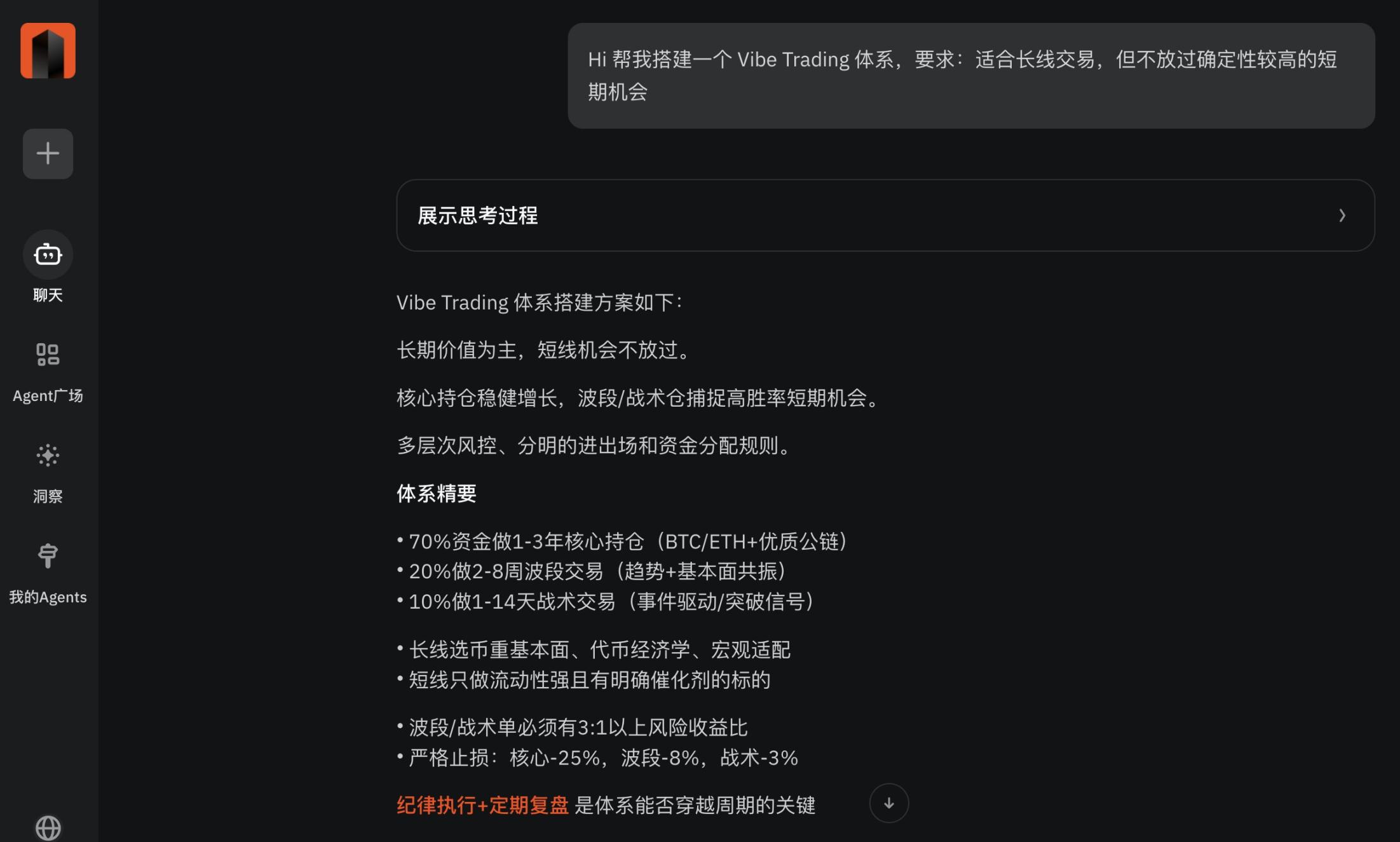
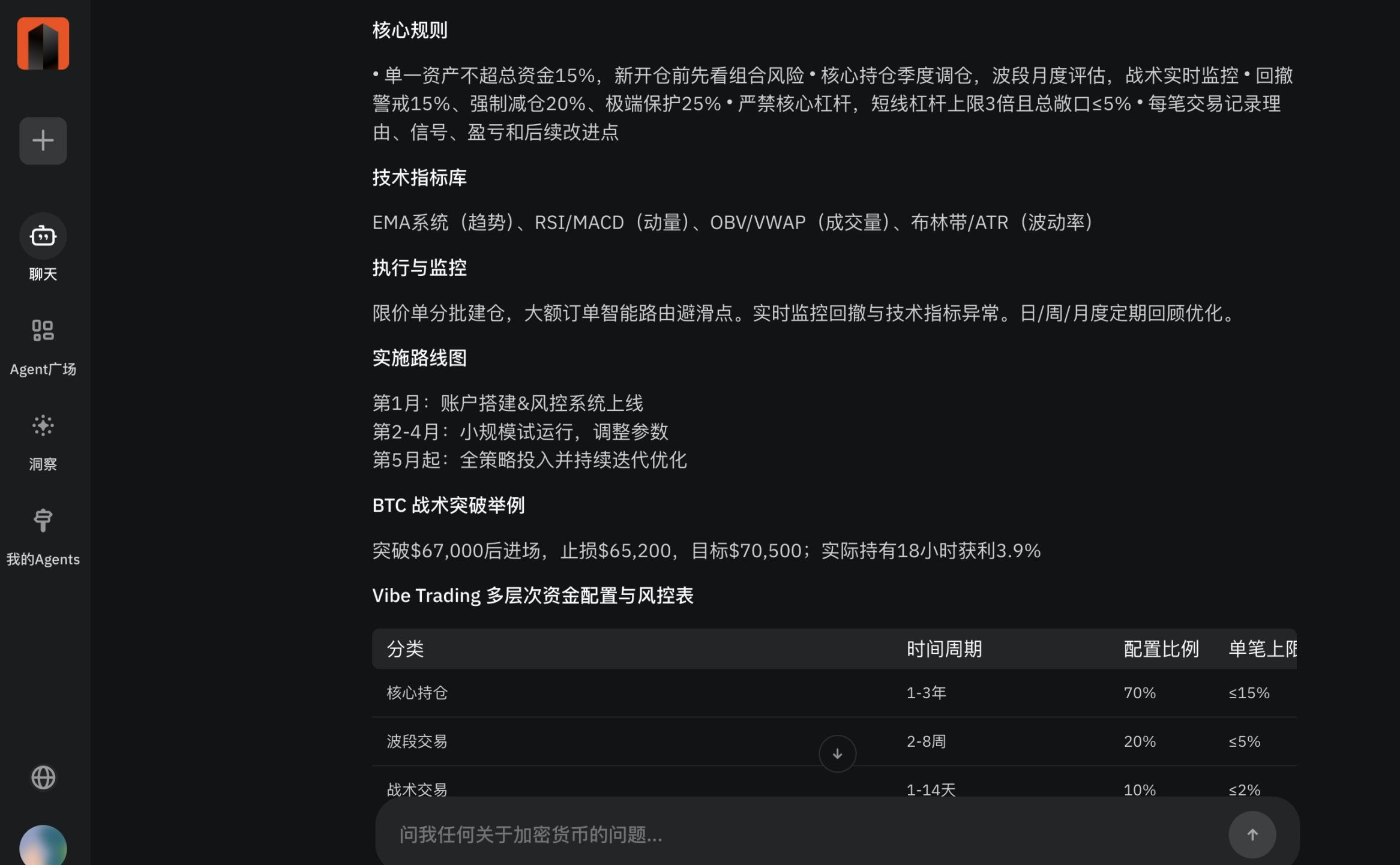
For example, the following suggestion from OG trader friend StarChild (@StarchildOnX) is for a Vibe trading system. The question is: help me build a Vibe Trading system suitable for long-term trading, but not missing out on high-certainty short-term opportunities. Below are the suggestions given.
- 70% will be held as a core portfolio (BTC/ETH + a few high-quality assets) for 1–3 years.
- 20% of the time is used for swing trading (trend + fundamental resonance) lasting 2–8 weeks.
- 10% of trades are tactical trades (event-driven/breakout signals) lasting 1–14 days.
In addition, each layer has different stop-loss orders, position sizing limits, and evaluation frequencies. See the diagram for details.
Develop the habit of using AI-assisted, execution, and review plugins:
In other words, AI and tools can help you monitor the market, clean data, send alerts, and record every transaction. If you don't enjoy trading but are tired of watching the market, AI can help you stick to your trading rules. It all depends on whether you develop the habit of using AI effectively.
When you have your own system, trading has the opportunity to transform from an instant thrill, a game in a casino, into something that can compound over time.
III. Leverage in the AI Era: Let the Agent Work All Night, You Protect Yourself
Having written this far, I've actually answered half of Naval's question:
You replaced watching the market and your emotions with a system;
A structure with compound interest was used to replace a gamble based entirely on luck.
However, after 2025, there is still a reality that cannot be ignored: even with long-term trading, short-term trading opportunities will still be found in the constant flow of information and news.
Having a system alone is not enough. You have to admit that it is no longer possible for humans to keep up with all the information with just a pair of eyes and a brain.
If you want to trade "seriously" in today's market, you'll probably need to do the following simultaneously:
- View hundreds of real-time candlestick charts
- Monitoring various on-chain data and exchange data
- Scroll through Telegram and X channels to avoid missing messages.
- Tracking several mainstream funding channels and the wallets of several large investors
- Compare prices and market depth across several exchanges.
- Dealing with real life while battling one's own emotional fluctuations
To be honest, this is no longer a problem that ordinary people can solve by "staying up for two more hours at night".
Most people eventually have to resort to the "gambling on luck" approach:
It's either dance to your emotions or completely give up. At this level, my understanding of Navarre's "leverage" is as follows:
- In the past, during the internet age, code and media were the levers;
- In the current AI era, "AI agents" are beginning to become a new form of leverage.
You can no longer handle all the information processing by yourself, but you can have a whole set of "little helpers" that won't make you tired or annoyed.
My own approach is very simple:
- Use ChatGPT and Gemini to break down strategies, write documents, and organize trading logs.
- I could also try adding a "permanent co-pilot" to the trading platform. I still recommend Starchild, an AI trading assistant integrated into WOOFi Pro.
I'm still exploring its advanced uses, but for now, the things it does for me are actually quite "everyday":
- Helping me analyze the market doesn't mean blindly following trades; it means preparing key price levels, trading ranges, and important data in advance.
- Please monitor the pullback for me. Once the portfolio touches the warning lines I've written down, remind me to reduce my position instead of making excuses.
- Please preserve my "calm version," and use data and rules to pull me back when I'm tempted to impulsively increase my position.
Let's get more specific from this point on. The above discussed the concepts; now let's look at the practical steps. You can try out the Vibe Trading process using Starchild in WOOFi Pro 2.0. Its starting point perfectly embodies the word "vibe": you only need to begin with a vague intuition.
Step 1: Start with an intuition & intention
You might think that the recent drop in price ($ETH) has been a bit too much.
Perhaps you have a vague feeling that BTC is about to choose a direction within a certain range.
I just want to "make a few sure-fire right-side trades within this quarter".
In the past, you would either keep this feeling to yourself or impulsively place an order.
In the Vibe Trading process, you simply speak this sentence to the AI, or type it into the input box, and it will "receive" your intention.
Step 2: Validate your intuition with data and a global perspective.
Then, we move on to a step that was almost impossible for individual investors in the past: using the system to fill in the missing information dimensions for you. AI & Starchild will:
- Related news and overall economic background
- On-chain data and fund flows
- Market sentiment and volatility
- Technical structure and key price levels of related cryptocurrencies
Bring it all to you and help you turn that little bit of "feeling" into a three-dimensional picture.
You are no longer "driven by emotions," but rather you see:
Does this feeling have any data to back it up, or does it resonate with a larger narrative?
Step 3: Turn your "idea" into a "plan".
This is the most crucial dividing line between Vibe Trading and the gaming tables.
The system will break down your statement "I think we can long" into a structured solution, for example:
- Suggested entry range (rather than a single point)
- Reasonable target price and phased profit-taking logic
- Stop-loss level and position size that match your overall position size
- If the market moves in the wrong direction, what signals indicate that it's time to exit?
In the long run, I think users will realize one thing themselves:
The essence of trading is not a subconscious bet, but a logical and bounded plan.
In Navarre's words, these things are just a kind of leverage: you write your specific knowledge, worldview and rules into it, and let a system that doesn't get tired or FOMO help you execute continuously.
I don't want to keep losing money in the market, silently being taught a lesson by it, and pretending not to improve anything. I should start from first principles; if AI assistance is truly effective, then I'll make adjustments. The money-making system in this article about super individuals still needs improvement, and I will continue to share future experiences with everyone.
See you in space, Cowboy…
Every super-individual originating from Crypto… Cheers