Exchange inflows halved from 232 trillion won to 112 trillion won... "Rises difficult without new liquidity."
);)
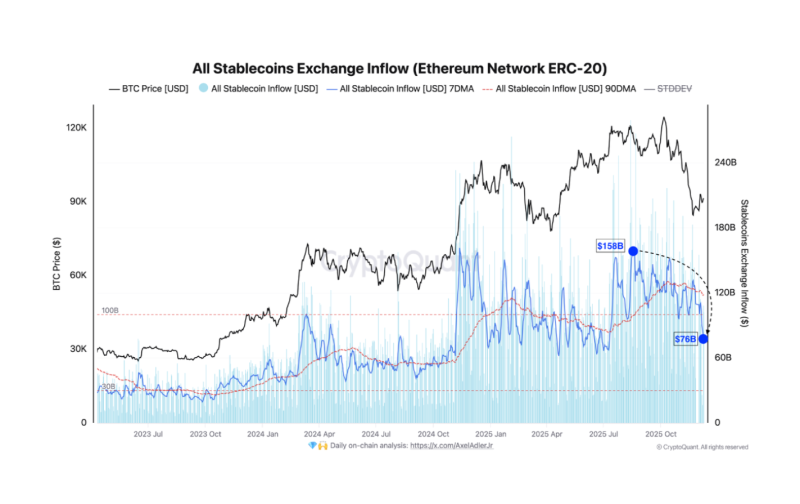
(Source: CryptoQuant)
"One of the key reasons Bitcoin is currently struggling to rebound is the lack of growing liquidity," Darkfost, an analyst at CryptoQuant, an on-chain cryptocurrency analytics platform, said today. "When we talk about liquidity in the cryptocurrency market, we're primarily talking about stablecoins."
Exchange inflows plummet by half since August
According to Darkpost, the amount of stablecoins flowing into exchanges has decreased sharply since August.
Stablecoin exchange inflows have decreased from $158 billion (KRW 232 trillion) in August to approximately $76 billion (KRW 112 trillion) today. This represents a 50% drop in liquidity growth in just four months.
The 90-day average inflow also fell from $130 billion to $118 billion.
Stablecoins are often called the "ammunition" of the virtual asset market. To purchase coins, investors must first convert their fiat currency into stablecoins and then deposit them on an exchange.
Therefore, the decline in stablecoins entering exchanges means that new purchasing funds are drying up.
"Demand is shrinking, and we can't handle the selling pressure."
Darkpost analyzed that this decrease in liquidity is causing a decrease in demand in the Bitcoin market.
"This phenomenon shows that Bitcoin is facing a dire situation due to weakening demand," he said, adding that "the level of market demand weakness is already insufficient to absorb the current selling pressure."
The slight rebound is merely a 'reduction in selling pressure' effect.
Darkpost analyzed that Bitcoin's recent slight rebound was not a real influx of buying power.
He emphasized that "the current market downtrend has not changed," and that "the small rebound seen during the period was primarily driven by a decrease in selling pressure, not a rekindling of buying interest."
This means that the price did not rise due to an influx of new funds, but rather only temporarily recovered as selling volume decreased.
The key to a true bull market is new liquidity.
Darkpost emphasized that new liquidity inflow is essential for Bitcoin to enter a true bull market.
"For Bitcoin to truly begin its bull run, the key is whether new liquidity can smoothly enter the market," he said.
ETF fund outflows are also bad news.
The recent outflow of funds from Bitcoin spot ETFs is also adding to concerns.
According to Bloomberg data, US Bitcoin spot ETFs experienced net outflows last week. Most ETFs, with the exception of BlackRock's IBIT, saw capital outflows.
Year-end rally expectations dampened
Market expectations for a year-end Santa rally are quickly fading.
Some experts predicted that "it is difficult to expect a meaningful rise without a recovery in liquidity," and that "an upward turn will be possible only if expectations of a rate cut are revived after the first quarter of next year or if ETF fund inflows resume."
However, some are optimistic, saying that "the current adjustment is a healthy breather" and that "Bitcoin's upward trend will continue in the long term."
Joohoon Choi joohoon@blockstreet.co.kr