The Middle East and North Africa (MENA) region now accounts for nearly 20% of the global blockchain gaming workforce. This represents the largest regional shift in the industry's history.
The Blockchain Game Alliance's 2025 Blockchain Industry Outlook report, released at the Global Blockchain Show Abu Dhabi on December 10, 2025, revealed a significant global shift in the workforce. The proportion of industry personnel in MENA (Mekong Delta) increased from just 0.5% in 2021 to 19.8% in 2025 – the fastest growth since data tracking began.
Explosive growth has changed the region's demographic structure.
The 5th annual BGA survey reveals a rebalancing of the global blockchain gaming industry. Western markets are shrinking, while other regions are accelerating digital infrastructure development and strengthening regulatory frameworks.
The 2025 survey yielded 506 valid responses, down from 623 in 2024, partly due to a slowdown in Western markets. However, emerging regions showed substantial growth: Africa now accounts for 5.5% of the industry workforce, while Latin America is at 11.9%. This indicates a clear shift away from the traditional dominance of Asia and Europe.
The percentage of women participating in the industry reached a record 22.7%, up from 17.3% in 2024. The majority are concentrated in the 25- to 44 age group. The youth-led boom continues in MENA and Africa. Notably, 40% of respondents from Africa are under 25 years old.
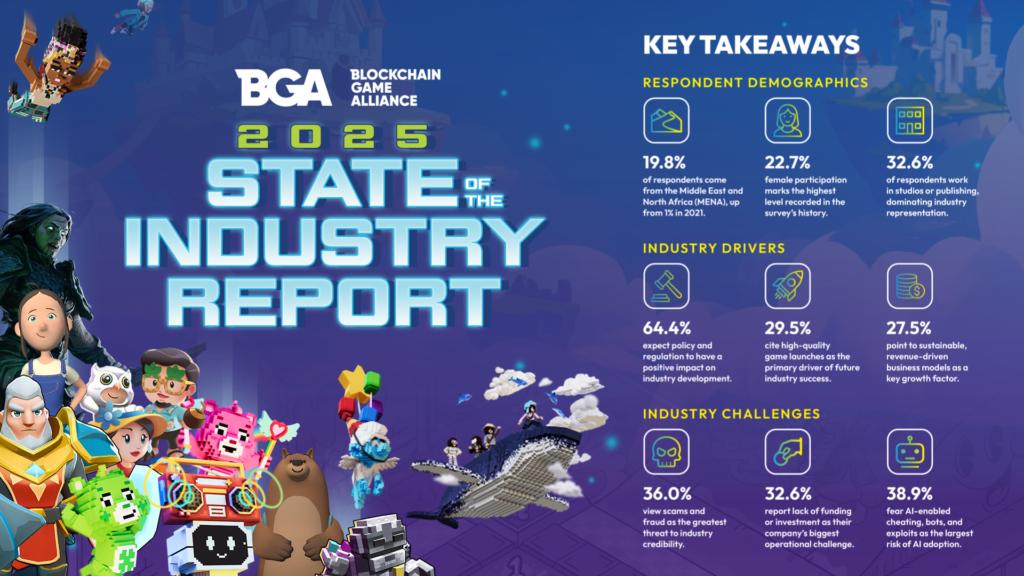 The BGA 2025 summary highlights MENA growth of 19.8%, industry drivers, and major risks. Source: BGA 2025 Report
Regulation and quality are the industry's top priorities.
Experts now XEM regulatory clarity as the most important factor for the future of blockchain gaming. As many as 64.4% expect policies and laws to have a positive impact on the industry. This reflects a growing belief that sustainable development relies on a transparent and clear legal framework.
MENA countries have been quick to establish regulations. The UAE, Bahrain, and Morocco are experimenting with or regulating stablecoin frameworks , making the region a beacon of payment innovation. Oman, for example, has seen a 700% increase in digital payment transactions in just one year. E-wallets now account for up to 74% of all transactions, supporting the blockchain economy operating within the modern financial system.
The launch of high-quality games ranked second on the list of key factors with 29.5%. This indicates a shift away from speculative models as in the past. Sustainable business models focused on revenue ranked third with 27.5%. Stablecoins also received 27.3% support for Vai as cross-border and in-game payment tools.
Studios are focusing on product quality after the downturn. Total Capital in blockchain games has fallen from over $10 billion in 2022 to just $293 million in 2025. Studios are now focusing on generating real revenue rather than chasing speculative Token . Guild participation has decreased from 20.7% in 2022 to 7.9% in 2025 as unsustainable models gradually disappear.
Fraud, lack of Capital , and AI have emerged as leading threats.
Despite many positive developments, the blockchain gaming industry still faces significant hurdles. Fraud and scams continue to be the top threat, cited by 36.0% of respondents. Rug Pull schemes and exploitative models still deter many gamers.
Lack of Capital is the second biggest challenge, accounting for 32.6%. This " Capital shortage" has caused 80% to 93% of startups to close since 2021. Most Venture Capital have also temporarily halted new Capital . Studios now have to demonstrate efficiency and sustainable growth potential if they want to survive.
Artificial intelligence (AI) presents both opportunities and challenges for the industry. While 46% believe AI will significantly boost marketing or content creation, 38.9% are concerned that AI could easily lead to fraud, mass-produced content, and a decline in genuine creativity.
Digital infrastructure boosts MENA's competitive advantage.
MENA's growth is not solely due to its open policies for innovation. The region's residents are highly familiar with digital technology, possess strong financial literacy, and are willing to take risks – crucial factors for blockchain adoption. Nearly 45% of traders in MENA start with demo accounts, demonstrating a significant demand for financial literacy. Clients here have a high win rate and are among the most risk-tolerant groups globally.
Modern payment systems play a crucial Vai . Many countries have developed real-time payment systems, automated payment centers, and mobile platforms, helping to reduce transaction costs, shorten processing times, and promotecross-border value transfers essential for the blockchain gaming ecosystem.
Many major studios have taken notice of this trend. A BGA survey noted participation from personnel at Ubisoft, Square Enix, Cointelegraph, Polygon Labs, DMCC Dubai, and major financial institutions in the region. Traditional gaming and blockchain are converging. Game publishers are exploring Web3 by integrating the new technology without abandoning a proven model.
Globally, stablecoins processed a total transaction value of up to $27.6 trillion in 2024, with MENA leading the way in payment innovation for retail investors. Legal advantages, infrastructure development, and user understanding are helping this sector to thrive as blockchain gaming moves from a niche market to a mainstream trend.
The industry is moving beyond a contraction phase and toward recovery by 2026.
The Web3 Token price has fallen 90% to 95% from its previous peak. Studios are abandoning the Token dependent model, shifting to traditional revenue streams combined with blockchain elements. While many projects have failed, those that survived have significantly better foundations. Studios with strong intellectual property and sustainable economies are beginning to attract investor attention after two years of Capital shortages.
MENA's rise is taking place against a backdrop of industry maturity, where developers benefit from stable regulations, diversified revenue streams, and Capital flows from national institutions and funds.
Looking ahead to 2026, the industry is hoping that the release of high-quality games will deliver the breakthrough success it expects. MENA has emerged thanks to its strong infrastructure, skilled workforce, and favorable legal framework. However, long-term success will still depend on creating engaging games that players choose for entertainment, not just financial gain. Next year will tell whether MENA is truly approaching the status of a "growth engine" in the blockchain gaming industry.