Written by: 0xjs
The Office of the Comptroller of the Currency (OCC) issued Interpretive Letter 1188 on December 9, 2025, confirming that national banks can act as intermediaries for "risk-free principal" in cryptocurrency transactions.
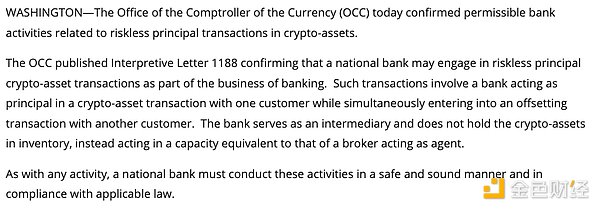
The U.S. Office of the Comptroller of the Currency (OCC) issued Interpretive Letter No. 1188, confirming that national banks can engage in risk-free principal-to-principal crypto asset transactions as part of their banking operations. Such transactions involve a bank acting as principal in a crypto asset transaction with one client while simultaneously engaging in a hedging transaction with another client. The bank, acting as an intermediary, does not hold the crypto assets but rather acts as an agent, similar to a broker.
This means that banks can purchase crypto assets from one client and immediately resell them to another without holding inventory or bearing market risk, limited only to settlement risk. This model is similar to brokerage activities in traditional securities or foreign exchange markets and is considered a legitimate component of "banking business."
This decision signifies that U.S. regulators are further embracing the integration of crypto assets, rather than suppressing them.
Overall, this is a positive sign and will help drive institutional adoption, but it also presents some potential challenges.
Main positive impacts
Enhancing institutional liquidity and market depth: Banks can directly intermediary services for crypto trading for their clients, similar to Coinbase or Binance, but in a regulated manner. This will inject more institutional funds, narrow bid-ask spreads, and increase market liquidity, especially for mainstream assets such as BTC, ETH, and stablecoins. It is expected that several banks will launch crypto trading platforms in the first quarter of 2026, further attracting large investors such as pension funds and corporate treasuries.
Accelerating the convergence of mainstream finance and crypto: This provides banks (such as JPMorgan and Bank of America) with a federal-level "safe haven," allowing them to process customer orders without the need for third-party exchanges. Previously, banks relied on platforms like Paxos or Coinbase Prime; now, they can build proprietary trading desks, driving crypto from the "fringe" to "core financial services." This could spur an increase in the allocation of crypto assets in wealth management (some banks have already recommended 1-4%).
Enhancing regulatory clarity and compliance attractiveness: The OCC's approval emphasizes that banks must comply with BSA/AML (Anti-Money Laundering) and risk management requirements, lowering the entry barrier for institutions. Simultaneously, it complements the November 2025 OCC letter #1186 (allowing banks to hold limited crypto assets to pay network fees), forming a complete framework. Industry analysts believe this will attract more compliant funds and reduce the drag on the market from "regulatory uncertainty."
Potential challenges and negative impacts
Centralization and Censorship Risks: Bank-dominated transaction flows could exacerbate centralization in the crypto industry, making it more susceptible to government intervention or asset freezes (such as targeting specific addresses). This contradicts the decentralized spirit of DeFi, could weaken the competitiveness of smaller exchanges, and fuel community concerns about a "Wall Street takeover."
Implementation obstacles: Despite federal approval, state-level banks still require local licenses (such as DFAL in New York), and the OCC demands stringent security reviews. In the short term, retail users may not immediately benefit; it is more institutional-oriented. Price volatility or settlement failures could still temporarily expose banks to market risks.
Increased competition: The entry of traditional banks will squeeze the market share of existing crypto exchage, forcing platforms like Coinbase to strengthen compliance to compete. However, this may also drive the maturity of the entire industry and raise overall standards.
Market Reaction and Outlook
Discussions on the X platform show that the crypto community generally views it as a "game changer," emphasizing its driving force for institutional adoption.
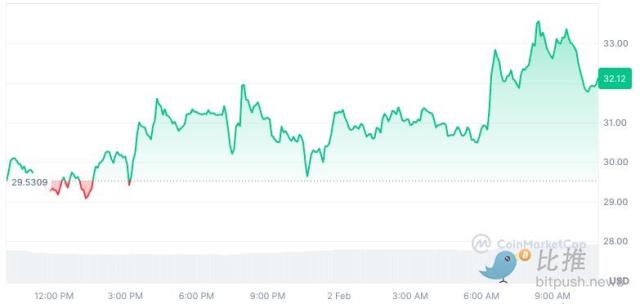
The prices of Bitcoin and Ethereum rose slightly after the release, reflecting market optimism.
In the long term, this could mark 2025 as the “Year Zero of Crypto Banking,” with bank intermediaries expected to account for 10-20% of the crypto market by the end of 2026.
In summary, this decision strengthens the status of crypto as a legitimate asset class and drives its shift from the fringe to the mainstream, but the risks of centralization should be noted. Investors should pay attention to subsequent banking product launches and legislative developments to assess the actual impact.