When Xiaomi's strategic partnership with the high-performance public blockchain Sei ignited the tech and crypto world at the end of 2025, the industry suddenly realized that the mainstreaming of Web3 had finally found the most "down-to-earth" breakthrough point—not complex on-chain protocol upgrades, nor niche ecosystem narratives, but rather putting the crypto ecosystem into the mobile phones used by hundreds of millions of people every day, making "access to Web3 upon startup" a reality.
The core impact of this collaboration goes far beyond simply "pre-installing a wallet app." Data shows that Xiaomi shipped 168 million smartphones globally in 2024, maintaining a top-three market share in Europe, Southeast Asia, and Africa. This "hardware-level distribution" directly bypasses the traditional Web3 customer acquisition challenges—users don't need to search, download, or learn seed phrase; they simply have an on-chain wallet upon startup and will be able to directly purchase all Xiaomi products with stablecoins in the future. As Sei co-founder Jeff Feng stated, this is a "watershed moment that reimagines the interaction between billions of users and digital assets."
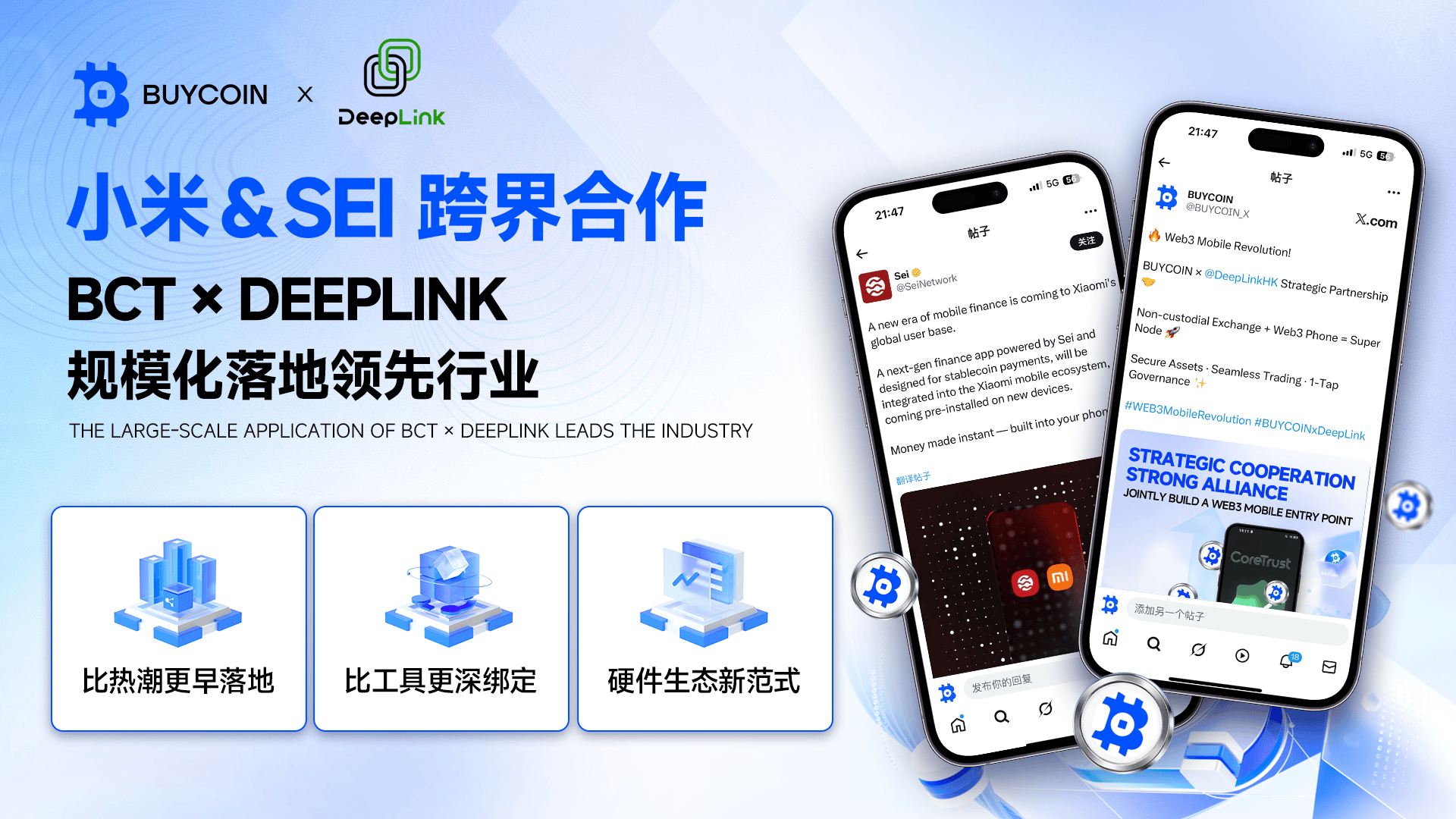
When the collaboration on "pre-installing Web3 wallets on mobile phones" sparked heated discussions in the industry, many people thought it was a "groundbreaking breakthrough" in the hardware application of Web3. However, what is little known is that a week before the official announcement of this collaboration, the strategic partnership between BUYCOIN exchange and DeepLink had already achieved large-scale implementation—over 100,000 DeepLink mobile phones had completed the pre-installation of the BUYCOIN ecosystem entry point, and the BUYCOIN application had also officially completed its listing and optimization in the DeepLink app store. The innovative model of "buying a phone means holding shares" had also entered the full-scale implementation stage.
If Xiaomi x Sei opened the door to "Web3 hardware entry points," then BCT x DeepLink has built a deeper "user-ecosystem community of shared interests" behind that door. With mature practical experience, it has answered the core question that Xiaomi's cooperation has not yet touched: When users have access to Web3, how can they truly become the masters of the ecosystem, rather than just simple users of functions?
Web3 Hardwareization: An Inevitable Trend from "Niche Tools" to "Mass Infrastructure"
The reason why Xiaomi's collaboration with Sei has become the focus of the industry is that it has essentially hit the "pain point" of Web3 development. For a long time, the popularization of the crypto ecosystem has been stuck at the "entry threshold": the seed phrase is hard to remember, the APP download process is cumbersome, and the on-chain operation is complicated, keeping the vast majority of ordinary users out.
Xiaomi's solution is to reconstruct the Web3 entry point using consumer electronics logic. Through MPC wallet technology, users can log in with their Google or Xiaomi accounts with one click, eliminating the need for complex seed phrase and making it easy to use. The wallet is not just a cryptocurrency storage tool; it also has a built-in dApp discovery center covering DeFi, GameFi, and other ecosystems. It also plans to support C2B payments at Xiaomi's 20,000 offline stores, achieving scenario-based integration. Leveraging Xiaomi's global user base of hundreds of millions, the goal is to expand the Web3 ecosystem from "millions of crypto users" to "hundreds of millions of consumer users," achieving large-scale reach.
This combination of "pre-installed hardware + scenario-based implementation + large-scale reach" has completely changed the customer acquisition logic of Web3—users who previously needed to be reached through community promotion and KOL advertising can now be directly and precisely delivered through mobile phone sales. Industry analysts generally believe that this marks Web3's official entry into the "hardware-driven breakthrough" stage: in the future, consumer hardware such as mobile phones and smart wearables will become more important Web3 entry points than exchange apps and wallet tools.
The collaboration between BCT and DeepLink represents an "advanced practice" and a "pioneering model" within this trend. As a core hardware partner focusing on the Web3 ecosystem, DeepLink's mobile products possess inherent "security hardware genes"—built-in bank-grade security chips and offline wallet functionality—providing hardware-level protection for users' private keys. This complements Xiaomi's "barrier-free" advantage, better aligning with Web3 users' core need for "security."
More importantly, the two parties did not stop at the superficial cooperation of "pre-installed tools", but directly entered the deep logic of "interest binding", making hardware a "rights certificate" for users to enter the Web3 ecosystem, and this model has been verified to be feasible through large-scale implementation.
From "Planning Blueprint" to "Practical Implementation": BCT×DeepLink's Differentiated Breakthrough Point
If the core of the Xiaomi x Sei collaboration is "solving the entry point problem," and it remains in the planning and preparation stage, then the core of the BCT x DeepLink collaboration is "solving the retention and value problems," and it has already completed the entire closed loop from signing to implementation. Both are combinations of "mobile phone + Web3," but the collaboration between BCT and DeepLink has built a competitive advantage that is difficult to replicate through multi-dimensional and in-depth breakthroughs.
In terms of shared benefits, BCT's "purchase equals shareholding" plan upgrades users from "being able to use Web3" to "owning the Web3 ecosystem." According to the cooperation agreement, for every DeepLink phone sold, the joint foundation will allocate 10% of the phone's selling price to purchase BUYCOIN platform tokens (BCT) on the secondary market, and automatically distribute them to the phone user through a smart contract.
This means that when users buy a phone, they automatically acquire "ecosystem shareholder rights" corresponding to BCT. As the governance and dividend token of BUYCOIN, holding BCT allows users to enjoy income and dividends across all scenarios, including spot trading, contracts, and lending on exchanges. Users can also participate in key ecosystem decisions such as asset listings and fee adjustments. Furthermore, the entire process from purchasing BCT to airdrop is traceable on the blockchain, and users can verify it at any time through a blockchain explorer, eliminating any possibility of opaque operations.
This model completely changes the traditional view of hardware as merely a tool, making the DeepLink phone a "ticket" to entry into the BUYCOIN ecosystem. Users are directly upgraded from "ecosystem users" to "ecosystem owners," which is more effective at retaining users than Xiaomi's "pre-installed features" and aligns better with the core logic of Web3's "user sovereignty." Currently, this plan is being implemented concurrently with the launch of the new DeepLink phone, and the first batch of buyers have already begun receiving BCT benefits.
In terms of ecosystem collaboration, BCT and DeepLink have achieved "system-level ecosystem integration," rather than the "independent app collaboration" like Xiaomi x Sei. The hardware security chip built into the DeepLink phone is deeply integrated with BUYCOIN's "non-custodial architecture." User private keys are stored in hardware and isolated from the internet, ensuring zero-touch platform access and completely eliminating the risk of asset misappropriation and hacker attacks. BUYCOIN's transaction, burning, and mining functions are also highly compatible with DeepLink phone hardware. Users can complete on-chain transaction signing via fingerprint or facial recognition without repeatedly entering passwords, and transaction preparation can be completed even offline.
Furthermore, it features system-level information collaboration and functional expansion. The DeepLink phone will proactively push BUYCOIN's ecosystem updates, such as key information like dividend payments and governance votes. It also has a built-in airdrop assistant to help users track and receive digital asset airdrops in real time. In the future, it will also integrate BCTPay payment services with the DeepLink phone's NFC function to enable BCT payments in offline scenarios.
This deep integration of "hardware security + ecosystem functions + scenario expansion" makes the Web3 ecosystem no longer "an app on a mobile phone", but "an integral part of the mobile phone experience", with a lower barrier to entry and a smoother experience.
In terms of compliance and security, the partnership between BCT and DeepLink also offers significant advantages. BUYCOIN holds compliance licenses in multiple regions, ensuring that the entire process of BCT issuance, destruction, and dividend distribution complies with regulatory requirements, making the market coverage of the partnership more certain. DeepLink phones not only feature bank-grade security chips but have also passed professional audits by Web3 security organizations, with biometric encryption and offline wallet functions further strengthening asset security. To address the potential impact of BCT price fluctuations on user rights, both parties have adopted a strategy of "phased purchases + price range control" to mitigate cost risks.
The Future of Web3 Hardware: Pioneers Define the Rules, Implementers Win the Market
The collaborations between Xiaomi and Sei, and BCT and DeepLink, while taking different paths and progressing at different times, are essentially both exploring "how Web3 can be integrated into everyday life through hardware." From an industry trend perspective, by 2025, the global blockchain hardware industry had achieved breakthroughs in both scale and quality. The integration of hardware with the Web3 ecosystem has become a clear direction, and future competition will inevitably shift from "competing for entry points" to "competing for benefits"—because simply being "barrier-free" can only attract users to try it out, while "profit sharing" is what retains users for long-term participation.
Xiaomi's collaboration succeeds in "scale imagination," leveraging its massive user base to bring greater industry attention to Web3 hardware and accelerate the trend's adoption. BCT's collaboration with DeepLink succeeds in "depth of implementation," using a "purchase-as-shareholding" model to create a "community of shared interests" between users and the ecosystem. This is precisely the core competitiveness of the Web3 ecosystem—after all, the essence of Web3 is not "more convenient tools," but "fairer value distribution."
For users, Xiaomi's collaboration may be their "first opportunity to experience Web3," while BCT's collaboration with DeepLink represents their "first real opportunity to own a Web3 ecosystem." As the number of hardware entry points for Web3 increases, what will ultimately retain users will not be "whose phone is cheaper," but rather "who can truly allow users to enjoy the benefits of ecosystem growth."
From this perspective, the collaboration between BCT and DeepLink not only provides a replicable and mature model for Web3 hardware implementation, but also leverages its first-mover advantage to capture users' minds and gain industry influence.
This wave of Web3 hardware expansion has only just begun, and those pioneers who truly understand "user sovereignty" and "profit sharing," and dare to be the first to implement solutions and define the rules, will ultimately become the industry mainstream. The collaboration between BCT and DeepLink has already proven that the core competitiveness of Web3 hardware is never about "who announces it first," but rather "who implements it first" and "who benefits users first"—this is precisely the value of pioneers and the key to future market competition.