


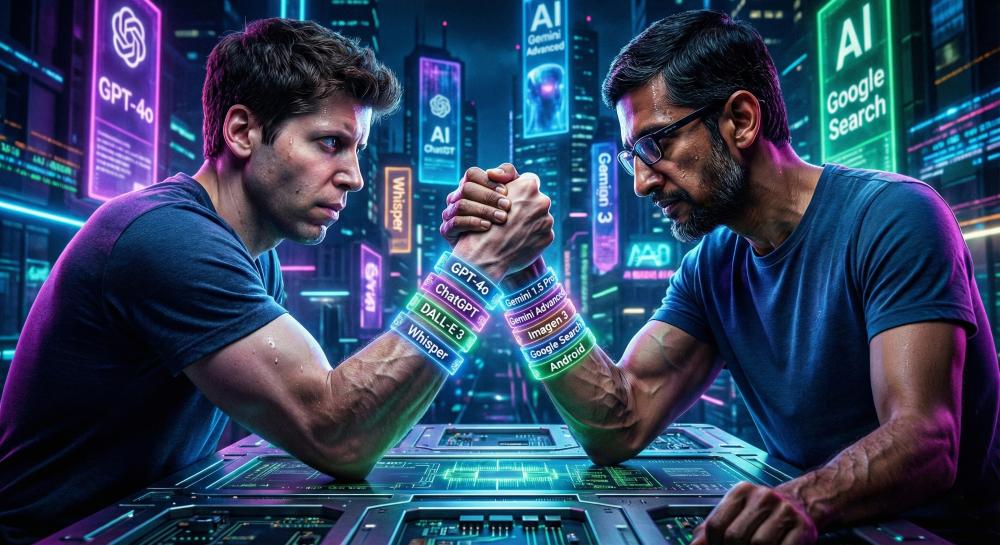
Sam and Pichai arm wrestling; image generated by AI.
A month ago, Google's Gemini 3 surpassed all competitors to become the "world's best". A month later, on the 10th anniversary of OpenAI's founding (December 11, US time), the new generation AI model GPT-5.2 was officially launched.
Ahead of this crucial product launch, Ultraman issued a top-level "red alert" internally in response to its main competitors' product development and talent poaching efforts.
Therefore, the unveiling of GPT-5.2 is not only about the market position of the two tech giants, but may also redefine the competitive landscape of the global artificial intelligence industry.
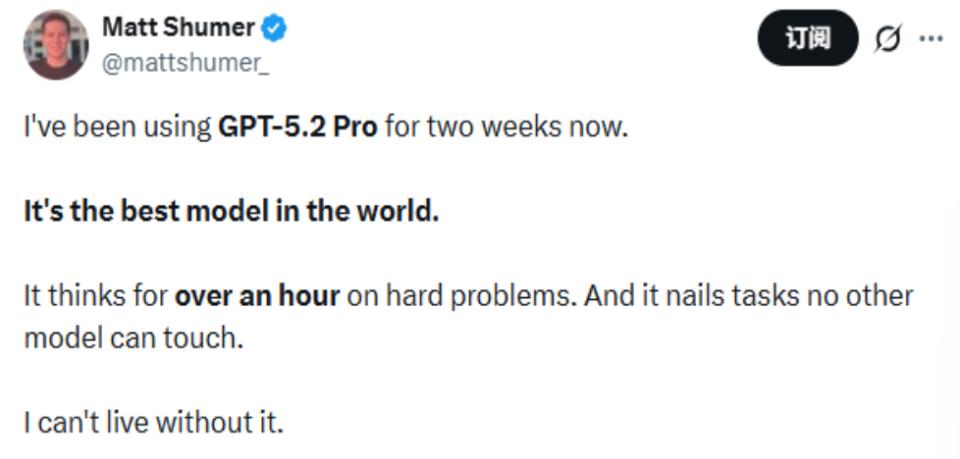
Matt Schumer, co-founder and CEO of HyperWrite, who had been in "internal testing" two weeks ahead of schedule, commented: "It has strong capabilities, especially inference capabilities, but it is slow and the scenarios are too limited. It can only be used through ChatGPT."
"This is the best model in the world. It can handle difficult problems in an hour and complete the task excellently. I can't live without it."
Silicon Valley AI expert Ellie Miller, also a "beta tester," defines GPT-5.2 as a "professional researcher": "serious" and "professional" in deep thinking and solving complex problems, but the content is structured and not very user-friendly for users who prefer fast, concise and human-like communication.
“For complex tasks, brainstorming, and specialized analysis, I would probably use GPT-5.2.”
AI developer Dp Singh agrees with the above assessment, emphasizing that for the first time, AI can achieve expert-level output in everyday professional tasks (such as creating presentations, spreadsheets, and analyzing charts) , not just in demonstration scenarios.
The professional capabilities demonstrated by GPT-5.2, on par with those of human researchers, have also attracted the attention of academic experts.
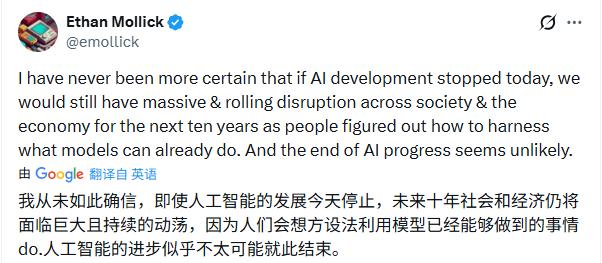
"I have never been so sure that even if AI development stopped today, society and the economy would still face tremendous changes in the next 10 years because humans would find ways to utilize the capabilities of models," said Ethan Morlick, a professor at the Wharton School of the University of Pennsylvania and an expert in artificial intelligence.
01 OpenAI cannot be "far ahead"
OpenAI has a clear vision for GPT-5.2: it is "the model best suited for real-world professional use to date."
The indicators that prove its "ability" are benchmark tests and performance scores.
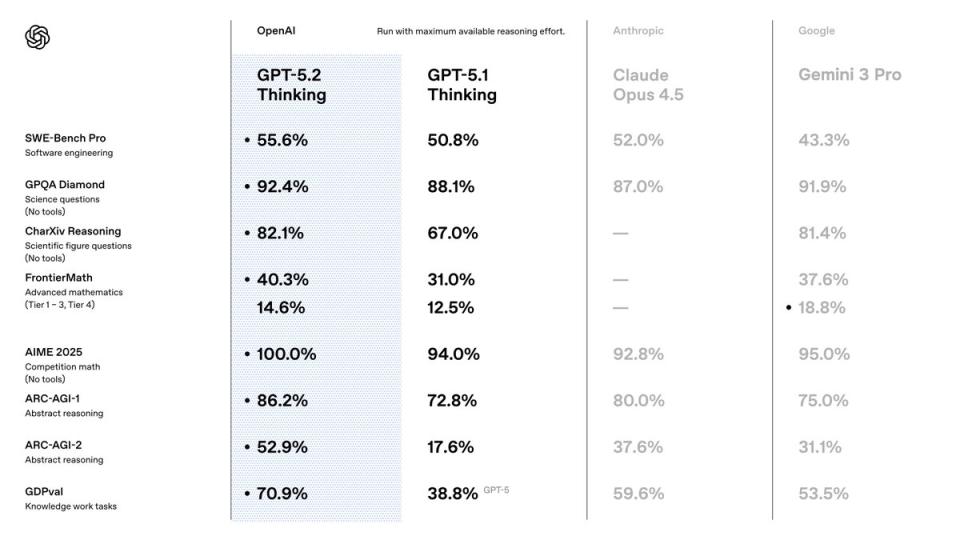
The image above is a benchmark test chart that OpenAI showcased on X (this chart wasn't even included in the official press release).
As can be seen, in its self-developed GDPval benchmark test, GPT-5.2 reached or surpassed the level of top human experts on 70.9% of the explicit tasks, a significant leap from its August release GPT-5 (38.8%), and also ahead of Anthropic's Claude Opus 4.5 (59.6%) and Google's Gemini 3 Pro (53.5%).
However, GDPval is OpenAI's own benchmark test, so it's problematic if it's not performed well.
More importantly, there are so many benchmarks in the industry. OpenAI cited eight different types of benchmarks this time, while Google cited about 20 benchmarks in Gemini 3. This gives us room to maneuver – we can include whichever benchmark data we have the best and leave the rest out.
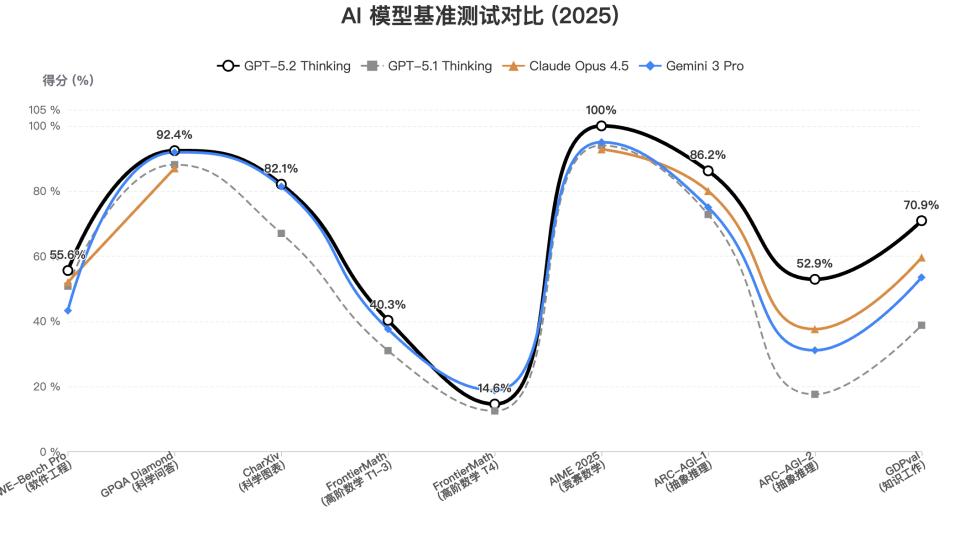
However, if we convert the table above into a line graph, we can clearly see that in multiple benchmark tests, the differences between the most advanced models from various companies using OpenAI's newly released GPT-5.2 are not significant.
It can be said that the AI race has evolved from a one-man show by OpenAI to a chaotic battle between multiple giants.
The New York Times also mentioned this view, citing industry experts who pointed out that "the technological gap between OpenAI's so-called AI foundational model and other companies' models has actually disappeared."
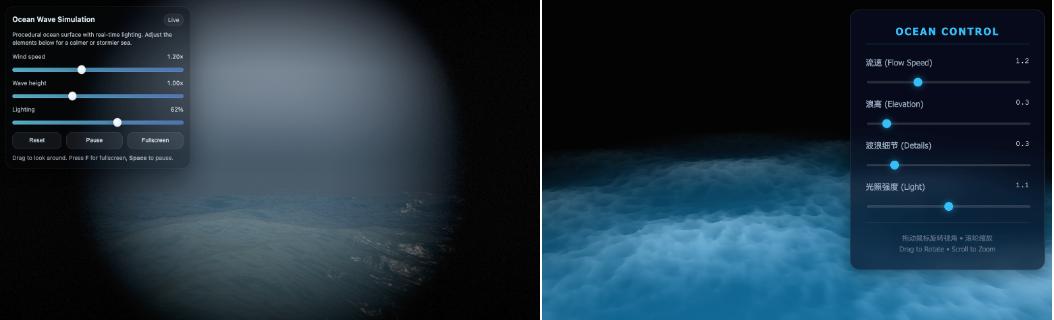
If benchmark tests are not intuitive enough, you can look at specific examples. The left image below is the "Wave Simulator" webpage provided by OpenAI, and the right image is the page generated in Gemini with the same prompts. In general, each has its advantages.
As mentioned earlier, due to the relentless pressure from competitors, Ultraman sounded a "red alert" within the company.
Judging from the gap between GPT 5.2 and its peers, it is estimated that the "red alert" will not be eliminated at the product and model level in the short term.
Regarding this issue, Figi Simo, CEO of the application business who was poached by Altman, said, "A red alert is a signal to the company that we need to focus our resources on a specific area; it's a way of prioritizing."
The gist is that the red alert isn't a life-or-death situation, but rather a way for management to demonstrate their resolve and set the direction. In reality, GPT-5.2 had been under development for several months; it's just that this particular time was chosen for its release.
The question is, if it comes down to the life or death of a company, besides the GPT-5.2 which doesn't really offer much of a competitive advantage, does Ultraman have any other weapon that's even faster?
Of course, compared to sounding the alarm internally, Ultraman's behavior externally is quite relaxed.
In an interview with CNBC, he expressed cautious optimism: "The impact of Gemini 3 on our business metrics is probably smaller than we feared." He predicted that OpenAI would lift the "red alert" status "in a very strong position" in January 2026.
02 A decade-long dream, or a decade of ten dreams?
OpenAI has just celebrated its 10th anniversary, and its official website has released a video introducing where the company came from and where it is going.
Ten years ago, when Musk was still active in the OpenAI project, Jensen Huang gave OpenAI the world's first DGX-1 server. Various big names left their signatures on it, and there was a motto on the background wall : "The key question is not what we know, but how we use what we know ... I believe that each of us has a responsibility to act as if the fate of the whole world rests on our shoulders."
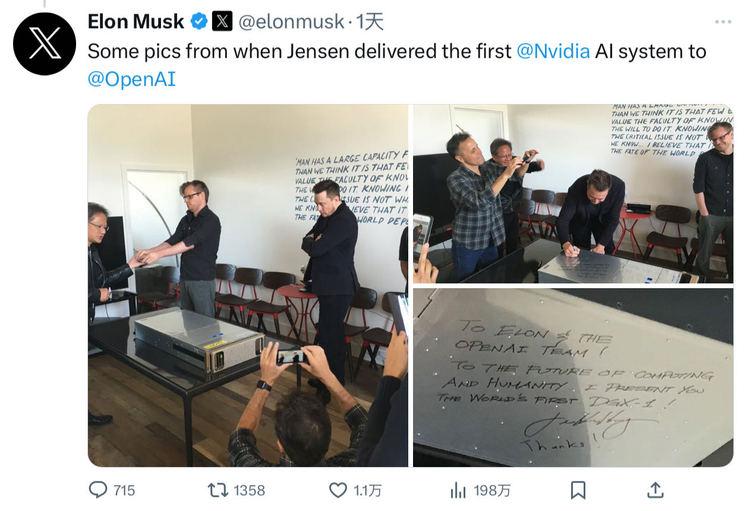
Over the past decade, OpenAI has delivered groundbreaking products like ChatGPT and Sora to the world. Ultraman has been traveling the world preaching and partnering with various Silicon Valley giants to provide computing power. However, as time has passed, OpenAI has gone from having a significant lead at the beginning to being caught up with or even surpassed by its competitors.
OpenAI is currently at a crossroads of uncertainty.
In its early days, OpenAI claimed that its goal was to "advance digital intelligence in a way that is most likely to benefit all of humanity, without being limited by the need to generate financial returns."
Catherine Flick, an AI ethicist at Staffordshire University, also emphasized that this founding principle has undergone a dramatic shift. This is because behind OpenAI's complex architecture lies a for-profit company with intricately intertwined interests.
“We now have a for-profit company that has completely shirked any responsibility for social benefits and has basically embraced the creed of growth at all costs,” Flick said, explaining that OpenAI is at the forefront of the generative AI revolution, where “there is money to be made.”
Amidst the red alert, OpenAI's top priority is to improve product experience, with commercialization taking a backseat, because this involves survival and also concerns Ultraman's grander ideal—superintelligence that may be achieved in 10 years. However, this vision is not an absolute consensus within OpenAI.
03 The Conflict Between Commercialization and Governance
Behind the technological race lies the immense pressure OpenAI faces to commercialize and generate profits.
Altman stated that OpenAI's goal is to achieve monthly revenue equivalent to $20 billion annually by the end of 2025, but he acknowledged that there is "still a long way to go" before achieving overall profitability.
Even more noteworthy is OpenAI's commitment to investing up to $1.4 trillion in computing infrastructure over the next few years to support its AI ambitions.
According to the latest data from market research firm Sensor Tower, ChatGPT's total monthly active users worldwide reached 810 million in November 2025, with a growth rate of only 6% from August to November, far below the more than 40% growth rate in the same period of 2024. Furthermore, its global market share also dropped from 38% to 35% within four months.
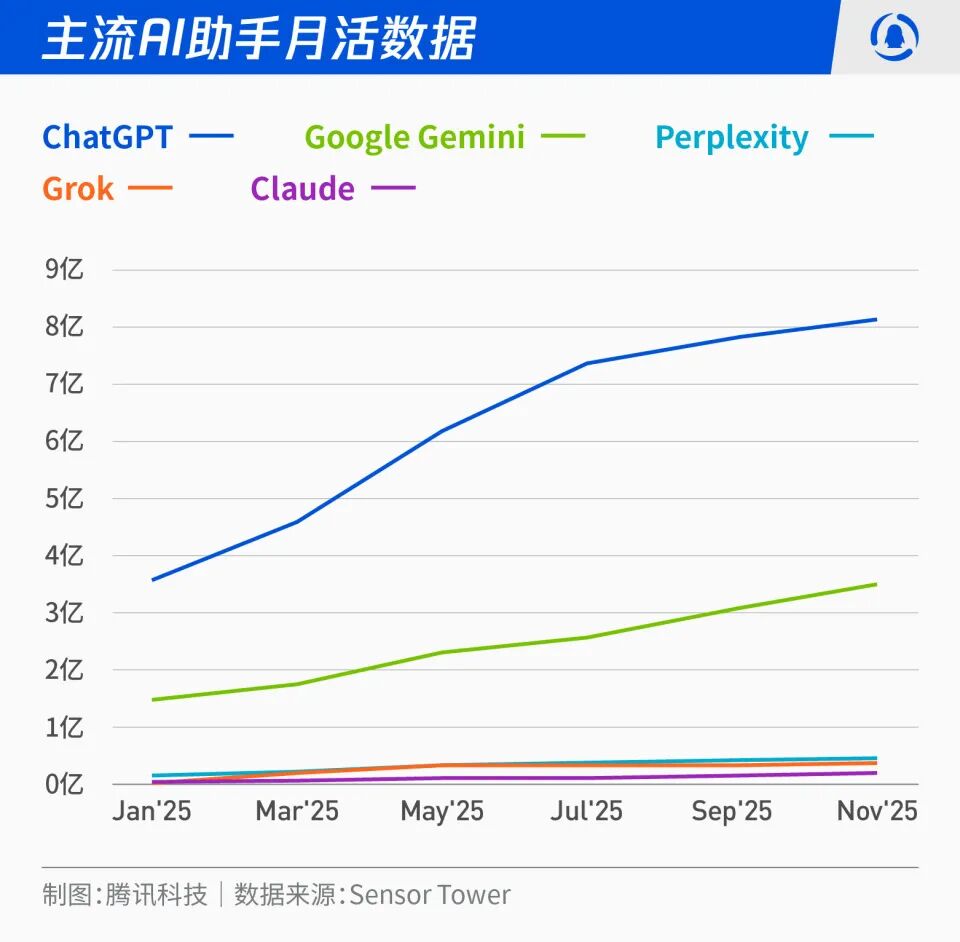
Currently, ChatGPT is OpenAI's revenue lifeline. Of its more than 800 million weekly active users, approximately 6% pay $20 per month for premium services.
OpenAI is trying to extract more value from free users, exploring directions including introducing advertising in ChatGPT and developing a revenue-sharing model (for example, OpenAI taking a cut when users shop through the chatbot).
Simo also confirmed that OpenAI plans to introduce a user age prediction feature to protect teenagers before launching an "adult mode" (which may allow adult content). The "adult mode" is expected to launch in the first quarter of next year.
At the same time, OpenAI is actively expanding into the enterprise software market, positioning itself as a company serving both consumers and enterprises. The performance improvements in GPT-5.2 in professional fields such as coding, law, and finance are precisely aimed at attracting high-value enterprise customers.
However, in this market, OpenAI will face fierce competition directly from giants such as Google and Microsoft, which are able to deeply integrate AI tools with mature office software ecosystems (such as Google Workspace and Microsoft 365).
Profitability can help OpenAI obtain a continuous stream of funding to continue its grand ideal of helping humanity, but this process will also give rise to a series of security and ethical issues.
Just before the release of GPT-5.2, OpenAI faced a new lawsuit alleging that ChatGPT's interactions with a mentally distressed user indirectly contributed to a murder-suicide tragedy in Connecticut. It's worth noting that this is not the first such lawsuit.
OpenAI responded that the incident was "heartbreaking" and pledged to continuously improve its system's ability to identify and respond to signs of psychological distress, guiding users to seek real-world help.
Furthermore, the ongoing lawsuit filed by The New York Times against OpenAI and its partner Microsoft for copyright infringement highlights the fundamental industry challenge of the legality of AI training data.
04. Competing with Google for Supremacy
This contest between OpenAI and Google has long transcended a simple comparison of technical parameters, evolving into a comprehensive war encompassing technological iteration, ecosystem building, business models, security governance, and capital endurance.
On the technical level, the competition for the top spot in benchmark tests is becoming increasingly fierce.
While OpenAI's VP of Research, Aidan Clark, did not disclose specific training breakthroughs for GPT-5.2, he acknowledged continuous improvements in fundamental aspects such as pre-training, addressing industry concerns about whether the potential of pre-training has been exhausted.
At the ecosystem level, OpenAI launched its own browser, aiming to challenge Google's Chrome and attempting to build a complete closed-loop ecosystem from underlying models to upper-level applications. Google, on the other hand, is trying to create synergistic advantages through integration, leveraging its vast existing product matrix.
Wei-Lin Chiang of LMARaena, an AI model evaluation platform, pointed out: "User growth for general models has reached a bottleneck, and the next growth engine will inevitably come from vertical fields."
He also emphasized that the core of the current competition is no longer simply user expansion, but rather who can take the lead in establishing reliable and efficient solutions in key industries such as healthcare and finance, and truly realize the transformation of technological capabilities into industrial value.
Finally, at the strategic and cultural level, OpenAI's rapid transformation from a non-profit research institution to a high-valuation commercial entity, and its urgent pursuit of profitability, are reshaping its internal culture. Some of the distinctions that early employees once took pride in—the differences from advertising-driven models like Google's—are becoming blurred under the pressure of reality.
“This is a race that will unfold on multiple fronts.” This statement by Rajan Krishnan, CEO of Vals AI, a company that tracks the performance of the latest AI technologies, aptly summarizes the complexity of the current battle for AI supremacy.
Overall, the release of GPT-5.2 is a powerful technological declaration by OpenAI in its professional field, but it is far from the end – it has failed to widen the gap with its competitors, and even OpenAI itself says that the alarm bells will not be extinguished until January 2026. More importantly, even if the "red alert" can be temporarily lifted in the short term, the highest level of competition alarms in the entire AI industry are already ringing.
This article is from the WeChat official account "Tencent Technology" , author: Su Yang Wuji, and published with authorization from 36Kr.






