Original title: Lighter's "0% Fees" Are Actually 5-10x More Expensive Than Other Exchanges
Original author: @PerpetualCow, crypto KOL
Original translation by AididiaoJP, Foresight News
There's a truth in business: if a product is free, then you are the product itself.
Lighter DEX is advertising "zero commission" to retail traders. It sounds too good to be true, and it actually is.
But what Lighter didn't highlight in bold was the latency structure behind these "free" deals.
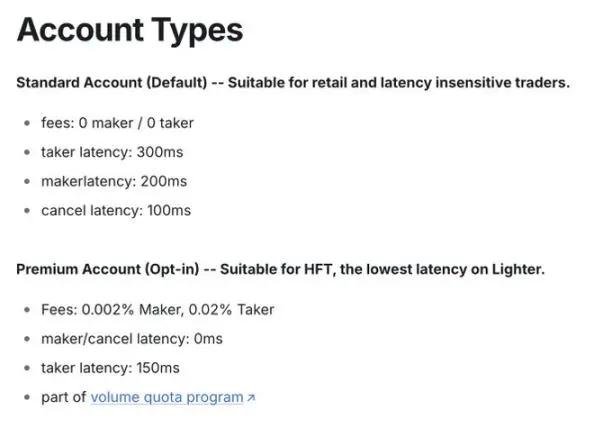
Lighter offers two account types: once you understand how delays work, you'll find that the 0% fee is actually the most expensive option on the platform.
That 200–300 millisecond delay is the entirety of their business model.
What exactly does 300 milliseconds mean?
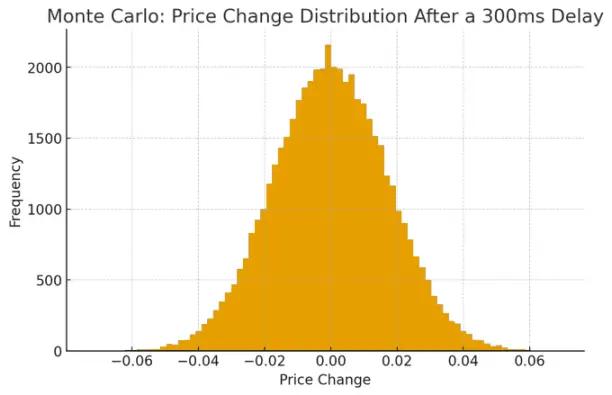
It takes an average of 100–150 milliseconds for a human to blink once. In the blink of an eye, faster traders have already caught price fluctuations, adjusted their positions, and traded against you.
The crypto market is highly volatile, with prices fluctuating by approximately 0.5 to 1 basis point per second at typical volatility levels (50–80% annualized).
In other words, within 300 milliseconds, random market fluctuations alone can cause prices to move by an average of 0.15–0.30 basis points.
The real cost of "free"
If we quantify it:
Academic research on the cost of adverse selection (Glosten & Milgrom, Kyle's Lambda, etc.) indicates that informed traders typically have an advantage of 2–5 times the magnitude of random price fluctuations.
If the random slip within 300 milliseconds is approximately 0.2 basis points, then reverse selection will add an additional 0.4–1.0 basis points.
For active traders and market makers, the actual costs are roughly as follows:
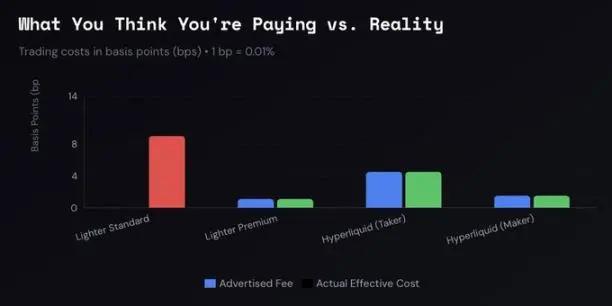
• Standard account actual cost: 6–12 basis points (0.06%–0.12%) per transaction
• Actual cost for advanced accounts: 0.2–2 basis points per trade (0.002%–0.02%)
The cost of a "free" account is 5–10 times higher than that of a paid account.
Zero fees are just a marketing figure; the real cost lies in the delays.
Premium accounts are definitely more cost-effective.
Under no circumstances is a standard account (0% fee) a better choice.
This applies to small investors, large investors, scalpers, swing traders, and even passive investors. It is especially not true for market makers, and indeed for everyone.
"I'm just a small retail investor; I don't need advanced architecture."
That's wrong.
Small investors are even less able to withstand slippage. If you trade with $1,000 and lose 10 basis points on each trade, that's equivalent to losing $1 each time. After 50 trades, 5% of your account will have vanished without a trace.
"I don't trade frequently, so delays don't affect me."
That's wrong too.
If you don't trade frequently, the fees for a premium account are negligible.
But even in those few transactions, the price you get is still worse. Since the cost of avoiding this loss is almost zero, why accept any disadvantage?
Upgrade directly to a premium account.
This model has precedents.
Traditional financial markets have long been familiar with this technique, which is called order flow payment.
@RobinhoodApp popularized this model by attracting retail investors with "free trading" and then routing orders to market makers who profited by trading against unsuspecting retail investors' orders.
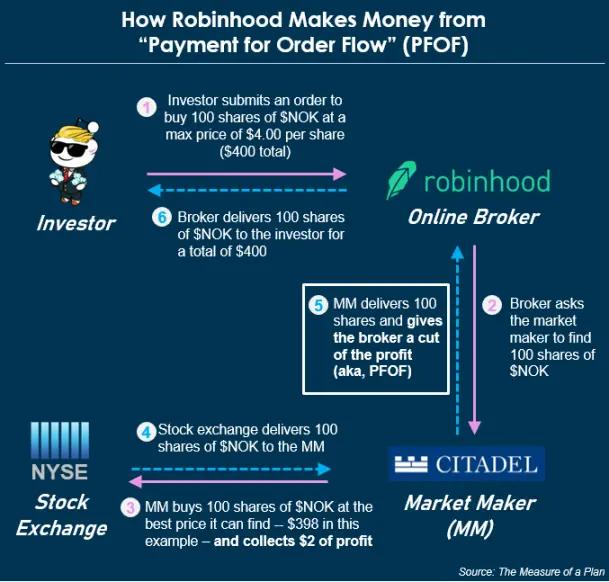
Lighter's model is structurally similar. Standard accounts don't receive free trades, but rather slower ones. This latency is converted into profit by faster participants.
The trading platform doesn't charge you transaction fees because you're actually paying for the quality of execution.
What Lighter did right and wrong
Lighter did not hide the latency data; after all, it is written in the documentation.
But transparency is not the same as clarity.
Highlighting "0% handling fee" in the title while hiding "300 millisecond delay" in the details is a strategy that prioritizes registration conversion rate over user understanding.
Most retail investors do not understand the meaning of delay, nor do they know what adverse selection is, so they cannot calculate the equivalent actual cost.
Lighter is aware of this.
There is no doubt that a premium account is more cost-effective than a standard account with "zero fees" in every respect.