


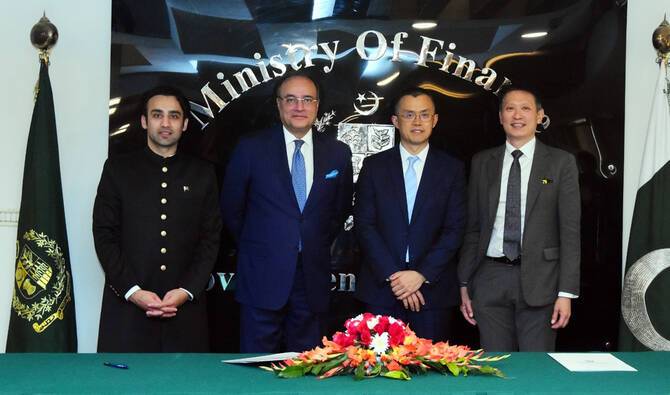
 Pakistan partners with Binance to Tokenize $2 billion in state assets. Photo: The Express Tribune.
Agreement with Binance has been established.
Pakistan has officially signed a memorandum of Mnemonics (MoU) with cryptocurrency exchange Binance to explore Tokenize up to $2 billion of state assets , while also preparing to issue a national stablecoin and finalize a licensing framework for global crypto businesses.
According to an announcement from Pakistan's Ministry of Finance, the agreement with Binance paves the way for the application of blockchain technology to the distribution of government debt instruments such as bonds and treasury bills, as well as strategic resources including oil, gas, and metals. Reuters reported that Binance will Vai as an advisor in the design and implementation of the Tokenize model.
Finance Minister Muhammad Aurangzeb described the MoU as a clear signal for Pakistan's financial reform roadmap and the beginning of a long-term partnership with Binance.
Binance founder Changpeng Zhao (CZ) – currently a strategic advisor to the Crypto Council of Pakistan – called the agreement a positive signal for the global blockchain industry, stating that it is the first step towards the full implementation of the Tokenize initiative. However, the MoU is not legally binding, and formal agreements must be finalized within six months and are subject to regulatory approval.
Controlled opening
Alongside the MoU, Pakistan has issued "No Objection" certificates (NOCs) to both Binance and HTX, allowing the two exchanges to begin the process of applying for operating licenses in the domestic market. NOCs facilitate businesses registering within the anti-money laundering (AML) system, participating in the goAML financial reporting mechanism, establishing legal entities in Pakistan, and preparing complete VASP license applications once the law is officially enacted.
However, this is not an operating license. Bilal bin Saqib, Chairman of the Pakistan Digital Asset Management Authority (PVARA), stated that the NOC is merely the first step in a supervised market entry model, aimed at ensuring exchanges meet governance, compliance, and risk control standards before being permitted to offer services.
Pakistan is currently ranked as the world's third-largest crypto market in terms of retail activity, with approximately 40 million users and an estimated annual volume exceeding $300 billion, a scale large enough to force authorities to balance innovation with systemic risk management.
In a separate statement, Binance said the phased approach aligns with Pakistan's regulatory roadmap and demonstrates a long-term commitment to the South Asian nation's digital economy.
The impetus for rapid reform
The MoU with Binance was signed just weeks after Saqib confirmed at the Binance Blockchain Week event in Dubai that Pakistan would definitely issue a sovereign stablecoin . According to him, this stablecoin is intended as a tool for collateralizing government debt, while also supporting payments and the country's digital financial infrastructure.
Meanwhile, Pakistan is also developing a pilot program for a central bank digital currency (CBDC). Saqib said, “We want to be at the forefront of digital financial innovation. Why should we be behind when we have the scale and market adoption we have?”
In less than a year, Pakistan has built almost a complete crypto regulatory apparatus: establishing the National Crypto Council in March, PVARA in July, urging global exchanges to apply for licenses in September, and now granting NOCs to major players.
In April, World Liberty Financial – an organization backed by the family of US President Donald Trump – expressedits intention to work with the Crypto Council of Pakistan to explore stablecoin infrastructure and Tokenize of real assets. Billionaire Michael Saylor also offered to advise Pakistan on its transition to the digital asset era.
In May, the Pakistani government continued to draw attention by announcing plans to builda Bitcoin reserve fund , while alsoallocating 2,000 megawatts of electricity for Bitcoin mining and AI data centers.
However, some former financial officials and domestic observers have questioned the transparency of Binance's selection for the $2 billion state asset Tokenize project, calling for greater disclosure of the criteria and process for partner selection.
Coin68 compilation






