The future of RWA is a "winner-takes-all" game.
Written by: Jack Inabinet
Compiled by: Saoirse, Foresight News
In the cryptocurrency space, liquidity is dominant.
No matter how you analyze this industry, this principle always holds true. From token prices to Ethereum's staking structure, everything is affected by liquidity.
Last week, the Depository Trust & Clearing Corporation (DTCC), a core institution of the US clearing system, received approval to provide tokenization services compliant with federal regulations. Following this announcement, the tokenization of institutional-grade real-world assets (RWAs) quickly became a focal point. Now, the cryptocurrency industry faces an unanswered question: how will these real-world assets be distributed on-chain?
Today, we will delve into the tokenization requirements proposed by DTCC itself, explore the role of liquidity in the "birth of a crypto king," and ultimately determine which blockchains are most likely to stand out in the Real-World Asset (RWA) space.
DTCC requirements
In its No-Action Request filing with the U.S. Securities and Exchange Commission (SEC), the DTCC specified the technical requirements for key components of the tokenization system, covering the underlying blockchain and the accompanying token tracking software.
This document is the core basis for the SEC's approval of the "no action exemption," which stipulates that any system used to implement key functions of tokenized services must meet the DTCC's internal "Tier 2" system standards.
Specifically, this standard requires key system components to have the following capabilities: "Supporting operation at both primary and secondary locations; recovery time after system failure not exceeding 4 hours; data loss due to failure not exceeding 2 minutes; and conducting cross-regional disaster recovery and business restart tests annually."
Although DTCC adheres to the principle of technology neutrality—not requiring all tokenized real-world assets (RWAs) to use a specific blockchain or tokenization protocol—all eligible solution combinations must meet compliance control requirements and achieve a "Tier 2" system rating.
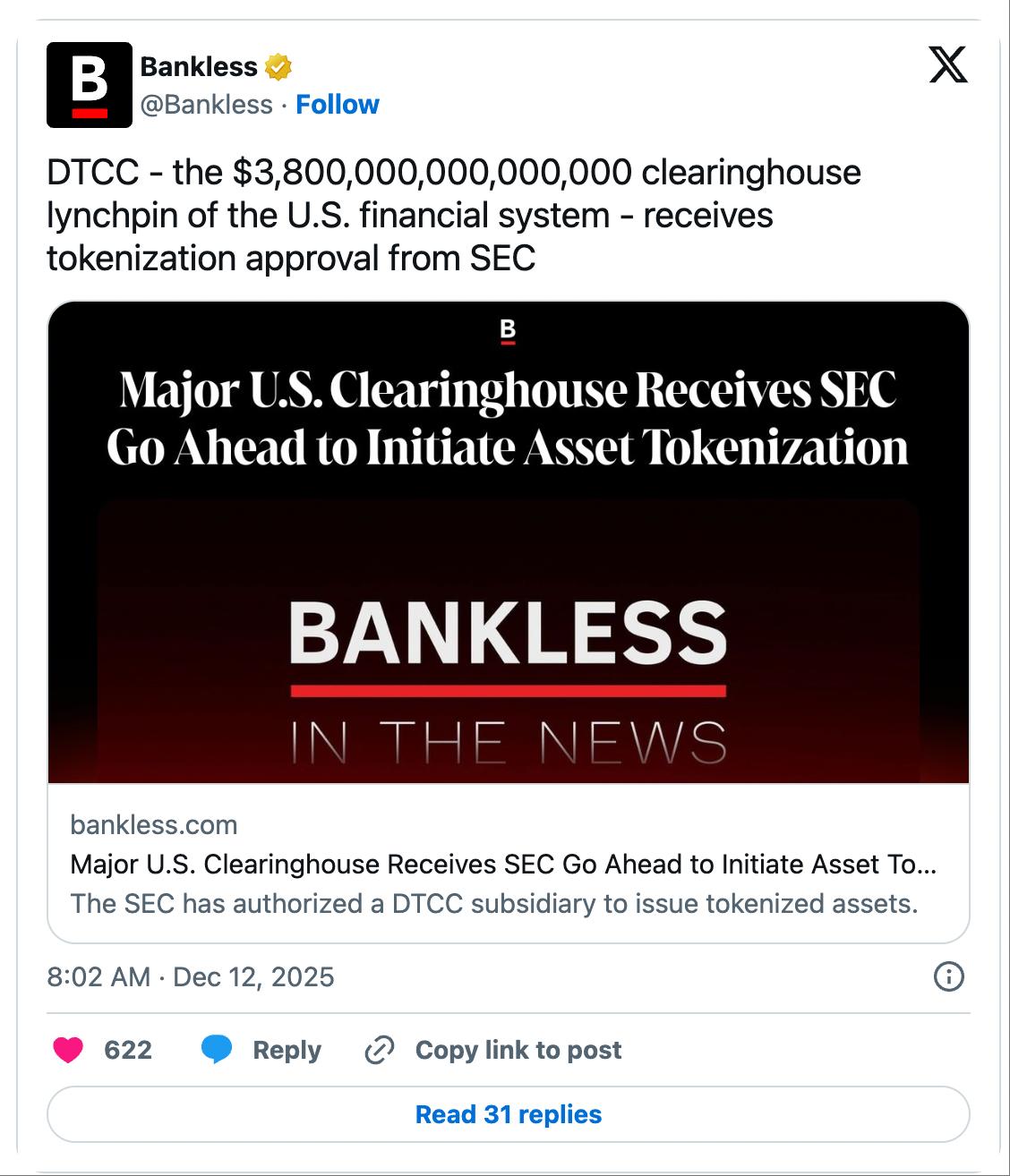
DTCC, a key clearing house in the U.S. financial system with assets of $3.8 trillion, has received tokenization approval from the U.S. Securities and Exchange Commission.
Liquidity plays a decisive role
In 2024, DTCC processed $3.8 trillion in securities transactions, making it the world's largest financial processing institution by value. This summer, its assets under custody surpassed $100 trillion. If one were to select the most important core institution in the global financial system, DTCC would undoubtedly be a highly convincing answer.
If we assume that high-quality liquidity will remain the key to success in the tokenized market, then DTCC's near-unlimited stock of assets will give it a lasting advantage, which will ensure its long-term dominance in the tokenized securities market.
Which chain will win?
Just as DTCC is destined to become a leader in the tokenization service field due to its massive size, from a liquidity dynamics perspective, a single blockchain and a single tokenization service will inevitably become the default choice for tokenization products supported by DTCC.
Currently, it is impossible to determine which blockchain will win in the RWA field, but based on the technical requirements of DTCC, some candidate blockchains can be preliminarily ruled out.
- Solana: Its network has experienced multiple outages lasting more than 4 hours, which does not meet the DTCC system uptime requirements; Solana has experienced several outages that have resulted in disqualification, the most recent of which occurred last year.
- XRP: As another blockchain supporting smart contracts, it is favored for its ability to integrate covert banking operations and has unique advantages in supporting institutional-level financial transactions. However, the network is also prone to outages, with the most recent outage occurring in February of this year.
- Ethereum Layer 2: While L2 is widely seen as the future direction for Ethereum's scaling, it may not meet the tokenization requirements of DTCC. Current mainstream L2 solutions rely on a single orderer, which is prone to failure; furthermore, it is questionable whether L2 can meet the DTCC requirement of "primary and secondary dual-site operation".
- Bitcoin: Although some Bitcoin supporters who advocate "Ordinals" advocate issuing tokenized assets on the Bitcoin network, the Bitcoin ecosystem lacks the smart contract functionality required to support complex financial applications and cannot meet the DTCC's requirements for asset transfer restrictions.
In this context, Ethereum is likely to become the default choice.
As one of the most decentralized blockchains in the world, Ethereum has achieved stable operation for more than 10 consecutive years and is one of the few blockchains that can undoubtedly meet the DTCC runtime requirements.
The problem lies in the fact that DTCC also requires critical systems to pass "annual cross-regional disaster recovery and business restart testing." Ethereum, however, was designed to be "never down," so how can "fault recovery testing" be conducted? Furthermore, during periods of high network load, will extremely high gas fees, determined by the market, be considered "unacceptable system interruptions"?
Circle's Arc Blockchain might be another solution. This blockchain uses a "Permissioned Proof-of-Authority" verification mechanism, which can ensure sufficient decentralization through multi-location operation, while also meeting testing needs with moderate centralization.
Another strong contender is Canton – a public blockchain developed by Digital Assets. The project claims to be the only network currently offering "configurable privacy protection" and "institutional-grade compliance," and states that its network of 500 validator nodes can support over $6 trillion in on-chain RWA, with a daily transaction volume of $280 billion.
Furthermore, there are currently no rules prohibiting the use of other proprietary database technologies that can support multi-site operation. DTCC could also very well choose to support a government-led, permissioned ledger similar to Fedwire.
in conclusion
The tokenization market is a "winner-takes-all" game.
Regardless of whether DTCC's tokenization ultimately chooses an existing general-purpose blockchain like Ethereum, a solution designed specifically for RWA like Circle Arc, or a government-led ledger in the "Fedwire style" that has not yet been launched, a future dominated by multi-chain fragmentation is unlikely to emerge.
The history of cryptocurrencies has clearly demonstrated that liquidity determines success. Whichever blockchain ultimately becomes the underlying support for DTCC's tokenized business will gain far greater appeal than other chains.