


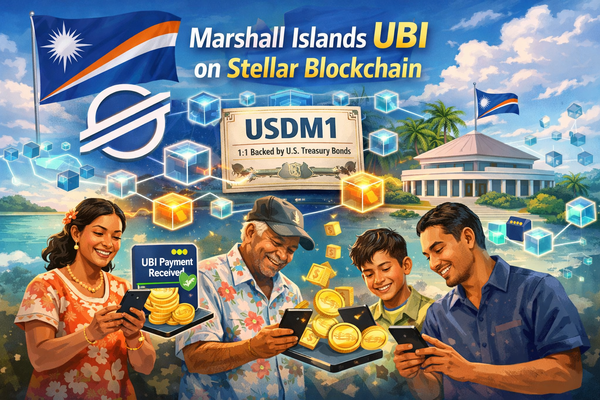
The Republic of the Marshall Islands has become the world's first country to implement a blockchain-based universal basic income (UBI). The Pacific island nation has directly distributed basic income to its citizens using digital sovereign bonds, "USDM1," issued on the Stellar blockchain. CoinDesk, a global cryptocurrency news outlet, reported.
The core of this project is the official adoption of blockchain as a means of executing national finances. The Republic of the Marshall Islands issued USDM1, a digital asset collateralized 1:1 with short-term US Treasury bonds, based on the Stellar network and used it as a means of UBI payments. This isn't a simple token experiment; it's a case of implementing the entire financial flow—from government bonds to tokens to citizen payments—on-chain.
The technical and operational partnerships are also noteworthy. This project involved the Stellar Development Foundation, a leader in the Stellar ecosystem, and Crossmint, a digital asset issuance and settlement infrastructure company. Payment processes are recorded and settled on the blockchain, ensuring transparency and traceability. The project also aims to reduce administrative costs and improve execution speed.
The market is evaluating this case as a practical model for "digital sovereign finance." While discussions of central bank digital currencies (CBDCs) and stablecoins have primarily focused on the monetary realm, the Marshall Islands' initiative is significant in that it extends blockchain to the financial realm of national debt and welfare spending. In particular, the direct link between government bond-backed tokens and welfare funding suggests potential for future expansion into areas such as disaster relief funds, social security, and official development assistance (ODA).
It's also noteworthy that small countries are leveraging public blockchains, which carry relatively less regulatory and administrative burdens, to achieve financial innovation. The Stellar network, known for its low-cost and high-speed payments, is considered suitable as a testbed for national payment experiments.
This UBI payment goes beyond just one example of welfare policy; it's the first demonstration that blockchain can function as a national financial infrastructure, offering important implications for the global RWA (Real Asset Tokenization) movement. It remains to be seen whether this model, combining government bonds, welfare, and blockchain, will spread to other countries.






