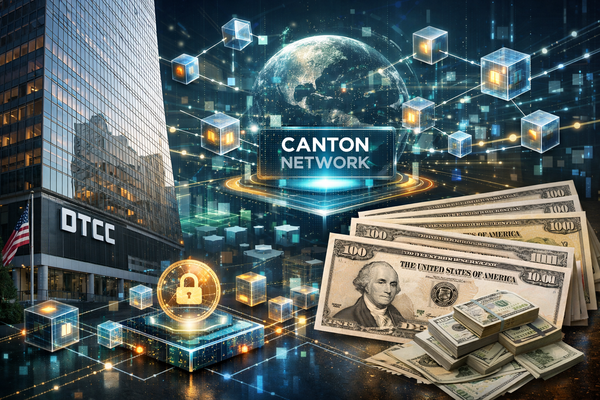
The U.S. Securities Depository, DTCC, has selected Canton Network, a blockchain specialized for real-world assets (RWAs), as its tokenization partner. This move is drawing significant market attention, as a key player in traditional financial infrastructure is embarking on a full-scale experiment in asset tokenization.
According to reports, DTCC will establish an environment where some U.S. Treasury securities deposited with its subsidiary, DTC, can be tokenized on the Canton Network. This signifies the potential transition to a structure where core financial assets, such as U.S. Treasury bonds, are issued, transferred, and settled via a blockchain network.
The Canton Network is a RWA-specific blockchain designed with financial institutions in mind, prioritizing privacy and regulatory compliance. It combines the openness of public blockchains with the controllability of private networks. DTCC's choice suggests that a tokenization infrastructure acceptable to institutional finance, rather than "complete decentralization," will likely gain traction first.
This decision demonstrates that asset tokenization is moving beyond the proof-of-concept (PoC) stage and entering the realm of core financial infrastructure. In particular, given that US Treasury bonds are a fundamental asset in the global financial system, their tokenization, if realized, could bring structural changes across collateral, settlement, and liquidity management.
The market sees this case as a signal for global central depository depositories (CSDs) and large financial institutions to accelerate their tokenization strategies. With DTCC, often called the "heart" of traditional finance, adopting blockchain as an official partner, asset tokenization is no longer an experiment but has entered the realm of infrastructure competition.