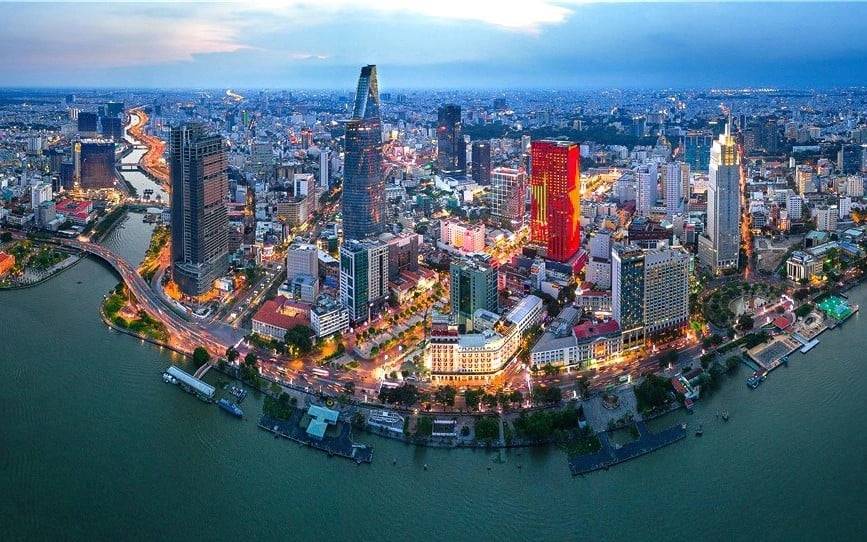
 Ho Chi Minh City promotes the establishment of an International Financial Center and explores opportunities for digital assets. Photo: Coinbay
Large in scale, but still has plenty of room for improvement.
Ho Chi Minh City is entering the final stages of bringing the Vietnam International Finance Center (VIFC-HCM) into operation this December, with the ambition of transforming the city into a new financial and technology growth pillar for the region.
Beyond focusing on traditional financial activities, the city is gradually opening up new experimental spaces for the digital economy, including the digital asset market and blockchain technology.
According to the latest report by Chainalysis , between July 2024 and June 2025, the total value of digital asset transactions in Vietnam is estimated to reach US$220-230 billion, equivalent to approximately VND 5,820-6,000 trillion. On average, more than US$600 million worth of digital assets are traded daily, reflecting the scale and high frequency of participation from individual investors as well as the domestic technology community. Vietnam is also among the top 5 countries with the highest crypto adoption rate in the world.
However, despite the vibrancy of transactions and recognition, this market remains in a legal "grey area." This presents both a risk and an opportunity for Vietnam to design a new management model that balances innovation with systemic control.
Some localities, such as Da Nang, have already announced pilot projects related to digital assets, while Ho Chi Minh City is expected to be the place that more fully converges the necessary elements: Capital, human resources, infrastructure, and legal mechanisms.
The significance of the handshake with Binance
Against this backdrop, the Ho Chi Minh City Department of Finance signed a Mnemonics of cooperation with Binance at the Autumn Economic Forum 2025. The Mnemonics identifies four main pillars of cooperation:
Firstly, both sides will cooperate in attracting and connecting international investors, financial institutions, and funds to explore, invest in, and establish operations at VIFC-HCMC.
Secondly, Chia share experiences in building a legal framework for digital assets, blockchain, and digital asset-based payment platforms, an area where many countries are still struggling to find a suitable model.
Thirdly, research and implement projects using a sandbox model, conducting controlled trials once the legal framework is finalized and approved by the relevant authorities.
Finally, training activities, capacity building in management, and human resource development in finance and technology.
Binance, founded in 2017, is currently the world's largest cryptocurrency exchange. As of June 2025, the platform accounted for nearly half of the volume of centralized exchanges globally, with daily trading value exceeding $217 billion. Binance representatives stated that the collaboration with Ho Chi Minh City will contribute to improving market management capacity, expanding international Capital connections, and attracting high-quality Capital flows into the financial, technology, and innovation sectors, not just crypto.
According to recent reports, the fintech and digital asset sandbox mechanism at VIFC-HCMC is attracting interest not only from Binance but also from many organizations in the global ecosystem, including exchanges, blockchain infrastructure companies, stablecoin issuers, and Venture Capital. Designing a sandbox from the early stages could help Vietnam avoid repeating the policy shocks that have occurred in some emerging markets, where technological innovation precedes but regulatory frameworks lag behind.
In parallel with digital assets, VIFC-HCMC is also positioned as a center for emerging financial sectors such as fintech, digital banking, carbon credit markets, financial data, and cross-border payment platforms.
Prior to signing the agreement with Binance, Ho Chi Minh City organized numerous consultation activities to gather opinions from the blockchain community. The Ho Chi Minh City Institute for Development Research (VIFC-HCMC) chaired seminars on building a fintech ecosystem, with the participation of major corporations, international investment funds, and Web3 projects originating from Vietnam such as Sky Mavis (Axie Infinity) and Kyber Network, as well as global blockchain organizations such as AVA Labs and Republic.
A common thread in the feedback was a willingness to collaborate, but with clear institutional requirements. Mr. Tran Huy Vu, co-founder and CEO of Kyber Network, argued that businesses need a precise understanding of the legal framework to assess their ability to participate and contribute to the ecosystem. Meanwhile, Mr. Nguyen Thanh Trung, founder and CEO of Sky Mavis, noted that many Vietnamese businesses already possess technological capabilities and market knowledge, but are still awaiting more specific regulations before investing deeply and long-term in the domestic market.
Resolution 05 and the "pivot" for the digital economy.
Institutionally, 2025 marks a turning point with the Government's issuance of Resolution 05/2025/NQ- CP on the pilot implementation of the cryptocurrency market. This resolution is XEM the first regulatory foundation for a new sector of the digital economy, and also provides a framework for localities, including Ho Chi Minh City, to design appropriate pilot models.
Experts assess Resolution 05 as a " Vai " for both the digital economy and corporate governance reform, thereby affirming that digital assets are an important component of the modern economy. Prioritizing the development of a legal framework is a positive sign, helping Vietnam enhance its attractiveness not only to traditional Capital flows but also to investors in the blockchain and digital asset sectors.
In other news, Vietnam is taking another step towards bringing its digital asset market under formal regulation. From July 1st, 2026, the country will apply a personal income tax of 0.1% on each digital asset transfer transaction. This mechanism is similar to securities transaction tax, calculated on the transaction value rather than profit, and applies to assets such as Bitcoin, Ethereum, and other digital assets.
According to Saigon Liberation