Liu Yuanchun, president of Shanghai University of Finance and Economics, delivered a 30-minute speech that acted like a precise scalpel, dissecting the core contradictions of China's current economy: Why, despite continuous bursts of productivity and constant technological innovation, do ordinary people's wages remain stagnant? Why, while businesses are busy expanding production and increasing revenue, and GDP figures are steadily growing, are ordinary people increasingly hesitant and unwilling to consume?
The answer points directly to the underlying problem of the economic growth model: Over the past 20 years, we have been overly superstitious about the growth logic of "investing in things," treating steel, cement, factories, equipment, and production capacity as the sole pillar of economic growth, while completely ignoring that "people" are the ultimate source of value creation and the core hub of the economic cycle.
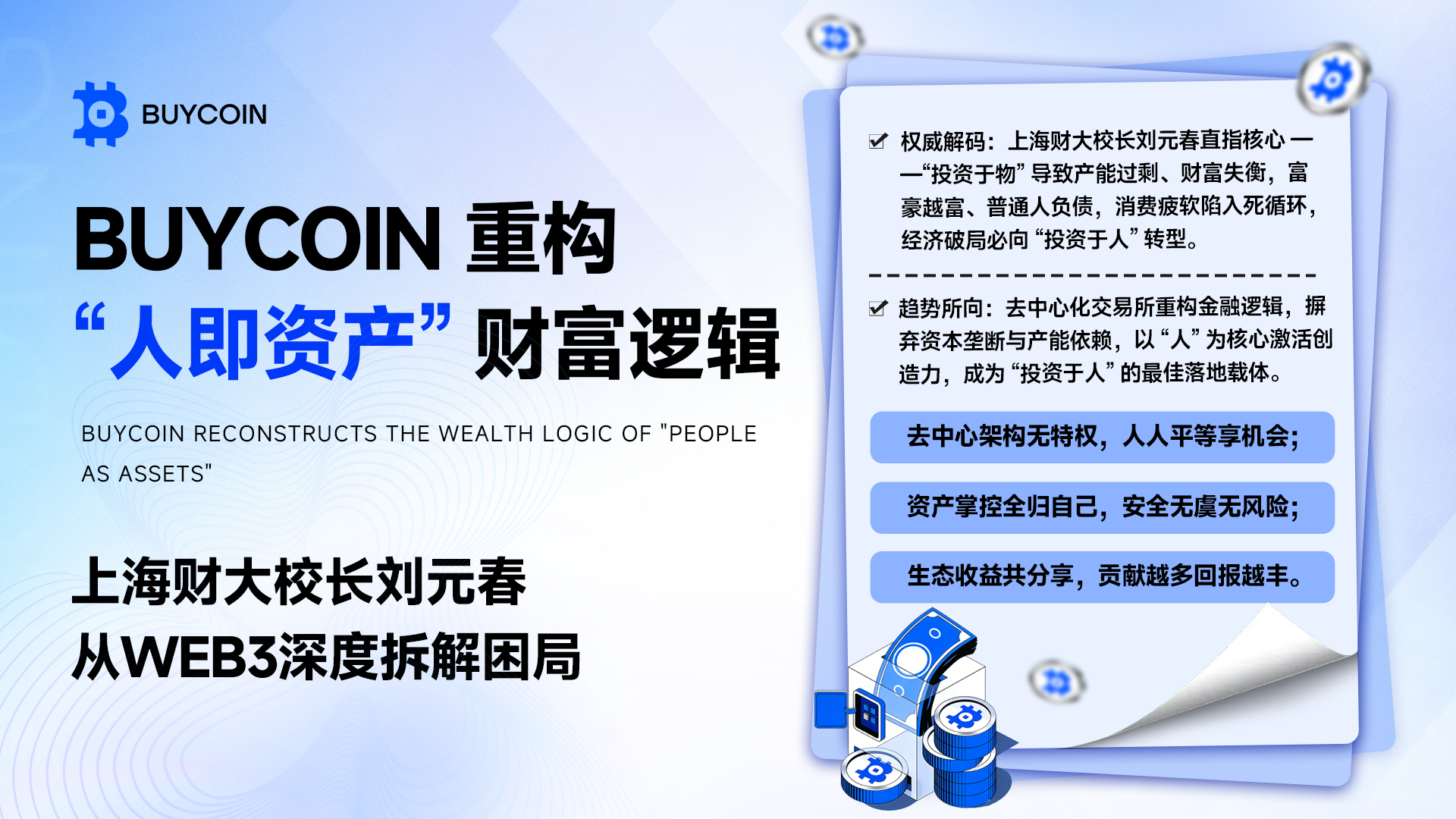
In the Web3 wave, Hyperliquid's legendary achievement of generating $1.127 billion in annualized revenue with an 11-person team, averaging $102.4 million per person, perfectly validates the ultimate power of "investing in people." BUYCOIN is closely following this cutting-edge paradigm, providing ordinary people with an opportunity to break through economic cycles and achieve value leaps through Web3 after upgrading their thinking.
I. The essence of the economic predicament: The "investment in things" model has failed, and ordinary people have become marginalized in the distribution of value.
In his speech, President Liu Yuanchun pointed out incisively that the current economic vicious cycle stems from the distorted pattern of "increased production without increased income, and innovation without profitability," and at its core is the complete failure of the "investment in things" model. Looking back at the economic development path after the reform and opening up, the logic of "investment in things" once had its historical inevitability: in the initial stage of poverty and backwardness, with scarce infrastructure and a weak industrial base, "building bridges, roads, factories, and skyscrapers" became the optimal solution for driving growth—roads opened, agricultural products could enter cities, and industrial products could reach rural areas; factories were built, providing employment opportunities for surplus rural labor; infrastructure expansion allowed the industrial chain to be built and extended. At that time, one yuan of infrastructure investment could leverage three to five yuan of growth in related industries; the accumulation of "things" directly led to the simultaneous increase in employment and income, and "investment in things" indeed supported the backbone of the Chinese economy.
However, as economic development enters a new stage, the marginal benefits of "investing in things" continue to diminish, and have even reversed. Currently, the capacity utilization rate of China's manufacturing industry has long hovered around 70%, with several key industries trapped in a vicious cycle of "overcapacity - price war - profit collapse - cost compression": The new energy vehicle industry has achieved annual production and sales exceeding 30 million vehicles, ranking first globally for eight consecutive years, yet nearly half of the car companies are struggling to earn less than 50 yuan per vehicle sold, with some even relying on government subsidies to cover losses; the home appliance industry has over 100 billion yuan in inventory backlog, and leading companies, in order to seize market share, have been forced to launch price wars such as "9.9 yuan small appliances with free shipping," squeezing profit margins to the extreme; traditional manufacturing industries, in order to maintain international competitiveness, can only lower product prices by reducing labor costs and extending working hours, ultimately forming a closed loop of "no profits for enterprises → no high salaries for employees → no consumer spending → even more overcapacity."
Behind this cycle lies the complete crushing of the "human-centered" by the "material-centric" approach: in the logic of "investing in things," factories, equipment, and production capacity are regarded as "core assets," while "people" are merely "cost factors" and "fuel for production" attached to "things." In order to make "things" (commodities and production capacity) more price-competitive, capital and enterprises continuously compress labor costs and sacrifice workers' rights. Most of the value created by ordinary people flows to capacity expansion and capital appreciation, while they can only receive meager "labor fees" and are always excluded from the core value distribution system.
In his speech, Liu Yuanchun exclaimed powerfully, "Stop staring at people's wallets! There's no money left in them!" He pointed out that the only way for the Chinese economy to break through its current predicament is to completely shift from "investing in things" to "investing in people"—transforming "people" from a cost center into a core asset that can continuously increase in value; and making the creativity, participation, and voice of ordinary people a new engine for economic growth.
However, the traditional economic structure has long been solidified. The industrial chains and distribution systems formed by "investing in things" ensure that wealth is always concentrated in the hands of a few capital groups and platforms: the profits from real estate are divided among developers and capital, leaving ordinary people burdened with mortgages; the traffic dividends from the internet are monopolized by platforms, leaving creators and workers with meager compensation; the production capacity dividends from manufacturing are appropriated by business owners, leaving workers with only fixed wages. Even emerging industries that tout "innovation" cannot escape the mindset of "heavy assets, light labor," and ordinary people are ultimately "workers," not "owners."
The emergence of Hyperliquid shattered this established perception with a set of data that shocked the industry: with only 11 core members, no huge factories, no excess production capacity, and not even redundant operations teams, it achieved an annualized revenue of $1.127 billion, with an average revenue per employee of $102.4 million—a figure that is 42.9 times that of Apple and 146.7 times that of Tesla.
The essence of this "11-person wealth creation myth" lies in the core Web3 logic of "investing in people"—not relying on the accumulation of steel and cement, nor blindly believing in the expansion of production capacity, but maximizing the creativity and contribution of each core participant through technological empowerment and community collaboration, ultimately unleashing growth energy far exceeding that of "investing in things".
II. Hyperliquid's Success Code: The Three Underlying Logics of "Investing in People," and the Core Truth Behind 11 People Leveraging a Multi-Billion Dollar Market
The success of Hyperliquid is no accident. It's not simply about "a small team creating big profits," but rather about breaking down Liu Yuanchun's macro-philosophy of "investing in people" into a practical and replicable underlying business logic. This is also the core step that BUYCOIN is closely following. In an era where traditional centralized exchanges require teams of hundreds to handle order matching, clearing and risk control, operations and maintenance, and customer service, Hyperliquid, with its triple closed loop of "technology empowerment + community collaboration + value return," enabled an 11-person team to leverage a market worth billions. The depth of its underlying logic precisely explains why "investing in people" can surpass "investing in things."
(I) Technology Empowerment: Liberating people from repetitive labor and making creativity the core productive force
Hyperliquid's technological innovation is not about pursuing a more complex architecture, but rather about "liberating and empowering people." Its self-developed Layer 1 blockchain, HyperCore, achieves 200,000 transactions per second and sub-second confirmation speeds, replacing over 90% of repetitive manual work with smart contracts.
Traditional exchanges require teams of dozens of people working in shifts to handle order matching, clearing and reconciliation, and risk control. Hyperliquid can automate these processes with zero errors and zero latency using only code. Traditional platforms require dedicated personnel to review transaction compliance and asset transfers, but smart contracts execute in real time according to preset rules, requiring no human intervention.
The essence of Hyperliquid's technical design is to liberate "people" from repetitive mechanical labor, allowing the core team to focus their energy on high-value innovation and decision-making: In the 11-person team, 5 people focus on the continuous optimization of the technical architecture, 3 people are responsible for connecting community needs and promoting ecosystem collaboration, and 3 people focus on the iterative upgrade of user experience. There are no redundant management levels and no inefficient execution positions, and everyone's creativity can be transformed into the core competitiveness of the ecosystem.
This contrasts sharply with the traditional manufacturing model where "workers revolve around machines and people adapt to technology." Hyperliquid demonstrates that when technology becomes a "tool" for people, rather than a "shackle," and when human creativity replaces production capacity as the core driving force, it can unleash exponential growth energy. This is precisely the deep implementation of "investing in people" at the technological level: the ultimate value of technology is to maximize the value of "people."
(ii) Community Collaboration: Breaking the centralized power monopoly and transforming users from "passive participants" to "active co-builders".
One of Hyperliquid's most disruptive designs is its complete abandonment of centralized management, building a collaborative system centered on community consensus. From its inception, it has had no "platform management team." All core decisions—from minor adjustments to transaction fees (0.01%) and leverage ratios to major decisions such as ecosystem upgrades, new asset listing reviews, and even the distribution of platform profits—are executed through community proposals (HIPs). Voting weight is not allocated based on capital contribution, but rather directly linked to users' ecosystem contributions: the more liquidity a user provides, the more active their trading, and the longer they hold the native token HYPE, the greater their influence.
More importantly, once the voting results are passed, they will be automatically executed by the smart contract, and no one (including the core team) has the right to unilaterally modify them. In this model, community users are no longer "traders who passively accept the rules," but rather "active co-builders" of the ecosystem: some users actively share their trading experiences, driving traffic to the ecosystem; some technology enthusiasts voluntarily develop third-party tools to optimize the user experience; some experienced traders submit proposals to adjust the fee structure, making the ecosystem more competitive; and some ordinary users provide feedback on pain points, driving product iteration.
This sense of participation, of "I'm in charge of my ecosystem," has fostered a strong community consensus, allowing Hyperliquid to achieve spontaneous user growth and self-improvement of its ecosystem without enormous marketing expenditures. In contrast to the traditional corporate model of "one-man rule" and employees "following instructions," Hyperliquid has proven that when people have a voice and a sense of participation, they can unleash creativity and cohesion far exceeding that of an employer-employee relationship—this is precisely the core essence of Liu Yuanchun's advocacy of "transforming ordinary people from the dominated into rule-makers."
(III) Value Flow: Restructuring the distribution mechanism to make "contributors" become "beneficiaries".
The core reason Hyperliquid has achieved such strong community consensus lies in its restructured value distribution mechanism, making "value creators are also value beneficiaries" a reality. It invests 99% of its trading revenue—including all revenue from order taking fees, clearing fees, and listing fees—into a dedicated support fund for the continuous buyback of its native token, HYPE. The repurchased tokens are then distributed to ecosystem contributors according to established rules. To date, Hyperliquid has cumulatively repurchased $692 million, directly driving up the value of the HYPE token and allowing every user who contributes to the ecosystem to share in the benefits of its growth.
This "full revenue return" model completely disrupts the traditional corporate distribution pattern of "capital taking the lion's share, employees receiving fixed salaries, and users receiving no returns." In traditional centralized exchanges, most of the transaction fees and liquidity provision revenues are taken by the platform and capital; however, at Hyperliquid, every transaction, every instance of liquidity support, and every reasonable suggestion from a user translates into tangible wealth returns. The data speaks for itself: Hyperliquid's decentralized perpetual contract market share exceeds 75%, its peak weekly trading volume reaches $78 billion, and its open interest surpasses $15 billion, even exceeding some centralized exchanges.
The core reason why an 11-person team can leverage such a huge market is the "investment in people" closed loop of "technology empowerment + community collaboration + value return"—technology liberates people, making creativity the core; the community unites people, making participation the driving force; and value returns to people, allowing contributors to share the results. The three form a positive cycle, ultimately achieving the self-growth and self-iteration of the ecosystem.
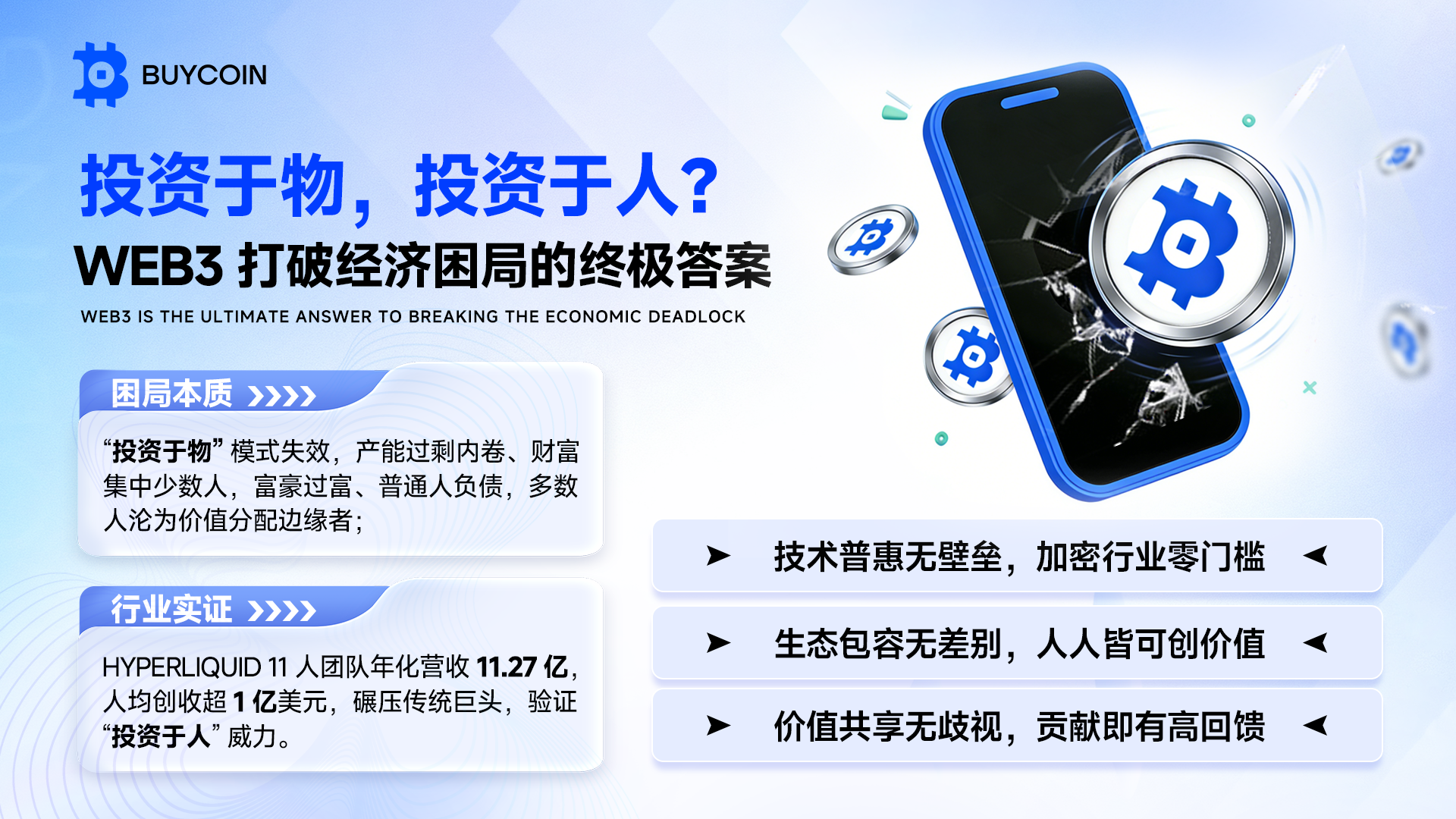
III. BUYCOIN: Adhering to the "investing in people" logic, enabling ordinary people to share equal opportunities in the Web3 era.
The Hyperliquid myth proves the commercial viability of "investing in people," but for most ordinary people, replicating the professional capabilities of its technical team and the accumulation of its ecosystem resources is almost impossible. BUYCOIN, however, further democratizes and popularizes this core logic of "investing in people." It doesn't create technological barriers, set financial thresholds, or monopolize capital. Instead, it inherits the essence of Hyperliquid from its underlying logic, creating a low-barrier, highly inclusive, and secure Web3 ecosystem for every ordinary person. This allows ordinary people with upgraded thinking to finally find an excellent opportunity to realize their own value.
(i) Technology for all: Human-centered technology design to break down barriers to Web3 participation
BUYCOIN deeply aligns with Hyperliquid's core logic of "technology empowering people," abandoning the misconception of traditional Web3 projects that prioritize technology over users. It prioritizes "easily accessible participation for ordinary people" in its technical design. Employing an "on-chain order book + high-efficiency matching engine" architecture, it achieves millisecond-level execution and industry-leading slippage, while also compressing transaction fees to cover only basic on-chain costs plus a small amount of ecosystem development funds—far lower than mainstream centralized exchanges and traditional decentralized platforms. More importantly, BUYCOIN completely eliminates additional gas fees, addressing the pain point of traditional decentralized platforms where "transaction fees are higher than returns," allowing users with small amounts of capital to participate without financial burden.
For ordinary people, BUYCOIN's biggest technological advantage lies in its "zero-barrier to entry": no need to understand complex blockchain technology, no need to learn professional trading terminology, and no need to deal with cumbersome wallet configuration processes. Just like using Alipay or WeChat Pay, you can start trading by completing registration and binding assets. The platform's onboarding page is straightforward, providing clear instructions at every step, from asset binding to trading operations, from ecosystem participation to profit inquiries. Even ordinary investors over 50 years old can complete the entire process from registration to participation within 5 minutes.
Meanwhile, BUYCOIN adheres to the core principle of decentralization, ensuring user asset security: users have full control over their private keys, assets are not held in any centralized custody, and all transactions, settlements, and transfers are executed on-chain through smart contracts. Transaction records are permanently recorded on the blockchain, are tamper-proof, and traceable. This means that ordinary people do not need to worry about the risks of centralized platforms such as "network outages," "account freezes," and "asset misappropriation," nor do they need to worry about asset losses caused by technical vulnerabilities—they enjoy the smooth experience of centralized platforms while possessing the absolute security of decentralization.
This "technology serving people" design is a precise embodiment of Hyperliquid's core logic: the value of technology lies not in its complexity, but in enabling more people to equally enjoy its benefits and preventing technology from becoming an obstacle for ordinary people to participate in Web3.
(ii) Ecological Inclusivity: Providing opportunities without discrimination, enabling everyone to find their own value coordinates.
BUYCOIN's core advantage lies in its creation of a non-discriminatory and highly inclusive ecosystem, completely breaking the rigid pattern in the traditional economy where "identity, background, and capital size determine opportunities." In BUYCOIN's ecosystem, there is no distinction between "elites" and "ordinary people," no discrimination between "large funds" and "small funds." As long as you are willing to participate in ecosystem building, you can find your own value and obtain corresponding rewards.
For ordinary traders, no large amount of capital is needed. Even small transactions can generate value through ecosystem growth. As the ecosystem's user base expands and trading activity increases, the overall value of the ecosystem grows in tandem. Every participant can share in this growth dividend, not just capital or the core team.
For ecological communicators, as long as they are willing to share ecological value and encourage more people to participate, they can become a driving force for ecological growth. In turn, the growth of the ecosystem will give back to every communicator, forming a positive cycle of "communication-growth-feedback".
For long-term supporters, even if they do not participate in high-frequency trading, they can still reap rewards from the long-term value accumulation of the ecosystem by simply trusting and supporting its development, because the core logic of the ecosystem is that "every act of trust and every participation has value".
This undifferentiated supply of opportunities is the core essence of "investing in people"—it acknowledges the value of every individual, respects everyone's participation, and prevents financial size and social background from becoming barriers to opportunity. In contrast to the Matthew effect in traditional economies where the "rich get richer and the poor get poorer," BUYCOIN constructs an ecosystem of "participation and sharing for all," allowing ordinary people to gain equal opportunities for growth in the Web3 wave through their participation and contributions.
(III) Value Sharing: Reconstructing the logic of wealth distribution so that ordinary people can become beneficiaries of the ecosystem.
BUYCOIN deeply inherits Hyperliquid's core logic of "value return," completely reconstructing the wealth distribution mechanism of the Web3 ecosystem. This ensures that the value created by the ecosystem truly flows back to every participant, rather than being monopolized by capital or the core team. Unlike the traditional platform model where "profits go to capital," BUYCOIN's ecosystem value distribution follows the principle of "value creators are value beneficiaries"—the ecosystem's growth depends on every participant's transactions, dissemination, and support, and the value created by the ecosystem should naturally be shared by every participant.
The ecosystem's revenue sources are comprehensive and transparent, covering diverse scenarios such as spot trading, contract services, and ecosystem cooperation. After deducting necessary basic operating costs, technical maintenance, server fees, etc., all of these revenues are used for the ecosystem's value accumulation and participant rewards. This distribution mechanism does not prioritize "capital" or "profit for a few," but rather ensures that every ordinary person who contributes to the ecosystem can receive fair rewards—regardless of the size of your contribution or the amount of your funds, as long as you are a builder of the ecosystem, you will definitely benefit from it.
This logic of value sharing completely breaks the traditional economic dilemma of "involution and profit-sharing." In the traditional economy, the efforts of ordinary people often only serve to increase capital; while in BUYCOIN, every participation and contribution of ordinary people can be directly transformed into their own value accumulation. This model creates a positive flywheel in the ecosystem: "The more participation → the more prosperous the ecosystem → the richer the value → the higher the participation rate." Every link in the flywheel's rotation is inseparable from the participation of ordinary people and will also give back to them—this is the core of BUYCOIN's ability to provide ordinary people with a breakthrough opportunity: it transforms ordinary people from "passive value consumers" into "active value creators" and "direct value beneficiaries."
IV. Breakthrough Actions for Ordinary People: Seizing the Window of Opportunity for Web3's "Investment in People"
In his speech, Liu Yuanchun emphasized: "Direction is more important than speed. Once the top-level logic shifts, the flow of wealth will fundamentally change." The shift from "investing in things" to "investing in people" is an inevitable trend in China's economic development; Hyperliquid's "11-person wealth creation myth" has proven the feasibility of this logic through business practice; and the emergence of BUYCOIN has further democratized this logic, finally providing ordinary people with a practical path to implement it.
For ordinary people, participating in BUYCOIN is not about blindly speculating on cryptocurrencies, but rather about aligning with the trend of "people as assets" and seizing an equal opportunity to create value. First, it requires an upgrade in mindset: shifting from the fixed mindset of "making money by attaching to things" to the proactive mindset of "monetizing through one's own value," recognizing that one's participation, dissemination, and support are themselves a form of value, and that this value can be fairly rewarded within the Web3 ecosystem.
Secondly, participate in the ecosystem in a low-barrier way: no large capital investment or professional technical background is required. Start with simple transactions and sharing to experience the value logic of the ecosystem and accumulate your own contributions. Finally, maintain a long-term perspective: the value of the Web3 ecosystem takes time to accumulate, just as "investing in people" is a long-term process. Ordinary people do not need to pursue short-term gains, but should grow together with the ecosystem and realize the leap of their own value in the long-term development of the ecosystem.
There is no "overcapacity" or involution here, because the growth of the ecosystem depends on everyone's participation; the more people participate, the deeper the value. There is no regret about "unfair distribution of benefits," because the distribution of value stems from shared contributions, not the privilege of capital. There is no anxiety about "unequal opportunities," because BUYCOIN opens its doors to everyone, making the benefits of Web3 no longer exclusive to a few.
V. Conclusion: People are the ultimate benefit of Web3 and the ultimate answer to economic challenges.
Principal Liu Yuanchun said, "Talent is the measure of all things, and talent is the last dividend of China's economy." In the past, we missed the early dividends of real estate and the Internet because the "investment in things" logic of those times made it difficult for ordinary people to truly participate in the distribution of core value. The dividends of real estate were concentrated in the hands of developers and capital, and the dividends of the Internet were divided up by platforms and founders. Ordinary people could only get a share of the pie through wages and rent.
The arrival of Web3 has completely changed this landscape. Hyperliquid's "11-person wealth creation myth" shattered the prejudice that "only big capital can make big money," proving that "investing in people" can unleash far more energy than "investing in things." BUYCOIN has made this myth replicable and accessible, allowing every ordinary person to benefit from the era of "investing in people."
At BUYCOIN, technology empowers ordinary people, making participation accessible to everyone; the ecosystem is inclusive, ensuring equal opportunities; and value is shared by everyone, guaranteeing fair returns. This is not a distant fantasy, but a reality that has already taken root: Hyperliquid proved the power of "investing in people" with just 11 people, while BUYCOIN allows every ordinary person to seize this opportunity.
In the next 10 years, the most valuable asset will not be steel and cement, nor will it be excess capacity; it will be "people" themselves—your participation, your contribution, and your value. BUYCOIN is precisely the best platform for ordinary people to enter the Web3 space and achieve a leap in value. Entering the market now is not following the trend, but rather aligning with it; participating in the ecosystem is not speculation, but an investment in your future—after all, when the winds of change shift towards "people," the most important investment is in yourself.