In his most recent public appearance, Altman was unusually blunt: "Google remains one of the biggest threats. They are too strong. Frankly, if they had taken it seriously in 2023, we might have been in a very difficult situation; in my opinion, they were capable of crushing us outright."
Just recently, when discussing the impact of the Gemini 3, he said, "Its impact on our metrics is not as significant as we feared."
However, Altman's vision is not to directly compete with Google in its strongest areas. Google's approach is more about cramming AI into everything: search, Gmail, maps, YouTube... almost every entry point is "adding a layer of AI." Altman, on the other hand, believes that generative AI will ultimately change the way we use software, and the key is not to patch old software, but to rebuild an "AI-native software."
In this logic, what he cares about most is not "how many products to connect AI to", but retaining users and making them dependent: first let users enter the door, show them the boundaries of capabilities, and then gradually strengthen "stickiness" through memory, personalization and deep customization.
He used the analogy of "toothpaste brands": "In a sense, AI is like toothpaste. Most people, once they choose a brand, will keep using it; they'll grab the same one every time they go to the supermarket without thinking twice." ChatGPT already has 800 million, or even close to 900 million users; some independent reports also show that it still leads in metrics such as user engagement time.
Beyond the "red alert" and the Google threat, this interview also threw out several more pointed questions: the so-called GPT-6 isn't in a rush; the next step seems more like a "customized" upgrade, likely to debut in Q1 of next year . OpenAI's "cloud" isn't about becoming the next AWS , but rather about packaging enterprises' needs for buying tokens, running agents, and hosting data into a single "AI platform." These assessments, taken together, constitute OpenAI's systematic statement regarding its models, products, infrastructure, and commercialization path.
This article is translated and compiled from a podcast episode hosted by Alex Kantrowitz.
1
If Google had taken this seriously, OpenAI would have been crushed long ago.
Alex Kantrowitz: OpenAI has been around for 10 years, and ChatGPT is only three, but the competition is already intensifying significantly. Lately, it feels like OpenAI headquarters is on high alert. After the Gemini 3 release, you see companies everywhere trying to undermine OpenAI's advantage. And this is the first time I've felt that the company no longer seems to have a very clear lead. So I'm curious, how do you see OpenAI moving out of this current phase?
Sam Altman: Let's talk about the "red alert" thing first. We consider these situations to be relatively low-risk, but they need to be activated frequently. I think it's actually a good thing to be a little paranoid and act quickly when a potential competitive threat emerges. We've encountered similar situations in the past, such as when DeepSeek appeared earlier this year, which triggered a "red alert." I think it's good to remain vigilant.
So far, Gemini 3 hasn't had the kind of impact we initially feared. However, like DeepSeek, it has exposed some weaknesses in our product and strategy, which we are addressing very quickly. I don't think we'll remain in "red alert" status for much longer. Historically, this status typically lasts six to eight weeks. I'm actually glad we were able to launch it.
Just today, we released a new image model, which is fantastic progress and something consumers have been really wanting. Last week we released version 5.2, and the feedback has been extremely positive, with growth being very rapid. We'll be releasing other new things soon, while continuing to make improvements, such as increasing service speed.
My assessment is that for a long time to come, we'll likely trigger similar "red alerts" once, at most twice, per year. This is essentially part of ensuring our continued success in this space. Of course, many other companies are doing very well, and I'm happy for them. But ChatGPT remains the undisputed leader in the chatbot market, and I expect that lead to widen, not shrink, over time.
The models themselves will continue to improve across various platforms, but for both consumers and enterprise users, the reasons for choosing a product go far beyond the model's capabilities. We actually anticipated the competitive landscape we've seen today, so we've been working hard to build a complete and coherent product system to ensure we become the product people most want to use.
I think competition is a good thing; it drives us to become better. I believe we will do very well in chat products and in the enterprise market. In the coming years, I also expect us to perform equally well in other entirely new product categories.
I think people really want to use only one AI platform. Just like in your personal life, you use one phone, and most of the time you want to use the same one at work. We're seeing the same trend in AI. ChatGPT's strength in the consumer market is clearly helping us win in the enterprise market. Of course, businesses need different features, but people will think, "I know OpenAI, and I know how to use the ChatGPT interface."
So our strategy is simple: build the best model, build the best product on that basis, and have enough infrastructure to support large-scale services.
Alex Kantrowitz: There is definitely a "first-mover advantage." Earlier this year, ChatGPT had around 400 million weekly active users; now it's reached 800 million, and reports even suggest it's approaching 900 million. But on the other hand, companies like Google also have a huge distribution advantage. So I'm curious about your thoughts: if the models eventually converge, what will truly matter? Is it distribution capabilities? App building capabilities? Or other factors I haven't considered yet?
Sam Altman: I don't think "commercialization" is an appropriate framework for understanding models. In the future, there will definitely be a situation where different models specialize in different fields. For ordinary use cases like everyday chat, there may be many very good options; but in fields like scientific discovery, you'll want to use models that are truly at the forefront and optimized for scientific depth.
Therefore, models will have different strengths. I believe that the greatest economic value will still be created by cutting-edge models, and we plan to always stay ahead of that frontier. We are also very proud to say that 5.2 is currently the most powerful inference model in the world, and the model for which scientists have made the most progress. At the same time, we are proud of the feedback from our enterprise clients—they believe it is the best-performing model for completing various enterprise tasks.
Of course, there will be times when we lead in some areas and lag slightly behind in others. But overall, I believe that the "most intelligent model" will still have enormous value even in a world where free models can meet a large number of basic needs.
The product itself is very important, but distribution and branding are also crucial. Take ChatGPT as an example: personalization is a highly engaging factor. People love how the avatars gradually "learn" about them over time, and you'll see us continuously investing in this area. This creates very profound experiences between users and these avatars, and these experiences become strongly intertwined with the product itself.
I remember someone once telling me that a person probably only chooses toothpaste once in their life, and then keeps using it—at least that's true for most people. ChatGPT is similar. People have a "magic moment." Healthcare is a prime example: someone inputs their blood test results or symptoms into ChatGPT, discovers a problem, sees a doctor, and is actually cured. For these users, engagement is extremely high, not to mention the added personalization capabilities.
There's still a lot to do on the product side. We just released our browser, which I think points us to a new and very promising form factor. Devices are a bit later, but I'm really looking forward to it.
In the enterprise market, the ways in which competitive advantage is built may differ, but the logic is similar. Just as personalization is crucial for individual users, there will be an "enterprise-level personalization" for businesses: a company will establish long-term relationships with companies like us, integrate its data, and then run various agents from different vendors to ensure that information is processed correctly. I expect this to be very sticky as well.
Many people still primarily see us as a consumer company, but we actually already have over one million enterprise users, and we will continue to deepen our presence in the enterprise market. API adoption is also extremely rapid; this year, API business growth has even surpassed ChatGPT's own. So, in the enterprise sector, things are truly happening starting this year.
Alex Kantrowitz: I'd like to return to the previous question: if we're not talking about "commoditization," but rather about the everyday usability, the models feel similar to the average user. So, when ChatGPT and Gemini become more similar in daily use, how much of a threat will Google's massive distribution advantage pose? After all, Google can push Gemini through countless entry points, while ChatGPT has to fight for every new user.
Sam Altman: I think Google is still a huge threat; it's an extremely powerful company. If Google really takes us seriously in 2023, we could be in a very bad situation; they have the ability to completely overwhelm us.
But at that time, their product direction in AI wasn't entirely correct. They also activated their own "red alert," but didn't really take it seriously. Now everyone is implementing "red alerts."
Furthermore, Google possesses what is arguably one of the best business models in the entire tech industry, and I think they will be very cautious and unwilling to give that up easily. I may be wrong, but I don't believe that simply "adding" AI to the search box will be as successful as completely reimagining an AI-first product.
This is actually a broader trend: embedding AI into existing models is often less effective than redesigning around AI from the outset. This is one of the reasons why we want to make consumer devices; this logic holds true on many levels.
If you add AI to an instant messaging application to help you summarize messages and draft replies, that's certainly a good start, but it's not the ultimate form. The true endgame should be: a sufficiently intelligent AI, acting as your agent, communicating with other people's agents to determine when to bother you and when not to, which decisions it can handle itself, and which it must ask you for advice on. The same principle applies to search engines and office suites.
I suspect this will take longer than we imagine, but I believe that in the major product categories, we will eventually see new products built entirely around AI, rather than "patching" older products. This is precisely what may be a weakness for Google, despite its enormous distribution advantage.
2
Chat boxes have been winning for three years, but the real battle lies in "interface reconstruction".
Alex Kantrowitz: I've discussed this issue with many people. When ChatGPT was first released, I remember Ben Thompson saying that you probably shouldn't cram AI into Excel, but rather rethink how you use Excel. For example, you upload data and then directly "talk to the data." Later, in actual development, people discovered that this still requires a backend system. So the question becomes: do you build a new backend system first, and then interact with it through AI? If so, why can't it be directly overlaid on the existing system?
Sam Altman: You can certainly layer them, but I spend a lot of time every day on various messaging apps: email, text, Slack… I think it's a flawed interface. You can add AI on top of it to make it a little better, but what I'd prefer is to be able to directly tell the AI in the morning: what I want to accomplish today, what I'm worried about, what I'm thinking about, what I hope will happen. I don't want to spend the whole day messaging people, I don't want you to summarize them, and I don't want to read a bunch of drafts. Handle what you can handle yourself. You know me, you know these people, and you know what I want to achieve. Update me in batches every few hours, if necessary. This is completely different from the workflow of these apps now.
Alex Kantrowitz: I originally wanted to ask you what ChatGPT would look like in the next year or two. To be honest, I originally thought that by now, ChatGPT's form should have changed significantly. What were your expectations at the time?
Sam Altman: I can't really say. I just felt this chat interface wouldn't go that far. It was initially released as a research preview, never intended to become a product. While it looks better now, overall it's not much different from the original. We know text chat interfaces are great; people are used to communicating like messaging friends. But I originally thought that if it were to become such a large product used in so many real-world jobs, the interface itself would have evolved much more.
I still believe it should continue to evolve. But I underestimated the power of this "universal" interface. I think future AI should be able to generate different interfaces for different tasks. If you're processing data, it should display the data appropriately and allow you to interact with it in different ways. We're seeing some hints of this in features like Canvas, but it's far from enough. It should be more interactive, not just a simple back-and-forth dialogue. It should continuously update as you think about an object.
It should also become more proactive over time, understanding what you want to accomplish each day, continuously working for you in the background, and providing updates. One of the most exciting things for me this year is how much Codex has really improved, which actually points to a part of the future product form I envision.
To be honest, this surprised me. "Awkward" isn't quite accurate, given its immense success. But the minimal changes to ChatGPT's interface over the past three years truly surprised me.
Alex Kantrowitz: But the interface is indeed user-friendly. However, the underlying changes are significant. You just mentioned personalization and memory, which is one of my favorite features. The memory function truly transforms the experience. I've been discussing an upcoming trip with ChatGPT for the past few weeks, involving a lot of planning. Even if I open a new window and just say, "Let's continue talking about this trip," it immediately picks up where I left off, knowing who I'm going with, what I'm going to do, and even that I'm making a fitness plan for the trip, and it can integrate all of this information. Just how powerful is this memory?
Sam Altman: I don't think we even have a concept of that yet. Even if a human had the world's best personal assistant, it would be impossible for them to remember every word you've ever said, read all your emails and documents, or pay attention to every single detail of your work every day. Humans do not have infinite, perfect memories.
AI can do this. We discuss this internally very often. Current "memory" is still very primitive, very early, probably at the level of GPT-2. But when it can truly remember every detail of your life and deeply personalize it—not just facts, but also those subtle preferences you might not even be aware of—that AI can capture, it will be incredibly powerful. This may not be something achievable by 2026, but it's one of the directions I'm most excited about.
Alex Kantrowitz: I spoke with a neuroscientist who said you can't find a storage place for "thoughts" in your brain, but computers do have storage space and can store everything. When these robots start storing our thoughts, privacy issues will certainly arise. But another interesting point is that people will develop genuine relationships with them. This is something that has been underestimated throughout our time. Many people have begun to feel that these robots are companions, caring for them. What are your thoughts on this intimacy and companionship? Is there a "knob" that can determine the distance between people and AI? If so, how do you adjust it?
Sam Altman: Actually, there are far more people who want that kind of "close companionship" than I originally thought. I don't know what word to use—"relationship" isn't quite right, "companionship" isn't quite accurate either—but they do want to build a deep connection with AI. And given the current level of model capabilities, there are already far more people who want this kind of relationship than I expected.
At the beginning of the year, saying you wanted this kind of experience was considered strange. Now, many people may still not say it outright, but their behavior shows: people want AI to understand them, be kind to them, and support them. This is valuable to many, even those who verbally say they don't care.
I believe some of these formats are very healthy, and I think adult users should have a wide range of choices to decide where they fit on this spectrum. Of course, some formats seem unhealthy to me, but there will definitely be people who choose them. At the same time, there are also people who just want the driest and most efficient tools.
I suspect that, like many other technologies, we will continue to experiment, discovering benefits and problems that were previously unknown. Society will eventually reach a consensus on where and how to set that "knob." Individuals, on the other hand, will have considerable freedom to adjust it to completely different positions.
Alex Kantrowitz: So your idea is to let the users decide for themselves?
Sam Altman: Yes, absolutely. But we're not sure exactly how far it should go, or how far we should allow it to go. We'll give users a considerable amount of personal freedom. Of course, there are things that other services might offer, but we won't do.
Well, for example, we won't—we won't let "RAI" (Responsible AI) do that kind of thing: like trying to convince people they should have an exclusive romantic relationship with it. We have to keep it in an open state.
However, I believe this kind of thing must happen in other services as well.
Alex Kantrowitz: Yes, because the more "sticky" the service, the more money it makes. These possibilities can be a little frightening once you really think about them.
Sam Altman: Absolutely agree. It's definitely the kind of thing... I personally feel—you can see it heading down the path of a "serious disaster."
3
Consumers win, businesses benefit: ChatGPT's reverse B2B approach
Alex Kantrowitz: You just mentioned enterprise business, so let's talk about Enterprise. Last week, when you had lunch with some news editors and CEOs in New York, you said that enterprise business would be a major priority for OpenAI next year. I'd like to hear you elaborate: Why is this a priority? Where do you see yourself compared to Anthropic? Many people say this seems like a shift for OpenAI because you've always been more consumer-oriented. Could you give an overall overview of your enterprise plans?
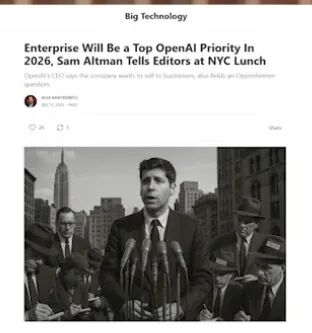
Sam Altman: Our strategy has always been consumer-first . There are several main reasons. First, our past models weren't robust enough or "skilled" enough to meet the needs of most enterprise scenarios; but now they're becoming good enough. Second, we saw a very clear opportunity to win in the consumer market, an opportunity that is both rare and hard to come by. I think if you win in the consumer market, it makes winning in the enterprise market much easier—and we're seeing that now.
But as I mentioned earlier, enterprise growth has already outpaced consumer growth this year. Considering where our models are now and how far they'll reach next year, we believe now is the time to build a sizable enterprise business very quickly . We already have an enterprise business, but it can grow much larger.
Businesses appear ready, and the technology appears ready.
The most typical example to date is, of course, coding, but other areas are also growing rapidly, with some verticals experiencing particularly fast growth. We're starting to hear more and more companies saying, "I just want an AI platform."
Alex Kantrowitz: Which vertical?
Sam Altman: Well, financial science is the area I'm most excited about right now . Customer support is also doing a great job. But speaking of which, we also have something called GDP .
Alex Kantrowitz: That's exactly what I was going to ask you. Can I just throw out my question? Sure. I messaged Box's CEO, Aaron Levie, and said I wanted to see Sam. What should I ask him? He replied: Ask the GDP eval.
Therefore, this is a metric for measuring AI performance in knowledge work tasks. I went to look at the GPT 5.2 release and the GDP-val chart you recently released. Of course, this is OpenAI's own evaluation. Even so: GPT-5 Thinking (the Thinking model released this summer) "outperformed/matched/closed to human knowledge workers" in knowledge work tasks at a rate of 38% (approximately 38.8%); while GPT 5.2 Thinking outperformed or matched human knowledge workers at a rate of 70.9%; and GPT 5.2 Pro reached 74.1%. Furthermore, it crossed the "expert-level" threshold—it seems it can handle about 60% of expert-level tasks, meaning it's roughly at an expert level in knowledge work. What does it mean that these models can do so much knowledge work?
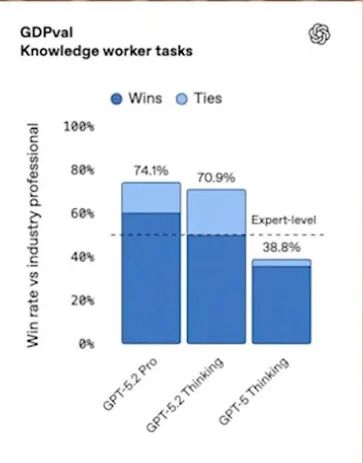
Sam Altman: Your question about "vertical domains" is a very good one, but the reason I hesitated a bit was because this assessment actually covers about forty different "business vertical tasks": creating a PowerPoint presentation, conducting legal analysis, writing a small web application, and so on. Essentially, this assessment is asking: for many tasks that businesses must perform, do experts prefer the model's output compared to the output of other experts ?
Of course, these are all small, well-defined tasks; they don't include complex, open-ended, or creative work like "coming up with a new product," nor do they include many team-based tasks. But even so—if you can delegate an hour-long task to a "colleague" and get a more satisfactory result 74% or 70% of the time, and at a lower cost—that's still quite remarkable.
If you go back three years to when ChatGPT was first released, and someone said we would reach this level in three years, most people would say: absolutely not. So when we think about how enterprises will integrate this capability, it's no longer just about "it can write code," but about a whole set of knowledge work tasks that can be distributed to AI . It may take time for enterprises to truly figure out how to integrate it into their processes, but its impact should be quite significant.
Alex Kantrowitz: I know you're not an economist, so I'm not going to ask you questions like "the overall impact on macro employment." But I want to read you a quote I saw on Substack's *Blood in the Machine*, from a tech writer. He said, "After chatbots came in, my job became managing bots, not managing a team of customer service representatives." I think that happens often. But he went on, "Once the bots are trained to provide good enough support, I'm out." Isn't that more common? Isn't that something "bad companies" do more often? Because if someone can program many different bots, you might want to keep them. I'm not sure. What do you think?
Sam Altman: I agree with you: it's clear that in the future everyone will be managing a lot of AI, making them do all sorts of different things. Ultimately, like any good manager—hopefully your team will get stronger, and you'll take on a wider scope and greater responsibility. I'm not a "job doomsday" believer. I do have some concerns in the short term, and I think the transition will be tough in some situations.
But on a human level, we seem to be naturally too concerned about others and what others are doing; we seem to be very concerned about relative status, always wanting more, always wanting to be useful, to serve others, to express creativity... I don't think these things that have driven us to where we are today will disappear.
Of course, I do believe that future "work" (I'm not even sure if it should still be called "work")—by 2050, the things we do every day will likely be very different from what we do today. But I don't hold the view that "life will lose its meaning and the economy will completely collapse." I hope we will find more meaning instead; the economic structure will change significantly, but I don't think you can bet that "evolutionary biology will lose."
I often think: how can we automate all of OpenAI's functions? Going further, I also wonder: what if OpenAI had an AI CEO? This doesn't make me uneasy; on the contrary, it excites me. I won't resist it. I don't want to be the kind of person who clings to the idea that "I can do it better by hand."
Alex Kantrowitz: Letting the AI CEO make decisions and directing us to allocate resources to things like "giving AI more power and computing power"—that sounds...you'd definitely put guardrails on it, right?
Sam Altman: Of course. You obviously don't want an AI CEO who is completely unregulated by humans. But if you imagine a version—this analogy might be crazy, but I'll say it anyway—where everyone in the world is essentially sitting on the board of an AI company, able to tell the AI CEO what to do, and if it doesn't perform well, everyone can fire it; that is, key decisions have governance mechanisms, and the AI CEO is responsible for executing the board's will as much as possible—then from the perspective of people in the future, this might be a fairly reasonable system.
4
GPT-6, hold on: the next step is more like a "custom upgrade"
Alex Kantrowitz: Okay, we'll talk about infrastructure shortly. But before we leave the "models and capabilities" section, when is GPT-6 coming?
Sam Altman: I'm not sure when we'll actually call a model GPT-6. But I expect to release some new models with significant improvements over 5.2 in the first quarter of next year .
Alex Kantrowitz: What does "significant improvement" mean?
Sam Altman: I can't give you a specific score right now. Overall, there will be improvements on both the "business-oriented" and "consumer-oriented" sides: the consumer-side model will see many improvements, but what consumers want most right now isn't a higher IQ; businesses still want a higher IQ.
Therefore, we will improve the model in different ways for different uses. Our goal is to create a new model that everyone will clearly prefer.
5
If we have double the computing power today, we'll have double the income today.
Alex Kantrowitz: Speaking of infrastructure: you have roughly $1.4 trillion in investment commitments for infrastructure. I've heard you say a lot about infrastructure. For example, you said, "If people knew what we could do with computing power, they would want more and more." You said, "What we can offer today is a huge gap compared to 10 times or 100 times the computing power." Could you elaborate a bit more: What are you going to do with so much computing power?
Sam Altman: I touched on that briefly earlier. My personal favorite area is using AI and massive computing power to drive scientific discovery . I believe scientific discovery is the "ultimate factor" in making the world a better place for everyone. If we can channel enormous computing power into scientific problems and discover new knowledge—and we're already seeing some initial signs, though very early and small results, of course—but my historical experience in this field is that once the curve starts to appear, starts to rise a little from the x-axis, we know how to make it better and better. But this requires an enormous amount of computing power.
So we are using a lot of AI in scientific discovery, treating diseases, and many other things.
A recent cool example is that we built the Sora Android app using Codex, and they finished it in less than a month. They used a huge number of tokens—one of the advantages of working at OpenAI is that you don't have a limit on the number of tokens you can use with Codex. They used a massive number of tokens but accomplished what would otherwise have required more people and more time; Codex essentially did most of the work for us. You can imagine that as this develops further, the entire company could use massive amounts of computing power to build products.
People have also discussed a lot: video models will eventually point to a "real-time generated user interface," which will also require a lot of computing power. Businesses will use a lot of computing power to transform their operations. If doctors want to provide truly personalized medicine—continuously monitoring each patient's various vital signs—you can imagine that will consume a lot of computing power.
It's actually quite difficult to define exactly how much computing power we've used to generate AI output worldwide. The figures I'm about to present are very rough, and I also feel that this approach isn't entirely rigorous, but I always thought that this kind of "thought experiment" was somewhat helpful, so please forgive my roughness.
Let's assume an AI company today outputs roughly 10 trillion tokens per day using cutting-edge models. It might be higher, but I don't think anyone can reach 1000 trillion tokens per day. Let's assume there are 8 billion people in the world, and that each person outputs an average of 20,000 tokens per day (I think this is completely wrong, but let's assume it for now). Strictly speaking, we should be comparing the "tokens output" by the model provider, not the "total tokens consumed." But you can start making a comparison: we might see a company output more tokens per day than all of humanity combined, then 10 times, then 100 times.
In a sense, this is a silly comparison; but in another sense, it can give you an order-of-magnitude intuition: how much of the "intellectual computing" on Earth comes from the human brain and how much comes from the AI brain—and the interesting relative growth rate between them.
Alex Kantrowitz: So I'm wondering: do you really know that this computing power demand exists? For example, if OpenAI doubles the computing power it invests in science, will we definitely have a scientific breakthrough? Or in medicine, do we know for sure that we can use it to assist doctors? How much of this is your speculation about the future, and how much is based on clear trends we are already seeing today?
Sam Altman: Based on everything we've seen today, we're concluding this will happen. This doesn't mean some crazy variable can't emerge in the future—for example, someone discovers a completely new architecture that brings a 10,000-fold efficiency improvement, in which case we might indeed seem to have "built too much" in the short term. But what we're seeing now: the speed at which the model progresses at each new level, the increasing desire to use it each time, the increased desire to use it each time costs decrease—all of this points to the same thing: demand will continue to increase, people will use it to do great things, and they'll use it to do silly things. But overall, this is the shape of the future.
And this isn't just about "how many tokens we can output per day." It also includes how quickly we can output them. As these coding models become more powerful, they can think for a long time, but you don't want to wait that long. So there are other dimensions besides the number of tokens themselves.
However, in a few key dimensions, the demand for "intelligence" will be significant, and we can do a lot with these capabilities. For example, if you have a very difficult medical problem, would you use the 5.2 or the 5.2 Pro? Even if the latter requires far more tokens—I think you would choose the better model, and I believe many people would.
Alex Kantrowitz: Let's go a step further. You mentioned scientific discovery, could you give an example? It doesn't have to be the kind of thing that's completely certain today—"I have problem X, and I can solve it by investing computing power Y"—but at least give a concrete example: What problems are there today that we "want to solve but can't do yet"?
Sam Altman: There was a discussion on Twitter this morning: a group of mathematicians were replying to each other. They were saying something like, "I was very skeptical about when LLMs would really be useful; but 5.2 was the model that got me across the threshold." They said it helped them make a small proof, discover some small things, but it was already changing their workflow. Then more people followed up saying, "Me too." Some said 5.1 had already reached that point, but not by much.
Considering that version 5.2 was only released about 5 days ago, this kind of feedback is emerging—the math research community seems to be saying, "It's like something important just happened."
Alex Kantrowitz: I've seen Greg Brockman highlighting various uses of this in his feed, both in math and science. Something's been "lit up" in these circles, along with 5.2. So it's worth watching what happens as it progresses.
Sam Altman: There's another challenge with computing power: you have to plan very far in advance. That $1.4 trillion you just mentioned will be spent gradually over a very long period. I hope it can be faster; I think if we can invest more quickly, there will be demand to meet it. But building these projects takes an extremely long time: data center construction, power supply, chips, systems, networks, etc.—everything is time-consuming. So it's a long-term process.
However, from a year ago to now, we have roughly tripled our computing power.
We hope to triple our computing power again next year, and then double it again the year after. Revenue growth is even slightly faster than that, but it generally follows the scale of computing power. So we have never encountered a situation where we cannot monetize our existing computing power well.
In other words, if we had double the computing power now, I think our income would also be double what it is now.
6
If OpenAI hadn't made such aggressive investments, it might have already been profitable.
Alex Kantrowitz: Okay, since you brought up numbers, let's talk about numbers. Revenue is growing, computing power spending is growing, but computing power spending is still growing faster than revenue. There are some figures in the reports saying that OpenAI might accumulate losses of around $120 billion between now and 2028/2029, and then start making a profit. Can you explain how this inflection point will occur? Where will the turning point be?
Sam Altman: As revenue grows, and as inference becomes a major part of computing resources, it will eventually "outweigh" training costs. That's the plan: spend a lot of money on training, but make more and more money afterward.
We would have been profitable much sooner if we hadn't continued to push training costs up so dramatically. But what we're betting on now is to invest very aggressively in training these large models.
Alex Kantrowitz: The whole world is watching: can your revenue match your spending? The question people are asking is: if this year's revenue trajectory could reach $20 billion, and your spending commitment is $1.4 trillion—how does that even out? I think it would be very valuable to be able to explain the logic behind these numbers clearly all at once.
Sam Altman: It's difficult. Because it's hard for people to build a quick and reliable mental framework to understand exponential growth. I certainly couldn't do it myself, and very few people I've met can. You can have a good intuition for many math problems, but with exponential growth, humans usually just don't do well. Evolution has made us good at a lot of "mental math," but modeling exponential growth doesn't seem to be one of them.
Our core assessment is that we can maintain a very steep revenue growth curve for a long time to come. Everything we're seeing indicates that without sufficient computing power, we simply cannot do it—we are constantly constrained by computing power.
Insufficient computing power has a very direct and significant impact on revenue. Therefore, if at some point in the future we find ourselves with a large amount of idle computing power but unable to monetize it per unit of computing power, it would be perfectly reasonable for people to question "how does this even work?"
But we've already done the math in many ways. We will certainly become more efficient in terms of flops per dollar—our work on reducing computing costs will gradually pay off. We've seen consumer growth, we've seen enterprise growth, and a bunch of new business types that we haven't even launched yet, but will all be online. And computing power is the lifeline that supports all of this.
Therefore, we set some checkpoints at various stages. We also have some flexibility if we miscalculate the timing or mathematical estimates. But our current situation has always been: computing power is never enough.
It has always limited what we can do. Unfortunately, I think this situation will likely persist forever, but I hope it will lessen and decrease over time. Because I believe we can actually deliver a lot of great products and services, and that would be a very good business.
Alex Kantrowitz: So, essentially it's this relationship: training costs are increasing in absolute terms, but their percentage of the overall cost structure is decreasing. And your expectation is that, through these means—like driving the enterprise market, like having people willing to pay for ChatGPT via API—OpenAI can grow its revenue to the point where it can cover these costs.
Sam Altman: Yes, that's the plan.
Alex Kantrowitz: I think the market has gotten a bit "out of control" lately. What's really unsettling the market is that "debt" is starting to enter this equation. Traditionally, you borrow when things are relatively predictable, and then the company uses that debt to build things and has relatively predictable revenue. But this is a completely new category; it's unpredictable. What are your thoughts on debt entering this space?
Sam Altman: First of all, I think the market had already "gone out of control" once earlier this year. You know, we might just go to meet with a company, and that company's stock price would jump 20% or 15% the next day, which I found very unhealthy.
To be honest, I'm actually quite glad that there's a bit more skepticism and rationality in the market now, because before it seemed like we were heading straight for an extremely unstable bubble. Now I think people have regained some discipline.
So I think the thing is this: everyone was too crazy before, and now they're more rational about debt. We generally know one thing: if we build infrastructure, someone in the industry will always get value from it. It's still very early, I agree. But I don't think anyone would still question whether "AI infrastructure will generate value."
Therefore, I think it's reasonable for debt to enter this market. I also believe that other types of financial instruments will emerge in the future. I suspect there will be some less rational innovations, and people will continue to "invent new tricks" for financing these things. But for example, lending money to companies to build data centers seems perfectly reasonable to me.
Alex Kantrowitz: What's really worrying is what happens if things don't continue at the current pace. For example—you might disagree—there's a scenario where advancements in model capabilities plateau, and then the value of this infrastructure will be lower than previously anticipated. Of course, these data centers will still be valuable to some, but they could also be liquidated and bought by someone else at a discount.
Sam Altman: I do believe there will be cycles of boom and bust in between; these things are never a perfectly smooth straight line.
First, this is very clear to me, and it's a judgment I'm willing to "bet the company on": the model will definitely become much, much better. We have a very clear window of judgment on this, and we are very confident about it.
Even if model capabilities cease to improve, I believe there is a strong inertia in the world. People need time to understand and adapt to new things.
I believe there is an enormous gap between the potential economic value represented by the 5.2 model and the value actually realized in the world today. Even if you freeze the model's capabilities at the 5.2 level, ask yourself: how much additional value can it create, and how much income growth can it drive? I would bet a "very large" number.
Actually, you didn't ask this question, but if I may expand on it a little—we've often discussed a 2x2 matrix: whether the timeline is short or long, whether takeoff is fast or slow. We assess how these probabilities change at different times and use this to understand what decisions and strategies the world should optimize.
But now, a new Z-axis has emerged in my mind: is the "capability overhang" small or large? Looking back, I realize I hadn't seriously considered this. I had implicitly assumed that if the model contained a lot of value, the world would quickly learn how to deploy and use it. But now it seems that in most parts of the world, this "capability overhang" is surprisingly large.
Of course, there will be some local areas, such as some programmers, who will become extremely efficient by using these tools.
Overall, we now have a wildly intelligent model, but frankly, most of the questions people ask are still similar to those in the GPT-4 era. Scientists, programmers, and different types of knowledge workers vary in their degree of change, but overall, there is still a huge gap in capabilities.
This will have a series of very strange consequences for the world. We are far from fully understanding how it will unfold, but it is certainly very, very different from what I expected a few years ago.
7
Why is it that even with such a powerful model, businesses are still not seeing results in its implementation?
Alex Kantrowitz: I'd like to ask you a question about "capability overrun." Basically, models can do far more than they are currently used to do. I'm trying to understand why, even though these models are so powerful, many companies aren't getting a return on investment when they actually implement them—at least that's what they told MIT.
Sam Altman: I'm a bit confused by this because we're hearing a lot of companies say, "Even if the price of GPT-5.2 increases tenfold, we're still willing to pay. Your current pricing severely undervalues it, and we've already profited immensely from it."
Therefore, these two statements do not seem to match.
If you ask a programmer, they'll say, "This is such a great deal, I'd pay a hundred times the current price."
Let's assume you believe the GDP valuation data—and of course, you have good reason not to, they might be wrong—but let's assume they're true: for well-defined, relatively short-cycle knowledge work tasks, seven out of ten times, you'd be just as satisfied with a 5.2 output as a human, or even more. Then you should use it extensively. But the reality is, people take far longer to change workflows than I imagined.
People have become so accustomed to having junior analysts do things like creating PowerPoint presentations that this habit is much more ingrained than I expected. To be honest, my own workflow is still pretty much the same as it used to be, even though I know I could be using AI much more extensively now.
8
Flash Q&A: A cloud that doesn't want to be AWS, and a less-than-exciting IPO.
Alex Kantrowitz: Okay, we have 10 minutes left. I have four more questions, and we'll try to go through them using the "lightning wheel."
The device you're working on. We just said we'd come back to OpenAI CEO Sam Altman. What I've heard is: phone size, no screen. Then why can't it just be an app? If it's a "phone" without a screen, then why not an app?
Sam Altman: First, we'll be making a small family of devices, not a single device. Over time… this isn't speculation, and I'm trying not to be wrong, but I think the way people use computers in the future will change: from something "dull, reactive" to something very smart, very proactive—something that understands your whole life, your context, everything that's happening around you, and is very aware of the people around you, whether physically or through the computer you're using.
I believe that existing devices are not suited to such a world. I've always firmly believed that we work on the "boundaries of device capabilities." You have a computer that makes a series of design choices, like whether it's on or off, but it can't be in a state where it lets me concentrate on this interview while simultaneously whispering reminders when I forget to ask you a question. Maybe that would be useful.
We have screens, which confine us to the graphical user interface methods we've used for decades; we have keyboards, which were originally designed to slow down input. These assumptions have been around for a long time, and they have indeed been effective. But now something entirely new has emerged, opening up a whole new space of possibilities. I don't think the current form factor is the optimal way to realize this new capability. If it were, it would seem very strange.
Alex Kantrowitz: We could talk about this for an hour, but let's move on to the next question: the cloud. You mentioned building a "cloud." One listener emailed us saying that their company is migrating from Azure to directly integrate OpenAI to provide AI capabilities for their products. Their goal is to have trillions of tokens flowing throughout the technology stack to support AI experiences. Is this the direction you're heading towards building a huge cloud business?
Sam Altman: First of all, trillions of tokens—that's a lot of tokens. You just asked about computing power requirements and corporate strategy, and companies have made it very clear to us how many tokens they want to buy from us. We may very well be unable to meet the demand again in 2026.
The overall strategy is this: Most companies seem to want to come to us saying, “I need a ‘company with AI.’ I need an API tailored for my company, I need a ChatGPT Enterprise tailored for my company, I need a platform I can trust to run all my agents and host my data. I need to inject trillions of tokens into my product. I need to make all my internal processes more efficient.”
We don't currently have a truly excellent integrated solution, but we want to create one.
Alex Kantrowitz: Is your goal to become something like AWS or Azure?
Sam Altman: I think it's a different type of thing. I don't have any ambition to offer the whole suite of services you use to host a website. But I do think that in the future, people will continue to have what's called the "Web cloud," and there will also be something else: companies will say, "I need an AI platform to power everything internally and everything I offer externally."
It still relies on physical hardware in some sense, but I think it will be a rather different product form.
Alex Kantrowitz: Let's talk quickly about "discoveries." Something you said really struck me: you believed that models—or the collaboration between humans and models—would produce small discoveries next year and major discoveries within five years. Is that the model itself, or the collaboration between humans and models? Why are you so confident about this?
Sam Altman: It's people using models. The ability for models to raise their own questions is still a long way off. But if the world can benefit from new knowledge, then we should be very excited. The entire history of human progress is essentially this: we build better tools, people use these tools to do more, and in the process, we build even better tools. It's a scaffolding of continuous advancement, generation after generation, discovery after discovery. The questions raised by people don't diminish the value of the tools.
To be honest, I'm very happy. At the beginning of this year, I thought the small discoveries wouldn't start until 2026, but they appeared in the second half of 2025. Of course, these discoveries are very small, and I really don't want to exaggerate them. But "a little" and "none" are, in my opinion, a qualitative difference. Three years ago, when we first released the model, it was completely impossible for it to make any new contribution to the total amount of human knowledge.
I suspect that the path from now until five years from now is the typical uphill climb for AI: a little progress every quarter, and then suddenly one day we will realize—"Wow, with model enhancement, humans are doing things that were completely impossible five years ago."
As for whether we attribute the credit more to smarter people or smarter models, I'm happy with either explanation as long as we actually make a scientific discovery.
Alex Kantrowitz: IPO next year? Do you want to be a publicly traded company? You look like you could run as a private company for a long time.
Sam Altman: There are many factors at play here. I do think it's pretty cool to have the public market participate in value creation. In a sense, if you compare ourselves to companies historically, we're going public very late. Being a private company is great, of course, but we do need a lot of capital and sooner or later we'll hit various shareholder limits.
Do I aspire to be the CEO of a publicly traded company? 0%.
Do I expect OpenAI to become a publicly traded company? In some ways yes, but in others I also think that would be a huge hassle.
Alex Kantrowitz: I listened very carefully to your interview with Theo Von; it was a great one. He's really knowledgeable and has done a lot of research. You said that before GPT-5 was released, it was smarter than us in almost every way. I thought to myself: Isn't that the definition of AGI? If that's not AGI, then hasn't the term become somewhat meaningless?
Sam Altman: These models are clearly very intelligent at the "raw computing power" level. There's been a lot of discussion about GPT-5.2 in the last few days, with IQs said to be 147, 144, or 151, depending on whose test you're using. You can also see many domain experts saying it can do amazing things and improve their work efficiency. We've also discussed the GDP impact.
But there's one thing you don't yet have: the model can't do this—when it discovers it can't do something today, it can't realize this on its own, proactively learn and understand, so that when you come back the next day, it has already done it correctly. Even toddlers possess this continuous learning ability, and it seems to be a very important part we need to build.
So, without that, can you still possess what most people consider AGI? I think the answer isn't clear. Many would say that our current model is already AGI. Almost everyone would agree that if this ability were added on top of the current level of intelligence, it would undoubtedly be AGI. But perhaps most people in the world would say, "Okay, even without that, it can already accomplish most of the important knowledge work, is smarter than most people in most aspects, and is already making small-scale scientific discoveries—that's AGI."
This illustrates the problem that the word itself is too vaguely defined. Although it's difficult for us all to stop using it.
One thing I really wish we had done right was that AGI wasn't properly defined. And now the new buzzword is "superintelligence." So my suggestion is: let's acknowledge that AGI just "whooshed" by. It didn't change the world immediately—or rather, it will change the world in the long run—but okay, we've built AGI at some point. We're currently in a period of ambiguity; some people think we've arrived, some don't, and slowly more people will think we have. Then we should ask: "What's next?"
I offer a candidate definition for "superintelligence": when a system performs better than any human being—whether it is serving as the President of the United States, managing a large corporation, or running a massive research institution—even with the help of AI.
This reminds me of the history of chess. There was a period when humans and AI combined were stronger than AI alone; later, humans became a hindrance, and the smartest approach is to create AI without any human intervention. I think this is an interesting framework for understanding superintelligence. Of course, it's still a long way off, but I really hope that this time we can have a clearer definition.
Alex Kantrowitz: Sam, I've been using your products every day for three years now, and they've really gotten better and better. I can hardly imagine how much better they can get.
Sam Altman: We will do our best to keep them getting better quickly.
Reference link:
https://www.youtube.com/watch?v=2P27Ef-LLuQ
This article is from the WeChat official account "InfoQ" (ID: infoqchina) , authored by Tina, and published with authorization from 36Kr.