The Silent Transfer of Global Financial Power
2025 is destined to be a watershed year in the history of fintech. By carefully reviewing the " World Crypto Rankings 2025" (WCR) report jointly released by Bybit and DL Research, we can witness from the data that digital assets have officially transformed from marginal speculative tools into infrastructure in the global economic structure.
This detailed report, covering 79 countries and employing 28 indicators and 92 data points, is more than just a ranking of these data points; it's a geopolitical map of the global shift in financial power, which is its biggest highlight.
In the past, market attention to cryptocurrencies has largely focused on the price fluctuations of Bitcoin or the dramatic rises and falls of memecoins. However, the WCR 2025 report is concerned with a deeper trend: institutionalization and utility are replacing speculation as the core driving force of the market .
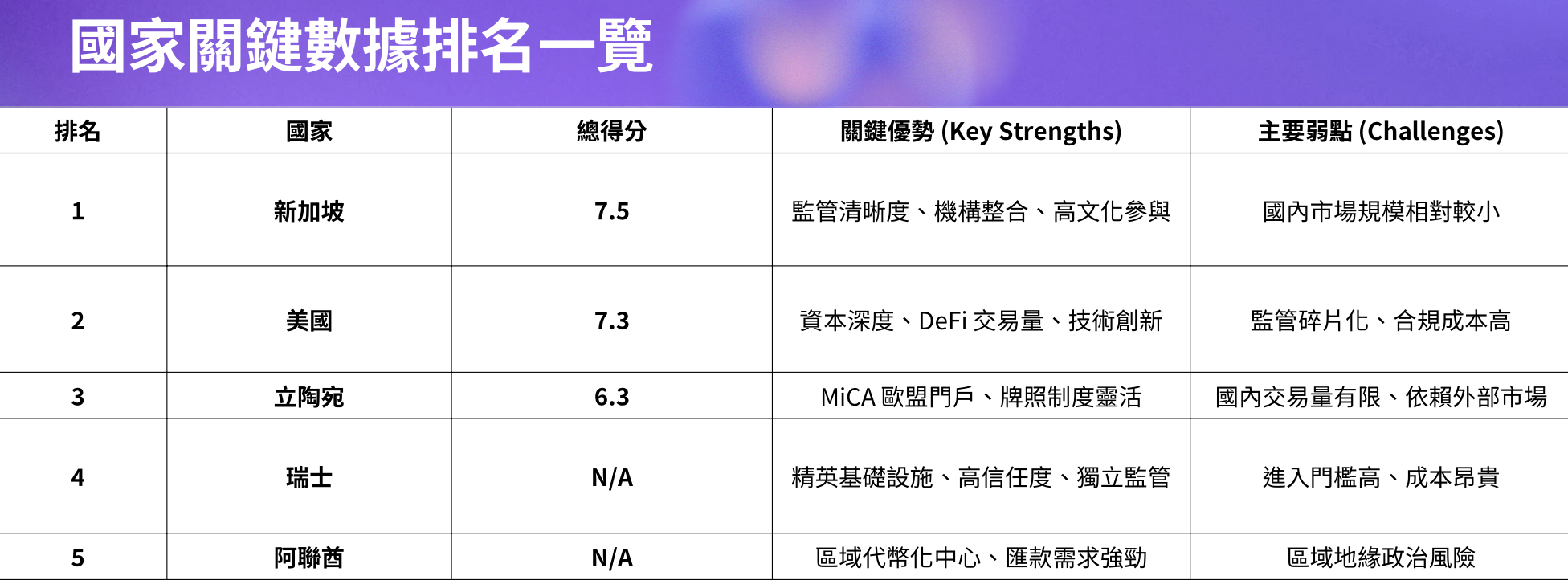
Singapore has surpassed the United States to become the world's number one, while Lithuania and Switzerland have entered the top five. These phenomena indicate that market size alone is no longer the only standard for measuring the maturity of the crypto economy. "Regulatory clarity" and "institutional integration capabilities" are the new power holders of the financial world.
Meanwhile, Chainalysis data shows that the Asia Pacific region (APAC) has become the fastest-growing region for on-chain activity in the past year, with a growth rate of 69%, and transaction volume has surged from $1.4 trillion to $2.36 trillion.
This trend of "Eastward rise and westward decline," coupled with the rise of stablecoins and real-world assets (RWAs), is reshaping the operating logic of global finance. We comprehensively analyze this landmark financial research report from the perspectives of methodological innovation, geopolitical power restructuring, asset class evolution, and the dual economic dynamics of demand-driven and investment-driven growth, and explore its implications for Taiwan's financial strategy.
Seeing through the truth behind the data
Traditional indicators
For a long time, the industry's standards for evaluating the cryptocurrency market have been too simplistic, relying primarily on the trading volume of centralized exchanges (CEXs) or the total value locked (TVL) on-chain. This approach suffers from a significant survivorship bias. It overemphasizes the influence of developed countries with large capital stock (such as the United States and the United Kingdom) while ignoring the real progress of cryptocurrencies in terms of institutional penetration, cultural acceptance, and grassroots usability.
For example, a high trading volume in a country may simply indicate the presence of a few large quantitative trading funds or market makers, rather than reflecting the integration of cryptocurrency into the daily economic activities of ordinary citizens or businesses. Chainalysis's ranking methodology emphasizes "grassroots adoption," which is why India, Pakistan, and Vietnam often rank highly. However, this perspective sometimes underestimates the infrastructure advantages of mature financial markets.
What is the four-dimensional assessment of Bybit x DL Research?
To provide a more comprehensive perspective, the 2025 Global Cryptocurrency Ranking Report introduces a more nuanced evaluation system consisting of four key pillars , designed to capture "depth" rather than just "breadth".

To rival economic giants like the United States. The key point in the crypto world is that the future of cryptocurrencies is not just determined by Wall Street capital, but also by the design and integration of social systems.
The rivalry between the United States and Singapore and Europe's breakthrough
Singapore: A Global Beacon of Institutionalized Adoption (Ranking #1)
Singapore's high score of 7.5 in this ranking is not a short-term breakthrough, but the result of long-term strategic planning.
- Regulation as a Service: The Monetary Authority of Singapore (MAS) is not merely a regulator, but also an industry leader. Through a clear Payment Services Act (PSA) and a final regulatory framework for stablecoins, Singapore provides businesses with a high degree of predictability. MAS's "Project Guardian," actively piloting the integration of tokenized assets with the traditional banking system, has directly contributed to the prosperity of the RWA market in Singapore.
- High penetration and cultural identification: The report shows that over 11% of Singapore residents hold crypto assets. This reflects the high level of digital financial literacy among Singaporeans and their view of crypto assets as a standard component of diversified investment portfolios. Singapore achieved near-perfect scores in both the "cultural participation" and "user penetration" indicators.
The United States: The Institutional Dilemma of a Capital Giant (Ranking #2)
Despite ranking second, the United States (7.3 points) remains the most influential single market in the world.
- Capital Magnetism: The approval of Bitcoin spot ETFs and the advancement of the GENIUS Act have made the United States a magnet for institutional capital. The US continues to lead the world in DeFi trading volume, CEX fund flows, and Lightning Network adoption.
- Uncertainty arising from a lack of unified regulation: Unlike Singapore's unified regulatory system, the US regulatory environment presents a multi-agency power struggle and trade-off (the jurisdictional dispute between the SEC and CFTC). While this uncertainty has not deterred capital inflows, it currently increases multiple compliance costs.
Chainalysis's data also corroborates this point: although the United States ranks extremely high in institutional service value, its adoption in grassroots retail is somewhat limited, which is a problem that new entrepreneurs still need to address.
Lithuania: A European Bridgehead in the MiCA Era (Ranking #3)
The rise of Lithuania (score 6.3) is one of the most impressive findings of this report. As a Baltic nation with a population of only a few million, Lithuania has successfully leveraged the EU’s Crypto Asset Market Regulation Act (MiCA) to position itself as a gateway to the European Single Market, attracting foreign financial institutions.
- Strategic Analysis: Lithuania has established an open financial system and a digitalized population. For global exchanges and service providers seeking to operate compliantly within the EU, Lithuania offers an efficient, low-cost, and frictionless pathway to registration and licensing.
- Leverage effect: The report specifically points out that although Lithuania's domestic trading volume is limited, its licenses have a wide reach across the European market. This demonstrates that in the digital economy era, jurisdictional competitiveness is more important than population size.
Switzerland: A crypto fortress for traditional banking (Ranking #4)
Switzerland represents another familiar European model: elite infrastructure.
- Independent of MiCA: Switzerland has established a high-standard regulatory system independent of the EU's MiCA, thanks to its deep-rooted private banking tradition and early presence in the Zug crypto valley.
- Trust Economy: Switzerland's strength lies in "trust." During a global crisis of confidence in centralized exchanges, Switzerland's bank-grade custody services became a safe haven for top institutional funds. It possesses unparalleled "cultural legitimacy" in policy, custody infrastructure, and research.
UAE: A tokenized hub connecting Asia, Europe and Africa (Ranking #5)
The United Arab Emirates (UAE)'s success lies in its precise geostrategic positioning. It is not only a regional hub for the Middle East and North Africa (MENA), but also a "tokenized financial bridge" connecting Asia, Europe, and Africa.
- VARA Framework Effect: The Dubai Virtual Assets Regulatory Authority (VARA) has established a dedicated policy framework that provides businesses with a high degree of flexibility.
- A Unique Dual-Track System: The UAE's crypto ecosystem features a unique dual-track system. On one hand, there's a government-led pilot program for asset tokenization; on the other, there's remittance-driven usage driven by a large expatriate workforce. This allows the UAE to score highly in both "institutional innovation" and "grassroots practicality."
The polarized cryptoeconomics
WCR 2025 reveals a profound and diverse global development structure: "investment-driven" in high-income countries and "necessity-driven" in low-income countries, coupled with a "hybrid development" model. Markets including the UAE, Brazil, and Hong Kong, which possess both policy support and active retail participation, fall somewhere between "investment-driven" and "necessity-driven." These countries use cryptocurrencies to meet local demand while simultaneously supporting cross-border trade and capital flows, offering clear and flexible regulations.
The game of wealthy countries: asset appreciation and diversified allocation
In high-income countries such as the United States, Singapore, and Switzerland, user penetration rate is positively correlated with regulatory clarity.
- Motivation: The primary motivation for people to hold cryptocurrencies is portfolio diversification. Keywords include ETFs, DeFi yields, and RWA.
- Behavioral patterns: The frequency of “transaction use” in these countries may not be as high as expected (because credit cards and electronic payments are already well-developed), but the amount of each transaction is huge and often related to institutional products.
Emerging markets are used as life preservers, emphasizing functionality.
In countries like Vietnam (ranked 9th), the Philippines, and Nigeria, cryptocurrency adoption is bottom-up.
- Vietnam Case Study: Despite not having the same level of formal government support as countries like Singapore, Vietnam still ranks among the top 20 globally (even reaching 4th on Chainalysis), thanks to its high level of grassroots activity and use of decentralized tools.
- Functional needs: In these markets, cryptocurrencies are used to combat inflation, circumvent capital controls, and serve as an alternative to the banking system, where people have significantly lower rates of bank penetration than in wealthier countries.
This explains why many developing countries score higher than developed countries on the "transaction usage" pillar. Chainalysis data shows that on-chain activity in the Asia Pacific region (APAC) grew by 69%, driven by this strong grassroots demand.
Three forces that are reshaping the market
The report data shows that cryptocurrencies are undergoing a transformation from hype to practical use, mainly reflected in the following three areas:
RWA: A Trojan Horse Strategy for Institutional Entry and Slaughter
The tokenization of Real-World Assets (RWA) is no longer just a theoretical concept.
- Explosive growth: Since January 2024, the total on-chain value of RWA, excluding stablecoins, has increased by 63% to $25.7 billion .
- Asset classes: US Treasuries and private credit are the leaders in this area. Private credit accounts for approximately $15.6 billion, while tokenized US Treasuries account for approximately $6.7 billion.
This marks the beginning of capital markets integrating tokenized assets into their regular operations. For countries with high institutional readiness (such as the United States, Singapore, and Lithuania), this will be the biggest growth driver in the coming years.
Stablecoins: Currency Competition and a Payment Revolution
The development of stablecoins has entered a new stage, characterized by localization and functional differentiation.
- De-dollarization trend: Although dollar-pegged stablecoins (such as USDT and USDC) still dominate the market, countries are beginning to explore stablecoins pegged to their own currencies in order to reduce their dependence on the dollar and retain monetary sovereignty.
- Payment Dominance: Stablecoins hold a dominant position in global crypto payments. A report by TRM Labs indicates that stablecoin transaction volume exceeded $4 trillion between January and July 2025, setting a new record.
On-chain payroll: the financialization of the labor market
This is perhaps the most socially impactful data in the report: the proportion of global professionals who receive part of their salary in cryptocurrency has surged from 3% last year to 9.6% this year.
- Driving force: This trend is primarily driven by stablecoins (accounting for over 90%), and is concentrated in economies with large numbers of remote workers and high remittance demands, such as the UAE, the Philippines, Kenya, and Brazil.
- Addressing the pain points: For freelancers in emerging markets, receiving cross-border salaries through traditional banking systems often involves high fees and several days of processing time. On-chain payroll offers an immediate, low-cost alternative and effectively mitigates inflation risks in some countries, making it a prime example of "necessary mass adoption."
Future Outlook and Strategic Opportunities for Taiwan
2026 Outlook: Regulatory Arbitrage and Compliance Migration
The report predicts that by 2026, a significant phenomenon of regulatory arbitrage will emerge globally. Countries that can establish clear regulatory frameworks and infrastructure will be able to capture tax revenue, attract top talent, and promote innovation; conversely, countries that maintain restrictive or ambiguous policies will face a loss of market capital and talent (activity migrates to jurisdictions with more developed frameworks).
With the full implementation of MiCA in Europe and the advancement of the GENIUS Act in the United States, the standardization of global crypto regulation will increase significantly. Future competition will focus on optimizing compliance costs versus the efficiency of "business model implementation."
Lessons for Taiwan
As a crucial part of the global technology supply chain, how should Taiwan position itself within the trends outlined in WCR 2025? The report offers some suggestions:
- Following Singapore's "regulation as a product" approach: Taiwan is currently in the exploratory stage of regulating virtual assets. Singapore's success proves that clear rules are not an obstacle to innovation, but rather a magnet for compliant capital. Taiwan should accelerate the implementation of a dedicated law for virtual assets to provide clear guidelines for industry players.
- Learning from Lithuania's "niche strategy": Lithuania has proven that small countries can become regional financial hubs through flexible licensing systems. Taiwan doesn't need to pursue a large and comprehensive approach; it can focus on RWA tokenization technologies (such as real estate, green energy assets, etc.) or the Web3 developer ecosystem to become a hub for Asian technology talent.
- Embracing the advantages of stablecoin payments: Given Taiwan's position in global trade, exploring enterprise-level stablecoin payment settlements (B2B Cross-border Payments) can significantly improve the efficiency of cross-border trade capital turnover, which is highly consistent with RWA and payment trends in the report.
Conclusion
The "2025 Global Cryptocurrency Ranking Report" is not a report card; perhaps a more accurate description is "the future of the financial market." The makeshift operations of cryptocurrencies are over, and the era of institutionalization has arrived for users.
In this new era, whoever can most effectively integrate blockchain technology into the existing legal and economic framework will control the financial discourse for the next decade. For Taiwan, now is the time to stop observing and actively participate in this reconstruction of global financial infrastructure.