Author: Spiral
Source: https://spiralbtc.substack.com/p/making-bitcoin-speak-human
Authors: Conor Okus & Mat Balez
If you've ever sent a real peer-to-peer Bitcoin payment, you know how nerve-wracking the process can be. We have to copy a string of characters that looks incredibly strange, paste it into our wallet software, and pray we don't accidentally mistype a single character and send our money to an inescapable hell.
"Human-readable Bitcoin Addresses (HBAs)" is the name we proposed for the BIP 353 standard; this standard brings the familiar, intuitive user experience from applications like Cash App, Venmo, and PayPal to Bitcoin applications. Users no longer need to deal with long and daunting wallet addresses; HBAs make sending Bitcoin as simple as sending an email.
As an open industry standard built on the Domain Name System (DNS), BIP353 transformed payment identifiers from formats like "bc1q0zv3j4kzv…" (addresses) into human-readable formats such as " ₿ conorokus@twelve.cash ". This is a significant improvement in usability, helping to reduce errors during copy-paste operations and eliminating the fear of initiating transactions.
DNS is already a familiar part of internet use. It's a powerful naming system that computers use to communicate with each other, translating a domain name (like " www.google.com ") into an actual IP address (like "142.251.16.100 "). When people type a domain name into their browser's address bar, they're using this system. We can achieve a similar effect in the Bitcoin world, the difference being that this will be used for payments.
Send the money to the name, not a random string.
Using names in payment apps is more convenient, clearer, and easier to remember. For example, "**$judysmith**" and " @moneyball ". They act as a bridge in the user experience, hiding most of the underlying complexities—such as identity, compliance rules, payment channels, and everything in between.
Bitcoin is powerful, but it still feels difficult to use.
As a technology, Bitcoin has been developed to be decentralized, open, and global, but we are still using something completely foreign to humans to "solve" human problems (Translator's note: This is a double entendre; the English word "address" can mean both "to solve" and "address").
- " Send me your blockchain address ." This requires the payer to carefully check and then copy and paste a short, seemingly random string.
- " Please give me a lightning invoice ." This also requires the payer to carefully check and then copy and paste a long, irregular string of characters.
If you're not part of the Bitcoin community, you wouldn't use this kind of language when initiating a payment, and this is precisely why it could potentially impact Bitcoin's success or failure. We must directly confront one of the most significant user experience issues in Bitcoin applications: can we create a human-friendly address system while preserving Bitcoin's core attributes?
This is a big problem, but if it can be solved properly, it can bring in the next wave of users and remove an obvious barrier to user adoption.
Solving a key peer-to-peer obstacle
HBA's primary use case is enabling Bitcoin payments to interoperate, not only across the entire ecosystem but also across different L1 and L2 payment protocols. It allows you to instantly and privately send single-transactions from any wallet or exchange to any other wallet or exchange, without prior coordination or special setup.
But HBA can also be used to enhance atomic sweeps. It allows you to move funds from a custodian to your own wallet securely, privately, and frictionlessly—all operations avoid address reuse. It's a simple path from "I bought Bitcoin" to "I control my Bitcoin."
Finally, when you're checking the recipient's address at a hardware signatureer vendor, HBA makes the process clearer and less error-prone. Verifying a short, recognizable name is much easier than scanning a long string of characters.
Open the hood
An HBA can be used to receive Bitcoin, regardless of the payment protocol used. It works by pointing to a BIP 321 URI stored in a secure DNS record, allowing the HBA to run on the internet infrastructure we already have. Both the HBA and the internet use the same global, stress-tested DNS system: every time you type a URL into your browser's address bar, a DNS lookup is performed, you just don't realize it. This is also familiar territory for wallet software.
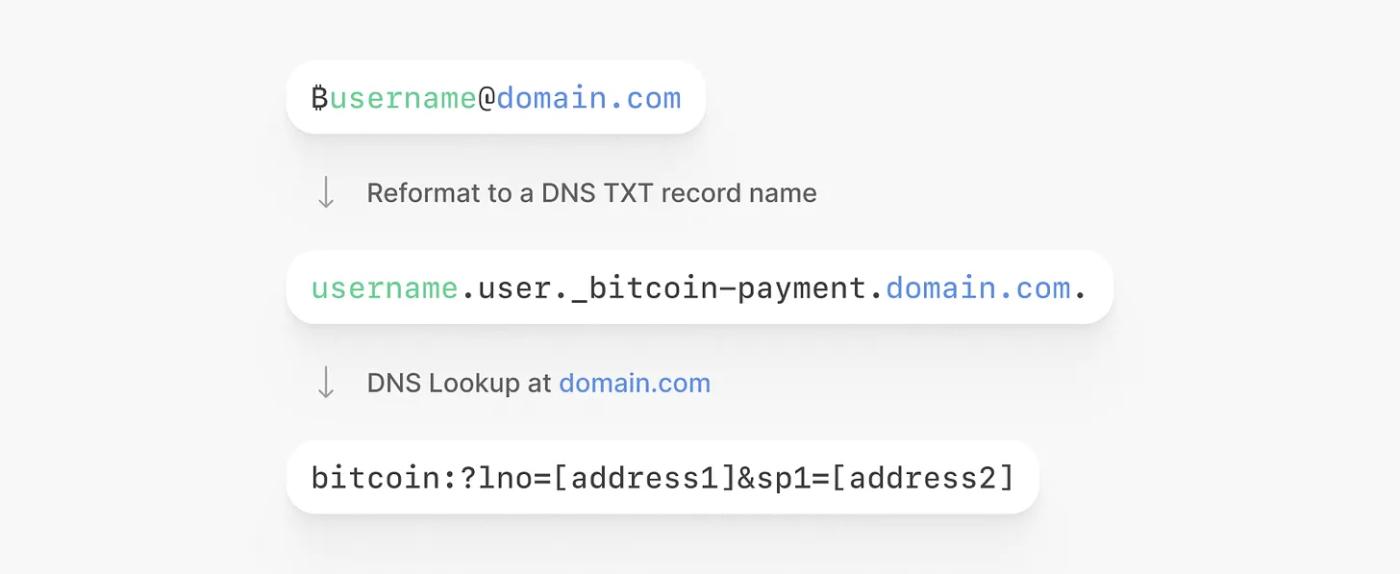
- HBA's DNS lookup process, from the Bitcoin Design Guide -
(Translator's note: Please note that in the above image, the parsed BIP321 URI contains two types of information: one is the Lightning Network offer; the other is the silent payment address.)
To be more specific, let's assume Bob wants to receive some Bitcoin.
The process works like this: First, Bob's wallet software or service helps him create a human-readable Bitcoin address. Behind the scenes, his payment instructions, such as a BOLT12 offer, are securely stored in the DNS. Then, if Alice wants to pay Bob, she doesn't need Bob to generate an invoice or coordinate anything in real time. Bob simply shares his HBA with Alice in whatever way he prefers: a text message, a phone call, on his website, or even on his business card—it doesn't matter. When Alice (in her Bitcoin wallet software) enters Bob's HBA, the wallet automatically retrieves Bob's payment information from the DNS, obtains his BOLT12 offer, and prepares the payment for Alice. With a single tap, her wallet sends the payment to Bob via the Lightning Network.
Furthermore, with the support of asynchronous payment protocols (recently implemented in LDK0.2), it doesn't matter whether Bob is online or not. The blessing will be delivered when his node or service returns to online. All of this requires no centralized server or Bob to stay online; all parties simply need to share a simplified address.
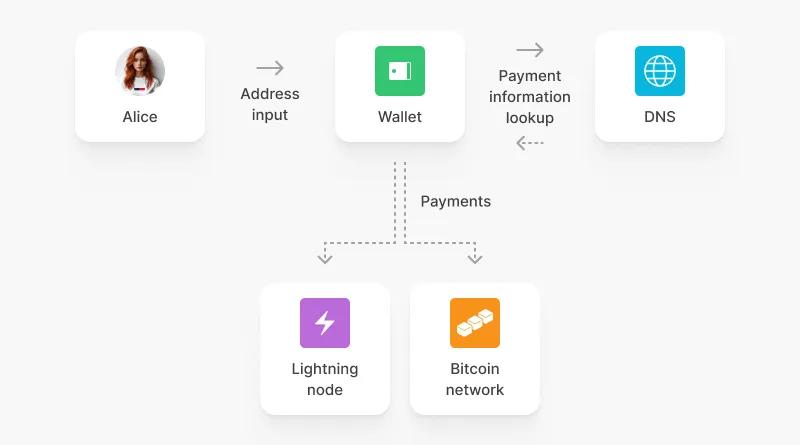
- Payment processes involving DNS queries, user wallets, and the Lightning/Bitcoin network, from the Bitcoin Design Guide -
Maintaining Bitcoin's Bitcoin nature
Perhaps the most important aspect of HBA is its breakthrough in user experience, enabling Bitcoin to expand into everyday life without sacrificing the qualities that make Bitcoin Bitcoin . Here are the areas where HBA aligns with Bitcoin's vision:
- Privacy : No third-party servers can track payment information (such as sender, amount, and metadata).
- Censorship resistance : Because no central server is needed to act as an intermediary, no one can block, filter, or freeze your payments.
- Security : HBA is designed to eliminate the risk of a service provider intermediary replacing your invoices or stealing payments sent to you. Furthermore, DNSSEC itself protects payment instructions, ensuring they are not tampered with.
- Interoperability : HBA breaks down closed payment silos, allowing payments to cross multiple systems. It can unify and integrate other payment protocols under a human-readable name.
HBA improves the ease of use of Bitcoin without sacrificing its principles.
HBA is the final Bitcoin identifier.
Because the BIP 353 HBA sits above other addressing schemes, it is expected to become the most easily interactive and future-proof unique identifier.
The need for such a solution has existed for a long time. But now, as Bitcoin payments are poised to scale and new protocols emerge with their own proprietary naming formats (such as Spark and Ark, and others coming soon), this issue is becoming increasingly critical. Without a unified standard, the entire ecosystem risks fragmenting into incompatible address schemes and a confusing user experience.
HBA gives the industry an opportunity to create a simple, human-friendly identifier that can be used with every protocol and every user.
So what about "Lightning Network addresses"?
"Lightning Network addresses" (implemented via the LNURL protocol) are similar human-readable addresses that have existed for many years, predating BIP353; they were created to address similar user experience needs, but with significant compromises in two areas:
- Trusting third-party servers means they can monitor your payment recipients, censor what you can pay for, and even, in certain settings, steal your funds. This is not the way Bitcoin scales to serve everyone.
- It is only compatible with the Lightning Network and is not designed to interoperate with other protocols (such as Ark, Spark, and Cashu) and blockchain payments (such as "silent payments"). LNRUL locks users into a part of the ecosystem.
Lightning addresses can be considered a stopgap measure, and they have now served their purpose. Using BIP353 + BOLT 12 , we now have a human-readable addressing system that enables similar usage without the centralization, trust factors, and interoperability limitations.
A new beginning
Now that we have a better solution, it's time to push HBA towards mass adoption. Phoenix Wallet—possibly the best self-custody mobile consumer wallet software—launched full support for sending and receiving funds to and through HBA in 2024 (found in Settings -> Experimental). Dozens of wallet apps and Bitcoin applications already support sending funds to BOLT12 Offers. Cash App (with 5.7 million existing users) has indicated they are developing such support. Momentum is building, and we eagerly anticipate seeing more wallet apps and Bitcoin products follow suit.
Here are some practical paths we believe are needed to support human-readable Bitcoin addresses in your application:
BIP 321 is used as a common address format.
Supporting BIP 321 URIs as a unified way to express payment instructions (regardless of the protocol used) creates a solid foundation for interoperability and future-proof features. Encouragingly, this is already supported by the vast majority of wallet software and exchanges, with only a small number of exceptions.
Supports sending to BOLT 12 and HBA
For most wallets and services, this is a relatively lightweight shift with minimal impact on user experience. The goal is simple: enable your users to make payments to anyone with an HBA, regardless of their wallet or network. Achieving this creates significant value for both the network and your users. Many cross-ecosystem wallets and applications have already added pre-existing support for BOLT 12, laying the groundwork for adding HBA support in the future.
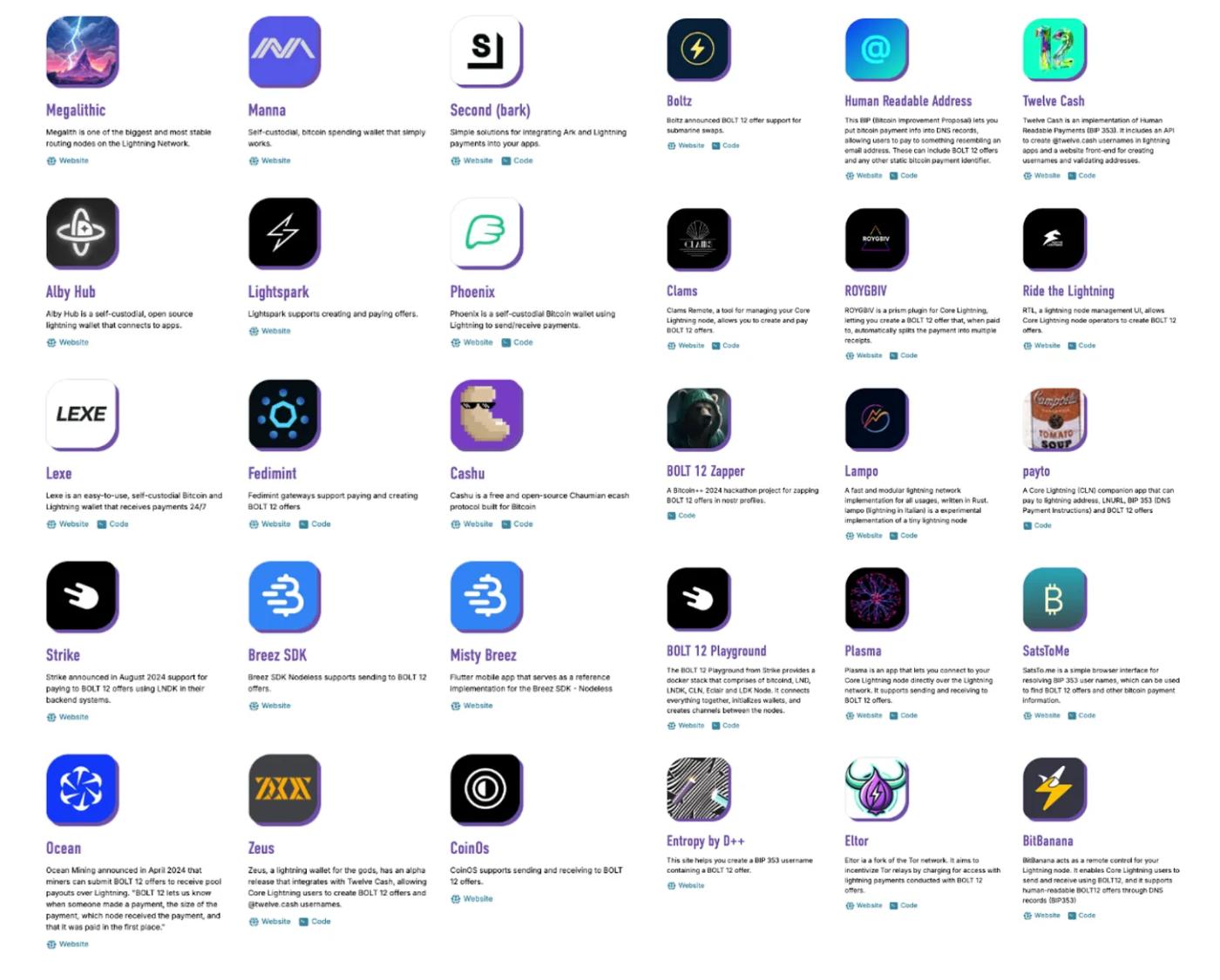
- Screenshot of BOLT 12 adoption status, from bolt12.org -
Supports receiving payments via BOLT 12 and HBA.
This creates greater value because your users will be able to receive Bitcoin on a stable, memorable, and interoperable address—right within your domain. It requires your DNS provider to implement DNSSEC, plus some backend and user experience development (e.g., username selection, managing offers); but it's valuable because it allows your users to present their HBAs anywhere.
One day, Bitcoin will no longer feel like a niche, complex financial instrument. People will find it transparent and effortless to use. Payments will be delivered through human-readable domain names, traversing different apps, borders, and currencies. At that point, users will no longer need to consider protocols, payment channels, or layers. In fact, they will no longer need to think about these things at all, which is the ideal state.
To get started sending payments using human-readable domains, download Phoenix Wallet and experience the magic firsthand. If you're more tech-savvy and looking for a self-hosted HBA solution, see this tutorial .
(over)