
Author: Azuma
Original title: The Economic Account Behind Polymarket's Exodus from Polygon
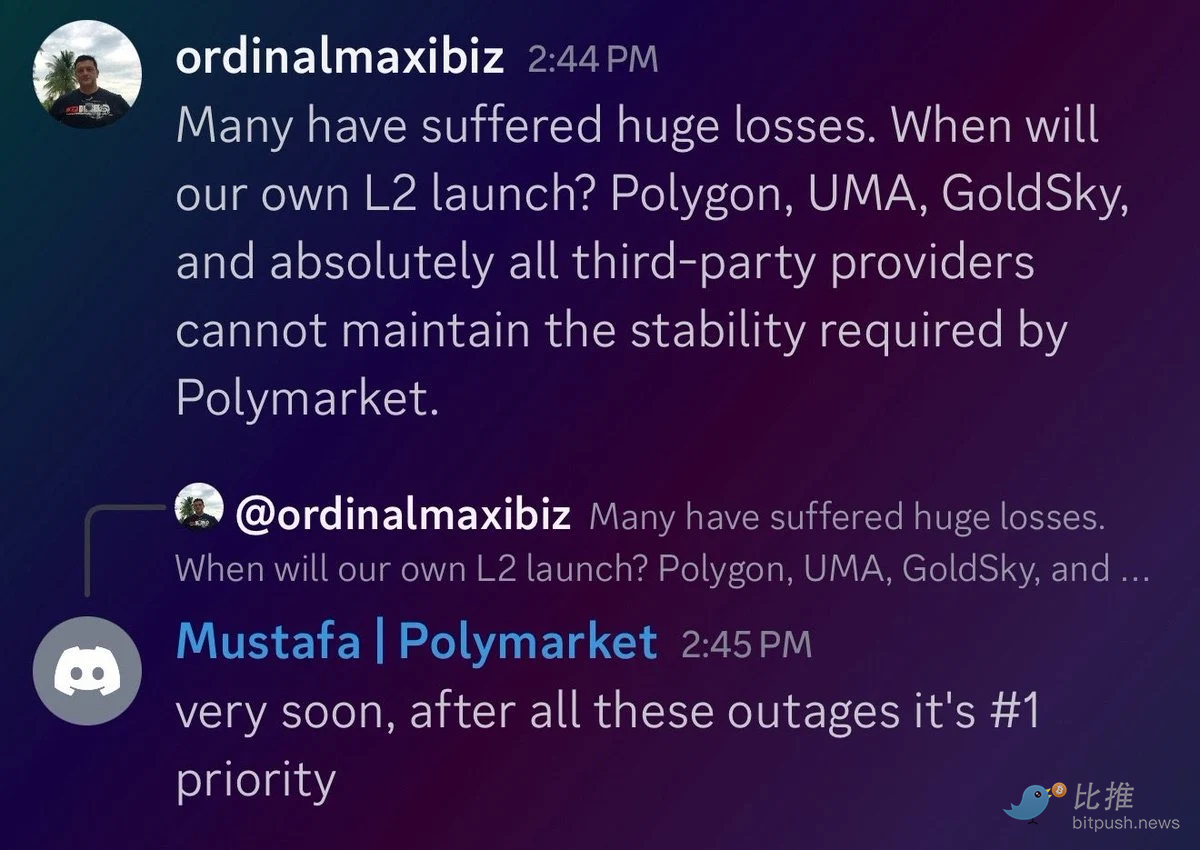
On December 22, an update regarding Polymarket, a leading prediction market, attracted widespread attention. Mustafa, a member of the Polymarket team, confirmed in the Discord community that Polymarket plans to migrate from Polygon and launch an Ethereum Layer 2 network called POLY, which is the project's current top priority.
A breakup that wasn't unexpected.
Polymarket's decision to leave Polygon is not surprising. One is a rising star in the application layer, while the other is a declining older infrastructure; there was already a mismatch between their market popularity and expected value. As Polymarket gradually grows into a new behemoth, Polygon's unstable network performance (the most recent outage occurred on December 18th) and relatively weak ecosystem have objectively become limitations for the former.
For Polymarket, building its own portal represents a win-win choice in both product and economic aspects.
In terms of products, in addition to seeking a more stable operating environment, building a self-built Layer2 network can help Polymarket reverse-engineer underlying features according to its platform requirements, thereby more flexibly adapting to future platform upgrades and iterations.
More importantly, it has economic implications. Building its own network means that Polymarket can consolidate the economic activities and related services generated around its platform into its own system, preventing the value from spilling over to external networks and instead gradually accumulating into its own systemic advantages.
explicit and implicit economic contributions
As an application layer, Polymarket's explosive popularity once brought Polygon a substantial direct economic contribution. Historical data compiled by data analyst Dash on Dune shows:
Polymarket has 419,309 active users this month and a total of 1,766,193 users throughout its history.
The total number of transactions this month was 19.63 million, and the total number of transactions in history was 115 million.
The total trading volume this month was $1.538 billion, and the historical total trading volume was $14.3 billion.
Regarding how to assess Polymarket's contribution to the Polygon ecosystem economy, Odaily Odaily discovered a rather coincidental ratio when compiling data from both.
Firstly, regarding the amount of capital locked up, Defillama data shows that the total value of all positions on the Polymarket platform is currently approximately $326 million, which is about a quarter of the total value locked on the Polygon network of $1.19 billion.
Secondly, there's the issue of gas consumption. Coin Metrics reported last October that transactions related to Polymarket were estimated to consume 25% of Polygon's total network gas.
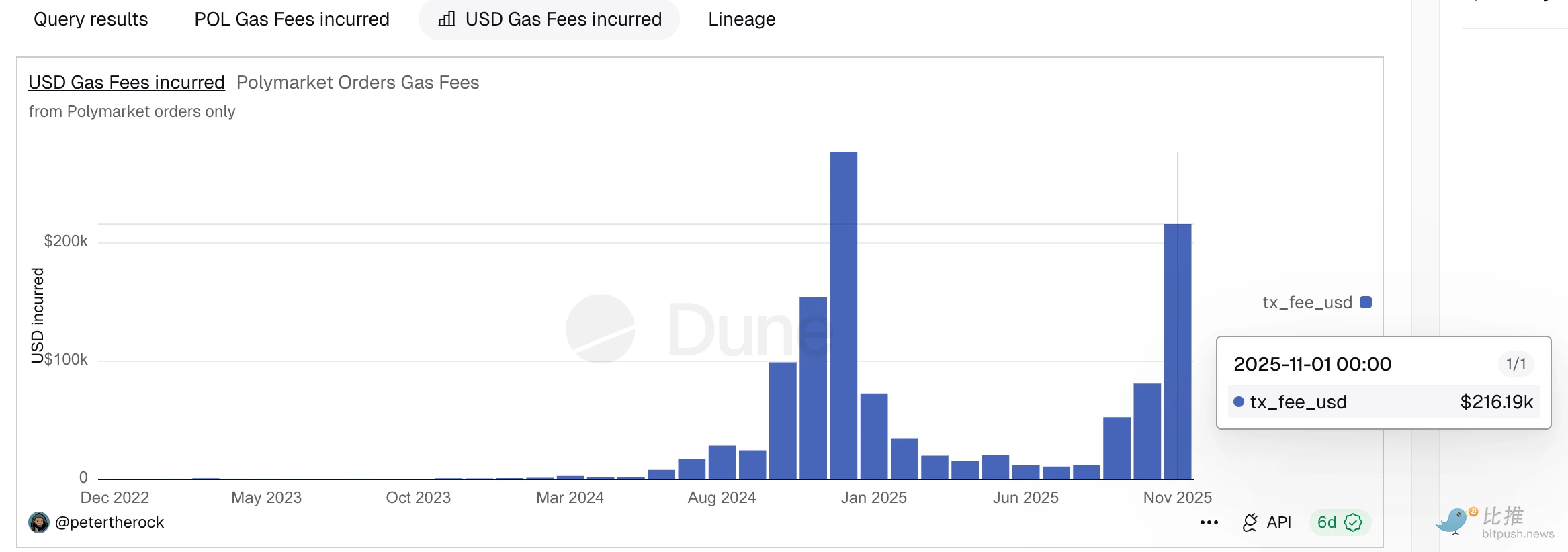
Considering that the data is outdated, we also checked recent changes. Statistics compiled by data analyst Petertherock on Dune show that Polymarket-related transactions consumed a total of approximately $216,000 in gas in November, while Token Terminal statistics show that Polygon's total gas consumption in the same month was approximately $939,000, which is also close to a quarter (about 23%).
While there may be coincidences due to statistical methods and time windows, similar results across dimensions can, to some extent, serve as an estimation reference for the economic significance of Polymarket to Polygon.
 In addition to quantifiable metrics such as active users, accumulated funds, transaction volume, and gas contributions, Polymarket's economic significance to Polygon is also reflected in a series of implicit contributions that are more difficult to measure directly but are equally real.
First, it revitalizes stablecoin liquidity. All transactions on Polymarket are settled in USDC, and its high-frequency, continuous trading significantly increases the demand for USDC on the Polygon network and its usage scenarios. Second, it retains the added value of user behavior. Beyond the prediction market itself, these users may also switch to other products on the Polygon ecosystem, such as DeFi, for convenience, thereby enhancing the overall ecosystem value of the Polygon network. These contributions are difficult to quantify with concrete data, yet they constitute the most valued and scarce "real demand" of the underlying network.
Why now? The answer isn't hard to guess.
In fact, judging from its user base, data performance, and market presence alone, Polymarket is fully capable of operating independently. This is no longer a question of "should it leave," but rather "when should it leave."
The core reason for choosing this particular time to begin the migration is likely the approaching release of Polymarket TGE. On one hand, once Polymarket completes its token issuance, its governance structure, incentive system, and economic model will become relatively fixed, significantly increasing the cost and complexity of subsequent underlying migration. On the other hand, upgrading from a "single application" to a full-stack system of "application + underlying layer" inherently signifies a change in valuation logic, and building its own Layer 2 undoubtedly opens up higher ceilings for Polymarket in terms of narrative and capital.
In conclusion, Polymarket's move to Polygon is not merely a simple underlying migration, but rather a microcosm of structural changes in the crypto industry. As top-tier applications begin to possess the ability to independently support users, traffic, and economic activities, the underlying network, if unable to provide additional value, will inevitably be "stabbed in the back."
Nothing more than the pursuit of profit.
Twitter: https://twitter.com/BitpushNewsCN
BitPush Telegram Community Group: https://t.me/BitPushCommunity
Subscribe to Bitpush Telegram: https://t.me/bitpush