

1. Introduction
Past market data reveals a fragmented picture: In 2024, stablecoins, as the "main artery" of the blockchain, had already handled a massive flow of $36.3 trillion; however, when it turned into a payment tool, it failed to penetrate the "capillaries" of the economy—its penetration rate in offline scenarios was less than 6%.
This vast market gap is where the Solulu story begins. Its ambition is to become the "infrastructure engineer" connecting on-chain value with offline entities. From its global licensing strategy prioritizing compliance to its U-card for everyday consumption and its efforts to reshape the settlement network for cross-border trade, Solulu is using a systemic approach to pave the way for the large-scale deployment of stablecoins.
This report will provide an in-depth analysis: Solulu's goal is not to become an all-around excellent student, but to be the "dark horse" that precisely breaks through and ignites the market.
2. Market Overview: The Stablecoin Arena – A Battleground of Potential and Hurdles
The current stablecoin market is experiencing unprecedented growth: on-chain settlement volume has achieved a historic breakthrough, but offline application penetration is severely insufficient. This pattern of "online prosperity and offline desert" reveals both the current state of the industry and points to its future direction.
2.1 In-depth Market Analysis: From Trading Pairs to Financial Foundation
Stablecoins have completed a crucial leap from being internal trading pairs in the cryptocurrency market to becoming part of global financial infrastructure. On-chain data from 2024 fully confirms this trend:
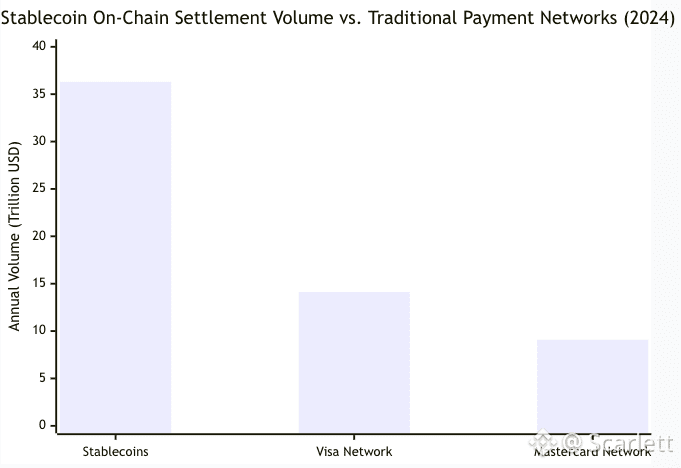
Chart Interpretation: The annual on-chain settlement volume of stablecoins reached $36.3 trillion. This figure not only surpasses the combined annual transaction volume of Visa ($14.1 trillion) and Mastercard ($9.1 trillion) for the first time, but more importantly, it reveals the enormous potential of stablecoins as a global value transfer layer. It proves that stablecoins have become a settlement network with massive throughput on the blockchain.
At the same time, the stablecoin market is showing a diversified development trend:
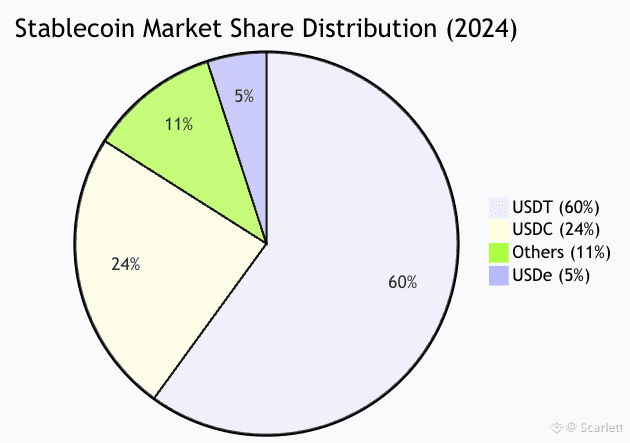
Chart Interpretation:
● USDT, leveraging its first-mover advantage and widespread exchange support, holds approximately 60% market share, becoming the market benchmark.
● USDC, with its high level of transparency and strict compliance regulations, has won the favor of institutions and compliance-sensitive users, capturing approximately 24% of the market.
● New-generation stablecoins such as USDe, through innovative derivatives hedging mechanisms, provide yields without relying on traditional bank account reserves, rapidly capturing 4%-5% of the market and demonstrating the market's innovative vitality.
2.2 Core Contradiction: On-chain Giants, Offline Babies
Despite the impressive on-chain data of stablecoins, their performance in the real economy presents a stark contrast. Currently, the penetration rate of stablecoins in offline payment scenarios is estimated to be less than 6%—meaning that over 94% of everyday consumption scenarios have not yet been reached by this digital asset.
The divide between "online prosperity and offline desert" has prompted us to delve into the root causes of this gap. The core contradictions are concentrated in three points: First, the user experience threshold is high, with professional concepts such as private key management, gas fees, and cross-chain technology deterring ordinary users; second, there is a lack of payment channels, with a lack of convenient tools that can seamlessly connect on-chain assets with offline merchants; and third, the regulatory environment is uncertain, with policy ambiguity causing merchants and users to adopt a wait-and-see attitude.
These profound industry pain points precisely constitute Solulu's core opportunity. A platform capable of systematically solving these problems will undoubtedly hold the key to unlocking the trillion-dollar payment market.
2.3 Policy Turning Point: From Gray Area to National Strategy
The signing of the U.S. GENIUS Act in July 2025 has accelerated compliance for the stablecoin industry, marking a milestone in its development.
The core regulations of the bill are clear and explicit: First, issuers must be "licensed," and stablecoins must be issued by financial institutions regulated by the U.S. federal or state level; second, reserve assets emphasize "safety first," limited to high-quality liquid assets such as U.S. dollar cash and short-term U.S. Treasury bonds; third, regulatory responsibilities are clearly defined, clarifying the core roles of the Federal Reserve, the Office of the Comptroller of the Currency, and other institutions in the regulation of stablecoins.
This policy shift is particularly significant: stablecoins have completely left the "regulatory gray area" and officially entered the core of the "national financial strategy," seen as a key tool for maintaining the dollar's hegemonic position in the digital age. For Solulu, which has always adhered to the core principle of "compliance first," this policy dividend has undoubtedly opened an unprecedented window of development—the clarification of regulations not only eliminates the biggest industry uncertainty but also gives compliant operators an unparalleled first-mover advantage.
3. Project Analysis: SOLULU – Building a Full-Scenario Ecosystem for Stablecoins
3.1 Vision and Positioning: To become the next-generation financial value transmission layer
Solulu's ambitions extend far beyond simply being a single-function trading platform. It targets the most crucial yet unbridgeable gap in the stablecoin ecosystem— how to truly transform stablecoins from "trading assets" into "practical currencies."
Its vision is to build a globally default, multi-chain, multi-currency stablecoin financial infrastructure. This positioning means that Solulu is not content to be a "supplement" to the existing system, but rather to become the underlying protocol that supports the free flow of value, enabling stablecoins to be transferred freely, instantly, and at low cost globally, just like information on the internet.
The realization of this vision relies on a profound industry insight: the future of stablecoins lies not in higher annualized returns, but in broader application scenarios and a smoother user experience. Solulu's mission is to drive stablecoins to complete a leap in their identity—from speculative assets whose prices fluctuate in the accounts of a few speculators to freely usable electronic cash in the wallets of ordinary people, and ultimately to become an indispensable compliant payment and settlement tool in corporate financial management.
3.2 Five Business Engines: Solid Pillars for Building a Value Loop
To achieve this vision, Solulu has systematically deployed five core businesses, which are interconnected and together form a self-reinforcing ecosystem:
3.2.1 Exchange Engine (Ecosystem Entry Point and Liquidity Cornerstone) This is not only the starting point for ecosystem traffic, but also aims to become the core hub for global stablecoin liquidity. Its core advantages are:
● Full-chain and multi-currency support: Supports versions of mainstream stablecoins such as USDT and USDC on mainstream public chains such as Ethereum, BNB Chain, and Solana, and plans to expand to non-USD stablecoins such as Euro and offshore RMB, truly realizing "one platform, global assets".
● Deeply aggregated liquidity: By partnering with top market makers and using a built-in intelligent routing system, the system automatically searches for the best price across multiple DEXs and liquidity pools when a user initiates a swap, ensuring extremely low slippage for large transactions and saving users every penny.
3.2.2 Payment Engine (A Key Tool for Connecting Real-World Consumption) This is the most direct manifestation of realizing the vision of "payment freedom," and its core products are virtual and physical U-cards:
● Seamless Global Spending: Deeply integrated with the global networks of Visa and Mastercard, users can make direct purchases at millions of online and offline merchants worldwide after card activation. The system automatically converts stablecoins into local fiat currency at the real-time exchange rate, achieving "seamless payment" and completely concealing the complexity of blockchain technology.
● Ultimate security and convenience: Supports advanced security features such as single-use card number, credit limit management, and instant freeze/unfreeze, and combines facial recognition registration to find the best balance between convenience and security.
3.2.3 Trade Engine (Conquering the Strategic High Ground of B2B Applications) Solulu keenly grasped the pain points of the trillion-dollar international trade market and launched a next-generation settlement network based on stablecoins:
● Revolutionary efficiency improvements: Reduce the time required for traditional letters of credit and wire transfers from 3-7 days to within 24 hours, and lower transaction fees from 1%-3% of the total transaction amount to fixed network costs of tens of dollars.
● Smart Contracts Empower Trust: Through collaboration with Web3 e-commerce platforms such as Caviar, we have developed "trade smart contract" templates. These contracts can lock payments and automatically execute payments upon fulfillment of conditions such as the bill of lading. All key milestones are recorded on the blockchain, significantly reducing disputes and increasing transparency.
3.2.4 Social Engine (Building a High-Frequency, Sticky Ecosystem Moat) Solulu Chat is not simply an addition of features, but a revolution in scenarios, aiming to seamlessly embed payment into the most frequent social behaviors of humans:
● Financial-grade social experience: Integrates end-to-end encrypted communication, supports stablecoin red envelopes, group wallets, and one-click payment collection, enabling "chat and pay at the same time".
● Opening up new business channels: Providing merchants with an immersive sales loop of "chat and buy," integrating customer service consultation with payment transactions, greatly improving conversion rates. This is not only a functional innovation, but also a core barrier to building user stickiness and viral spread.
3.2.5 Incentive Engine (The Growth Flywheel Driving the Ecosystem's Cold Start): The innovative liquidity pool plan is the ecosystem's "fuel system," cleverly binding user interests deeply with platform development.
● Value contribution equals returns: Users become "liquidity contributors" by staking stablecoins, earning competitive base returns and "arbitrage quotas" for discounted SOLU purchases.
● Sustainable community incentives: Combining multi-level referral rewards, quickly build an initial user and liquidity network, forming a positive cycle of "more users -> higher liquidity -> better user experience -> attracting more users".
3.3 Core Ecological Value: SOLU Token's Double Helix Value System
The SOLU token is the "economic lifeblood" of the entire Solulu ecosystem, and its value is driven by a double helix of "rigid demand" and "strong deflation".
3.3.1 Basic Token Information
● Name: Solulu Token
● Code: SOLU
● Total mintage: 1 billion pieces
● Initial issuance chain: BNB Chain (BEP-20)
● Token Allocation:
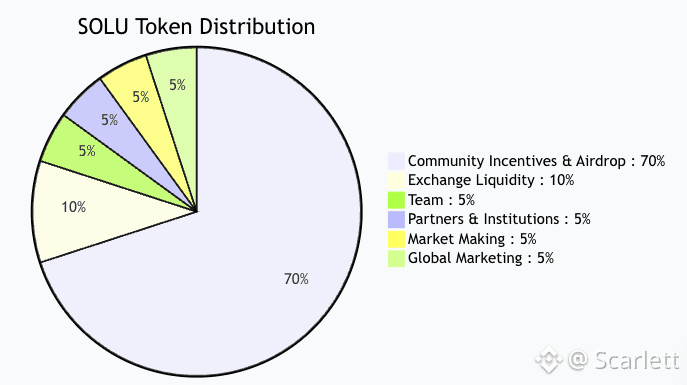
The SOLU token distribution mechanism is meticulously designed, and its strategic intent is clear and explicit:
➢ The 70% of the network-wide promotion incentive airdrop highlights the core principle of "community first," aiming to quickly build a user network through large-scale ecological incentives, transform early participants into ecosystem co-builders, and form a powerful growth flywheel.
➢ 20% liquidity and market allocation (10% for exchange liquidity, 5% for market makers, and 5% for global promotion) jointly ensure the trading depth and market stability after the token is listed, laying a solid foundation for the healthy development of the ecosystem.
➢ The 10% core contributor quota (5% each for teams and institutions) is subject to long-term lock-up and linear release mechanisms, ensuring that the core strength of the project is deeply bound to the long-term interests of the ecosystem development, demonstrating the team's firm confidence in the future of the project.
3.3.2 Rigid Demand: SOLU is not a tree without roots; its utility is deeply integrated into every core aspect of the platform.
● Payment and Discounts: Enjoy significant discounts on transaction fees (exchange, card transactions, etc.) when using the SOLU payment platform, creating continuous and inelastic purchasing demand.
● Governance and Rights: As the platform evolves, SOLU will develop into a governance token, with holders having the right to vote on key decisions such as fee adjustments and treasury usage, giving the community true ownership.
● Staking and Dividends: Users can share in the platform's revenue dividends by staking SOLU. In the future, higher-level benefits (such as premium U-cards and API limits) will also require staking SOLU to obtain.
3.3.2 Strong Deflation: Building a Clear Value Upward Path To combat inflation and drive long-term value growth, Solulu designed a very decisive deflationary mechanism:
● Revenue repurchase and destruction: The platform will use a portion of its transaction fee revenue (e.g., 30%) to periodically repurchase and destroy SOLU in the open market.
● Ecological tax revenue is completely destroyed: All transaction "tax revenue" generated in the liquidity pool program will be used 100% to buy back and destroy SOLU.
● Clear Scarcity Goal: Solulu has set a clear long-term goal—to reduce the total circulating supply of SOLU from 1 billion to 210 million through continuous burning. This commitment provides long-term holders with a clear expectation of value.
By combining "application scenarios to create demand and deflationary mechanisms to ensure scarcity," the SOLU economic model forms a powerful value loop: the more prosperous the ecosystem, the more revenue, the greater the burning of tokens, and the scarcer the tokens become, thereby attracting more people to hold and use them, ultimately driving the entire Solulu ecosystem to continue to develop upwards.
4. Core Strengths and Potential Risks
4.1 Triple Moat
Faced with fierce competition and complex challenges in the stablecoin sector, Solulu is systematically building three insurmountable barriers to defend its long-term value and competitive advantages.
The first line of defense is its forward-looking compliance barrier. While most projects in the industry are still taking a wait-and-see approach to regulation, Solulu has taken the lead in obtaining the US MSB license and is actively pursuing regulatory certification in key markets such as New York's MTL and the UAE's VARA. This "compliance-first" strategic layout has enabled it to seize a valuable first-mover advantage in the wave of increasingly stringent global regulations, and has transformed compliance from a common industry challenge into its most solid foundation of trust.
A deeper moat lies in the synergistic effect of its business ecosystem. Solulu is not a single-function tool, but a full-stack platform integrating asset exchange, daily payments, cross-border trade, and social finance. The various business modules create a powerful synergy where "1+1>2": the exchange engine provides a stable liquidity entry point for payments and trade, U-card payments bridge the last mile between on-chain assets and real-world consumption, and social finance creates high-frequency interactive user engagement scenarios. This ecosystem design significantly increases user switching costs, building a competitive barrier far exceeding that of single-function products.
The third layer of protection is the solid technological foundation supporting the operation of the ecosystem. The platform adopts a microservice architecture and multi-chain compatibility technology, which not only can easily handle high-concurrency transaction requests and ensure high system availability, but also has excellent scalability for the future—ensuring that the entire ecosystem can smoothly evolve with market demand iterations and technological innovations, and always maintain industry-leading service capabilities.
4.2 Risks and Challenges
While Solulu shows promising prospects thanks to its multiple competitive advantages, its development path still faces challenges in several key areas. These challenges, though difficult, clearly point to the core battleground that must be conquered in the popularization of stablecoins, and also conceal opportunities to turn advantages into victories.
The first challenge is establishing a differentiated advantage in a highly competitive market. Currently, the industry is dominated by crypto-native payment tools like Binance Pay and BitPay, which have secured market share through their first-mover advantage, as well as traditional financial giants and technology companies leveraging their mature ecosystems. This competitive landscape underscores the core value of the industry, and Solulu's key to breaking through lies in its unique "full-stack ecosystem" positioning—through the synergistic effects of asset exchange, payment, trade, and social networking, it carves out a differentiated development path in a homogeneous competitive landscape, upgrading the competition from a single payment tool to a contest of ecosystem capabilities.
Secondly, there's the strategic balancing challenge in global compliance. The progress in acquiring licenses in key markets such as New York's MTL, UAE's VARA, and Singapore's MAS will undoubtedly directly impact the pace of globalization. However, this precisely highlights the foresight of Solulu's "compliance first" strategy. The platform doesn't passively respond to regulation; instead, it proactively transforms compliance from a potential risk into a core competitive advantage. By establishing clear regulatory qualifications in key markets, it sets a benchmark of trust in the global digital asset payments field. This "compliance-based trust" strategy, in turn, creates a barrier that is difficult to replicate in long-term competition.
The most fundamental challenge lies in the "protracted war" of cultivating user habits and educating the market. Transforming stablecoins from trading assets into everyday payment tools undoubtedly requires changing deeply ingrained financial behaviors, incurring high education costs and a slow conversion cycle. However, this challenge itself will forge Solulu's most enduring competitive advantage. Once user education is completed through the convenient experience and wide range of payment scenarios provided by the U-card, deeply embedding the concept of "stablecoins as payment tools" in the public's mind, Solulu will establish an insurmountable leading position and strong user loyalty. This competitive barrier, based on the accumulation of user habits, is far more robust than short-term marketing can shake.
5. Summary and Outlook
Solulu's emergence has precisely capitalized on the historic opportunity for stablecoins to transition from "financial assets" to "practical tools." Its strategic vision covering all scenarios, its pragmatic approach prioritizing compliance, and its "five-in-one" ecosystem structure collectively constitute its unique potential as a dark horse in the field.
However, its path to becoming an industry benchmark is paved in the process of addressing core challenges. The current competitive landscape, compliance barriers, and user education difficulties, while formidable challenges, precisely outline the commanding heights Solulu can occupy if it can overcome them: establishing differentiation through a full-stack ecosystem in the competition, building trust through its first-mover advantage in compliance, and cultivating user loyalty through an exceptional user experience in education. These three challenges precisely point to the essential path Solulu must take to transform from a dark horse to a leader, and are also the precise bullseye of its strategic layout.
In this emerging field where blueprints and practical actions are equally important, Solulu has already demonstrated a remarkable start with a clear path to breakthrough. The next 12-24 months will be a crucial window to verify its execution capabilities: user growth curves, the acquisition of key licenses, and TVL health will become the core benchmarks for measuring its dark horse status.
The stablecoin market is currently on the verge of explosive growth, and Solulu, with its unique ecosystem strategy and clear path to breakthrough, has already secured a favorable position in this payment revolution. How this dark horse will turn challenges into opportunities remains to be seen.