Authors: Viee, Amelia, Denise I Biteye Content Team
Over the past year, the crypto market has quietly reached a new crossroads.
With the Fed's policy shift, coupled with the rise of new narratives such as x402, prediction markets, on-chain US stocks, and security tokenization, the market is no longer driven by a single emotion as it used to be, but is beginning to show more complex and mature structural changes.
As 2025 draws to a close, several top institutions have released their outlook reports for the crypto market in 2026. These include a16z (@a16zcrypto), Galaxy (@galaxyhq), Bitwise (@BitwiseInvest), Messari (@MessariCrypto), Grayscale (@Grayscale), Delphi (@Delphi_Digital), VanEck (@vaneck_us), and more.
Unlike some KOLs' short-term predictions, these institutional reports share a common characteristic: they do not discuss "what will be the next big thing," but rather answer "what is this industry becoming."
Through these perspectives, a clear signal is emerging— crypto is transitioning from an emotion-driven retail investor cycle to an "institutional era" centered on compliance, value, and long-term capital.
This article will focus on institutional investors, analyzing the 2026 cryptocurrency market predictions of seven leading institutions and attempting to extract the core logic behind their shared bets.
Before we delve into the details, here's a quick overview of institutional consensus:
Macroeconomic headwinds are turning favorable, the era of institutional investors is beginning, and the funding environment is expected to improve.
The four-year cycle is weakening, and the market may be entering a structural slow bull market.
Stablecoins and RWA strengthen the connection to reality and expand on-chain application scenarios.
Predicting the improved market application prospects, the integration of AI and Crypto is accelerating.
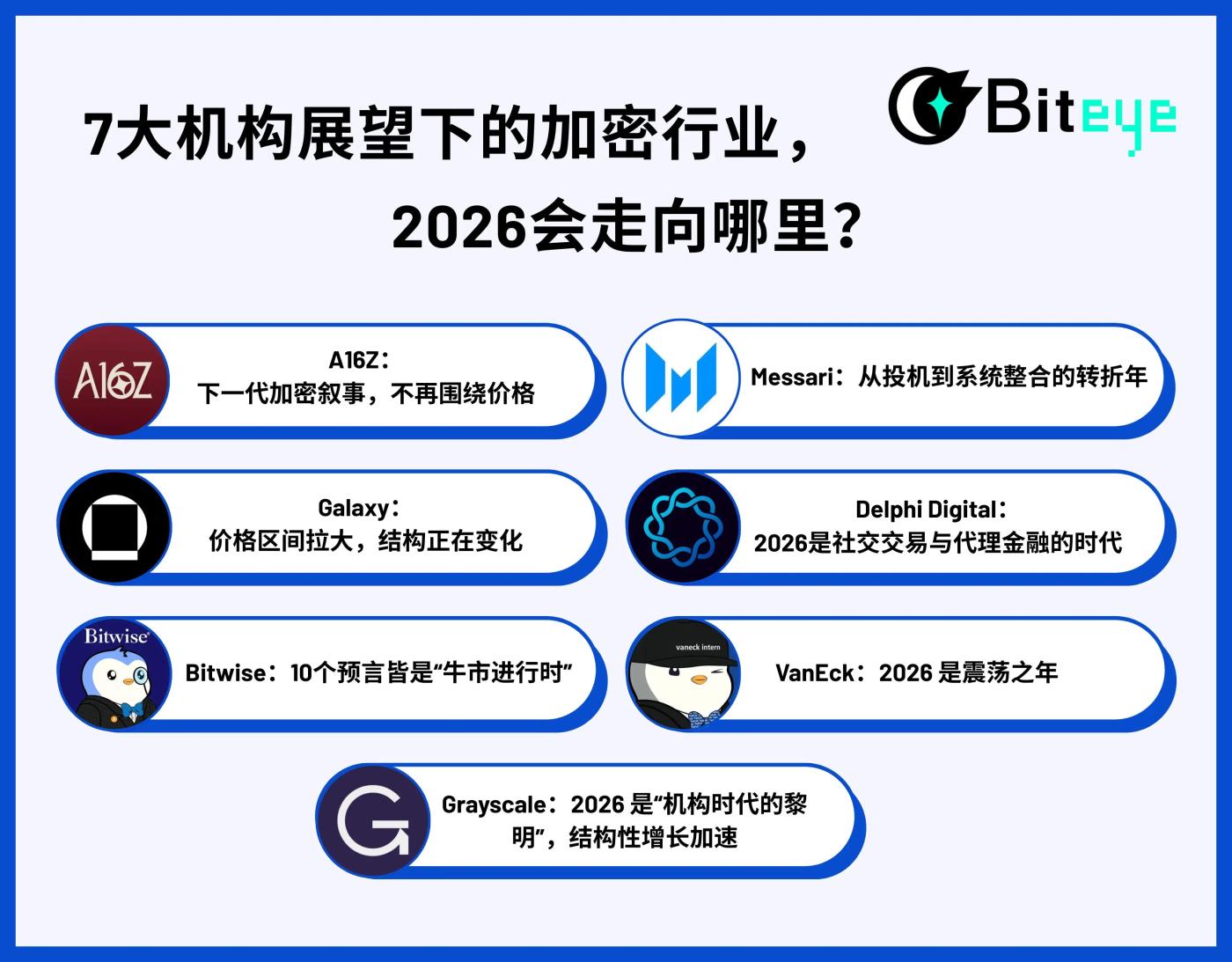
a16z: The Next Generation of Crypto Narrative, No Longer Revolving Around Price
In its 2026 outlook, a16z did not focus on short-term price or regulatory games, but returned to a core question: how will the next generation of crypto products be adopted by real users? They summarized 17 promising directions, with the keywords being implementation, user experience, and scaling.
Among these changes, the most representative one comes from the integration of AI and encryption.
When AI agents start automatically trading, placing orders, and calling on-chain services, how can these non-human agents prove "who I am"? a16z has proposed a new paradigm called "Know Your Agent (KYA)," which may become a prerequisite for AI agents to be on-chain.
At the payment level, a16z predicts that in the future, agents will automatically complete transaction settlements through protocols similar to x402, without user intervention; the agent will identify the demand and trigger the payment.
In the content field, facing massive amounts of AI content, a16z proposed the "staking media" model, in which speakers bet on their views and use funds to back the content. This model may be the next paradigm for on-chain media.
Other areas include stablecoin deposit and withdrawal upgrades, RWA crypto-native adoption, stablecoin-driven upgrades to bank ledger systems, diversified wealth management, the rise of AI research assistants, AI agent real-time content revenue sharing mechanisms, decentralized quantum-resistant communication, "privacy as a service" becoming infrastructure, DeFi security paradigm shift, intelligent prediction markets, privacy chains, verifiable cloud computing, emphasis on product-market fit (PMF), and crypto legislation unlocking more potential for blockchain.
Original article: https://a16zcrypto.com/posts/article/big-ideas-things-excited-about-crypto-2026/
Galaxy: Price range widening, product structure changing.
Galaxy's report, starting from the market structure, paints a picture of an "uncertain but not pessimistic" 2026.
Predicting Bitcoin's price movement in 2026 is extremely difficult. Options market pricing suggests that by the end of June 2026, Bitcoin may fall to around $70,000 or $130,000, with roughly equal probabilities. This wide range reflects market uncertainty about its future direction. Furthermore, Bitcoin is shifting towards a pricing model similar to that of mature assets like gold.
At the public blockchain level, Galaxy predicts that the Solana ecosystem will shift from being driven by Meme towards generating real business revenue. Regarding the stablecoin RWA, it is expected that stablecoin trading volume will surpass that of the US ACH system, and the adoption of RWA by traditional financial institutions will accelerate; for example, large banks or brokerages will begin using tokenized shares as collateral. Major bank card networks (such as Visa/Mastercard) will complete over 10% of cross-border clearing transactions through public blockchain stablecoins.
Finally, the overall market capitalization of privacy tokens is expected to exceed $100 billion, while the weekly trading volume of prediction markets like Polymarket may steadily surpass $150 million, potentially creating a new growth engine. Regarding the integration of AI and on-chain technology, Galaxy explicitly predicts that AI-powered agent payments using the x402 payment standard will account for approximately 30% of daily transactions on the Base protocol by 2026.
This means that the on-chain smart agent economy is no longer just a concept, but has begun to enter the stage of real-world application.
Original article: https://www.galaxy.com/insights/research/predictions-2026-crypto-bitcoin-defi
Bitwise: All 10 predictions indicate a "bull market is underway"
If we're talking about which institution is most clearly on the bullish side, Bitwise is one of them.
The Bitwise report begins by presenting a key signal: by the end of 2025, total assets in US cryptocurrency spot ETFs exceeded $12 billion, indicating that Wall Street has fully entered the market, while holdings data on platforms like Coinbase and Robinhood show that retail investors have not left either. This rare dual-engine funding structure lays the foundation for the continuation of the next cycle.
Bitwise has presented 10 key predictions, the clearest signal of which is that Bitcoin will reach another all-time high, primarily due to the combined effects of continued ETF inflows, declining macroeconomic interest rates, and the 2024 halving. Other predictions include:
Bitcoin's volatility will be lower than Nvidia stock.
In 2026, various spot ETFs and derivative ETFs will flood the market.
Crypto stocks will outperform tech stocks
Polymarket open interest is set to hit a new high, surpassing levels seen during the 2024 election.
The on-chain vault, also known as "ETF 2.0," will double its assets under management.
More than 100 crypto ETFs will be listed in the US.
Bitwise also gave an "Easter egg" prediction: the correlation between Bitcoin and US stocks will decrease, and AI was named "the next trading infrastructure," with Crypto's native AI projects potentially showing independent price movements.
Original article: https://bitwiseinvestments.com/crypto-market-insights/the-year-ahead-10-crypto-predictions-for-2026
Messari: A Turning Point from Speculation to Systems Integration
Messari defines 2026 as a "turning point year".
They believe that although sentiment was low in 2025, institutional participation accelerated, laying the foundation for the next stage of systemic integration. The continued rise of BTC proves its solid recognition as a monetary asset, while other mainstream assets such as ETH and BNB have failed to generate a premium comparable to BTC. Most Layer-1 public chains are likely to underperform BTC.
A significant change is the rise of privacy assets and application-level currencies. More and more consumer applications may choose to build their own currency systems instead of simply relying on the native tokens of the underlying public blockchain. This will drive on-chain currency innovation into a new stage, with Virtuals and Zora being the most representative examples.
Beyond the monetary aspect, Messari also emphasized the importance of integrating AI, DePIN, DeFi, and traditional finance (TradFi). These structural forces will continue to shape the future ecosystem, making 2026 not just a "bull market expectation," but the starting point for a true acceleration of the industry's intrinsic value process.
Original article: https://messari.io/report/the-crypto-theses-2026
Grayscale: 2026 is the "Dawn of the Institutional Era," with Accelerated Structural Growth
Grayscale's vision for 2026 is very clear: a pivotal year for the crypto market's transition from a "retail cycle" to an "institutional capital-driven" model.
In their view, the future market will be driven by both macroeconomic factors and a clearer regulatory framework. This structural shift has two core pillars: first, the continued growth in demand for scarce digital assets such as Bitcoin and Ethereum as alternative value assets in the macroeconomic environment; and second, significantly improved regulatory clarity, which will connect traditional capital with blockchain technology more deeply.
Regarding price predictions, Grayscale remains optimistic for 2026. The report predicts that Bitcoin will reach a new all-time high in the first half of the year, suggesting that the traditional "four-year cycle" logic may be coming to an end, with more reliance on long-term capital accumulation and macroeconomic allocation.
Grayscale also outlined several key investment themes, including the continued expansion of stablecoins' payment boundaries, particularly driven by regulations such as the GENIUS Act, indicating that asset tokenization is at an inflection point and will gradually increase its share in global finance. In the DeFi sector, lending remains the dominant direction, with future funds favoring protocols with sustainable revenue models and no longer supporting high FDV projects without revenue. Furthermore, staking yields will become the default investment option, and financial products centered around staking yields will emerge in 2026.
While some popular narratives, such as quantum computing and crypto vaults (DAT), have generated a lot of buzz, they are unlikely to have a real impact on the market in the short term.
Original article: https://research.grayscale.com/reports/2026-digital-asset-outlook-dawn-of-the-institutional-era
Delphi Digital: 2026 is the era of social trading and proxy finance
Delphi Digital defines the key growth drivers for 2026 as "social transactions" and "agentic finance," believing that intelligentization will be a significant paradigm shift in on-chain finance.
So-called proxy finance refers to the use of on-chain AI agents to automatically rebalance, execute strategies, and maximize profits, allowing users to participate in complex financial activities without constantly monitoring the market. Delphi also positions "social trading" mechanisms (such as mirror strategies and copy trading systems) as a key means to attract the next wave of retail investors.
At the macro level, Delphi believes 2026 will be a significant turning point, with the key variable being a shift in liquidity. They anticipate the Federal Reserve will begin cutting interest rates, which will help attract funds back to risk assets. With clearer regulations, the Bitcoin ETF flywheel effect, and increased institutional adoption, they are optimistic about DeFi supporting the implementation of more complex automated on-chain strategies.
Original article: https://delphidigital.io/year-ahead-2026
VanEck: 2026 is a year of upheaval
VanEck's judgment was relatively restrained.
They believe the crypto market in 2026 will not experience the dramatic volatility of previous cycles, but rather a year of fluctuation. While Bitcoin retraced over 80% in the last cycle, its largest drop so far this cycle is only about 35%, and coupled with the halving of volatility, this suggests that most of the retracement has already been absorbed. In their three analytical frameworks, VanEck points out:
Global liquidity is complex. While the Fed’s rate cut should have been beneficial to the market, the rapid cash burn and difficulty in financing AI have made it more expensive for companies to borrow money, and market liquidity remains tight.
The crypto market leverage has undergone multiple rounds of cleansing;
On-chain activity remains low, but there are signs of recovery.
Against this backdrop, VanEck recommends allocating 1%-3% of your portfolio to Bitcoin through dollar-cost averaging, and moderately reducing holdings when the market overheats. Furthermore, stablecoins are penetrating the B2B payment sector, optimizing cross-border settlements, and VanEck is optimistic about e-commerce and fintech platforms that can drive the adoption of stablecoins.
Original article: https://www.vaneck.com/us/en/blogs/investment-outlook/plan-for-2026-predictions-from-our-portfolio-managers/
Summary of institutional views: Generally optimistic.
Based on the forecasts of the aforementioned institutions, the landscape of the crypto market in 2026 is gradually becoming clearer. Although each institution has a different entry point and focus, their core judgments show a certain degree of consensus and optimism:
1. Improved Macroeconomic Environment : Almost all reports believe that 2026 will be a key turning point from "headwinds to favorable conditions." Whether it's the Federal Reserve's anticipated interest rate cuts or the warming global liquidity environment, both have created new macroeconomic advantages for scarce assets such as Bitcoin.
2. The Institutional Era Officially Begins: Alongside this macroeconomic shift, the structure of capital is iterating. 2026 will no longer be just a cycle for retail investors, but the beginning of the "institutional era." ETF products, on-chain vaults, asset management indices, and retirement funds entering the market... not only are the methods of purchase changing, but the nature of capital is also shifting from short-term speculation to stable allocation. Furthermore, DeFi, RWA, and stablecoins will become key connecting points, introducing the logic of traditional capital into the on-chain world.
3. The four-year cycle effect is weakening: The market rhythm dominated by the four-year halving is being replaced by a longer-term capital logic. In 2026, it may no longer follow the past pattern of rise and fall, but enter a long-term "slow bull market mode" similar to mature assets such as gold and stocks.
4. Stablecoins and RWA serve as a bridge between reality and the blockchain: Meanwhile, the main themes of stablecoins and RWA are constantly strengthening. Stablecoins are seen as a key node in the restructuring of financial infrastructure, permeating payments, clearing, and corporate finance; the emergence of RWA means that traditional assets will also be moved onto the blockchain, expanding market depth.
5. The prediction market has a bright future : The success of platforms such as Polymarket represents a promising future for this type of application. With the easing of regulations, these prediction markets may even participate in a wider range of financial activities.
6. The integration of AI and blockchain : a16z, Delphi, Grayscale and others all regard it as a potential breakthrough. AI will continue to develop rapidly in 2026, while blockchain will be increasingly introduced to provide trust, payment and decentralized solutions. The cross-narrative of AI + Crypto is rapidly gaining momentum.
In conclusion
The echo at the end of each cycle will reverberate at the beginning of the next cycle.
Looking ahead to 2026, the crypto industry may be poised for explosive growth.
From ETFs and on-chain US stocks to AI Agents applications, the new narrative no longer relies on speculative drivers, but is linked to real needs and macroeconomic structures.
This round may be slower, but it will be more solid.
Disclaimer: This is for informational purposes only, and Biteye does not endorse the views expressed herein.