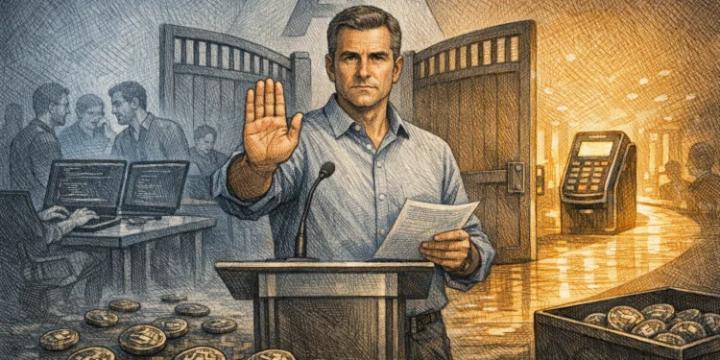
Coinbase CEO Brian Armstrong predicts that US banks will change their stance on regulating stablecoins and will eventually lobby Congress to allow interest payments on these digital assets.
Armstrong's forecast, published on December 27th in X, contradicts the current move by the banking industry to remove profit-generating features from the GENIUS bill.
Armstrong predicts that banks will change their minds about banning stablecoin interest payments.
He noted that banks are currently looking to retain Capital at low interest rates, but in the long run, they will have to adopt new technologies to compete in attracting Capital.
“I predict that banks will actually reverse course and will be lobbying to be allowed to pay interest, to pay yields on stablecoins, in the next few years,” Armstrong wrote .
This forecast shifts the current legal battle over the GENIUS bill into a clash between preserving traditional profits and the inevitable development of the market.
The GENIUS bill, scheduled to be signed into law in July 2025, prohibits stablecoin issuers like Circle and Tether from paying interest directly to holders.
However, this law allows intermediaries – such as exchanges – to pass on yields from Treasury bond reserves to users.
That is why banking advocacy groups are calling on lawmakers to XEM the bill and close this loophole.
They argue that non-bank platforms can now offer near-risk-free yields of around 4% to 5% on cash equivalents from Treasury bonds. In this context, commercial banks find it difficult to compete without raising deposit interest rates, leading to reduced profit margins.
However, Armstrong argues that any attempt to change the existing regulations is a "red line" for the crypto industry.
He criticized the approach of the lobbying group for the bank as "circular reasoning." He argued that they raised concerns about safety but then defended the model of paying lower-than-market interest rates to depositors.
The CEO of Coinbase also stated that the current lobbying spending by banking associations is a complete "waste of money."
Notably, a coalition of 125 crypto companies, including Coinbase, sent a letter to the Senate Banking Committee opposing the amendment to the bill. They argued that amending the bill would reduce transparency and certainty in regulation.
Armstrong's view implies that banks will no longer be able to hold deposits at near-zero interest rates. Instead, the banks themselves will issue their own Tokenize dollars to directly benefit from this yield differential.
Until this change occurs, Coinbase and other exchanges will continue to defend the current model that allows them to be a lucrative channel for those holding USD.