Over the past year, ChatGPT has been continuously iterating on its product features, evolving from a single conversational assistant into a comprehensive platform encompassing social interaction, community collaboration, and shopping decision-making.
These updates include the introduction of group chats with shared conversations among multiple users, cross-session memory functionality, the "GPT" application with customizable role-playing, and deep integration with the e-commerce ecosystem.
To support its trillion-dollar valuation, ChatGPT must move towards platformization, first challenging Google, then invading Meta and even Amazon, repeating the path taken by internet super platforms.
01 The Evolution of Social Interaction and Community Functions
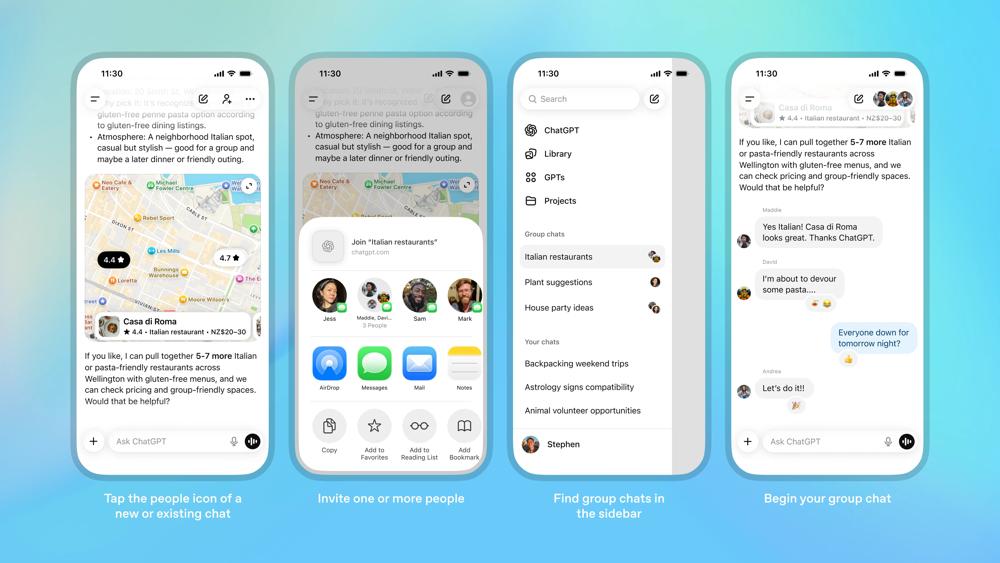
In late 2025, OpenAI launched the ChatGPT group chat feature, enabling multiple users to interact with ChatGPT together in the same conversation. This feature allows users to invite friends, family, or colleagues into a shared space to plan events, discuss ideas, and even have AI assist in decision-making.
For example, several friends can work together with ChatGPT in a group chat to plan a weekend trip, allowing AI to compare destinations, draft itineraries, and generate packing lists.
Group chat conversations are separated from private individual conversations, ensuring that each user's personal ChatGPT memories are not leaked to others. Users can invite 1 to 20 people to join the group chat via a shared link and set avatars and nicknames for the group to facilitate participant identification.
It's worth noting that ChatGPT has been optimized for "social behavior" in multi-person scenarios: it decides when to respond and when to listen based on the group context, and allows users to @mention "ChatGPT" in the conversation to get it to respond.
The launch of this group chat feature marks a significant step forward for ChatGPT, moving from one-on-one conversations to multi-person collaboration, and signifies that ChatGPT is becoming a new space for people to share and communicate.
To further support community collaboration, OpenAI has also launched the "Projects" workspace. Projects are like smart shared folders, which can group together multiple chats, files, and contexts, facilitating long-term, repetitive work.
Users can upload reference materials (PDFs, tables, images, etc.) to projects and add project-specific custom commands so that ChatGPT can remember specific backgrounds and preferences within the project.
All chats and files stored in the project are remembered by the AI, so ChatGPT won't "forget" previously discussed content in the project environment, continuously maintaining the context. More importantly, the project supports sharing: especially for paid version users in enterprise and educational settings, the project space can be shared with team members for collaborative editing.
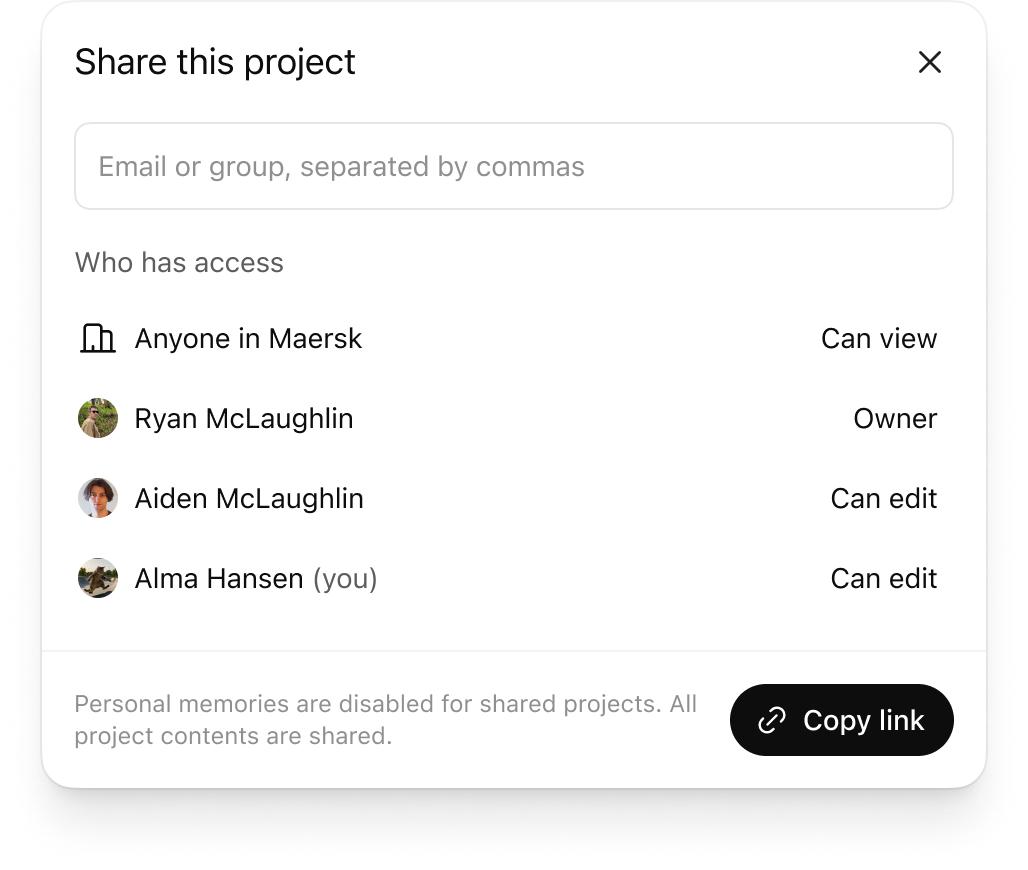
For example, a team can share a "marketing plan" project, which centralizes discussion records and proposal documents. ChatGPT can then provide consistent copywriting suggestions, and team members can easily take over the work.
Shared projects allow members to be assigned permissions (view only conversations or edit project settings), ensuring secure and controlled collaboration. This suite of features transforms ChatGPT into a collaborative workspace, meeting the needs of group communication, resource sharing, and collaborative creation, moving it further towards becoming a community-based tool.
02 Integrating into Shopping Decisions: ChatGPT Becomes an E-commerce Assistant
A large number of users have begun to use ChatGPT as a shopping advisor, with hundreds of millions of people seeking product advice from it every week. OpenAI has responded to this trend by integrating real-time product data and shopping information into ChatGPT.
When users ask questions such as "What are the best running shoes under $100?" or "What are some recommended gifts for pottery enthusiasts?", ChatGPT will now directly search the web for and display relevant product listings.
These product results are sorted purely by AI based on query relevance, rather than by advertisements or promotional links, emphasizing that they are unsponsored.
It is worth noting that in September 2025, OpenAI announced a partnership with e-commerce platform Shopify, bringing in its massive product data.
Shopify provides real-time information such as prices, inventory, product images, and models, allowing ChatGPT to search hundreds of millions of products in one place, covering almost all Shopify independent website merchants' inventory.
This means that when ChatGPT recommends products based on user descriptions, it is actually accessing a massive product database for matching. As Shopify's VP of Product stated, "People are discovering products through conversations with AI, no longer just through search or ads"—ChatGPT is naturally transforming users' interests into shopping behavior.
For consumers, this offers a completely new shopping experience: instead of browsing e-commerce websites one by one, they can simply describe their needs or ask questions on ChatGPT, and AI can provide selection suggestions by integrating information from various merchants.
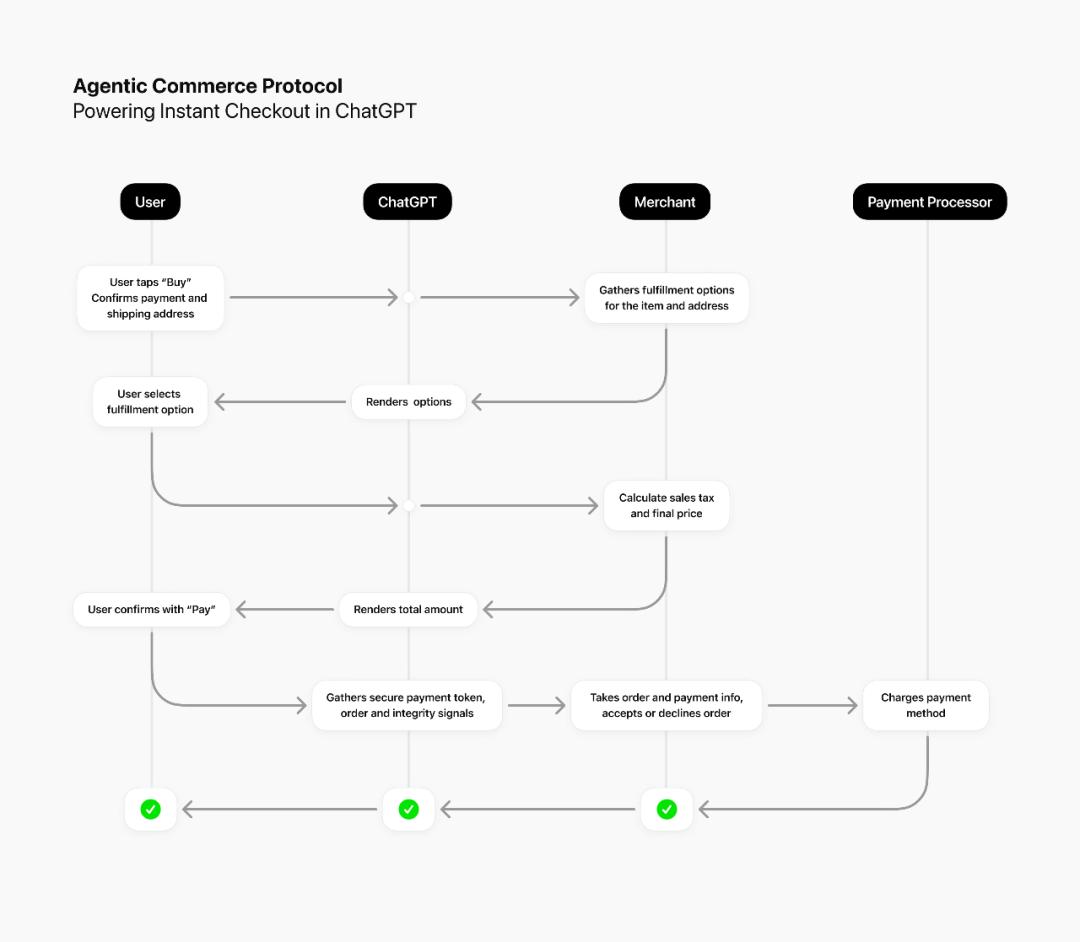
Furthermore, OpenAI has launched an "Instant Checkout" feature, enabling true in-chat shopping. Next to products recommended by ChatGPT, users will see a "Buy" button if the merchant supports instant purchase.
After clicking, users can directly confirm their order, fill in their shipping and payment information in the chat interface, and complete the payment with one click, without having to be redirected to an external website.
OpenAI partnered with payment platform Stripe to develop an Agentic Commerce Protocol to facilitate this process. ChatGPT acts as a "digital shopping assistant" for users: securely transmitting order, address, and payment information to the merchant's back-end system, much like a virtual personal shopping guide placing orders on your behalf.
In fact, even before launching official instant purchase, ChatGPT had already been exploring shopping decision-making assistance through plugins. After opening its plugin platform, many e-commerce-related plugins were launched. For example, the Instacart plugin allows ChatGPT users to generate recipes and directly order ingredients, while the Klarna plugin compares price discounts across various e-commerce websites. These third-party plugins have enriched ChatGPT's shopping skills.
However, compared to plugins that require manual installation and invocation by users, OpenAI's deep integration with Shopify and other platforms, and its native support for product search and ordering, undoubtedly lowers the barrier to entry and improves the seamlessness of the user experience.
ChatGPT's Apps Directory is now open, allowing users to directly search and browse various published ChatGPT applications/plugins within the chat interface.
ChatGPT can also automatically suggest relevant tools or plugins based on the conversation content, allowing users to access them with a single click. For example, when users discuss "booking flights and hotels," the system may suggest using a travel booking app.
This plugin ecosystem, especially its connection with shopping platforms and brand merchants, makes ChatGPT an increasingly versatile portal: whether it's obtaining product information, comparing and selecting, or directly purchasing and paying, everything can be completed within a closed loop within ChatGPT.
03 The Road to Platformization and Super Apps
In terms of AI platformization, OpenAI will seek partners in the social and e-commerce fields (such as Stripe in the payment field and Shopify in the e-commerce field), while also facing competition from traditional giants.
Its ultimate goal is to seize the gateway position for future users to obtain information, communicate, and consume, making ChatGPT an indispensable central hub.
Based on the above functions and layout, ChatGPT is rapidly developing towards a platform model, and is showing the beginnings of a "super application".
First, in terms of the application ecosystem, OpenAI has upgraded ChatGPT from a model to an application platform: it has opened up the Apps SDK, allowing developers to build plugins and dedicated applications for ChatGPT, and launched the ChatGPT app store for users to discover and install third-party functions.
This is similar to the App Store model in mobile operating systems. OpenAI even plans to allow creators of popular GPT apps to share revenue, incentivizing individuals and businesses to join the ChatGPT platform. This initiative will attract more developers, creating "killer" features for ChatGPT and fostering a thriving, positive-feedback ecosystem.
Secondly, in terms of functional integration, ChatGPT now integrates numerous scenarios such as chat, search, office work, creation, and shopping. On the one hand, ChatGPT, through its built-in multimodal capabilities and tool modes, can handle various content formats such as text, code, images, and voice, almost covering all aspects of users' digital lives.
On the other hand, the addition of new social collaboration elements such as group chats, projects, and GPT sharing makes ChatGPT not only a platform for interaction between users and AI, but also gradually fulfilling users' needs for communication and co-creation. In particular, the group chat + project sharing function gives ChatGPT the opportunity to become a platform for team collaboration and community activities, and in some functions it begins to compete with or merge with collaboration/community applications such as Slack and Discord.
Looking at e-commerce services, ChatGPT has created a closed-loop consumption experience, from price comparison and recommendations to direct order placement and payment. Taking WeChat as an example, its success lies in its integration of chat communication, content sharing, and payment shopping, making it an all-encompassing super app.
ChatGPT follows a similar path: dialogue is the core entry point, with plugin mini-programs (similar to WeChat mini-programs or App Store applications) layered on top, payment capabilities integrated, and social feed and content creation functions introduced.
Once ChatGPT's social network is fully formed, coupled with its already implemented features such as voice dialogue, image generation, Q&A, and office document (Canvas mode) editing, users can treat ChatGPT as an "AI version of WeChat" or an "operating system for the AI era"—from chatting, meetings, and report writing to shopping and browsing news feeds, everything can be done within the same app with AI assistance. This extremely high stickiness and breadth of reach are key characteristics of super apps.
Platformization has also strengthened OpenAI's competitive advantage. With user-provided preference data, third-party application integration, and the onboarding of merchants and developers, the ChatGPT platform will accumulate rich content and services, moving beyond just model parameter advantages to a competition of an entire ecosystem.
The more users use it, the more indispensable it becomes; the more developers there are, the harder it is to replace. This network effect will solidify OpenAI's leading position in the field of general AI, making it the potential to become the next super platform spanning multiple industries.
04 Monetization Model and the Logic of a Trillion-Dollar Valuation
OpenAI is exploring diversified monetization models to support its high R&D investment and ambitious growth expectations. Its current main revenue sources include:
• Subscription Revenue: Since the launch of ChatGPT Plus in 2023, individual user subscriptions ($20 per month) have generated substantial cash flow. In 2025, OpenAI added the higher-priced ChatGPT Pro and a Business/Enterprise plan for enterprises. Reportedly, the company achieved approximately $4.3 billion in revenue in the first half of 2025, exceeding its total revenue for 2024. The subscription model demonstrates that consumers are willing to pay for stronger models, faster responses, and new features, providing OpenAI with a solid foundation of revenue.
• Enterprise and API Revenue: OpenAI has partnered with numerous enterprises through Azure OpenAI services and direct API licensing, providing them with model access and customized solutions. For example, Microsoft pays OpenAI for integrating GPT-4 into Office Copilot and GitHub Copilot; many startups also build applications based on OpenAI interfaces. This revenue stream is growing rapidly and forms a B2B cash flow that complements subscriptions.
• App Distribution and Revenue Sharing: As the ChatGPT Apps ecosystem is established, OpenAI may take a commission from in-app purchases or app subscriptions, similar to Apple's App Store revenue sharing model. OpenAI has already stated that it is exploring ways for developers to sell digital services or content on ChatGPT.
Once the GPT app store matures and revenue generation is enabled, OpenAI will act as a "platform revenue taker," receiving a portion of the ecosystem's transaction volume. Furthermore, OpenAI plans to pay creators based on user engagement with a particular GPT, suggesting that OpenAI may allocate a percentage of its total revenue as developer incentives while retaining a portion as profit.
• E-commerce commissions and payment revenue: As mentioned earlier, ChatGPT's instant purchase feature charges merchants a service fee for each transaction. Assuming ChatGPT successfully handles a massive volume of product searches and purchases, these transaction commissions have the potential to become a significant revenue pillar for OpenAI.
For example, Amazon Marketplace's commission rate is around 8-15%, generating hundreds of billions of dollars in annual revenue. Even if OpenAI charges a lower rate, its ability to integrate products across the entire internet theoretically allows it to access the trillion-dollar global e-commerce market. Even capturing just a tiny share would be substantial. Furthermore, OpenAI's partnership with Stripe to develop the Agentic protocol could potentially allow it to further penetrate the payment revenue stream—for example, potentially receiving a share of every payment transaction in the future.
• Advertising and Marketing: Search engine-style advertising models are being carefully evaluated by OpenAI. Contextual advertising (sponsored content embedded in or accompanying AI responses) could become another cash cow. According to The Information, OpenAI has begun internal discussions about introducing advertising into ChatGPT responses, including brand integration in partnership with media outlets.
AI dialogues are highly context-sensitive. If a user asks "Where should I eat today?", the AI can recommend restaurants while simultaneously displaying paid upgrade options or coupons, potentially leading to higher conversion rates than traditional search ads. OpenAI recognizes that with hundreds of millions of people using ChatGPT as an information retrieval and decision-making tool, it has achieved a traffic level similar to Google Search, making advertising monetization a natural progression.
However, OpenAI is also very cautious, worried that advertising will affect user trust and experience. Therefore, it will not introduce it on a large scale in the short term, but will instead consider it in a highly relevant and non-intrusive form, with clear labeling.
Even so, once advertising is implemented, it will mark OpenAI's entry into the heart of Google and Meta's territory, significantly raising its revenue ceiling. After all, the global search advertising market is worth hundreds of billions of dollars, and capturing a portion of it is enough to support an extremely high valuation.
Through these diverse initiatives, OpenAI is expanding from a single subscription + API model to a comprehensive business landscape encompassing subscriptions, enterprise subscriptions, platform revenue sharing, transaction commissions, and advertising. This combination almost covers the main profit models of internet giants: similar to Microsoft's enterprise subscriptions, Apple's App Store revenue sharing, Amazon's e-commerce commissions, Google's search advertising, and Tencent's payment ecosystem and value-added services. For this reason, the capital market has extremely high expectations for OpenAI.
By October 2025, when OpenAI conducted its employee stock sale, its valuation had climbed to $500 billion. Reports indicate that OpenAI had explored raising funds at a valuation of $750 billion and was preparing for a trillion-dollar IPO in the coming years.
The logic supporting this valuation is not based on current financial data, but on a bet on its future dominance—if ChatGPT becomes the new super digital platform after Windows and Android, it will have hundreds of millions or even billions of users, as well as full-chain service capabilities that connect work, life, and consumption.
From a revenue perspective, if OpenAI can secure a place in search advertising (assuming hundreds of billions of dollars) around 2030, obtain e-commerce transaction commissions (hundreds of billions of dollars), and add enterprise services and subscriptions (billions of dollars), its total revenue could climb to hundreds of billions of dollars.
Given that technology platforms typically have a price-to-sales ratio of over 10, a market capitalization of one trillion dollars is not a pipe dream.
Of course, this is thanks to OpenAI's continued success in technological leadership, regulatory compliance, and ecosystem building. After all, Google, Meta, and Amazon are not to be underestimated; repeating their path and making it even more advanced is no easy task.
At the same time, other native AI applications will also imitate ChatGPT, starting to create groups and sell products, which will lead to another round of competition for super entry points.
This article is from the WeChat public account "Wu Duidui" (ID: esnql520) , authored by Wu Duidui, and published with authorization from 36Kr.