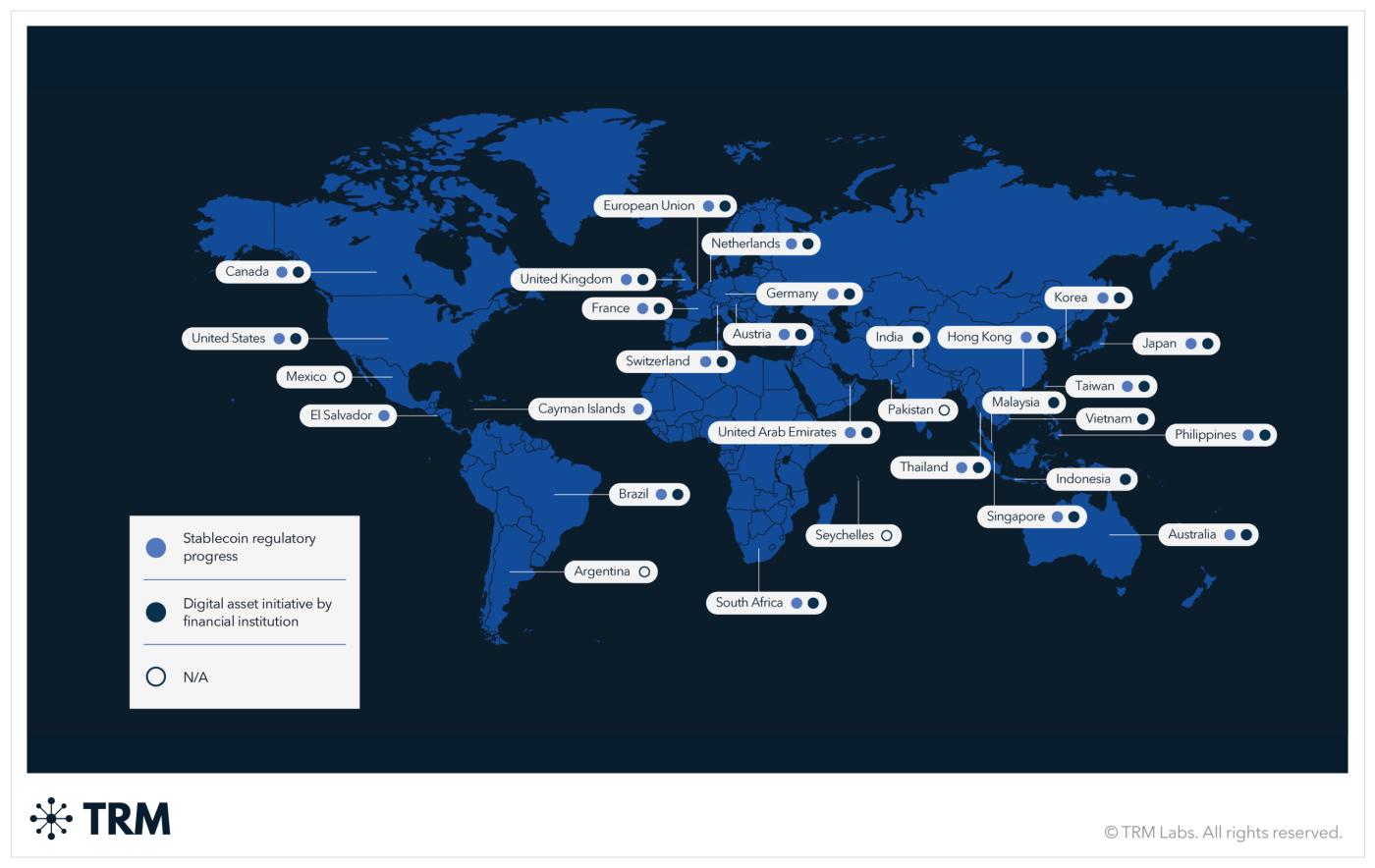
- Regulators across more than 30 jurisdictions have shifted from exploratory approaches to formal stablecoin rules, with over 70% identifying stablecoin oversight as a regulatory priority.
- In the United States, new federal legislation and regulatory guidance have clarified reserve requirements and explicitly allowed banks to facilitate crypto transfers under defined compliance frameworks.
- Together, these developments signal a structural transition toward clearer, enforceable regulation that positions stablecoins as regulated financial infrastructure rather than experimental digital assets.
Global crypto regulation is moving from fragmented discussion to enforceable frameworks, with stablecoin oversight emerging as a central pillar of financial stability and institutional participation.
CRYPTO REGULATION SHIFTS FROM DISCUSSION TO STRUCTURE
Over the course of 2025, the global cryptocurrency regulatory landscape underwent a significant transformation, moving away from a framework dominated by theoretical debate, isolated court rulings, and fragmented policy signals toward concrete legislation and supervisory structures implemented across multiple jurisdictions. Within this shift, stablecoin-specific regulation emerged as a central policy priority, reflecting regulators’ growing concern over liquidity risk, reserve management, and the potential systemic impact of digital assets.
One of the most consequential regulatory developments occurred in the United States. The Guiding and Establishing National Innovation for U.S. Stablecoins Act (GENIUS Act) came into force on July 18, 2025, establishing a federal regulatory framework for payment stablecoins. The legislation requires certain stablecoins to maintain 1:1 backing with U.S. dollars or other low-risk assets and introduces a dual federal–state supervisory structure aimed at improving transparency and consumer protection.
OVER 70% OF JURISDICTIONS ADVANCE STABLECOIN RULES
According to a global crypto policy review published by TRM Labs in 2025, covering 30 jurisdictions, more than 70% of jurisdictions identified stablecoin regulation as a priority during the year. This figure highlights the emergence of a broad international consensus around the regulation of digital cash and payment infrastructure.
At the same time, the report noted that approximately 80% of surveyed jurisdictions announced digital asset initiatives involving banks or regulated fintech institutions, indicating that regulatory progress is increasingly creating clearer institutional pathways for traditional financial actors to engage with crypto infrastructure.
OCC CLARIFIES BANK PARTICIPATION IN CRYPTO TRANSFERS
In the United States, regulatory clarity extended beyond legislation into operational guidance for banks. In early December 2025, the Office of the Comptroller of the Currency (OCC) issued an interpretative letter clarifying that national banks may conduct “riskless principal” cryptoasset transactions on behalf of customers. Under this model, banks act as intermediaries facilitating crypto transfers without taking balance-sheet exposure.
This clarification was significant, as many U.S. banks had previously been cautious about executing crypto transactions for clients due to uncertainty over which crypto-related activities were permissible. By analogizing riskless cryptoasset transfers to brokerage services in traditional securities and derivatives markets, the OCC provided a clear compliance pathway for banks to participate in crypto settlement activities.
In addition, on December 12, 2025, the OCC conditionally approved national trust bank charter applications for five digital-asset-related firms, including entities focused on custody and settlement services, a move that may further accelerate the integration of crypto assets into the federally regulated financial system.
U.S. POLICY SHIFTS ALIGN WITH GLOBAL REGULATORY MOMENTUM
Regulatory developments in the United States have closely aligned with broader global trends. Analyses by multiple independent policy trackers indicate that an increasing number of jurisdictions are proposing or implementing regulatory frameworks that cover both stablecoins and wider digital asset infrastructure.
Regulatory emphasis has shifted away from early-stage “sandbox” experimentation toward enforceable rules designed to protect wallet users and preserve financial stability. These frameworks typically focus on operational risk, liquidity management, reserve transparency, and the prevention of regulatory arbitrage, supported by enhanced disclosure requirements, reserve audits, and clearly defined supervisory responsibilities.
FROM UNCERTAINTY TO STRUCTURAL CLARITY
Taken together, these developments signal a structural shift in global digital asset policy. Regulatory approaches are moving away from fragmented and uncertain oversight toward more coherent and consistent frameworks, with particular focus on stablecoin integrity, the boundaries of bank participation, and consumer protection.
This transition reflects a growing consensus among policymakers that, in the absence of clear regulatory regimes, the expansion of stablecoins and other digital assets could introduce liquidity, reserve, and systemic risks similar to those present in traditional financial systems.
By establishing clearer regulatory expectations and legally enforceable frameworks, regulators are not only seeking to mitigate risk, but also to create conditions that support broader institutional participation—potentially laying the groundwork for deeper integration between digital assets and the mainstream financial system in the years ahead.
Read More:
USDe Market Cap Halved: A Test of Trust and Mechanism for Crypto-Native Stablecoins
Ethereum: The Pivotal Settlement Network for Global Stablecoin Liquidity
〈STABLECOIN OVERSIGHT GOES GLOBAL〉這篇文章最早發佈於《CoinRank》。