



BitMart's "Crypto Market Observation Bureau" is a brand-new in-depth Chinese interview column launched by BitMart. It invites the most insightful and influential builders, investors, and researchers in the Web3 industry to discuss financial innovation, technological evolution, and long-term trends, leaving behind judgments and experiences that are truly valuable for the industry.
Article author and source: BitMart
This episode's guest: Henry Zhang, founder and CEO of DigiFT.
With 20+ years of experience in mainstream finance, we spearheaded China's first online RMB payment system and built the world's first licensed, non-custodial on-chain AMM trading platform.
Host: Yuanyuan, VP of Marketing at BitMart
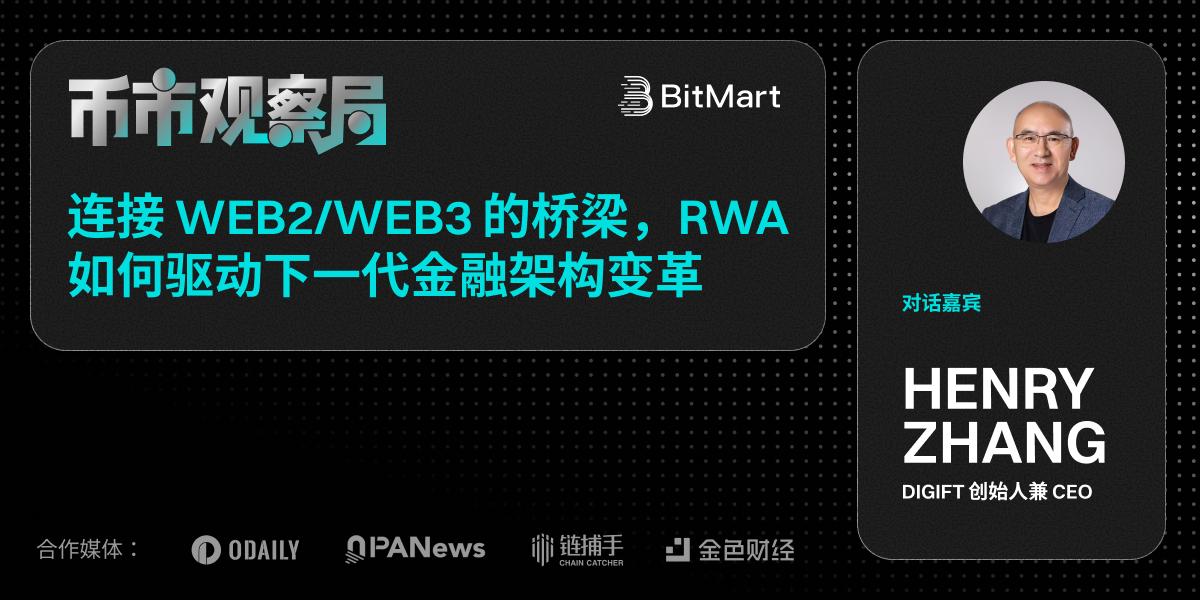
In the first episode, we focused on a very hot and popular concept in 2024–2025: RWA (Real World Assets).
For this purpose, we invited a guest with extensive experience in both mainstream finance and Web3 finance: Henry Zhang, founder and CEO of DigiFT.
As early as 2000, he participated in and led the development of China's first online payment system for RMB.
Twenty years later, he founded DigiFT, a company that uses the latest Web3 technology to bridge the gap between Web2 and Web3, and entered the Monetary Authority of Singapore (MAS) regulatory sandbox, becoming the first DeFi project to obtain an MAS license;
Today, DigiFT, which he leads, has become the only on-chain AMM trading platform in the world that simultaneously holds licenses in Singapore and Hong Kong.
In this dialogue, we attempt to answer several key questions:
- What is the essence of RWA?
- What value and lessons can the experience of traditional (mainstream) finance offer to Web3 finance?
- What does the BMRUSD stablecoin project, a collaboration between BitMart and DigiFT, primarily offer users?
- Why is DigiFT's work called "connecting Web2 and Web3"?
- What advice does he have for young people who are hesitant about getting into Web3?
The following is a summary of the key points of this dialogue.
I. From China's first set of RMB online banking to the next infrastructure upgrade for Web3 finance
Henry has worked in mainstream finance for over 20 years, but what truly changed his long-held judgment was his personal experience 25 years ago of how the internet transformed the payment system.
In 2000, he was in charge of e-commerce at Citibank China, where he worked on China's first online payment system for RMB.
The internet was very primitive back then: computers were expensive, internet speeds were slow, users didn't trust online payments, and regulations were far from complete. But a few years later, online banking and internet payments became essential infrastructure for daily life.
This experience made him realize for the first time how technology is reshaping the underlying structure of finance.
Henry said, "The previous generation of technology was the Internet, which brought finance from offline to online; this generation of technology is blockchain, which will bring finance from online to on-chain."
He firmly believes that Web3's value transfer capabilities will bring about the next financial revolution.
II. The experience of traditional (mainstream) finance helps Web3 finance avoid detours.
In the Web3 context, banks and investment banks are often referred to as "TradFi," but Henry says, "I prefer to call it mainstream finance because it remains the absolute mainstay of global finance." The decades of experience of mainstream finance are not outdated; on the contrary, they are the underlying capabilities that Web3 finance should absorb most, mainly reflected in three points:
1) A systematic approach to risk management is the foundation for the steady and sustainable development of finance.
Mainstream finance is essentially a risk management industry. Over the past century, every crisis and black swan event has yielded a mature set of methodologies, learned through hard-won lessons: operational risk, credit risk, technological risk, fraud and internal control, asset segregation, custody, and governance mechanisms. These experiences directly determine whether "money is safe."
If Web3 finance wants to enter the mainstream user world, this system is indispensable.
2) The regulatory framework is part of the financial infrastructure, not an external force on finance.
In mainstream finance, laws and licenses are not constraints, but rather mechanisms for building market trust, defining the rights and responsibilities of participants, and ensuring the sustainable operation of transparency and accountability systems.
If Web3 finance wants to become globalized and institutionalized, it cannot completely break away from the regulatory system. Instead, it should, like DigiFT, redesign an on-chain model that is "regulatory, verifiable, and trustworthy" under a new technological architecture.
3) The ability of mainstream financial institutions to absorb technological evolution is key to whether Web3 can enter the "mainstream market" in the future.
Regardless of whether it's the communication era, the electronic era, the internet era, or the mobile internet era, the financial industry has always been among the first adopters of new technologies.
Today, against the backdrop of the third-generation internet, finance has entered the on-chain era. The technological adoption paths, migration strategies, and governance requirements of mainstream finance provide a roadmap for Web3 finance.
Henry summed it up simply: "What mainstream finance leaves behind is not the old framework, but the wisdom that has been proven."
If Web3 finance can incorporate these elements, its development will be faster, more stable, and on a larger scale.
III. The Essence of RWA: The "Three Iterations" of Certificates
RWA can easily be described in an abstract way, but Henry explains it with a very simple analogy: the essence of RWA is a "certificate," which takes different forms in different eras.
The first generation: paper certificates, including stocks, bonds, property certificates, etc., a single piece of paper representing ownership and income rights.
The second generation: centralized electronic records, which are also the digital records in the banking and securities systems, and are a centralized accounting method.
The third generation is also an electronic record, but it is recorded on the blockchain. In essence, it is still an electronic record of "ownership + right to benefit". The only difference is that the accounting has become: blockchain accounting, real-time clearing and settlement, 24/7 operation, programmable and composable.
Henry emphasized: "RWA does not change the risk attributes of the underlying assets; it changes the efficiency, transparency, and composability of clearing and settlement. So it is not 'old wine in new bottles,' but rather 'old wine using a more efficient circulation infrastructure.'"
This is one of the biggest misunderstandings in the industry right now: some people confuse "Web3 as an asset" with "Web3 as a method".
RWA doesn't work magic with assets; it simply puts assets into a more efficient liquidity system.
IV. What DigiFT is doing: On-chaining Web2 finance × Mainstreaming Web3 finance
Henry summarizes DigiFT with four key elements: First, Tokenization: standardizing and on-chain asset tokenization, including government bonds, money market funds, and equities; second, Distribution: licensed distribution, distributing these assets to investors in compliance with regulatory requirements; third, Trading: on-chain trading liquidity, as DigiFT is the only globally regulated institution authorized to trade security tokens using an AMM mechanism; and fourth, Use Cases: building composable finance, making RWA a part of the financial Lego set.
These four things correspond to the two major trends summarized by DigiFT in the RWA 2025 report: Web2 finance going on-chain and Web3 finance going mainstream.
“We don’t think Web2 and Web3 are opposed. The real long-term trend is the deep integration of the two.”
V. BitMart × DigiFT: Building "Trustworthy On-Chain Rewards" with RWA – The Collaboration Logic of BMRUSD
In the practical implementation of RWA, a common question is: how can the high efficiency and composability of on-chain technology be connected to a larger user base? The BMRUSD stablecoin launched by BitMart in collaboration with DigiFT is a systematic exploration of this issue.
BMRUSD's underlying assets come from DigiFT's regulated, transparent, and transparent portfolio of RWA tokens—including high-grade money market funds, short-term bonds, and other asset classes that generate stable returns.
These assets have already passed the governance system of mainstream finance, have highly transparent information disclosure, and have a clear and verifiable on-chain path. DigiFT is responsible for providing the transparent on-chain RWA asset infrastructure, while BitMart is responsible for transforming this underlying capability into a product form that ordinary users can directly use, trade, and configure.
Henry's assessment of this collaboration was very direct:
"We hope to enable users to obtain more efficient and verifiable benefits without sacrificing security and transparency."
BMRUSD also represents an important trend:
Centralized exchanges (CEXs) are opening up the "on-chain yield curve" through compliant RWAs while maintaining a user-friendly experience. This allows users to: not understand the complex structure of RWAs, not manage on-chain wallets, and not bear the burden of opaque yield sources. Instead, they can use BMRUSD like a stablecoin, enjoying yield capabilities supported by real, verifiable on-chain RWAs. From an industry perspective, this type of product is building a new paradigm: "Real on-chain assets × Exchange-level user scale × Mainstream financial transparency." This is a crucial step for RWAs to truly enter the mainstream financial system.
VI. Regulatory Sandbox + Dual Licenses in New and Hong Kong: Trustworthy Innovation
DigiFT's journey is a prime example of how on-chain finance can move towards regulation and mainstream systems. They are currently the only on-chain trading institution globally that has obtained relevant licenses in both Singapore and Hong Kong and operates in a non-custodial + AMM (Active Market Maker) model.
They were the "first DeFi project to emerge" from Singapore's regulatory sandbox, and they are also further refining the compliance model for on-chain securities and RWA in Hong Kong.
Henry emphasized: "The real challenge is maintaining the globally scarce 'licensed + non-custodial' model. Technological innovation and regulatory security must be balanced, and regulatory sandboxes are the most crucial path."
Regulation is not an obstacle, but a necessary condition for the formation of a "trustworthy infrastructure" for the industry.
VII. Regarding the "RWA 2025 Report": The two most important things for the RWA industry in 25 years.
DigiFT's collaboration with Tiger Research to release RWA industry research is not a marketing stunt, but rather an effort to share research and provide industry education resources. The report mentions the top 10 RWA events of the year. However, Henry believes there are two particularly important events:
The first significant event: Major mainstream financial institutions (UBS, BlackRock, Invesco, Apollo, etc.) have officially tokenized and on-chain their real-world assets. The importance of this event far exceeds short-term market attention.
"This means that Web2 finance is systematically 'on-chain,' and real assets are beginning to flow on-chain in the form of tokens."
This is because it signifies that: for the first time, on-chain finance has taken on the asset volume of mainstream financial institutions; financial institutions are no longer just "researching" but "issuing real products"; and the first closed loop of regulation, custody, and risk management in the RWA field has truly been completed.
Henry believes this is the real "starting gun" for RWA over the next decade.
The second event: the mainstreaming of Web3 native assets—the rise of BTC ETFs and the Bitcoin Treasury. In contrast to the first event, "Web2 → Web3," this event represents a flow from "Web3 → Web2."
Henry stated, "BTC ETFs and Treasury Companies (DATs) essentially bring Web3 native assets into the mainstream financial system." Its significance lies in the fact that Bitcoin, as the most native asset of Web3, is packaged as a mainstream financial security; investors can participate in Web3 assets without holding on-chain private keys; Web3 finance is beginning to become part of mainstream investment portfolios; this is the true 'mainstreaming' of Web3 finance.
Henry believes this is "another major artery of on-chain finance": "One is the on-chaining of mainstream assets, and the other is the entry of Web3 assets into mainstream finance. The convergence of these two lines is what truly constitutes a new generation of financial system."
8. Advice for young people: Interest + Trend = The most worthwhile place to bet.
If you were to give advice to a young person hesitant about entering the Web3 industry, his answer would be very concise: "The best career choices should meet two criteria: first, you must be genuinely interested in it; second, it must be an upward trend. Hard work is important, but getting on a better track first is even more important."
If you believe that "value will gradually be on-chain," then Web3 finance is in a worthwhile early stage to enter.
9. In short: Why does the world "need" RWA?
Finally, Henry summarized why the world needs "RWA" (Why the World Needs Web3 Finance). He believes: "The financial industry needs to move into the next generation of infrastructure. The previous generation was the internet, which brought finance from offline to online; this generation is blockchain, which is migrating finance from online to on-chain. RWA is a key part of this process. It shows what the next generation of mainstream finance will look like."
What DigiFT aims to do is to build a bridge connecting Web2, Web3, and mainstream finance with on-chain finance.
—------
This episode was recorded on December 10, 2025. To listen to the full episode, please search for and subscribe to "Coin Market Observation Bureau" on Xiaoyuzhou, Apple podcasts, and Spotify.
You are also welcome to follow BitMart's Twitter account for more industry insights, market trends, and platform updates.
Risk warning:
The opinions or views expressed in this column represent only the personal views of the guests and do not represent the views of BitMart or its affiliates, nor should they be considered as professional financial investment advice.
Cryptocurrency investment is highly speculative and carries a significant risk of loss. Past performance, hypothetical scenarios, or simulation results are not indicative of future results. The value of cryptocurrencies may fluctuate, and buying, selling, holding, or trading cryptocurrencies may involve significant risks. Before engaging in trading or holding cryptocurrencies, please carefully assess their suitability based on your investment objectives, financial situation, and risk tolerance. BitMart does not provide any investment, legal, or tax advice.





