The government has begun building a tax infrastructure for profits from digital asset transactions, including Bitcoin. With a tax system slated to take effect in January next year, taxation of profits generated from cryptocurrency investments is expected to be a reality, with the National Tax Service leading the way. However, the possibility remains that the National Assembly will revisit the tax deferral, leading the market to focus on the direction of future tax law revisions.
According to the digital asset industry, major domestic exchanges, including Dunamu, Bithumb, Coinone, Korbit, and GOPAX, will introduce a "Overseas Tax Liability Verification" submission process starting January 1st. Customers who trade digital assets on overseas exchanges or have overseas tax obligations will be required to submit relevant information and supporting documents to their domestic exchanges.
This measure is a follow-up to the detailed implementation regulations for the "Automated Crypto-Asset Clearing Framework (CARF)" announced by the Ministry of Strategy and Finance in September of last year. CARF is an international cooperative system introduced by 48 countries, including the UK, Germany, and Japan, to prevent offshore tax evasion and establish a foundation for fair taxation. Korea also joined this year.
Once CARF is fully operational, digital asset exchanges will collect transaction information from foreigners (non-residents) trading on domestic exchanges. This information will be shared with the OECD system via the National Tax Service. Simultaneously, the National Tax Service will also be able to receive transaction information from foreign authorities on domestic investors using overseas exchanges.
Accordingly, starting this year, both "overseas digital asset transactions by domestic investors" and "domestic transactions by foreigners" will be subject to the National Tax Service's review. This means that even overseas transaction details, previously virtually invisible, will now be incorporated into the tax infrastructure.
Pressure from financial authorities is also intensifying. The Financial Intelligence Unit (FIU) is rigorously inspecting compliance with customer identification procedures, and digital asset exchanges plan to further strengthen identity verification procedures in line with the introduction of CARF. Indeed, late last year, the FIU imposed heavy penalties, including a fine of 2.73 billion won and an institutional warning, on Korbit for violating customer identification and transaction restriction obligations.
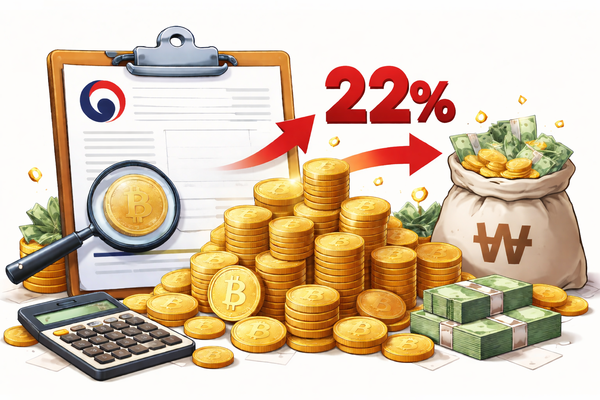
The market is interpreting this series of measures as a signal that the government has begun practical preparations for the implementation of "coin taxation" in January of next year. Under the current Income Tax Act, income earned from the transfer or lending of virtual assets will be classified as miscellaneous income and taxed starting January 1 of next year. Virtual asset income exceeding 2.5 million won per year will be subject to a 22% tax rate, which combines the 20% miscellaneous income tax and the 2% local income tax.
The taxable income is the total income minus the actual acquisition price and necessary expenses such as transaction fees. For example, if you purchased Bitcoin for 10 million won and sold it for 20 million won, the capital gain is 10 million won. After deducting 2.5 million won from this amount, the remaining 7.5 million won is subject to a 22% tax rate, resulting in a tax burden of approximately 1.65 million won.
However, the possibility of another delay in coin taxation cannot be ruled out. Digital asset taxation was introduced through a 2020 amendment to the Income Tax Act, but its implementation has been postponed three times: to 2023, 2025, and 2027. Lack of investor protections, inadequate tax infrastructure, and market backlash have repeatedly hampered its implementation. Investors remain resentful of the added tax burden amidst the recent overall contraction of the digital asset market.
The market is focusing on whether the tax reform bill for next year, scheduled for release in July, will include a tax deferral for coins and how the Income Tax Act amendment will be handled in the National Assembly in the second half of the year. With the Ministry of Strategy and Finance splitting into the Ministry of Finance and Economy and the Ministry of Planning and Budget on the 2nd, Deputy Prime Minister and Minister of Strategy and Finance Koo Yoon-chul will be in charge of tax law, including virtual asset taxation.
Experts point out that further delays could undermine policy confidence, given that digital asset taxation has already become established in major countries like the US and Japan. Kim Gap-rae, a senior research fellow at the Capital Market Research Institute, emphasized, "The longer the tax gap, the greater the market confusion, and repeated delays could undermine institutional trust and policy consistency." He added, "If we aim for implementation by 2027, we must restructure the virtual asset taxation system to reflect the current reality."