


In December of last year, a fierce battle erupted on Aave's governance platform as token holders questioned whether Aave Labs was pocketing all front-end fees and new product revenues. Ultimately, the proposal to regain control of the brand failed with 55% opposition, and the price of AAVE fell by 10% that day.
The internal strife in this community governance could have led to long-term infighting, but the situation began to change when founder Stani Kulechov proposed the idea of "profit sharing outside the agreement" on January 3, 2026.
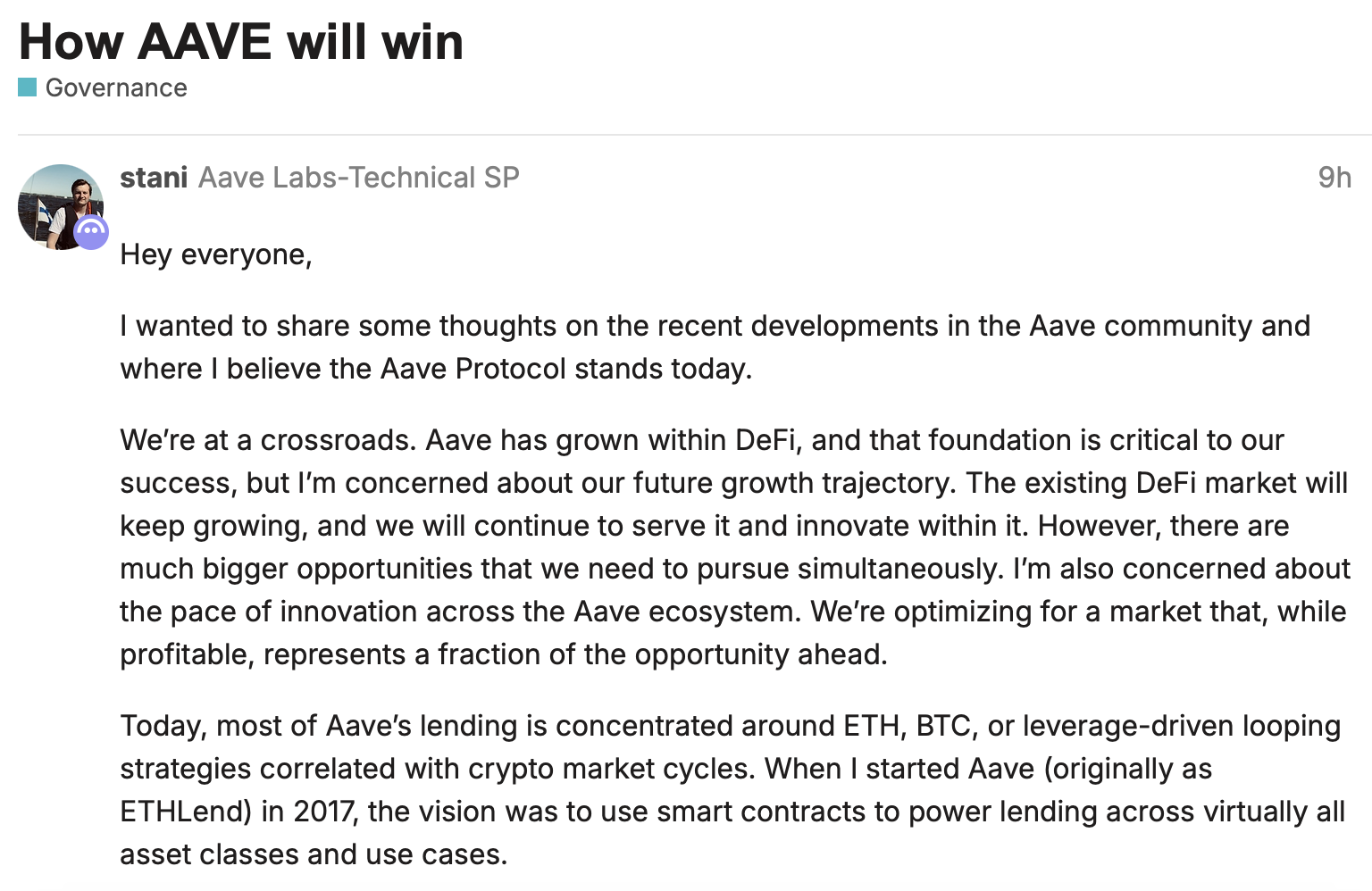
Founder: Return cash flow to tokens
In a lengthy post at the governance forum, Aave founder Stani Kulechov stated that going forward, profits from all high-value-added products developed by Aave Labs and decoupled from the core protocol will be distributed to AAVE holders. Institutional-grade services targeting the $500 trillion real-world asset (RWA) market are considered to have the greatest potential for profit.
Stani Kulechov is essentially telling the community that Aave Labs retains control over development, but cash flow will be channeled into tokens to satisfy holders' profits.
We are committed to sharing revenue generated outside the protocol with token holders. Reconciliation is important to both us and AAVE holders, and we will soon follow up with a formal proposal that includes the specific structure of how the cash flow will operate.
If the idea comes true, the on-chain revenue sharing records will not be easily falsified, allowing Aave's governance focus to immediately shift from who can modify the code to how much revenue sharing token holders will receive each quarter.
Different Paths for DeFi Giants, Same Goal
Currently, there are roughly three ways to share revenue in DeFi. For example, Aave adopts a holding company model, Aave Labs generates revenue like a subsidiary, and the tokens of the base layer share the profits.
In contrast, MakerDAO, through Sky's governance structure, uses protocol profits to buy back and burn MKR on the secondary market, indirectly increasing the net asset value per unit of tokens, while also offering deposit interest rates to attract funds to snowball.
Curve also takes the power leverage route. veCRV holders control the emission flow of CRVs, and external projects pay "bribes" to obtain emission credits. Token holders profit through these bribes. Although it is not a direct dividend model, it is essentially capturing cash from the outside.
The common goal behind these three paths is simple: large DeFi protocols should no longer rely on governance narratives to boost market attention, but rather, like traditional finance, translate valuations into calculable cash flows to attract token holdings and keep the flywheel running.
Aave's new proposal puts this into the clearest sense, aligning tokens with the concept of equity in established companies.
The main reason is that regulations have become more friendly.
In the past, DeFi's "dividend" design was very likely to cross regulatory red lines because the U.S. SEC has classified any protocol mechanism that "distributes profits according to the proportion of holdings" as falling under the scope of securities law, so project teams can only design more complex incentive mechanisms.
However, since Trump's return to the White House in 2025, regulators have adopted a more friendly stance towards the crypto industry, indirectly granting DeFi regulatory exemptions and easing restrictions. The market has observed a shift in enforcement focus towards combating fraud and illicit financial flows, while refraining from interfering with the profit distribution of large protocols, effectively encouraging it. Simultaneously, legitimate traditional financial markets have begun to align with DeFi. Aave's decision to launch revenue sharing at this time is seen as a logical strategic move, capitalizing on the policy vacuum.
If regulations tighten again in the future, Aave could decentralize the profit-sharing logic to the DAO, allowing Aave Labs to act only as a development service provider, thus reducing the risk of securitization. This approach provides a model for many other agreements.
On-chain data shows that Aave currently has approximately $33 billion in locked assets (TVL). Assuming new products generate a 1% annualized profit and a 30% profit-sharing ratio, it is roughly estimated that nearly $100 million in cash flow could be released annually. For token holders, this already suggests a supportive price-to-earnings ratio. The AAVE token has subsequently risen by approximately 10% in the past 24 hours, currently trading at $165.





