Bitcoin, which is entering a correction phase, and the tokenized securities offering (STO) market, which is poised to enter the institutional market, have emerged as two axes that will determine the direction of the digital asset market in 2026. The cryptocurrency market is experiencing both a bottoming out and the possibility of further decline amidst capital outflows and increased volatility, putting Bitcoin's "institutionalization" to the test. The STO market is entering a phase of structural growth, driven by regulatory reform and product expansion centered around the tokenization of real and financial assets. With the global expansion of real asset tokenization (RWA) and the passage of related legislation and the launch of an over-the-counter (OTC) exchange in Korea, expectations are growing that the STO market will gain traction.
Bitcoin: Bottoming Out? Further Downward Fall?
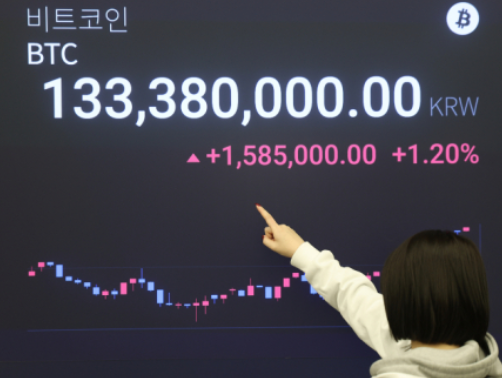
As of the morning of the 5th, the price of Bitcoin, the "virtual currency leader," was trading in the low $90,000s. This represents a nearly 30% drop from its peak of $124,752 in early October of last year. Bitcoin's market capitalization has also shrunk from a peak of $2.5 trillion to the current $1.7 trillion. Since the Bitcoin price plunge in October of last year, cumulative outflows from the virtual asset sector have reached $3.2 billion, indicating that investor sentiment remains frozen.
Nonetheless, there are many optimistic forecasts for Bitcoin's price rise this year. Tom Lee, co-founder and CEO of BitMine, a US investment research firm, predicted that Bitcoin would trade in the $200,000-$250,000 range next year. He also predicted that institutional capital inflows through exchange-traded funds (ETFs) would continue steadily into 2026. However, another internal report from Fundstrat sparked controversy by predicting that Bitcoin's price could fall to $60,000-$65,000 in the first half of next year.
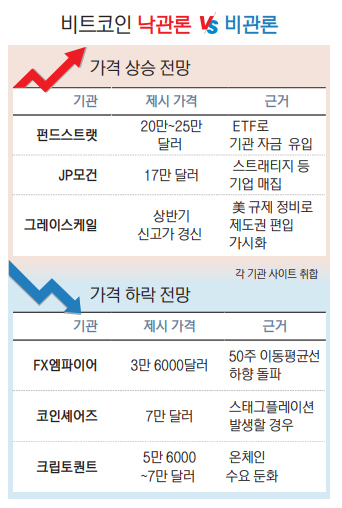
Grayscale, a US digital asset investment manager, is betting on a Bitcoin rally, driven by regulatory oversight. They believe that if the "Market Structure Act" passes the US Congress, institutional market participation will accelerate further. The bill's core purpose is to clarify virtual asset regulation by dividing the authority of the Securities and Exchange Commission (SEC) and the Commodity Futures Trading Commission (CFTC). Based on this, Grayscale predicts that Bitcoin's price will reach a new high in the first half of this year.
Wonderframe CEO Kim Dong-hwan said, "Expectations for a shift in US monetary policy and the global liquidity environment remain favorable to Bitcoin. Traditional assets like gold and silver reacted first, and Bitcoin's price will eventually move toward equilibrium." He added, "The possibility that the institutionalization of stablecoins, such as the Genius Act, could restore market liquidity is also a positive factor."
Conversely, pessimistic predictions of a price drop have emerged. CoinShares, presenting several scenarios, warned that the Bitcoin price could plummet to the $70,000 range if stagflation, a combination of slowing economic growth and rising prices, occurs. Investment publication FX Empire reported that the Bitcoin price will continue to decline, citing the breakdown of the 50-week moving average, a technical indicator. They noted that historically, a Bitcoin price break below the 50-week moving average has resulted in a 50-60% drop. The publication predicted that the Bitcoin price could fall to the $36,000 range this year. Furthermore, blockchain analytics platform CryptoQuant suggested that the price could fall to the $56,000-$70,000 range due to slowing on-chain demand.
Quantitative investment expert Kang Hwan-guk believes Bitcoin is not significantly deviating from its so-called "four-year cycle," which involves peaking and then undergoing a correction after a halving. However, he cautioned that a 70% plunge from the peak, as in the past, is unlikely, and that if a correction were to occur, a realistic range would be between $50,000 and $70,000.
Regarding investment strategies, he emphasized setting benchmarks over short-term predictions. He suggested re-entry signals such as a shift in global money supply (M2), a sharp drop below $70,000, and a breakout above the 120-day moving average, stating, "The 120-day moving average is an appropriate benchmark for confirming a trend reversal while avoiding excessive trading."
■The unlocked STO is on track in Korea as well.
In its recently published "2026 Global Trends" report, the Hyundai Research Institute stated, "The digital asset market, which previously grew based on speculative trading demand centered on virtual currencies, is now entering a structural transition period, driven by tokenization of real and financial assets (RWAs) and stablecoins." The global STO market, which tokenizes and trades real assets such as bonds, stocks, real estate, and artwork, is projected to reach $18.19 billion by the end of 2025, growing at an average annual rate of approximately 115%.
Key examples of RWA tokenization include BlackRock's tokenized fund "BUIDL," which uses U.S. Treasury bonds as its underlying asset, and "TetherGold (XAUt)" and "PAXGold (PAXG)," which tokenize gold. The combined market capitalization of these assets exceeds $4 billion.
Korea's STO market, which has lagged behind global trends, is expected to enter a period of full-scale revitalization starting next year. This is because the relevant bill for institutionalizing the STO market, which has been under discussion for nearly three years, is nearing passage in the National Assembly. Furthermore, preliminary approval for an over-the-counter (OTC) exchange, which will allow for fractional investment transactions by dividing real assets into blockchain-based tokens and trading them in small amounts, is expected in January.
The domestic STO industry is also preparing various products to keep pace with this trend. The Busan Digital Asset Exchange (Bdan) is preparing to launch tokenized products for coffee beans and carbon emissions credits in the first half of this year. Bdan CEO Kim Sang-min stated, "Digital finance is no longer an option, but an essential element that determines national competitiveness." He predicted, "With the institutional reforms and the rapid influx of excellent piecemeal investment products, the market will gain momentum."
Stockkeeper, which gained fame through its Hanwoo (Korean beef) investment platform "Bankow," recently completed the liquidation of five investment contracts, achieving a 17% return. Consequently, profits were distributed to approximately 4,980 investors. This year, Stockkeeper is strengthening its profit stability through "vertical integration," going beyond simple investment brokerage to directly controlling the entire process from breeding and investment to production, distribution, and sales. Stockkeeper is also exploring expansion into other livestock assets beyond Hanwoo, such as horses and chickens.
Stockkeeper CEO Ahn Jae-hyun said, "After the launch of the over-the-counter (OTC) exchange for piece investment this year, the role of issuers will become much more important," adding, "We plan to create a structure that can attract more customers based on stable returns."
Some fragmented investment firms are developing products based on underlying assets in other sectors. A prime example is Fundble, known for its real estate fragmented investment. Fundble is currently considering investment targets ranging from real estate assets, primarily completed buildings, to real estate-linked financial assets such as secured loans. Furthermore, it is considering issuing revenue claims arising from cultural and content IP in the form of non-monetary trust beneficiary securities.
“We are seeking collaborations with content planning companies and others to develop IP investment products,” said Cho Chan-sik, CEO of Funble. “Once the relevant bills are passed and the enforcement ordinances are established, the STO market could fully open around the fall of next year.”