Written by: TechFlow TechFlow
Standing in Vitalik's position, every move he makes becomes the focus of attention.
If he mentions a project on social media once, people will speculate about his motives. But if he shares and comments on a project multiple times, or even describes it as "exciting," then there is no need for speculation; it represents long-term attention and high recognition.
You're probably already familiar with this project: ZK Intelligent Verifiable Computing Platform Brevis.
In October 2025, Brevis announced the launch of zkVM Pico Prism, which implements Ethereum real-time proofs on consumer-grade hardware. With the support of Vitalik Buterin, the Official Twitter, and Ethereum OG researchers, it officially took center stage in the future Ethereum scaling process.
While the Ethereum ecosystem rejoices over the Brevis series of technical milestones that promise a 100x scaling increase by 2026, Brevis also powerfully conveys its message through a series of significant ecosystem collaborations with Usual, PancakeSwap, Aster, Euler, Linea, Uniswap, and others:
As an infinite computing layer for everything, Brevis is not built solely for Ethereum, but has a strong ability to be implemented in diverse production-grade application scenarios across multi-chain ecosystems.
In a public interview in October, Brevis co-founder and CEO Michael stated:
We hope that in ten years, 99% of EVM-related computations will occur off-chain and be verifiable through Brevis.
From Ethereum's future scaling to the 288 million proofs already generated in production-level scenarios, how many years will the wave started by Brevis advance Ethereum's future? And how far will it push the boundaries of ZK verifiable computation in production-level scenarios?
Despite the sluggish market, Brevis is absolutely in high demand.
This is a project that shines with star power from any angle.
In 2023, as the ZK narrative entered a cooling-off period, a group of computer science PhDs and Crypto OGs, graduates of prestigious universities such as UIUC, MIT, Berkeley, and Princeton, with the vision of "making large-scale computing verifiable," entered the field, and Brevis was born.
The core members' strong academic background has shaped Brevis's rigorous approach to technical implementation, and has also enabled Brevis to frequently gain widespread recognition for his major technical breakthroughs. As mentioned earlier, his implementation of Ethereum's real-time proof on consumer hardware triggered a massive response from core members, including Vitalik Buterin, the Official Twitter, and Ethereum OG researcher Justin Drake, a feat still talked about by the community today.
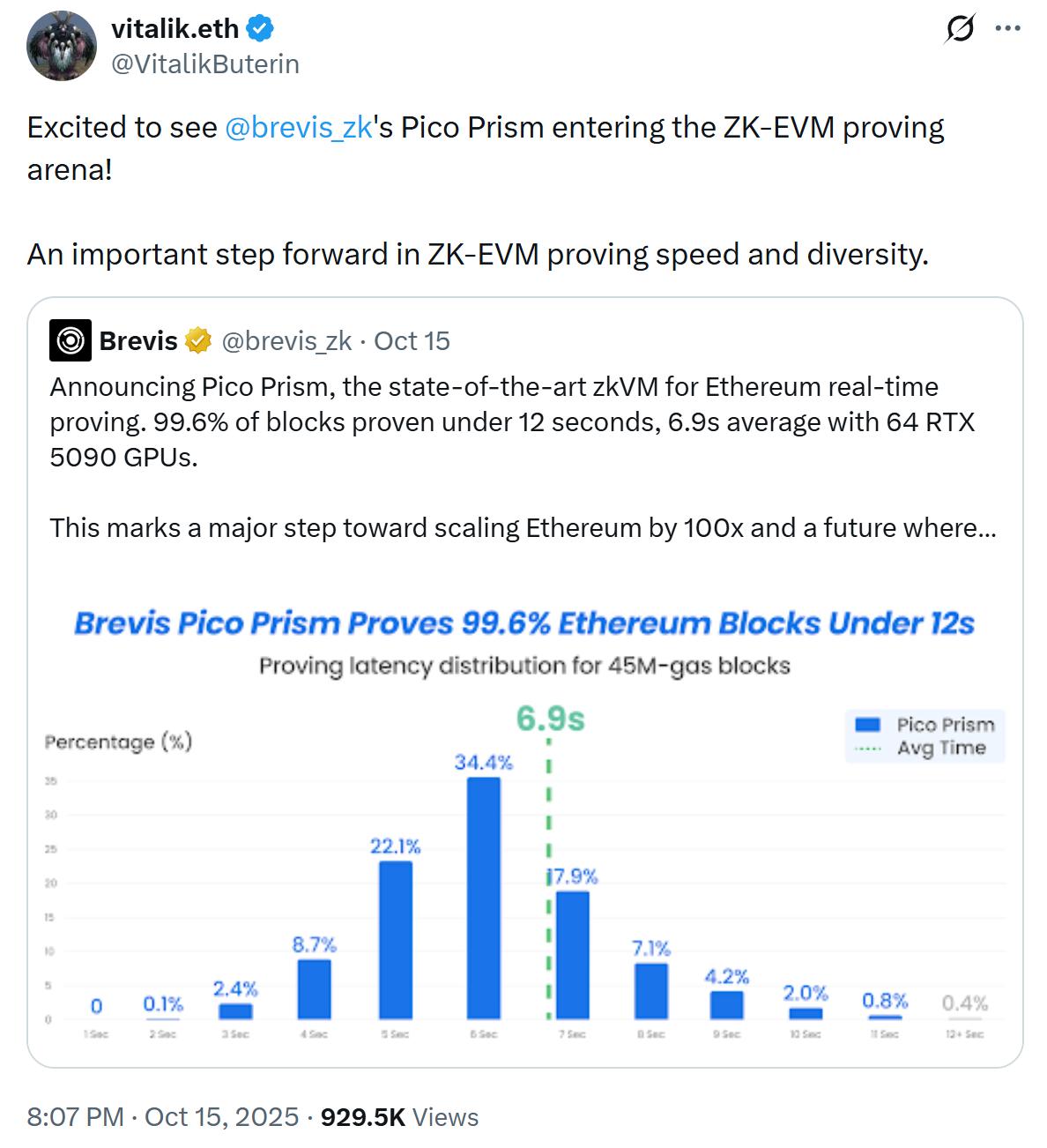
Vitalik Buterin retweeted it, calling it: "This is a significant step forward in proving the speed and diversity of ZK-EVM."
When Ethereum's Official Twitter, they wrote: "This is a giant leap toward the future of Ethereum."
Ethereum OG researcher Justin Drake wrote a lengthy article introducing zkVM Pico Prism and stated that Ethereum's future is bright.
"Academic" was once one of ZK's most prominent labels. However, amidst the doubts surrounding ZK's long-term stagnation in the conceptual stage and his inability to bring his work to fruition, "academic" has become a kind of irony for ZK at times.
As pragmatic academics, the core team members of Brevis have naturally noticed this point. While pursuing technical rigor, they have always insisted on driving products based on needs. ZK is not the goal, but a means.
This philosophy prompted Brevis to move from the laboratory to practical applications early on:
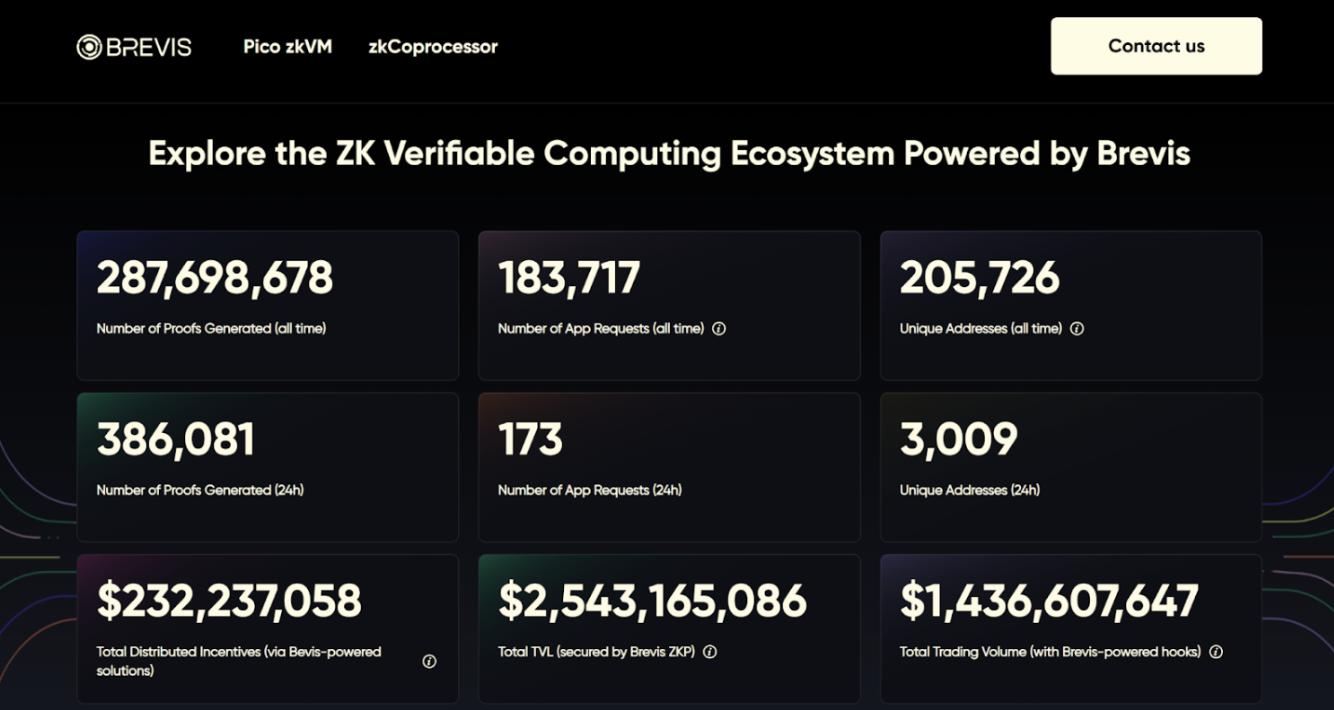
According to its official ecosystem page, Brevis has partnered with dozens of projects across DeFi, infrastructure, and stablecoin sectors, including well-known names such as PancakeSwap, Metamask, Linea, Uniswap, and Aster. Currently, Brevis has generated over 288 million ZK proofs, has over 200,000 users, distributed $230 million in verifiable rewards, and its TVL (total value added) exceeds $2.54 billion.
The capital market also cast its vote of confidence in Brevis early on:
In September 2024, Brevis completed a $7.5 million funding round, attracting Polychain Capital and Yzi Labs as co-lead investors, with participation from IOSG Ventures, Nomad Capital, Bankless Ventures, Hashkey, and several undisclosed angel investors.
Therefore, saying that Brevis is extremely popular is not an exaggeration.
However, the true significance of a project lies not only in how much recognition it receives, but fundamentally in how it brings real change to the real world. Brevis's status as a star project is inseparable from the technical feasibility and large-scale implementation capabilities of its solutions.
Delving into the narrative of the "infinite computing layer of everything": How does Brevis achieve this?
In short, Brevis's core is: off-chain computation, on-chain verification.
As an infrastructure platform focused on zero-knowledge (ZK) verifiable computation, Brevis moves expensive and restricted on-chain computations to an efficient off-chain environment, and then uses ZK proofs to securely bring the results back to the chain, without worrying about soaring gas costs, security, or trust issues.
Driven by the vision of an "infinite computing layer for everything," the Brevis ecosystem comprises three main product components: Pico zkVM, ZK Data Coprocessor, and ProverNet.

Pico zkVM can be seen as the engine of Brevis's "infinite computing layer" vision. It is designed to build secure, scalable, and high-performance decentralized applications, and has a series of core advantages compared to other zkVMs:
First, Pico zkVM is flexible and has a low barrier to entry. Its modular design allows developers to customize functions like building blocks. It also supports developers to write any program in Rust while maintaining RISC-V compatibility. There is no need to learn complex circuit languages or manually optimize recursion. Developers only need to change a few lines of configuration to optimize performance, cost, and security for their applications.
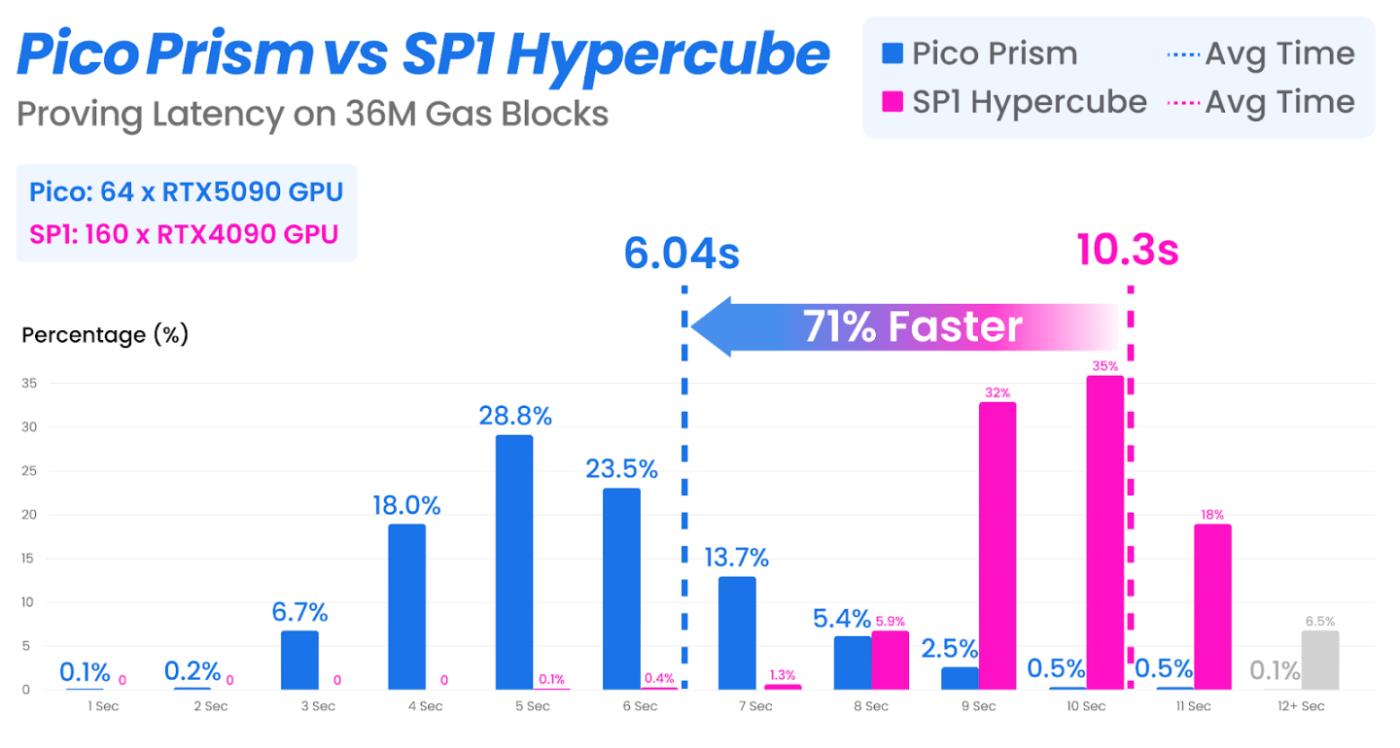
More importantly, Pico zkVM is faster and can prove any computation, which fundamentally solves the problem of large-scale deployment of ZK: the multi-GPU version of Pico Prism launched in 2025 achieved 99.6% real-time proof coverage of Ethereum mainnet blocks on consumer-grade hardware, making Brevis the world's fastest zkVM. Compared with the second-place SP1 Hypercube solution, Pico Prism is 32 times faster, while reducing GPU hardware costs by 50%, supporting lower cost and higher efficiency in proof generation.
In addition, through collaboration with another core function, ZK Data Coprocessor, Pico zkVM will achieve a performance boost in processing historical on-chain data, making Pico zkVM more practical and enabling large-scale adoption in production environments.
ZK Data Coprocessor is arguably Brevis's most mature and widely deployed product. Its core function is to enable smart contracts to access and compute any historical on-chain data without trust and at low cost, essentially giving contracts an "infinite historical database."
Previously, when contracts wanted to access historical data, there were generally two options: one was to search for it manually, but the gas costs were outrageously high; the other was to use a centralized oracle, but this involved trust and security risks.
ZK Data Coprocessor offers a third option: it not only provides access to almost all historical on-chain information, but also has a very low barrier to entry. Developers do not need to understand ZK circuits to access the data. The Brevis backend will automatically pull real historical data from the chain, efficiently generate ZK proofs and verify them. The entire process has extremely low gas costs and is completely trustless.
The last key product module is ProverNet: a decentralized ZooKeeper proof generation marketplace where any application can submit proof requests and any professional prover can bid to complete the task.
We know that the requirements for proof vary greatly in different projects and scenarios. If each application builds its own proof infrastructure, it will not only be costly but also inefficient.
ProverNet aims to put proof generation into a public marketplace: applications submit requirements, professional provers offer prices and respond to the requirements, complex tasks can be broken down into sub-tasks and completed collaboratively by different provers, and once the proof is generated, it can be verified on any target chain.
Tasks are matched and matched using Brevis's Truthful Online Double Auction (TODA), while ProverNet runs on Brevis's dedicated Rollup Brevis Chain, further ensuring efficiency. Currently, ProverNet is available in Mainnet Beta.
These three product components are nested in layers: ZK Data Coprocessor is responsible for "acquiring data", Pico zkVM solves the problem of "proving secure and efficient generation", and ProverNet determines who will prove and how to prove the optimality through the market, forming a complete closed loop of "infinite verifiable computation".
Talking about technology like this might still be a bit abstract for many beginners.
Fortunately, Brevis has a wide range of application scenarios, which can help users quickly understand Brevis's core advantages and the core value of realizing the "infinite computing layer for everything" through vivid and specific examples.
Ethereum scaling up to 288 million proofs: true large-scale deployment
The most discussed use case for Brevis is Ethereum scaling.
In July 2025, the Ethereum Foundation published the paper "Shipping an L1 zkEVM #1: Realtime Proving", officially confirming the L1 zkEVM scaling path: a node generates a ZK proof for a block, and this proof can be verified by millions of nodes across the network. The computing power required for verification is only one ten-thousandth or even less of the computing power required for the block itself.
This aligns perfectly with Brevis's technological direction and was further ignited by the launch of Brevis zkVM Pico Prism.
On October 15, 2025, Brevis announced that its zkVM Pico Prism had achieved real-time Ethereum proofs on consumer-grade hardware: using 64 RTX 5090 graphics cards, it completed 99.6% of Ethereum L1 block proofs within 12 seconds, with 96.8% of the block proof times falling below the Ethereum Foundation's 10-second standard. In a test on September 1, 2025, under Ethereum's current 45M gas limit, Pico Prism's average proof time was only 6.9 seconds.
This means that, theoretically, Ethereum can immediately achieve 10 to 100 times scaling through zkVM Pico Prism, and because Pico zkVM supports multi-GPU parallel computing, Brevis can even achieve truly unlimited scaling without adding a lot of extra computing resources.
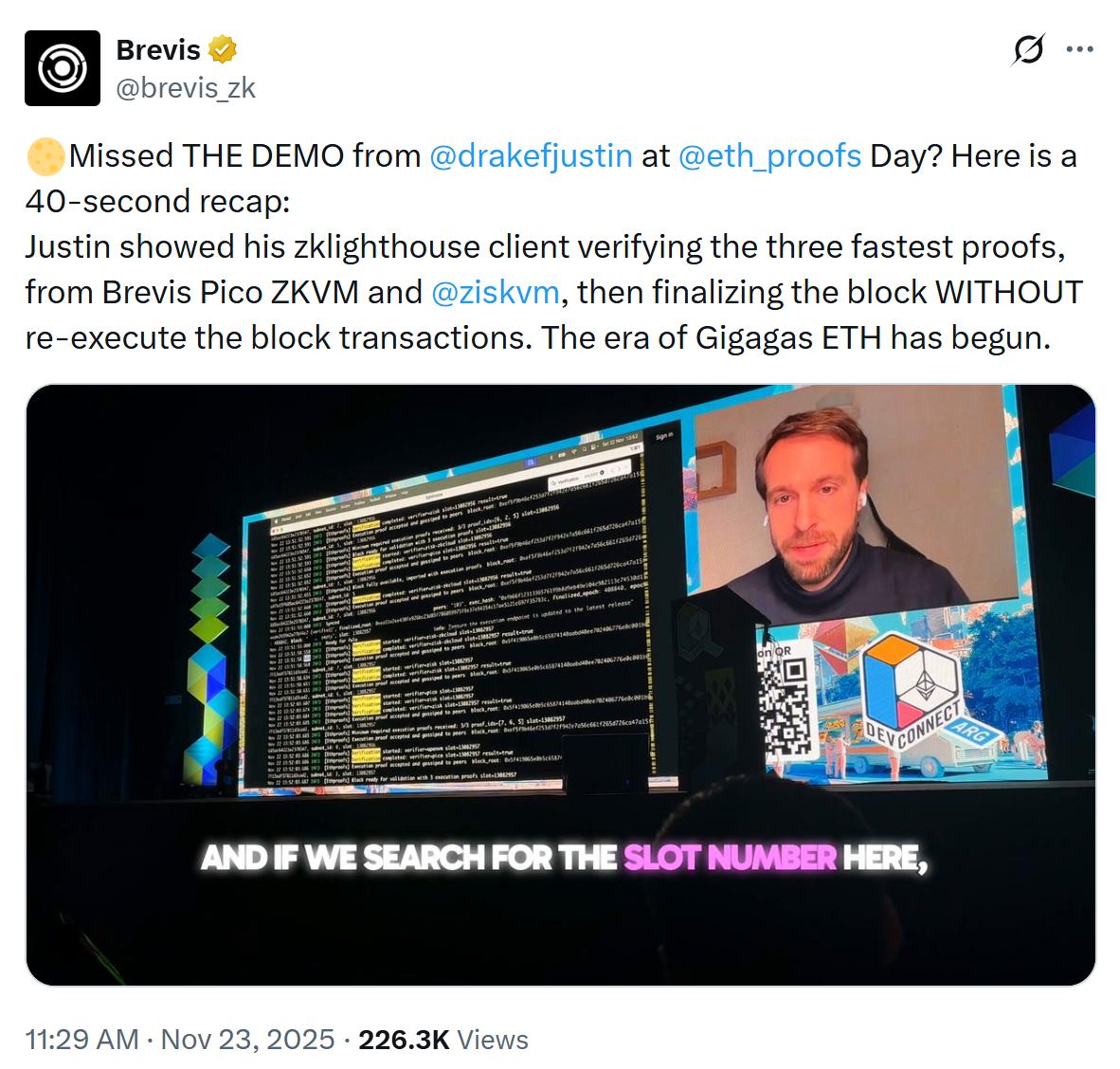
At the ETH Devconnect conference in November 2025, Ethereum OG researcher Justin Drake demonstrated Brevis's Pico ZKVM, a new consensus algorithm, through a demo. Shortly afterward, Vitalik Buterin tweeted about potential future improvements Ethereum might make in this direction. Brevis's Pico ZKVM breakthrough has transformed the Ethereum L1 zkEVM scaling roadmap from a plan into a achievable future.
While Brevis's implementation of Ethereum's Proof-in-Time has sparked widespread discussion, Brevis's value extends far beyond Ethereum.
In theory, Brevis's "off-chain computation, on-chain verification" logic is applicable to any scenario, and Brevis's technology stack supports multiple chains, pursuing the realization of "infinite computation for everything". This is another core advantage of Brevis's technology: large-scale deployment in real-world scenarios.
If you are an active participant in the crypto world, you have likely already experienced Brevis services without even realizing it.
Over the past year, Brevis has established deep partnerships with dozens of leading protocols, covering almost all leading projects in the DeFi, stablecoin, DEX, and L2 ecosystems. This further demonstrates the industry's recognition of Brevis. Moreover, each partnership is not just a superficial "concept integration," but a real large-scale application in production environments, showcasing the enormous value of verifiable computation across multiple scenarios.
The collaboration between Brevis and PancakeSwap is one of the most typical examples: traditional DEXs cannot access historical data at low cost, making it difficult to achieve personalized experiences. However, through the collaboration with Brevis, complex logic is executed off-chain and verified on-chain, and then transaction volume proofs are generated for users. Smart contracts execute different transaction fee rates based on the proofs, bringing more refined user experience management and allowing PancakeSwap to evolve from a uniform fee rate DEX into a platform that intelligently responds to user behavior.
Furthermore, the CPI (Continuous Incentive Protocol) model, jointly pioneered by Brevis and Usual, is seen by many as a new paradigm replacing traditional airdrops and snapshot incentives: the Brevis ZK Coprocessor identifies truly contributing participants by continuously tracking users' real-world behavior within the Usual ecosystem. The same is happening in ecosystems like Euler and Linea, where complex incentive distribution models built using ZK proofs ensure fairness, rationality, security, and transparency in incentive allocation.
In addition, on October 24, 2025, the Uniswap Foundation officially announced that it would grant Brevis up to $9 million in funding to develop and operate the Hooks Routing Rebate Program. This program aims to leverage the advantages of Brevis ZK proof, such as high efficiency, low cost, and trustlessness, to incentivize DEX aggregator products to integrate v4 hooked pools more quickly, ultimately benefiting users in terms of liquidity, slippage, and trading fees.
Recently, Brevis also announced a partnership with multi-chain DEX Aster, aiming to optimize the speed, security, and privacy of perpetual DEXs through verifiable computation technology. Brevis can migrate complex on-chain computations off-chain and generate zero-knowledge proofs to reduce on-chain verification costs. The two parties will explore feasible solutions to protect user position privacy while ensuring market transparency.
These features that were once "too expensive and too slow" to implement are now being realized through Brevis, bringing higher transaction efficiency, fairer value distribution, and a better user experience.
In the future, with the expansion of more ecosystem collaborations and the maturation of the ProverNet market mechanism, Brevis's verifiable computing value will penetrate more deeply into a wider range of scenarios.
Make verifiable computation the default configuration for next-generation on-chain applications.
In the current somewhat dull cycle of the crypto market, attention has become more honest: things that don't consistently deliver results are hard to keep being brought up.
Brevis's "hype" doesn't just come from its prestigious academic background, funding list, or Vitalik Buterin's retweet, but from its alignment with a stronger consensus: to make verifiable computing the default configuration for next-generation on-chain applications and accelerate the arrival of the future of verifiable computing through a wealth of real-world applications.
It is precisely because of the 288 million proofs created by Brevis in real-world applications that we can more clearly perceive that after years of exploration, ZK verifiable computing is truly on the eve of a full-scale explosion.
Of course, before it truly takes off, Brevis's future still faces many uncertainties. For example, the current Pico Prism still has room for optimization. Brevis says its next step will focus on reducing proof costs and plans to achieve 99% real-time proofs using fewer than 16 RTX 5090 GPUs in the coming months. In addition, the economic cycle of the Brevis ecosystem has not yet truly begun.
In the future, with technological breakthroughs, the completion of economic modules, and the achievement of a series of milestones, Brevis will be able to turn challenges into opportunities to prove its value, and continue to deliver "verifiable results" in a wider range of multi-chain scenarios.
Standing on the trend of verifiable computing in the future, we remain optimistic.