As we pointed out in our article "WEEX Labs: Looking Ahead to 2026, What Significant Opportunities Do You Foresee?", 2026 is a pivotal year for the cryptocurrency market, potentially witnessing a comprehensive transformation from regulatory clarity to deep institutional consolidation.
Therefore, we have compiled a list of some events that may have a significant impact on the crypto market narrative and future trends, which we would like to share with you below. Please note that these events are not definitive predictions, but rather speculations based on existing market consensus and emerging trends, and may result in a continuation of the bull market, significant volatility, or localized adjustments.
US legislation on crypto market structure passed.
As you may recall, in July 2025, when the GENIUS Act, the CLARITY Act, and the Anti-CBDC Surveillance National Act made progress, it triggered a wave of speculation in the Ethereum, stablecoin, and PayFi sectors.
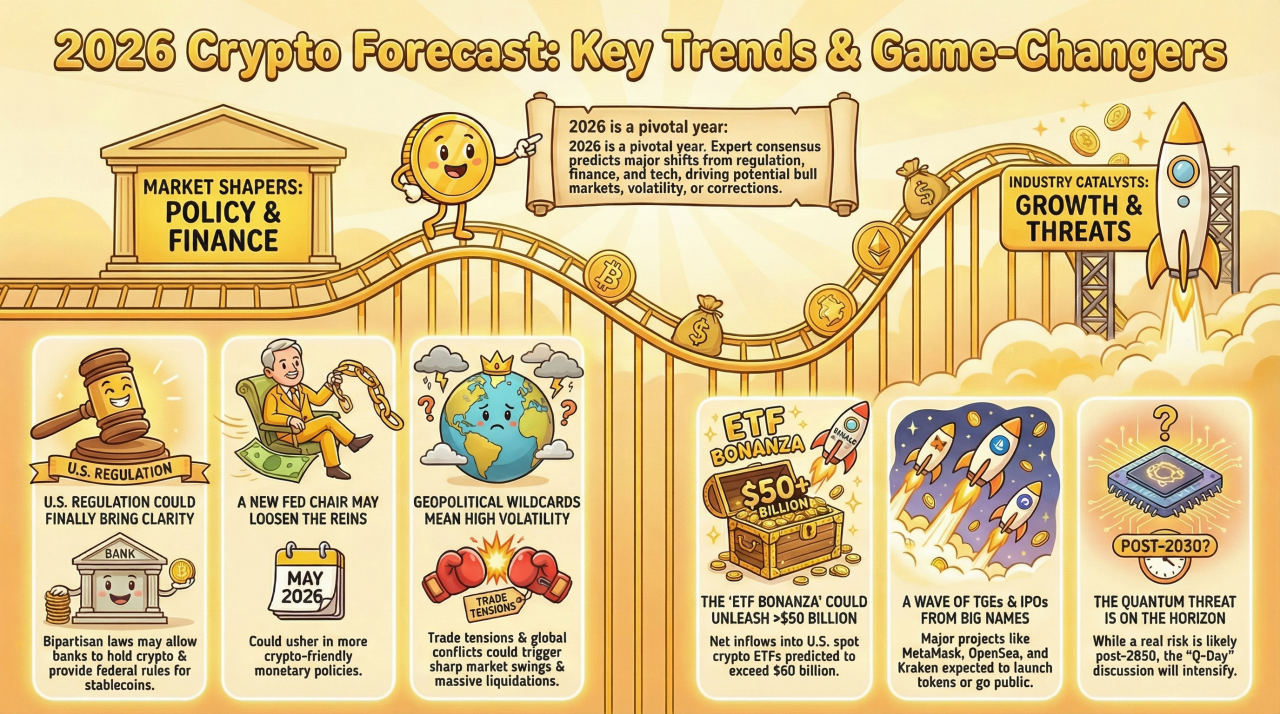
The next step is expected to be the passage of a bipartisan crypto market structure bill by the US Congress in the first half of 2026 (such as the CLARITY Act, which will enter the revision/review stage). This will simplify compliance processes, allow banks to directly hold crypto assets, provide federal guidance for stablecoin issuance, and may even trigger a second wave of hype.
New Federal Reserve Chairman Takes Office
By 2025, we've already seen far too many instances of Trump complaining about the slow pace of interest rate cuts by current Federal Reserve Chairman Powell.
Jerome Powell's term as Federal Reserve Chairman will end in May 2026. With Trump expected to announce his nominee for Fed Chair in January, a potential candidate such as Kevin Hassett or Kevin Warsh could push for looser monetary policy, including adjusting bank capital requirements to allow for greater crypto exposure.
Fed's gradual interest rate cuts
According to the Federal Reserve's Summary of Economic Projections (SEP) released on December 10, 2025, the median projection of the federal funds rate at the end of 2026 is 3.4%, with a central trend of 2.9%–3.6%, while the current rate range is 3.5%–3.75%. This means that there is limited room for rate cuts this year, possibly only 1-2 times (0.25% each time).
As is customary, the Federal Reserve holds eight FOMC meetings throughout the year (January, March, April, June, July, September, October, and December), and specific interest rate cut decisions will be dynamically adjusted based on the latest data at these meetings.
Regardless of the circumstances, the trend of the Federal Reserve cutting interest rates is irreversible. We have seen many observers point out that further rate cuts will inject more liquidity into the market, thereby driving a rebound in BTC and altcoins, especially in Q1-Q2.
Geopolitical events continue to escalate
As we saw in 2025, geopolitical events often amplify volatility in the crypto market rapidly.
• On April 2, Trump announced a 10% tariff on global imports and a higher tariff on Chinese imports, which caused BTC to fall by more than 3%. Subsequently, Trump announced a 90-day suspension of most tariffs (except for those on China), and the market rebounded briefly.
The theme for June was the escalating conflict between Israel and Iran, including US military action against Iran, which triggered a surge in geopolitical risks in the Middle East, but did not lead to a significant rise in Bitcoin and gold prices.
On October 10th, Trump announced a 100% tariff on all Chinese imports, causing Bitcoin to drop by as much as 17% that day, with the cryptocurrency market seeing a liquidation of $19 billion within 24 hours. In the following days, the tariff controversy eased slightly, and the cryptocurrency market experienced a brief rebound.
It is foreseeable that similar geopolitical uncertainties may continue to escalate into 2026. With the US-China trade confrontation, Middle East conflicts, the Russia-Ukraine conflict, and other potential factors still unresolved, these geopolitical risks could lead to short-term recessionary or rebound-like adjustments in the crypto market, warranting our continued attention.
TGE & IPO
Although the wealth-creating effects of large-scale projects such as TGE and IPOs have shown diminishing marginal returns, they are still not negligible.
In 2026, the cryptocurrency market will see a surge in TGE (Trusted Token Offerings). For example, well-known wallets like MetaMask, NFT trading platforms like OpenSea, and the L2 public blockchain Base may launch TGEs.
In addition, prediction markets represented by Polymarket, the Perp DEX market represented by edgeX, the privacy sector represented by Brevis, and the AI sector represented by Sentient are also about to launch TGEs. These TGEs are expected to generate wealth effects, attract developers and users, and promote the industry's further transformation towards practical applications.
Meanwhile, the IPO process in the crypto industry will accelerate in 2026. Following the $3.4 billion raised by crypto companies in 2025, more crypto companies are expected to go public this year. Among them, Kraken, valued at $20 billion, plans to go public in the first half of the year; Consensys, valued at $7 billion, is partnering with JPMorgan Chase; BitGo focuses on custodial security; Animoca Brands is valued at $6 billion through a reverse merger; Ledger has sold over 6 million hardware wallets; and Bithumb is listing in South Korea, underwritten by Samsung Securities.
In summary, the TGE and IPO events of well-known crypto projects mark the evolution of the crypto market from its early, unregulated growth to a more mature and institutionalized stage, which is expected to attract mainstream capital injection and drive the emergence of innovative technologies such as TradFi, Custody, and Privacy.
More crypto ETFs launched
According to the latest forecasts from multiple institutions, the US crypto ETF market will experience an "ETF palooza" in 2026, with the launch of new spot ETFs such as LTC and DOGE, as well as multi-asset and leveraged crypto ETFs, to attract more off-exchange funds.
For example, Galaxy Digital predicts that U.S. spot cryptocurrency ETFs could see net inflows exceeding $50 billion in 2026, driven by expanded distribution channels, surging institutional demand, and tokenization integration.
It is worth noting that we have already seen the price-boosting effect of institutional funds entering ETFs on BTC, but the performance on ETH, SOL and other cryptocurrencies is not as prominent. This may be a result of slower demand due to differences in institutional perception.
While we are not entirely sure whether the marginal effect of ETF products can be reversed, there is no doubt that multi-asset, multi-functional crypto funds will become more mainstream, and will put crypto projects to the test in terms of their operational capabilities and business acumen.
Quantum threat
Over the past year, progress in quantum computing has mainly focused on experimental verification, while breakthroughs by companies such as Google have also attracted some attention. Some reports have even mentioned that Q-Day (Quantum Breaking Day) may occur in 2026-2027.
The market generally believes that quantum computing is far from sufficient to crack Bitcoin's Elliptic Curve Digital Signature Algorithm (ECDSA). For example, a report by a16z points out that quantum computers will not be powerful enough to crack BTC encryption until at least 2030.
However, the Bitcoin community has begun discussing upgrade paths, and the quantum threat is expected to be a long-term offensive and defensive issue. In any case, this will strengthen the resilience of the crypto ecosystem.
about Us
WEEX Labs is the research arm of the WEEX exchange, dedicated to tracking and analyzing cryptocurrency, blockchain technology, and emerging market trends, and providing professional assessments.
Adhering to the principles of objectivity, independence, and comprehensiveness, the team aims to explore cutting-edge trends and investment opportunities through rigorous research methods and cutting-edge data analysis, providing the industry with comprehensive, rigorous, and clear insights, and offering all-round development and investment guidance to Web3 startups and investors.
Disclaimer
The views expressed in this article are for informational purposes only and do not constitute an endorsement of any products or services discussed, nor do they constitute any investment, financial, or trading advice. Readers should consult a qualified professional before making any financial decisions. Please note that WEEX Labs may restrict or prohibit all or part of its services from restricted regions.