


Recently, a change has been quietly circulating in the AI industry: several leading model companies are frequently in contact with advertisers.
In an interview, OpenAI CEO Sam Altman casually remarked, "Actually, I quite like advertising." This seemingly ordinary statement is a stark contrast to his promise two years prior, when ChatGPT first went viral, that he would "never cram ads into products." Insiders revealed that OpenAI had already held numerous meetings to discuss embedding ads into its AI interfaces. Around the same time, Google was also reported to be in talks with several consumer brands about native advertising partnerships with Gemini. Although the company quickly denied this, the market had clearly sensed the shift in sentiment.

Currently, no mainstream AI product has actually featured advertisements, but the actions of leading AI companies reveal a message: AI, which you perceive as trustworthy and provides unbiased knowledge, may soon become a shopping guide. Every recommended link may conceal a hidden transaction you're unaware of.
So why have AI companies, which once scoffed at advertising, quietly changed their tune? What might AI in advertising mean for ordinary people?
From burning money to making money: The survival logic of AI has changed.
In the past few years, training a large model has often cost hundreds of millions of dollars. Companies at the forefront of technology, such as OpenAI, Anthropic, and Google DeepMind, have long relied on venture capital or funding from their parent companies to barely keep operating. However, the "burning money without making money" model is clearly unsustainable, and user subscriptions alone cannot fill the huge hole of initial investment.
Take OpenAI as an example. Although its number of subscribers exceeded 20 million in 2025 and its revenue reached $4.33 billion in the first half of the year, the high cost of computing power and continuous R&D expenditures meant that the membership fee was far from enough to cover the huge initial investment. For every $1 of revenue, $3 had to be spent, resulting in a net loss of $13.5 billion.
With leading AI companies continuing to suffer losses, recouping investment and achieving profitability have become urgent needs. Advertising, the most mature and efficient monetization method in the internet world, has naturally been brought to the forefront. The development of the internet over the past two decades has already proven that when a technology boasts a massive user base and high-frequency interaction, advertising is the most direct and mature way to monetize. In the search era, Google rose to prominence through keyword advertising, with annual advertising revenue exceeding $200 billion at its peak; in the short video era, TikTok restructured the consumption journey with its feed ads. Now, perhaps it's AI's turn.
Today, AI assistants converse with hundreds of millions of people every day, not only understanding users' intentions but also offering "suggestions" at just the right time. This capability itself implies enormous commercial potential.

The idea of introducing advertising into AI is actually quite similar to that of search engines in their early days. Back then, people also felt that stuffing ads into search results would ruin the user experience, but they later discovered that if done with sufficient restraint, users would actually find the information useful. Today, AI stands at a similar crossroads.
The most direct approach is to add lightweight ads to the interface , such as brand recommendations in the sidebar of a webpage, a small banner at the bottom of the app, or an occasional non-interrupted pop-up notification card. These designs usually don't interfere with the main conversation but can bring stable exposure and revenue, making them the "safest" option.
Another possible form is incentivized interaction. Free users who want to continue using premium features or extend their conversation time can choose to watch a 15-second branded video to gain additional model call credits. This approach has been proven effective in mobile games and utility apps, maintaining the openness of basic services while converting some traffic into revenue. For many, this is more acceptable than direct payment.
The most controversial and unsettling term is GEO (Generative Engine Optimization), which refers to subtly weaving product content into multiple rounds of conversation.
For example, when a user asks "Which electric toothbrush is good?", the AI may prioritize recommending a partner brand and present it in the tone of an "objective review," which actually implies commercial guidance.

Many industry professionals worry that once AI begins to serve commercial interests, its neutrality will be severely compromised. Users will find it difficult to distinguish whether a suggestion is based on facts or algorithmic bias towards partner brands. A more insidious risk lies in the possibility that platforms might subtly downplay competitors' weaknesses or amplify partners' strengths in product comparisons to boost click-through rates. This kind of subtle manipulation is harder to detect than pop-up ads, yet it's more likely to influence judgment.
This is why, despite the fact that many companies have been internally testing various commercialization solutions, their public statements remain cautious and even contradictory. Some insist that "AI must remain pure," believing that once trust is overdrawn, it is difficult to rebuild, while others helplessly admit: "Business is about making profits, and large models will not continue to operate because of idealism."
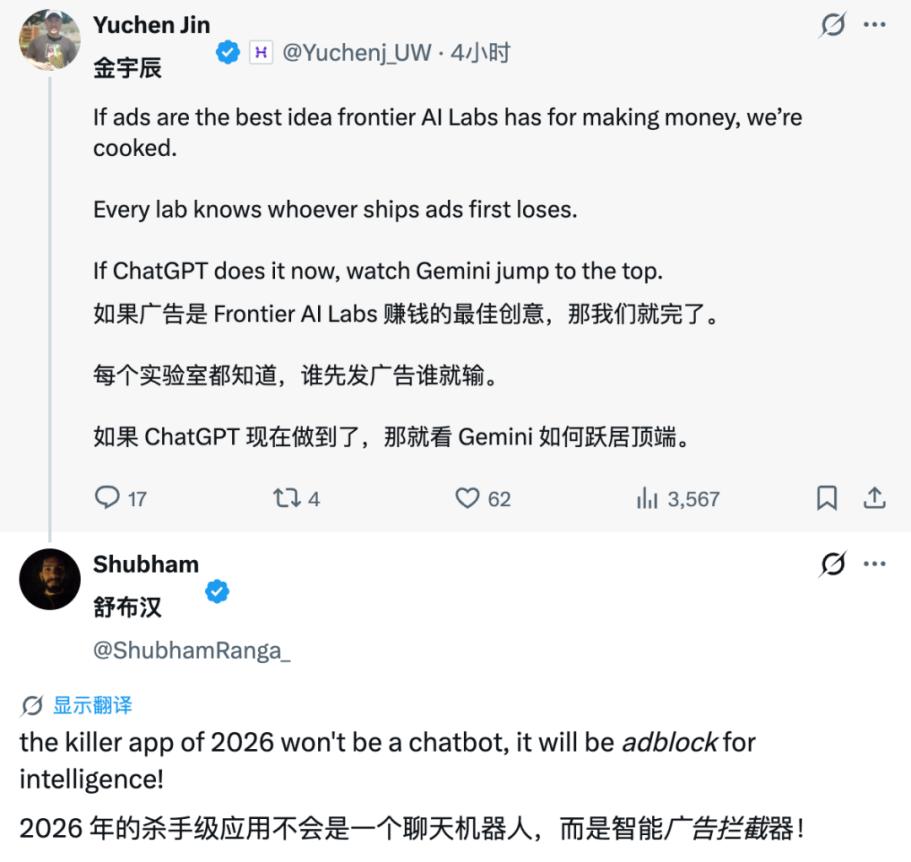
Advertising is just the tip of the iceberg, and may even eventually exist in a more covert form. But the intensity of its discussion reflects the collective anxiety and exploration of a profitable path across the entire industry. When burning cash becomes unsustainable and investors' patience runs out, AI companies must prove that they are a sustainable business.
AI will usher in the commercial era.
Although ChatGPT has not yet officially launched ads in its mainstream version, various signs have clearly outlined the industry's shift: OpenAI CEO Sam Altman has gradually moved from an idealistic stance emphasizing that "AI should serve all of humanity" to a more pragmatic approach. Rumors of internal testing of advertising products and monetization interfaces abound, while competitors such as Perplexity, Claude, and even large-scale domestic model platforms have begun experimenting with embedding monetization mechanisms into search enhancement or enterprise services.
These signals all point to one fact: the AI utopia that relied on venture capital funding and offered free access to users is rapidly fading away. Large-scale commercialization is no longer a question of "whether it will come," but rather "how quickly and in what way."
So, besides advertising, how exactly will the commercial landscape of AI unfold?
First, the membership subscription model will no longer be a simple tiered system of basic and premium versions, but will evolve towards refinement and scenario-based customization. In the future, users may pay separately for AI-powered legal advice, study abroad application assistance, or programming agents. The more specialized the function, the stronger the perceived value, and the higher the willingness to pay. This on-demand subscription model can both increase ARPU (average revenue per user) and truly embed the product into users' high-frequency workflows.

Secondly, the B2B enterprise level remains the commercialization focus for large-scale AI companies. Whether it's customizing risk control models for banks, accelerating molecule screening for pharmaceutical companies, or providing real-time inventory and demand forecasting for retail enterprises, companies are willing to pay a premium for AI capabilities that can directly improve efficiency or generate revenue. According to Microsoft's fiscal year report, in the fiscal year ending June 30, 2025, Azure cloud service revenue exceeded $75 billion, a year-on-year increase of 34%. Google and Amazon are also deeply integrating large-scale AI into their respective cloud service systems. For enterprise customers, AI is not a toy, but a productivity tool. This determines that its commercial ceiling, in the early stages before users' willingness to pay is significantly unlocked, is still far higher than that of C-end subscriptions.
Meanwhile, customized models for vertical industries are becoming a high-value sector. While general-purpose models are powerful, in specialized fields such as healthcare, law, and manufacturing, data compliance, depth of domain knowledge, and task accuracy are key. As a result, a number of AI companies focusing on customized models have emerged: some specialize in medical image analysis, others in intelligent contract review, and still others provide predictive maintenance solutions for the manufacturing industry. These small but sophisticated models, though lacking widespread public recognition, can leverage millions or even tens of millions of dollars in contracts to generate stable cash flow.

Looking further ahead, as multimodal capabilities and tool-invoking technologies mature, AI may evolve into the central hub of the entire digital ecosystem. It will no longer simply answer questions, but proactively invoke systems such as calendars, payments, logistics, and customer service to complete a closed loop—from recommendation and price comparison to order placement and booking—within a single conversation. Large-scale platforms will then extract transaction commissions. This model of "AI facilitating transactions and sharing profits" could become the core business model of the next generation of the internet.
These potential changes mean that by 2026, we may not suddenly be faced with an AI assistant bombarded with pop-up ads, but we will certainly feel a subtle yet profound shift: the once free, open, and idealistic era of AI is quietly coming to an end. In its place is a more complex, more efficient, and more utilitarian business system.
The entry of capital is not simply a matter of charging fees.
The cost of capital entering the market
However, the entry of capital is never as simple as adding an ad slot to the interface or setting up a paywall in the features. It brings about a profound restructuring of the entire product logic and value orientation: gradually shifting from serving users to being responsible to investors. This transformation is often silent, yet its impact is far-reaching.
In the past, mass media guided attention through page layout, and live-streaming e-commerce relied on persuasive sales tactics to create impulse purchases. While these influences were strong, their boundaries were relatively clear: we knew television advertising was salesmanship, and we understood that influencers might receive commissions for their recommendations. Today, however, AI is embedded in our daily decision-making in an objective, neutral, and intelligent manner. It helps you choose restaurants, compare phones, write resumes, and even plan your life path. Because of this, its influence is deeper, more subtle, and more persuasive. Once this seemingly selfless system begins to carry commercial objectives, its manipulative nature becomes even more difficult to detect.
The most noticeable change for users is the distortion of content orientation. For example, when you ask, "Which air purifier is worth buying?", the top three listed by AI happen to be brands heavily promoted by a certain e-commerce platform; or when comparing two mobile phones, the battery issue of one is glossed over, while the "positive user reviews" of the other are described in detail. These recommendations may not be wrong, but the priority and presentation may have been influenced by commercial partnerships. Over time, the information users receive appears neutral, but in reality, it has undergone subtle filtering and bias.
At the same time, the boundaries of privacy are blurring. To achieve accurate recommendations, AI needs to continuously collect users' conversation history, interests, geographical location, and even emotional state. Once this data is used for commercial profiling or cross-platform tracking, the user's "digital self" may be dissected into a string of tradable labels. On the surface, this is just to make the answers "more tailored to you," but in reality, this data may also be used to optimize advertising, predict consumer behavior, or even be shared with third parties. And most of the time, users are unaware of which of their information has been used or where it has been used.

The far-reaching impact is reshaping the entire content ecosystem. As AI becomes the new hub of information distribution, creators quickly realize that to be cited, recommended, and seen by traffic, they must cater to AI's "tastes." Consequently, more and more content begins to revolve around keyword stuffing, formulaic structures, and safe, mediocre viewpoints. Only in this way can AI more easily capture, summarize, and incorporate it into responses. Public discourse is thus accelerated towards traffic generation: in-depth analysis gives way to viral headlines, and diverse voices are drowned out by homogenized content. Over time, AI is not only reflecting reality but also quietly shaping a shallower, more homogenized information environment.
As AI becomes increasingly intertwined with commercial interests, regulatory scrutiny is rapidly following suit. Governments worldwide are beginning to seriously examine whether user data used to train recommendation models has been adequately authorized. Will algorithms, when providing recommendations, be biased towards certain brands due to commercial partnerships, or even unintentionally amplify biases?
The EU's Artificial Intelligence Act explicitly requires high-risk AI systems to increase transparency; the US Federal Trade Commission (FTC) is investigating whether generative AI contains misleading content; and China has successively issued a series of national standards, including the "Large-Scale Model of Artificial Intelligence," emphasizing content security and traceability. These actions send a clear signal: AI can no longer evade responsibility by claiming "I'm just a tool." Once it becomes a link in the commercial chain, it must be subject to corresponding rules and regulations.

Ultimately, the large-scale commercialization of AI is an inevitable choice driven by capital logic. But for ordinary users, this means we must recalibrate our relationship with AI: no longer treating it as an omniscient and omnipotent mentor, but as a smart and "purposeful" participant.
When faced with its suggestions, ask more questions; when faced with its recommendations, examine them more closely. Only by maintaining critical thinking can we identify truly valuable content in the flood of information.
After all, in an era where even objectivity can be priced, the ability to think independently and actively verify information is perhaps the most valuable skill a person should hold onto.
This article is from the WeChat public account "BrainTec" , author: Coral, and published with authorization from 36Kr.






