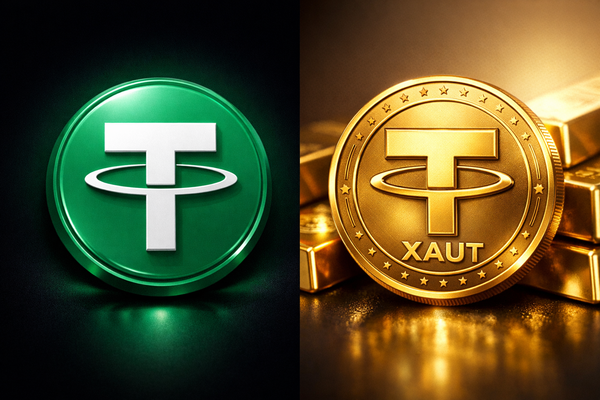
Stablecoin issuer Tether has introduced a new unit, the "Scudo," aimed at expanding gold's use in everyday payments. Scudo is a decimal unit representing 1/1000 troy ounce of the gold-backed Tether Gold (XAUT) token, and is a strategy aimed at simultaneously enhancing the usability of gold payments and intuitive pricing. This attempt to address the structural limitations of gold as a high-value asset through its unit design has garnered significant market attention.
Tether cited the recent surge in international gold prices and the rapidly expanding global demand for physical gold and gold-backed assets. The company stated that Tether Gold's market capitalization had more than doubled in just a few months by the end of 2025, explaining that the demand for gold holdings is being increasingly realized through blockchain technology. The company envisions evolving beyond simply holding "tokenized gold" into a practical asset capable of settlement and settlement.
While gold has long been considered a quintessential safe-haven asset, it faced numerous practical limitations when used as a means of everyday payment. Prices expressed in ounces were unintuitive to the average consumer, and complex decimal calculations were required for small payments. Storage and transportation costs for physical gold were also problematic. Tether aims to lower these barriers with a new unit of measurement called the "scudo." A scudo is a very small gold unit, equivalent to one-thousandth of a troy ounce, or approximately 0.0311 grams, designed to be suitable for micropayments, such as a cup of coffee or a subscription service.
This approach is similar to Bitcoin's use of the satoshi unit to subdivide payment units. Just as Bitcoin expanded its practical usability by dividing its high unit price of "1 BTC" into smaller units, Tether aims to integrate gold into the everyday economy by dividing it into smaller units. Utilizing scudos allows consumers to more intuitively perceive product prices in gold terms, while merchants and businesses can streamline transaction records and accounting.
The market is evaluating this move as an "experiment in digital gold payments." With dollar-based stablecoins dominating the global payment infrastructure, it's an attempt to bring gold, a traditional store of value, into the blockchain payment network. Especially in an environment plagued by inflation, currency volatility, and geopolitical risks, potential demand for gold-backed payments has been consistently raised. Tether is emphasizing that Scudo is technically capable of fulfilling this demand.
However, challenges remain. Variables include how quickly gold-based payments will be adopted in physical stores and online services, how price volatility will impact consumer experience, and how regulators will view gold-backed payment tokens. Nevertheless, the introduction of the scudo is significant in that it represents an attempt to redefine gold from a "storage asset" to a "tradable monetary unit."
Ultimately, the success of this experiment hinges on how seamlessly scudo can integrate into everyday payment flows. Just as Tether, a dollar-denominated stablecoin, has become a key component of the global payment infrastructure, the market is watching to see whether scudo can become the standard unit of the digital gold economy.