The stock tokenization market is entering a new stage of evolution.
After the initial exploration surrounding trading experience and product form, the industry is beginning to show some more fundamental signs of change—stock tokens are no longer simply seen as "assets that can be traded on-chain," but are gradually being understood as basic asset modules that can be repeatedly used, combined, and embedded into higher-level financial structures. This new development is highly similar to the early development path of DeFi, which moved from trading to infrastructure.
In fact, HabitTrade's recently announced Stove Protocol can be seen as a representative example in this direction. Unlike previous solutions centered on platforms or single products, Stove chooses to provide a permissionless protocol interface in an open-source, non-profit, and zero-protocol-fee manner to map regulated, properly custodied U.S.-listed stocks onto the blockchain in a 1:1 manner.
This approach does not focus on optimizing a specific transaction scenario, but rather attempts to answer a longer-term question: when stocks truly enter the on-chain system, what structure should they have to be used by a wider range of financial applications?
To some extent, the emergence of this protocol paradigm marks a shift in stock tokenization from a competition centered on "product form" to an evolutionary path centered on "protocol form." Under this new structure, stock tokens can be abstracted into verifiable, composable, and scalable underlying asset modules, opening up new possibilities for more complex financial applications and cross-protocol collaboration.
The Development Path and Trends of Stock Tokenization
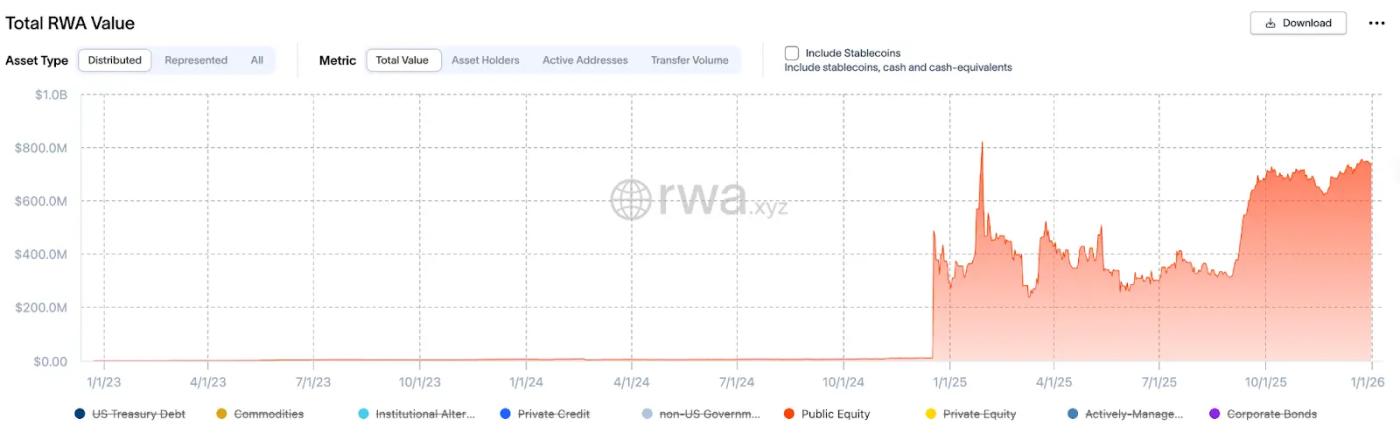
Equity tokenization is becoming one of the fastest-growing sub-sectors in the RWA (Real Estate Tokenization) field in 2025. Since the end of 2024, this area has entered a phase of rapid expansion. According to data from rwa.xyz, the size of related assets has grown from near zero to approximately $780 million, reflecting the accelerating market demand for bringing listed company equity into the on-chain system.
Structurally, the core of stock tokenization lies in transforming traditional listed company stocks into digital assets that can exist and circulate continuously on the blockchain through a 1:1 mapping to real assets. This enables them to operate 24/7 and be globally accessible, introducing a scarce and stable real-world credit anchor to the crypto ecosystem and providing a more certain value foundation for DeFi.
Although stock tokenization is not a new concept—after the DeFi Summer, projects such as Synthetix and Mirror provided on-chain stock price exposure through synthetic asset models, and centralized platforms such as FTX also explored tokenized US stock trading—these early models essentially remained at the level of "price exposure." They did not correspond to the holding and custody of real stocks, nor could they provide legal or economic control over the underlying assets. They exposed systemic risks under conditions of oracle failure, collateral volatility, or extreme market conditions, thus limiting their expansion to a wider range of users and institutions.
Real asset backing has become the core of this round of growth.
The significant growth in equity tokenization during this market cycle is fundamentally due to a shift in the underlying paradigm: the industry is now predicated on the holding and custody of real-world stocks off-chain, with corresponding tokens issued on-chain at a 1:1 ratio. Compared to earlier solutions that primarily provided "price exposure," this approach, backed by real assets, establishes a clearer and more verifiable correspondence between on-chain tokens and real-world assets. This has resulted in substantial improvements in security, compliance explainability, and institutional acceptance, laying the foundation for their integration into a broader financial system.
First Paradigm: Exploration Period
The core significance of the first tokenized shares lies in the fact that stocks can be tokenized and circulated on-chain. This stage is more reflected in "on-chain stock trading products," opening up possibilities for this field.
Structurally, the typical form of this stage is the issuance model dominated by third-party compliant institutions: the project team does not directly assume the role of a brokerage firm, but cooperates with licensed securities institutions, which then complete the purchase and custody of stocks in the traditional market, and then issue on-chain tokens at a 1:1 ratio, and attempt to support their use in multiple chains or platforms.
Backed Finance's xStocks is a practitioner of this approach. xStocks partners with compliant brokerages such as Alpaca Securities LLC to map corresponding stock equity into on-chain tokens for users to trade or use in combination. This model is relatively flexible in structure, but its compliance boundaries and scalability are highly dependent on the specific jurisdiction and the regulatory qualifications of the partners.
Second-generation paradigm: Compliance and financial structure period
As the market enters a more realistic expansion phase, the narrative focus of crypto-equities is shifting: from an early emphasis on on-chain transaction experience to a structural design that is closer to the operating logic of traditional finance, including a clear compliance framework, legal relationships, and connectivity with the existing securities system.
In this phase, the first emerging approach is a closed-loop solution led by licensed financial institutions. This type of path typically involves brokerages or financial platforms covering the stock trading, custody, and issuance of related financial products, providing users with trading exposure related to stock prices within a compliant framework. For example, Robinhood's Stock Tokens operate primarily under the MiFID II regulatory framework in the European market, employing a structure similar to Contracts for Difference (CFDs). Users participate in the economic outcomes resulting from price fluctuations, while the platform's off-chain stock holdings are mainly used for overall risk management and hedging. This model has significant advantages in regulatory communication and compliance interpretation, and is also easier to integrate into the existing financial system.
Another approach comes from solutions that lean towards structured finance. For example, Ondo Finance uses regulated funds or SPV structures to hold securities-like assets and tokenizes the corresponding beneficial rights or shares to introduce them onto the blockchain. This type of design emphasizes the clarity of the legal structure, risk isolation, and institutional acceptability, enabling on-chain assets to connect with traditional asset management systems under compliance.
At the same time, the market is also beginning to explore directions that are closer to the native on-chain brokerage model. StableStock, for example, relies on HabitTrade's real-world trading and settlement capabilities to attempt to more closely integrate stock trading, custody, and on-chain asset representation under the premise of compliance, so that the on-chain system can more directly accept the execution results of the real securities market.
As the market popularity of solutions like StableStock surges, the underlying infrastructure capabilities are being re-evaluated. HabitTrade has supported stablecoin-settled US stock trading since 2021, building a fundamental channel between on-chain funds and traditional capital markets, covering key aspects such as trade execution, settlement, and custody. However, it was only after compliance and structured finance became industry consensus that these underlying, infrastructure-oriented capabilities gradually revealed their long-term strategic value, rather than being seen merely as components serving a single product or short-term traffic.
Second-tier token schemes exhibit a relatively consistent characteristic: while compliance and institutional acceptance have significantly improved, their overall structure still primarily revolves around platforms or specific financial products. Equity tokens are more often embedded within established systems, and their usage boundaries, combination methods, and expansion paths are often limited by the design logic of the original financial structure.
The rapid growth at this stage has fully validated the feasibility of mapping real assets at the technical and compliance levels. However, from an overall architectural perspective, most solutions are still in a transitional phase. The current approach mainly addresses "how to achieve tokenized representation and basic transactions under compliance conditions," rather than "how to allow stocks to exist on-chain as a financial underlying asset in the long term."
In the absence of mature hedging, fund management, and risk transmission mechanisms, the pricing and liquidity of on-chain stocks still struggle to achieve intrinsic consistency with the real market, and their price discovery is not yet truly anchored to the trading and liquidation rhythm of the underlying stocks. This naturally leads to a structural ceiling for the related assets when undertaking higher-frequency and more complex financial activities.
Even within the framework emphasizing a "1:1 mapping," the correspondence between on-chain tokens and real-world stocks in practice is more about fulfilling obligations and establishing legal connections than about integrating a complete financial structure. Assets have been put on-chain, but the financial structure surrounding those assets has not migrated accordingly. This is a crucial hurdle that stock tokenization needs to overcome for its further evolution.
The Third Paradigm: The Turning Point of Protocol-Based Architecture
As analyzed earlier, when stock tokens are primarily viewed as tradable assets that cannot be repeatedly used, staked, combined, or used for risk management, their growth potential is inherently limited. To truly bridge the structural gap of "assets are on-chain, but the financial structure is not," stock tokenization requires a set of reusable underlying protocol standards.
Under the aforementioned constraints, third-token stocks are beginning to emerge: industry focus is gradually shifting from "platform products" to "public protocols," and from "transaction-oriented" to "ownership and rights-oriented." Under this new structure, Stove itself places greater emphasis on the openness of its ecosystem—the protocol itself does not concentrate participation qualifications on a few institutions or platforms, but rather reserves collaborative space for different types of participants, including compliance enforcers, developers, and application protocols.
Therefore, the emergence of Stove is not merely the addition of a new implementation method, but rather a signal of a paradigm shift: stock tokenization is beginning to be viewed as a financial infrastructure issue, rather than a design problem for a single crypto product. This aligns perfectly with HabitTrade's focus since 2021, which revolves around underlying capabilities such as compliance enforcement, settlement, custody, and issuance, rather than relying on a product model driven by short-term traffic.
If the core issue addressed by the first two generations of paradigms was "how to bring stocks onto the blockchain," then the third-generation path represented by Stove answers a more fundamental question: when stocks actually exist on the blockchain, in what way should they exist?
Stove Protocol: An Open Standard for Building Stock Tokenization as a Public Good
As mentioned above, the first two generations of stock tokenization solutions focused more on exploring "how to make stocks a tradable on-chain product." Stove Protocol, on the other hand, takes a much deeper approach. It attempts to solve not only a specific trading experience, but also focuses on two more fundamental issues: whether on-chain users can truly access the real-world stock assets themselves, and whether these assets can be continuously used by a wider range of financial applications.
In Stove's design, real-world stocks are still purchased and held off-chain by compliant brokers. On-chain tokens exist only as programmable representations of corresponding rights and always maintain a 1:1 mapping to real-world stocks. Unlike previous platform or product-centric solutions, Stove itself does not participate in transaction matching, does not bear price spread risk, and does not set protocol fees. Instead, it abstracts key capabilities such as minting, redemption, and settlement into a standardized interface, opening it up to the entire Web3 ecosystem in an open-source, non-profit manner.
This design means that stock tokens can be repeatedly invoked by different types of on-chain protocols, provided they comply with regulations. For users, this makes on-chain stocks more than just simple assets that can be bought and sold; they can actually reflect economic outcomes such as price fluctuations, dividends, and corporate actions. For developers and protocols, it lowers the barrier to entry, allowing them to build financial scenarios such as lending, portfolios, or fund management around the same type of stock assets without having to repeatedly solve custody, settlement, and consistency issues.
Stove Protocol System Architecture
In terms of results, the core objectives of the Stove Protocol can be summarized in two points:
This allows on-chain users to directly trade regulated, real-custody stock assets, achieving the same economic outcomes as off-chain stocks.
By using open protocols, the barrier to entry for stock tokenization is lowered, enabling more applications, protocols, and developers to build stock-related scenarios on a unified standard.
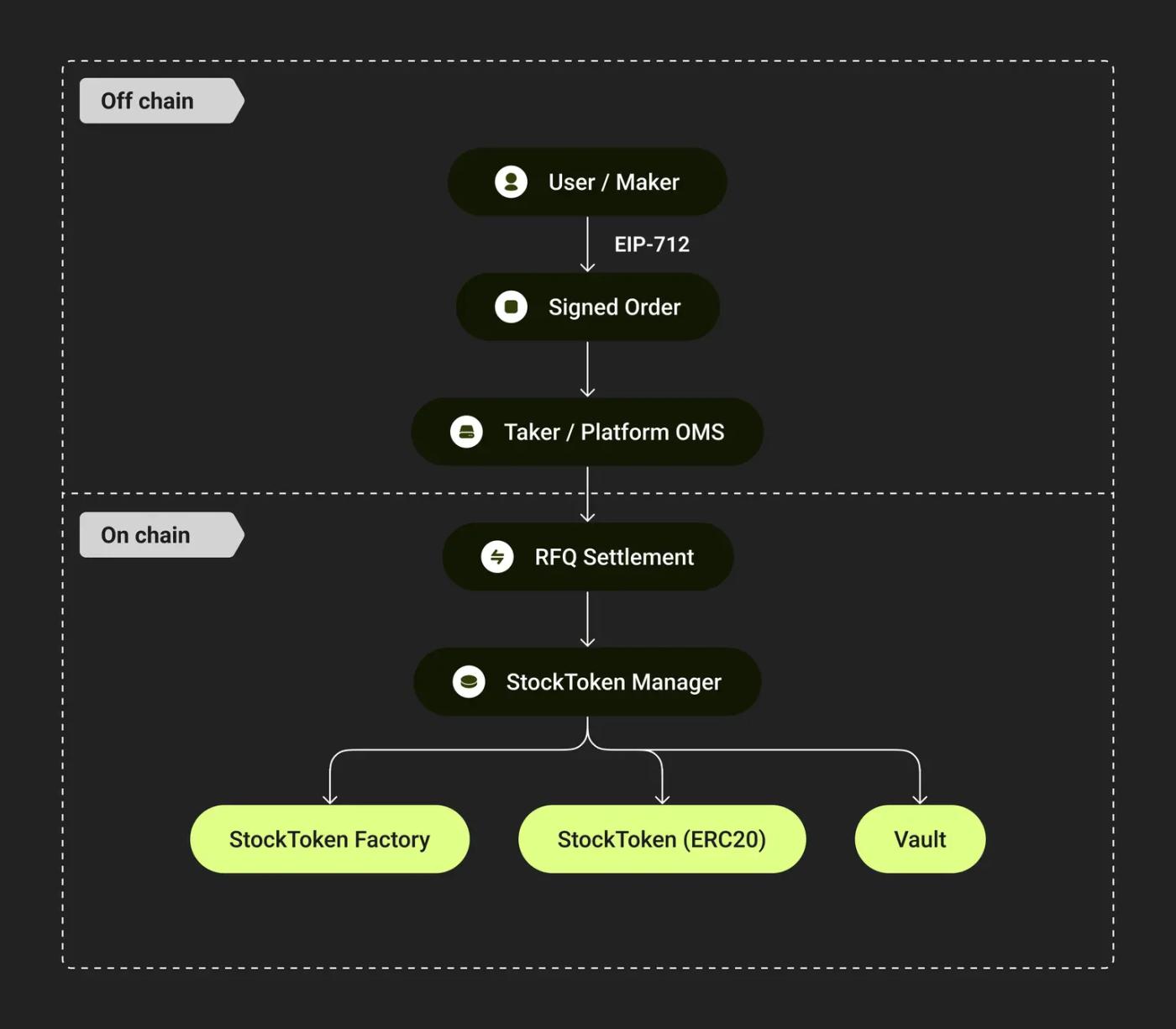
To achieve this goal, the Stove system did not simply adopt a direct connection model of "off-chain custody + on-chain token issuance." Instead, it broke down stock tokenization into several decoupled but verifiable key links: trading intent and real-world market execution occur off-chain, while asset mapping, settlement, and state recording occur on-chain. The protocol itself does not act as a counterparty or participate in traffic competition; instead, it focuses on bringing the execution results of the real-world securities market into the on-chain system in a verifiable manner.
Because it is not tied to a specific platform or application, Stove is more like providing a basic standard for stock tokenization that can be reused in the long term. Under this positioning, the protocol modularizes key capabilities such as order settlement, token lifecycle, asset generation, corporate behavior, and fund custody, and exposes them to the outside world through a unified interface. This allows stock tokens to no longer be limited to a certain product form, but have the potential to be continuously used by different projects.
RFQ Settlement
RFQ Settlement is a core module in the Stove Protocol that connects off-chain compliance execution with on-chain asset settlement. It is used to achieve verifiable and auditable on-chain settlement, given that real-world stocks must be traded and custodied by licensed institutions.
Since stock transactions cannot be directly matched on the blockchain, Stove does not use AMM. Instead, it introduces the RFQ (Request-for-Quote) model, which splits the transaction process into two stages: users generate and sign orders off-chain, expressing verifiable trading intentions; and qualified executors complete the stock purchase and sale in the real market and then submit the results to the blockchain for settlement.
On-chain contracts are responsible for verifying order signatures, parameters, and execution results. Upon successful verification, they trigger the minting or burning of tokens, ensuring that the on-chain asset state always remains consistent with real-world stock holdings. Transaction execution remains off-chain, while settlement and state changes occur on-chain, thus achieving a balance between compliance, gas costs, and transparency.
RFQ Settlement does not participate in matching or charge protocol fees. All settlement logic is executed according to deterministic rules, existing only as a bridge layer for the on-chain system to reliably receive off-chain execution results. This is a key reason why Stove can adapt to the operating logic of the real stock market while maintaining its open protocol attributes.
Token Factory & Manager
StockTokenFactory and StockTokenManager together form the asset layer of the Stove Protocol, ensuring that stock tokens remain consistent with the state of stocks in the real world throughout their entire lifecycle, from creation to exit.
We observe that in stock tokenization scenarios, real-world assets are not static. Events such as IPOs, stock splits, dividends, code changes, and delistings occur continuously. If these changes cannot be systematically mapped onto the blockchain, the "1:1 mapping" will remain in its initial state and is unlikely to hold in the long term. To address this, Stove explicitly separates the token generation logic from its operational management, incorporating the lifecycle of stock tokens into protocol-based management through a Factory + Manager combination.
StockTokenFactory is responsible for creating deterministic and predictable token instances for each stock. Based on the CREATE2 mechanism, each stock token address can be uniquely derived from parameters such as the stock code and exchange, enabling external protocols to verify whether a token corresponds to a specific stock asset without trusting a third party, thereby avoiding duplicate issuance or implicit substitution. Each token uses a zero-decimal-digit structure, semantically directly corresponding to "one share of stock".
StockTokenManager is responsible for ensuring the consistency of the token's state over the long term. It centrally manages the minting and burning of tokens and interfaces with RFQ Settlement, executing a mint or burn in every legitimate settlement to ensure that on-chain supply always matches actual off-chain holdings. Simultaneously, Manager is also responsible for mapping corporate actions such as stock splits, dividends, code changes, and delistings onto the blockchain using standardized processes, and using time-lock mechanisms to constrain key operations, reducing the asymmetric risks caused by sudden changes.
Under this design, each stock token exists within a clearly defined state machine: from normal circulation to corporate actions triggering its exit, all key nodes are completed through on-chain calls and leave verifiable records. This provides users with a predictable asset endgame path and also defines clear risk boundaries for external protocols.
By combining StockTokenFactory and StockTokenManager, Stove upgrades stock tokenization from a one-time mapping to a long-term, auditable, and reusable asset infrastructure. This constitutes the core difference between the Stove Protocol and most "stock token products": the former builds a standardized asset layer, rather than just a set of tokens for trading.
Corporate Actions
In a stock tokenization system, what truly determines whether it can be established in the long term, used repeatedly, and entered into more complex financial scenarios often comes from an easily overlooked prerequisite: when stocks in the real world continue to change, can the tokens on the chain still continuously and accurately represent the same asset?
Corporate actions such as stock splits, stock consolidations, dividends, code changes, and delisting are typically handled collaboratively by exchanges, clearinghouses, and securities firms within the traditional financial system. This is the very premise for stocks to exist as long-term financial assets. If these changes cannot be systematically mapped onto the blockchain, then the so-called "1:1 mapping" only holds true at the moment of issuance and will gradually become invalid over time. Stock tokens will then degenerate into static certificates rather than sustainable assets.
This is why, in many existing or transitional equity tokenization schemes, corporate behavior is often treated as a peripheral issue—relying on manual operations, centralized announcements, or ex-post corrections. This approach may be sustainable when the scale is small and the use cases are singular, but once tokens are used for lending, portfolio construction, or long-term holding, the uncertainty is rapidly amplified and evolves into systemic risk.
Against this backdrop, Stove Protocol considered corporate behavior as a core prerequisite that must be addressed in the tokenization of stocks from its inception. The goal of the Corporate Actions module is to ensure that on-chain stocks remain consistent with the state of stocks in the real world at any given time, thereby enabling stock tokens to have the potential for long-term existence and repeated use.
Under this module, key corporate actions such as stock splits, stock consolidations, cash dividends, code changes, and delisting are all incorporated into a unified processing flow at the protocol layer, and strictly correspond to the execution and liquidation results of securities firms in the real market. Whether it is an adjustment in the number of holdings or the distribution of economic benefits, the results can be clearly reflected on the blockchain, rather than relying on manual interpretation or platform credibility.
To prioritize state consistency, the Corporate Actions module requires that once a corporate action is triggered, the corresponding token is only allowed to continue circulating until the relevant state has been fully processed and recorded. This design does not prioritize operational convenience, but rather aims to prevent assets from being used under conditions of information asymmetry or state misalignment at the system level.
In conclusion, the Corporate Actions module addresses the question of whether stock tokens can consistently be considered a reliable mapping of real-world stocks over the long term. Only when changes in the real world are systematically and transparently introduced onto the blockchain can the "1:1 correspondence" be a state that can be continuously verified.
Vaults
Stove Protocol introduces an independent Vault System at the system level to uniformly hold and manage the real-world cash flows related to corporate activities. Its core function is to act as an anchor point for cash settlement between the blockchain and the real world, ensuring that the economic outcomes corresponding to stock tokens actually occur, rather than remaining at the level of symbolic or expected mapping.
When a listed company distributes dividends, performs reverse stock splits, or delists, the corresponding cash distributions or compensation funds will be incorporated into the treasury system and managed and distributed according to on-chain rules. Through this mechanism, on-chain tokens represent not only price changes or rights claims, but also economic outcomes consistent with real-world corporate actions.
In Stove's design, all operations involving vault funds are explicitly constrained by the protocol layer. Funds are only executed by system modules according to rules within a predetermined process, thus ensuring clear and traceable execution paths for key actions such as dividend distribution and delisting liquidation. The significance of this structure lies in transforming trust in "people" into trust in "processes" as much as possible.
By unifying corporate activity-related funds into a verifiable on-chain treasury system, Stove Protocol provides a crucial layer of security for stock tokenization: on-chain assets not only correspond to real-world stocks in form, but their economic outcomes can also be continuously and transparently realized. This directly relates to users' judgment of the long-term credibility of stock tokens and determines whether they possess the fundamental conditions for entering more complex financial scenarios.
Based on the same approach, Stove adopts a relatively restrained design approach in its overall architecture regarding key operations and system evolution. Without disrupting existing asset mapping relationships, the protocol allows for gradual adaptation to regulatory environments and market changes in a controlled manner. This avoids the system losing resilience in the face of real-world constraints and prevents key asset logic from spiraling out of control due to frequent adjustments. This "evolvable but not dependent on human discretion" approach is a crucial premise for Stove's attempt to exist as long-term infrastructure.
From token issuance to ecosystem adoption, expanding the application path of stock tokens
Tokenization of stocks is only the first step. The long-term value will be determined by whether these tokens can be used sustainably and naturally enter a wider range of on-chain financial scenarios.
We see that Stove Protocol is trying to build an open collaborative structure around tokenized stocks, making it possible for different applications to call it repeatedly.
In this structure, the protocol itself, through standardized interfaces and open-source tools, is exposed to a wider range of ecosystem participants.
Compliant custodians and Market Takers are responsible for maintaining the authenticity and redeemability of on-chain tokens and real-world stocks, while developers and DeFi protocols can freely explore different application forms such as lending, yield, derivatives, or combinations based on this.
The introduction of data, oracles, and infrastructure providers further supports price discovery, settlement consistency, and cross-chain circulation.
The core of this design lies in leaving enough room for subsequent applications to be built.
By opening up its SDK, public interfaces, and cross-protocol compatibility, Stove is expected to further lower the barriers for stock tokens to enter different DeFi scenarios, enabling them to move beyond being limited to a single trading platform or specific use case and gradually become composable and reusable financial infrastructure components.
From an industry perspective, this ecosystem approach means that Stove bases the value of its protocols on the breadth of standard adoption.
The significance of tokenized stocks as a form of on-chain real-world assets will only truly emerge when they can flow freely between multiple protocols and continuously participate in real on-chain financial activities.
The next fundamental piece of the on-chain capital market puzzle
As the stablecoin system matures and real-world assets such as government bonds and money market funds continue to be added to the blockchain, Web3's acceptance of "real-world assets on-chain" has significantly increased. Against this backdrop, stocks, as the most mature, liquid, and rationally valued asset class in the real-world financial system, possess the practical foundation to become the next type of standardized on-chain asset.
From a longer-term structural perspective, the key to stock tokenization lies not in expanding new trading instruments, but in establishing a sustainable and scalable connection between the real capital market and the on-chain financial system. This logic has been fully validated in the evolution of DeFi: the continuous release of asset value often occurs after its usage radius is systematically expanded, rather than remaining within a single trading scenario.
The current growth of stock tokenization is mainly reflected in the scale of issuance and trading, while its long-term potential depends more on the improvement of capital efficiency and the reshaping of asset usage by financial instruments. Therefore, what truly determines its development ceiling is whether on-chain stock assets can be natively invoked by the protocol and integrated into higher-level financial structures such as lending, portfolio management, and fund management.
It is at this level that the exploration of protocolization, standardization, and public goods attributes begins to show its significance—these determine whether stock assets can be repeatedly used on-chain, collaborate across protocols, and truly become underlying financial assets.
Therefore, stock tokenization is becoming an unavoidable fundamental piece of the puzzle in the process of on-chain capital markets developing into a complete form. Its maturation pace will still be influenced by regulation, but from a structural evolution perspective, its development direction is already clear enough.